
Top Benefits of Multi-Layer Sheets for Caregivers

It’s 2am. The sheets are soaked again. Your loved one is embarrassed, your back hurts, and you have to be up in four hours. If this is your life right now, I want to give you the short answer first.
A multi-layer sheet can cut a bed change to about 60 seconds instead of 15–20 minutes. It can also cut laundry by 50–80%. PeelAways is the one I keep coming back to because it has 5–7 waterproof layers, comes in sizes crib to king, and has 28,000+ reviews with a 4.8-star rating.
What matters most:
- Less laundry after wet nights
- Faster bed changes at 2am
- Less lifting and repositioning
- Better bedding solutions for incontinence
- More privacy and dignity for the person in bed
If you’re changing wet sheets more than once a week, this kind of setup can make the night a lot easier.
How Peelaways Waterproof Disposable Fitted Sheets Help Caregivers Change Beds In Seconds

sbb-itb-45288fe
Why this problem is harder than people realize
The hard part is not just the wet bed.
It’s the whole chain reaction after it.
You wake up. You turn on a light. You help someone sit up or roll over. You pull off wet bedding. You start laundry. You try to settle them back down. Then you lie there awake, waiting for morning.
That’s why sheet changes feel so heavy. One accident can steal sleep, strain your back, and leave your loved one feeling ashamed, contributing to the emotional impact of incontinence.
The numbers back that up.
A full bed change often takes about 15 minutes or more. A peel-away layer change can take under 60 seconds. That time gap matters when you are tired and doing this alone.
There is the money side too.
Less washing means less spent on:
- Water
- Electricity
- Detergent
- Replacement bedding
- Mattress damage
And there is the human side.
When someone is lying in a wet bed, every extra minute feels long. A faster change means less exposure, less stress, and a calmer night.
What to look for before buying
Before I would choose bedding for incontinence care, I would check five things.
1. Number of layers
You want enough layers to get through more than one bad night. PeelAways has 5–7 layers per set.
2. True waterproof protection
If moisture leaks through to the next layer, the whole point is gone.
3. Soft fabric
If the top feels stiff or noisy, the person in bed will notice right away.
4. Right size
Look for the exact bed size you need. PeelAways runs from crib to king.
5. Proof from other buyers
A product with 28,000+ reviews and a 4.8-star rating tells me other families are using it in real homes, not just talking about it.
If you want to check sizes and pricing, start here: peelaways.com/shop.
PeelAways
This is the one I would point to first if you use pads, briefs, or overnight protection and still end up changing sheets.
PeelAways is a fitted sheet system with stacked disposable layers. When the top layer gets wet or soiled, you peel it off and there is a clean one underneath.
That changes the whole job.
Instead of stripping the bed, you do a fast reset.
Why it stands out to me:
- About 60-second changes
- 5–7 waterproof layers
- 50–80% less laundry
- Sizes from crib to king
- 28,000+ reviews
- 4.8-star rating
It fits a few common situations well:
- Home incontinence care
- Potty training accidents
- Overnight illness
- Post-surgery recovery
- Facility use
If you want to look at it directly, here are the main links:
If you want more help on overnight cleanup and bed protection, these are worth reading too:
Comparison table
Here’s the plain tradeoff.
| Factor | Regular full sheet change | PeelAways |
|---|---|---|
| Time per change | 15–20 minutes | About 60 seconds |
| Laundry | High | 50–80% less |
| Physical strain | More lifting, bending, tucking | Less handling |
| Mattress protection | Often needs a separate cover | Built-in waterproof layers |
| Privacy | Longer cleanup | Shorter cleanup |
| Sizes | Depends on what you buy | Crib to king |
That is the part that matters at 2am.
Not theory. Not features on a package.
Just how fast you can get someone dry and back to sleep.
FAQ
Are multi-layer sheets only for older adults?
No. I would use them for potty training, post-surgery recovery, illness, and bedding for caregivers and special needs care too.
How many changes do you get from one set?
It depends on the product, but PeelAways has 5–7 layers, so you get 5–7 uses before replacing the set with disposable or washable bed sheets.
Do they feel like plastic?
PeelAways says the layers use soft bamboo/rayon fabric. That matters if the person in bed is sensitive to rough or noisy bedding.
Are they worth the cost?
If you are doing repeated sheet changes, I think the math gets simple fast. Less laundry, less wear on bedding, and less chance of ruining a mattress while keeping beds dry during incontinence care can offset the upfront price.
What size should I get?
Match the sheet to the bed:
- Crib for potty training
- Twin XL for many care and hospital-style beds
- Queen or King for home beds
Bottom line
If you are tired of stripping a wet bed in the middle of the night, multi-layer sheets can cut one of the worst caregiving tasks down to a one-minute job. This is a simple way to organize your caregiving routine for better efficiency.
That is why I keep pointing people to PeelAways.
It has 5–7 waterproof layers, cuts laundry by 50–80%, changes in about 60 seconds, comes in sizes crib to king, and has 28,000+ reviews with a 4.8-star rating. To me, that is the whole pitch: less laundry, less strain, and more dignity for the person in bed.
If you want to start with the one I’d choose, go here: peelaways.com/shop or the PeelAways Amazon listing.
Blog readers save 10% with code BLOGS10 at checkout. Available on peelaways.com and Amazon. Free shipping on orders over $100.
Why Multi-Layer Sheets Matter in Daily Caregiving
It’s 2am. The bed is wet again. You’re half awake, your back already hurts, and you know a “quick” sheet change is about to turn into a whole thing.
This is the part people don’t see.
Repeated bed changes don’t just eat up time. They wear you down. The biggest strain points are constant laundry, broken sleep, mattress damage, and all the lifting, rolling, and repositioning that comes with a full sheet change.
Soiled bedding can turn into an everyday job fast. If you’re dealing with nighttime incontinence, managing incontinence in elderly loved ones requires a strategic approach. you may be stripping and washing sheets every single day. By the end of the week, that routine can become one of the biggest time drains in your care schedule. The National Association for Continence estimates nearly 100 million people in the U.S. live with urinary incontinence or another bladder condition.
And the sleep loss hits hard. One accident at night doesn’t stay in the night. It follows you into the next morning, and the next task, and the next load of laundry. A 2024 study on caregiver burden found that leakage from absorbent incontinence products, along with soiled laundry and odors, was among the most burdensome parts of care, adding major physical and emotional strain.
Then there’s the mattress.
Once moisture gets through, it can soak into the mattress and leave stains or odor that don’t just wash out. At home, that’s frustrating and expensive. In a care setting, that problem multiplies across dozens or even hundreds of beds.
The physical part is rough too. A standard sheet change often means lifting, rolling, tucking, and repositioning someone who may be weak, in pain, or hard to move without help. That’s a lot to ask of one tired person in the middle of the night. In a toileting assistance study, 61.7% of caregivers reported burden from urinary leakage and 43.2% from fecal incontinence, with leakage and soiled laundry flagged as especially burdensome.
That’s why multi-layer sheets simplify caregiving in daily care. They cut down handling, reduce laundry, and make each bed change much faster. When you’re doing this day after day, that kind of time and effort savings isn’t small. It can mean a calmer night, less strain on your body, and a little more dignity for the person in the bed.
1. Less Laundry and Lower Household Costs
It’s 2am. The bed is wet again. You’re stripping sheets with one hand, steadying your loved one with the other, and all you can think is: I cannot do another full load of laundry before sunrise.
That’s where multi-layer sheets can take a real load off.
Beyond saving time, they can also lower household costs. For families dealing with frequent accidents, multi-layer sheets can cut laundry volume by 50–80%. That means less sorting, less pre-treating, less drying, and far fewer moments where a single accident turns into a full wash cycle. You peel away one soiled layer and keep going.
Each wash you skip means less water, less electricity, and less detergent. It adds up fast. And it’s not just your utility bill. Fewer heavy loads can also mean less wear on your washer and dryer over time.
The waterproof layers help on another front too. They protect the mattress from stains, odor, and the cost of replacing it early. When you’re already paying for pads, wipes, creams, and everything else that comes with care, fewer surprise costs matter.
Fewer washes. Fewer replacements. More predictable monthly care costs.
That lower-cost piece is a big reason these sheets work in so many care settings.
2. Bed Changes Done in About 60 Seconds
It’s the middle of the night. The bed is wet again, your back is already barking, and you know what comes next: lifting corners, tugging sheets, and trying not to wake or embarrass the person you love. That whole routine can reduce caregiver stress if simplified.
With PeelAways, a bed change takes about 60 seconds. You peel off the soiled layer and smooth the clean one underneath. That’s a big shift from a full strip-and-remake, which usually takes 15 to 20 minutes.
And those minutes don’t just disappear. They stack up.
One daily change saves about 14 minutes. That’s more than 1.5 hours a week and about 70 hours a year. In skilled nursing settings, that time goes back to hands-on care instead of laundry, remaking beds, and constant resetting.
There’s also the physical side of it. A full bed change means lifting mattress corners, bending over, reaching across the bed, tucking sheets, and doing the kind of awkward pulling that wears down your back and shoulders over time. PeelAways cuts a lot of that out. Less bending. Less repositioning. Less strain on your body.
PeelAways has 5 to 7 waterproof layers, so you can handle several nighttime changes without washing the whole bed each time. Each layer peels away in seconds and leaves a clean surface underneath. That speed helps keep care cleaner and can lower cross-contamination risk.
If you’ve ever stood there at 2 a.m. thinking, I cannot do one more full sheet change tonight, this is the part that hits home.
3. Better Hygiene and Lower Cross-Contamination Risk
It’s 2am. The bed is wet again. You’re trying to move fast, keep your loved one calm, and not drag one more soaked sheet through the room.
This part matters more than people think. A bed change isn’t just about getting someone dry. It’s also about keeping germs from ending up on your hands, your shirt, the floor, or the doorknob you touch on the way to the laundry room.
With a standard sheet change, you often have to lift and carry soiled linens across the room or down the hall. That can spread contamination to nearby surfaces, clothing, and skin. Soiled bedding is a known infection-control issue because urine, stool, blood, vomit, and other body fluids can carry microorganisms.
PeelAways cuts down that mess in a simple way. Fluids stay on the top waterproof layer, so you peel that layer off, fold it inward, and throw it away without touching the clean layers underneath, following proper incontinence bedding disposal methods. Instead of mixing a soiled sheet into shared laundry, you contain it right away.
It also helps avoid one habit that causes more spread than people realize: shaking dirty linens. The peel-away method skips that step, which can keep particles from going into the air. So cleanup feels less like a full laundry event and more like one quick, contained task.
4. Comfort, Skin Protection, and Dignity for Care Recipients
It’s 2am. The bed is damp, your loved one is uncomfortable, and you’re trying to fix it all without making the moment feel any harder than it already does. When someone spends long hours in bed, even a little moisture can turn into sore, irritated skin fast.
Dry skin matters. When skin stays against moisture, irritation can start quickly, especially for older adults, people with limited mobility, or anyone who is in bed for long stretches. Multi-layer sheets help keep skin off wet bedding while you make a fast change.
Comfort matters too. Protection doesn’t mean much if the sheet feels rough or plasticky. PeelAways uses soft bamboo/rayon fabric with waterproof, absorbent layers. It feels more like fabric against the skin, which can help cut down on rubbing and that cold, stiff feel people often hate in waterproof mattress pads or plastic covers.
Dignity matters just as much. A full bed change can feel exposing and upsetting. A peel-away layer makes cleanup faster and more private, which can help lower embarrassment during incontinence care. One customer, Ronda, said it better than I could:
"He can handle accidents himself without scrubbing or embarrassment."
That speed and privacy can make day-to-day care feel a little less heavy, whether you’re at home or in a care setting.
5. Works for Home Care, Potty Training, and Care Facilities
It’s 2am. The bed is wet again. You’re tired, your loved one is upset, and the last thing you want is another full sheet change in the dark.
That’s where multi-layer sheets help most. In places where accidents happen often, speed matters. So does keeping the bed clean without turning one accident into a full laundry event.
At home, a peel-away layer can take a hard night and make it more doable. If turning or lifting someone is tough, being able to remove one soiled layer instead of changing the whole bed is a big deal. One caregiver said it best:
"With 2 incontinent special needs teenagers... these have relieved a lot of stress. They hold a LOT of liquid and are easy to use and tear away. No more 15 loads of laundry and wet mattresses!"
That same setup also helps with potty training. Nighttime accidents still happen, but the bed can be ready again fast. Less cleanup. Less disruption. A much better shot at getting everyone back to sleep.
In care facilities, the payoff is staff time. When aides need to move fast from room to room, a peel-away sheet can cut bed-change time down to about 60 seconds instead of the usual 15 to 20 minutes with a full bedding change. That adds up over a shift. PeelAways comes in 5–7 layers, has more than 28,000+ reviews with a 4.8-star rating, and comes in sizes from crib to king. For medical and facility beds, it’s also available in Cot and Twin XL through Medline.
If you want to see the sizes and options, you can check peelaways.com/shop or the PeelAways Amazon listing. For more on cleanup, bed protection, and easier overnight care, see other articles on PeelAways blog and peelaways.com.
6. Long-Term Cost Savings and Reduced Caregiver Burnout
It’s 2am. The bed is wet again. You’re stripping sheets, starting another load, and trying not to think about the water bill, the mattress, or how tired your body feels.
This is where the cost of caregiving hits harder than most people expect.
Beyond day-to-day ease, one of the biggest gains here is lower long-term cost. Multi-layer sheets can cut caregiving costs over time by reducing laundry, lowering how often bedding needs to be replaced, and cutting the time spent on bed changes. For families, that can mean fewer loads of laundry, lower utility bills, and less money spent replacing sheets. For care settings, PeelAways says the payoff can come in 3–12 months, with laundry savings of about $200,000–$500,000 at scale.
At home, the upfront price can be balanced out by lower spending on detergent, water, electricity, and replacement bedding. The waterproof layers also help shield the mattress from repeat moisture exposure, which can help avoid costly mattress replacement.
And then there’s the part people don’t always put on paper: burnout.
Burnout has a cost too. A 2025 survey found that 78% of family caregivers deal with it weekly or daily, and 68% say they feel financial strain. That tracks with real life. When you’re doing extra laundry, lifting, remaking beds, and losing sleep, it wears you down fast. This is especially true when you have to replace sheets on an occupied bed manually.
When a bed change drops from 15–20 minutes to about 60 seconds, the time savings stack up fast. Two changes a day can save 30–40 minutes daily, or about 3–4 hours a week. That’s time you can use to sit down, catch your breath, or handle one of the hundred other things caregiving throws at you.
Less laundry. Less wear on the mattress. Less strain on your back and your mind.
That’s what makes care easier to keep doing.
Where Multi-Layer Sheets Fit Best
It’s 2am. The bed is wet again, your loved one is half-asleep, and you’re trying to fix it without turning on every light in the room. In that moment, the right size sheet matters more than people think.
Match the sheet size to the care setting and the accident pattern. That’s what keeps cleanup fast and keeps the bed fully covered.
For family caregivers at home, Queen and King sizes make the most sense for standard home beds. If one partner has incontinence or is healing after surgery, these sizes help both people stay in the same bed with less stress and less awkward cleanup.
Post-surgery recovery is its own kind of hard. Wound drainage, night sweats, and IV-related leaks can happen out of nowhere. Multi-layer sheets make it easier to get back to a dry surface without disturbing dressings, which matters a lot when the person in bed can’t move much.
Crib-A-Peel fits managing overnight accidents best. It fits standard U.S. cribs (28" x 52") and handles nighttime accidents without making you do a full sheet change. For older kids, that can mean more privacy and less embarrassment on a rough night.
In facility settings, Twin XL (80" x 39") is often the best fit. It works with hospital beds, adjustable homecare beds, and many assisted living and skilled nursing beds. CNAs spend 56.4% of their time managing urinary incontinence needs, including an average of 1.7 bed linen changes per shift due to wetting accidents. That’s a huge chunk of the day. In behavioral health units, cot-sized sheets (75" x 30") can work well for crisis beds and short-stay setups.
Use the guide below to match the right size to each care setting. The better the fit, the faster the cleanup.
| Setting | Best Size | Why It Fits |
|---|---|---|
| Potty training / infants and toddlers | Crib (28" x 52") | Fits standard U.S. cribs; fast overnight cleanup |
| Temporary or crisis beds | Cot (75" x 30") | Group homes, behavioral health, short-stay units |
| Skilled nursing / assisted living | Twin XL (80" x 39") | Fits hospital and adjustable homecare beds |
| Home care (couples or shared beds) | Queen (80" x 60") | Standard home bedroom; discreet, full-surface coverage |
| Large primary beds / repositioning space | King (80" x 78") | Maximum surface area; easier caregiver access |
Traditional Bedding vs. Multi-Layer Sheets: A Side-by-Side Look
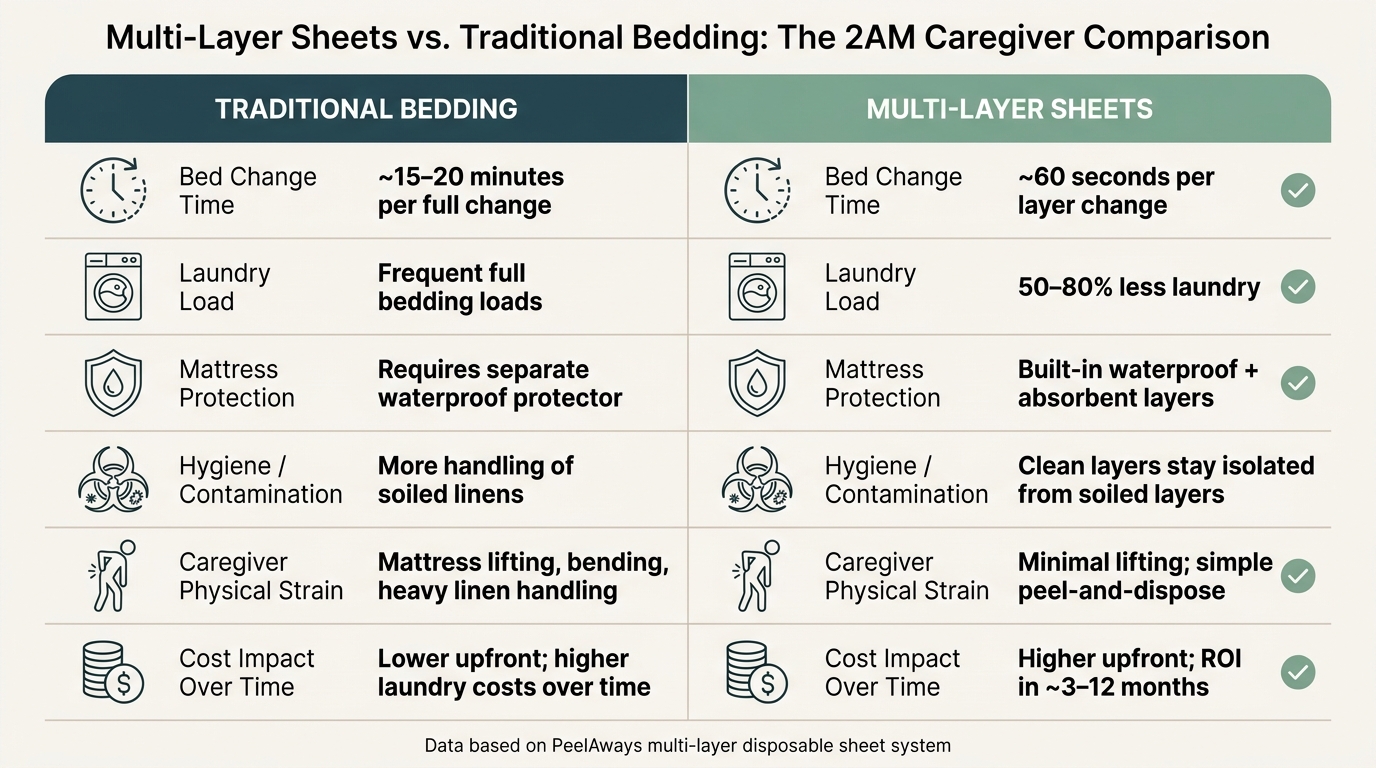
Multi-Layer Sheets vs. Traditional Bedding: The 2AM Caregiver Comparison
It’s 2am. The bed is wet again, your arms are tired, and you already know this isn’t a five-minute fix. You’re not just changing sheets. You’re lifting, stripping, wiping down, and trying to keep your loved one calm through all of it.
Here’s the plain tradeoff in one place: time, physical work, hygiene, and cost.
The biggest gap is time: about 60 seconds versus 15–20 minutes. That difference adds up fast when accidents keep happening. With regular bedding, you have to strip the bed, deal with wet linens, and make the whole bed again. With multi-layer sheets, you peel off one soiled layer and move on.
That also means less strain on your body. Regular bed changes often mean lifting the mattress, bending over, and hauling heavy wet sheets. Multi-layer sheets cut down that work.
The table below lays it out side by side.
| Factor | Traditional Bedding | Multi-Layer Sheets (e.g., PeelAways) |
|---|---|---|
| Bed change time | ~15–20 minutes per full change | ~60 seconds per layer change |
| Laundry load | Frequent bedding loads for incontinence care | About 50–80% less laundry |
| Mattress protection | Depends on a separate waterproof protector | Built-in waterproof + absorbent layers |
| Hygiene / contamination | More handling of soiled linens | Clean layers stay isolated from soiled layers |
| Caregiver strain | Mattress lifting, bending, heavy linen handling | Minimal lifting; simple peel-and-dispose |
| Cost impact over time | Lower upfront; higher laundry costs over time | Higher upfront; ROI in about 3–12 months |
When you zoom out, less laundry also means lower operating costs at scale.
A Closer Look at PeelAways
It’s 2am. The bed is wet, your loved one is half-awake and embarrassed, and you’re already thinking about the load of laundry waiting for you. That’s the moment PeelAways made sense to me.
Here’s the product behind those time-saving and laundry-saving gains.
PeelAways is a patented 5- to 7-layer disposable waterproof sheet system for incontinence care. When the top layer is soiled, you peel it away in about 60 seconds and there’s a clean layer right underneath.
That one detail matters more than people think. A full sheet change can take 15 to 20 minutes, especially when someone can’t move much or feels ashamed about the mess. PeelAways cuts that job down to about a minute.
Each layer is made from soft, breathable bamboo/rayon fabric and is free of vinyl, PVC, and phthalates. It feels soft. It stays quiet. And because every layer is fully waterproof, moisture stays on the used layer instead of seeping through to the next one.
That’s why it works in a few different settings:
- Home caregiving
- Potty training
- Facilities that need fast bed turnover
If you’re trying to pick a size, here are the main options: Crib-A-Peel is $30.99, Cot is $34.99, Twin XL is $41.99, Queen is $47.99, and King is $53.99. Cot and Twin XL come in 7-layer options.
It’s one of those products that sounds simple until you’re the one changing sheets in the middle of the night. Then it feels like a small mercy.
Conclusion
It’s 2am. The bed is wet again. You’re tired, your loved one feels exposed, and the thought of stripping the whole bed one more time is enough to make your shoulders drop.
That’s why this matters.
Repeated bed changes wear you down fast. They take time, pile up laundry, and put extra strain on your back and your patience. Multi-layer sheets take one of the hardest parts of caregiving and turn it into a fast reset. Less washing. Faster bed changes. Less physical strain. For the person in bed, that can mean less waiting, less exposure, and more dignity.
If you want the simplest next step, PeelAways multi-layer disposable sheets are an easy place to start. It’s one of those small changes that can make a long day feel a little more bearable. PeelAways offers blog readers 10% off with code BLOGS10 at checkout.
Blog readers save 10% with code BLOGS10 at checkout. Available on peelaways.com/shop and Amazon. Free shipping on orders over $100.
Comments
0



SAVE MONEY & WATER
Professionals & Institutions save a fortune on labor/laundry.

SUPERIOR COMFORT
The first thing our customers notice is how soft our sheets are.

100% WATERPROOF
Each layer is 100% Waterproof, perfect for spills and accidents

SAVE TIME
Change the sheet in under 1 minute without stripping the bed.

Leave a comment