
Signs It's Time to Switch from Pads to Disposable Sheets

It’s 2 a.m. The sheets are soaked again. Your loved one is embarrassed, your back hurts, and you still have to remake the bed before you can even think about sleep.
If pads keep leaking, bunching, or leaving the mattress damp, it’s time to switch to disposable sheets. Full-bed disposable sheets work better when accidents happen several nights a week, when bed changes take 15 to 20 minutes, or when you need a clean bed in under 60 seconds instead. For many of us, that switch means less laundry, less stress, and less shame in the middle of the night.
The clearest signs are:
- Leaks keep getting past the pad
- You’re changing sheets several times a week
- The mattress feels damp or starts to smell
- Skin looks red after lying on wet bedding
- You’re losing sleep from cleanup
If that sounds like your nights, a full-bed option like PeelAways may be the better fit. It has 5 to 7 waterproof layers, comes in sizes from crib to king, has 28,000+ reviews with a 4.8-star rating, and can cut laundry by 50% to 80%. You can also find it on Amazon and read more on the PeelAways blog and other PeelAways care guides.
I know how small a leak can look on paper.
I also know how big it feels at 2 a.m.
Pads are fine for light accidents now and then. But once leaks keep spreading past that small covered spot, the whole night starts revolving around cleanup. That’s usually the point when pads stop helping enough.
What I’d look for before buying is simple:
- Full-bed coverage, not just one patch under the hips
- Waterproof protection that keeps the mattress dry
- A fitted design that stays put during sleep
- Fast sheet changes when accidents happen more than once a night
- Less laundry, because wet loads add up fast
A standard pad can help with small misses.
A washable underpad or disposable sheet can help too, but you still have washing, drying, and another full bed change.
Regular sheets alone won’t solve the problem.
They still need backup underneath, and once the wetness gets through, you’re back to stripping the bed.
That’s why I keep coming back to PeelAways. I see it less as a “product” and more as one of those things I wish someone had told me about sooner. When one layer gets soiled, you peel it away and the next clean fitted layer is already there. No wrestling corners. No full remake. No dragging out a whole new sheet set when you’re exhausted.
Here’s the short version:
| Option | Best for | Main downside |
|---|---|---|
| Pads | Light, occasional leaks | Small coverage area can shift |
| Washable underpads | Lower-frequency accidents | More laundry and full bed changes |
| Regular sheets | Everyday bedding | No built-in waterproof backup |
| PeelAways | Frequent leaks and overnight care | Meant for people who need full-bed backup |
A few common questions come up fast.
Do disposable sheets make sense if I already use incontinence pads or diapers?
Yes. If leaks still reach clothes or bedding, you need bed protection too.
When is it time to stop using pads alone?
When leaks happen several nights a week, more than once a night, or the mattress is getting wet.
Can disposable sheets help with skin comfort?
They can help by keeping wetness off the bed surface longer and cutting time spent lying on damp bedding.
Are they only for older adults?
No. They can help with bedwetting, post-surgery care, disability care, and home care after illness.
How much time can this save?
A full bed change can take 15 to 20 minutes. PeelAways can bring that down to under 60 seconds.
For me, the bottom line is simple: when cleanup becomes the hardest part of the night, pads are no longer enough. That’s when full-bed protection starts making more sense than trying to fix the same leak over and over.
If you want the option that cuts laundry, keeps the mattress dry, and makes bed changes much faster, I’d look at PeelAways on peelaways.com/shop or PeelAways on Amazon. You can also read more at the PeelAways blog and browse other PeelAways articles.
Making aging and caregiving easier, one bed at a time
Blog readers save 10% with code BLOGS10 at checkout. Available on peelaways.com and Amazon. Free shipping on orders over $100.
Disposable Bed Sheet Incontinence Bed Pad Peelaways

sbb-itb-45288fe
Signs That Pads Are No Longer Enough
It’s the middle of the night. The sheets are wet again, the pajamas need changing, and you’re standing there half-awake knowing this will cost you another chunk of sleep. If that scene feels way too familiar, the pad may not be doing the job anymore.
Pads stop being enough when moisture keeps getting past the area they cover. Once it’s soaking pajamas, reaching the mattress, or turning your nights into one cleanup after another, you’re not dealing with a small miss. You’re dealing with a system that’s falling short.
Frequent Nighttime Leaks and Wet Bedding
When pajamas are wet by morning, or your loved one wakes up more than once because the bedding has to be changed, that’s a clear sign the pad has reached its limit. Pads only protect a small section of the bed. And during sleep, even a small shift can move someone right off that protected spot.
So the leak doesn’t just stay on the pad. It spreads past the edges and hits the sheets or mattress. When that keeps happening, keeping beds dry usually makes more sense than hoping the pad lands in the right place every time.
Repeated Linen Changes Become a Daily Burden
A full bed change can take 15 to 20 minutes per incident. That may not sound like much on paper. At 2 a.m., when you’re lifting, wiping down, stripping sheets, and trying not to wake someone all the way up, it feels like forever.
When it happens three or more times a week - or more than once in a single night - it stops being a small chore and turns into a serious caregiving burden.
Repeated overnight changes can wear you down fast, both physically and emotionally. Your back feels it. Your sleep takes a hit. And your loved one often feels embarrassed right along with you.
Once cleanup becomes routine, the next issue is harder to ignore: moisture control.
Mattress Moisture, Odor, and Skin Irritation Mean Protection Is Falling Short
If the pad feels damp after use or the mattress is wet underneath, the protection is failing. That’s the plain truth. And once moisture starts getting through, it tends to bring other problems with it.
Reusable pads can also hang onto odor even after scrubbing and disinfecting. Anyone who’s dealt with this knows how frustrating that is. You wash everything, you do your best, and the smell still lingers.
Then there’s skin. When skin stays against a wet surface, redness and irritation can show up fast. That’s often the moment when a small pad no longer feels like enough, because now you’re not just cleaning up leaks. You’re trying to protect comfort and dignity too.
Why Disposable Sheets Make Care Easier When Leaks Keep Happening
It’s 2am. The bed is wet again. You’re pulling off sheets in the dark, trying not to wake them all the way, and already thinking about the laundry waiting for you.
When pads keep failing, the hard part isn’t just the leak. It’s everything that comes after. Stripping the bed. Tugging at the mattress. Wrestling with corners when you’re tired and your back is already done. Disposable sheets help stop that cycle by covering the full mattress and turning a full bed change into a fast peel-away swap. That’s when full-bed protection starts to matter more than a small patch of coverage.
How PeelAways Changes a Bed in 60 Seconds
This is the part that hit me right away: when one layer gets soiled, you pull down the corner and peel it away. Underneath, there’s already a fresh fitted sheet in place.
So instead of starting over in the middle of the night, you’re done in about 60 seconds.
No mattress lifting.
No fighting fitted corners.
No dragging out a whole new set of sheets when you’re half asleep.
Each clean layer can stay in place for 7 to 10 days, so you only remove a layer when an accident happens. That alone can take a lot of pressure off nights that already feel too long.
Daily Benefits That Matter Most to Caregivers and Families
The day-to-day relief adds up fast. PeelAways can cut laundry by 50% to 80%, which can mean several fewer loads each week.
That matters if you’re the one doing it all. Less washing. Less bending. Less lifting. Less time spent cleaning up a bed when you’d rather be getting your loved one settled and back to sleep.
It can also mean a faster, more private cleanup for a child dealing with bedwetting. For older children, exploring teen bedwetting solutions can provide additional support. And honestly, that piece matters. The less fuss, the less stress for everyone in the room.
That’s usually the point where it makes sense to look at how to choose bedding for incontinence care to find the right balance between pads, washable underpads, and full-bed protection.
When to Switch from Pads to Disposable Sheets
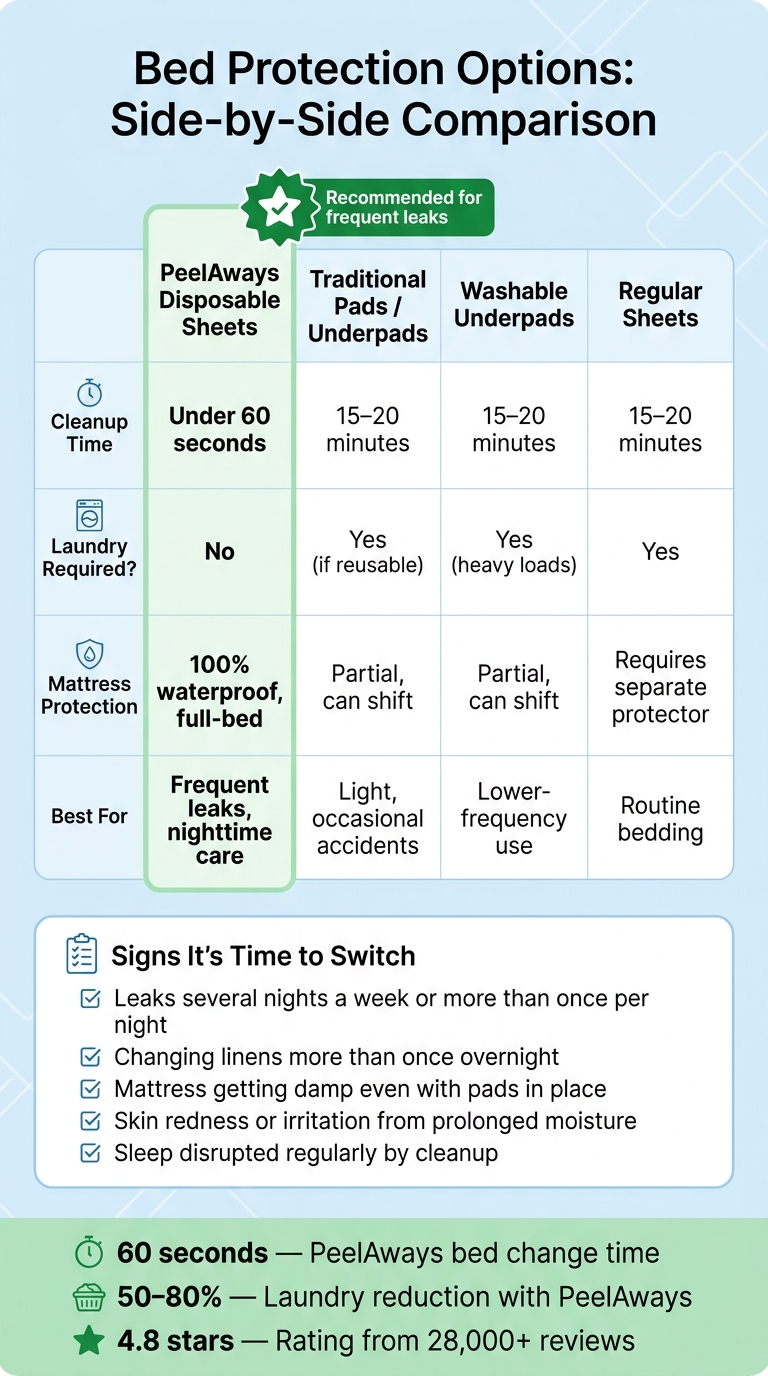
Pads vs. Disposable Sheets: Which Bed Protection Is Right for You?
It’s 2am. The pad bunched up again. The mattress feels damp, your loved one is uncomfortable, and you’re standing there knowing this isn’t a one-time mess anymore.
That’s usually the moment things change.
Once leaks become routine, the question stops being “Will pads work?” and becomes “Is there a faster, better way to protect the bed?” That point looks a little different in every home, but the pattern is the same: pads stop matching the workload.
And when that happens, the next question is simple. Which option cuts down the work instead of adding to it?
Waterproof Mattress Pads vs. Disposable Sheets and Other Bedding Options
Here’s the clearest side-by-side view.
| Solution | Cleanup Time | Laundry Required? | Mattress Protection | Best For |
|---|---|---|---|---|
| PeelAways | Under 60 seconds | No | 100% waterproof, built-in | Frequent leaks, nighttime care, facilities |
| Traditional Pads/Underpads | 15–20 minutes for a full bed change | Yes if reusable | Partial coverage; can shift during the night | Light, occasional accidents |
| Washable Underpads | 15–20 minutes for a full bed change | Yes (heavy loads) | Partial coverage; can shift during the night | Lower-frequency use |
| Regular Sheets | 15–20 minutes | Yes | Requires a separate protector | Routine bedding |
That’s the part people don’t always see at first. A pad may help with a small accident, but when leaks happen often, partial coverage starts to feel like a constant gamble. You’re still checking corners. Still worrying about shifting. Still doing laundry.
Full-bed protection is usually easier to live with when accidents stop being occasional and start becoming part of the nightly routine.
A Quick Decision Checklist for Families, Parents, and Care Facilities
If your routine looks like any of these, it’s probably time to switch:
- Leaks are happening several nights a week or more than once a night
- You’re changing linens more than once overnight
- The mattress is getting damp even with pads in place
- Skin irritation or redness is showing up from moisture sitting too long
- Sleep is getting wrecked by cleanup, and the exhaustion is piling up
For care facilities, the switch starts to make financial sense once linen changes turn into a daily workload. For parents, it usually happens when cleanup starts taking over both mornings and nights.
That’s where PeelAways can feel like a relief. It was made for the kind of nights when you don’t have 15–20 minutes for a full bed change. You just need to strip one layer and keep moving. One minute instead of a whole production. Sizes run from crib to king, with 5–7 layers, and it’s backed by 28,000+ reviews and a 4.8-star rating.
If you want to see it, you can check PeelAways on peelaways.com/shop or the PeelAways Amazon listing. You may also want to read more on the PeelAways blog, like how PeelAways works and tips for easier nighttime cleanup.
Once cleanup becomes the hardest part, full-bed protection isn’t just nice to have. It becomes the thing that helps you get through the night with less work and a little more dignity intact.
Conclusion: Make the Switch Before Cleanup Becomes the Hardest Part of Care
It’s 2am. The bed is damp again, the room smells like detergent and sleep you’re not getting, and your loved one is trying not to look embarrassed. Your back hurts, your eyes burn, and you still have to strip the bed one more time.
If pads are failing several nights a week, the mattress is getting damp, and sleep keeps getting broken up, pads aren’t enough anymore. At that point, waiting only makes the nights harder. When leaks keep happening, it makes sense to switch before exhaustion becomes your baseline.
When cleanup starts taking over the night, full-bed protection is often the simpler path. PeelAways multi-layer disposable sheets turn a full bed change into a quick peel-and-replace swap. Instead of spending 15–20 minutes changing the bed, you peel off one layer and you’re done in under 60 seconds. The waterproof, breathable layer helps keep your loved one dry and the night a little calmer. And honestly, that matters. It puts the focus back where it should be: on care, not cleanup.
That’s why I keep coming back to PeelAways. They come in 5–7 layers, in sizes from crib to king, and they’ve earned 28,000+ reviews with a 4.8-star rating. If you’re already using diapers or incontinence pads, this is the extra layer that can save your night.
You can find PeelAways on peelaways.com/shop and on Amazon. If you want to read more first, take a look at other guides on PeelAways like How PeelAways Work and caregiving tips on the PeelAways blog.
For families and caregivers, the goal is simple: less cleanup, less laundry, and less disruption.
Making aging and caregiving easier, one bed at a time.
Blog readers save 10% with code BLOGS10 at checkout. Available on peelaways.com and Amazon. Free shipping on orders over $100.
Comments
0



SAVE MONEY & WATER
Professionals & Institutions save a fortune on labor/laundry.

SUPERIOR COMFORT
The first thing our customers notice is how soft our sheets are.

100% WATERPROOF
Each layer is 100% Waterproof, perfect for spills and accidents

SAVE TIME
Change the sheet in under 1 minute without stripping the bed.

Leave a comment