
Pressure-Relief Mattresses vs. Overlays: Key Differences

Pressure-relief mattresses and overlays are designed to prevent and manage pressure ulcers, but they differ significantly in design, effectiveness, and cost. Mattresses are thicker, provide better pressure distribution, and are ideal for high-risk or immobile patients. Overlays, on the other hand, are thinner, portable, and more affordable, making them suitable for short-term or low-risk scenarios. Here's what you need to know:
- Pressure-Relief Mattresses: Full-depth, distribute weight effectively, prevent bottoming out, and often include advanced features like alternating pressure or low air loss systems. Prices range from $190 to $1,800.
- Pressure-Relief Overlays: Thin toppers placed on existing mattresses, available in foam, gel, or air-filled options. Affordable, portable, and ideal for moderate-risk patients. Prices range from $40 to $440.
Quick Comparison:
| Feature | Mattresses | Overlays |
|---|---|---|
| Thickness | 6+ inches | ~3 inches |
| Pressure Distribution | Excellent | Moderate |
| Cost | $190–$1,800 | $40–$440 |
| Best For | High-risk, immobile patients | Low-to-moderate risk, short-term use |
| Portability | Heavy, not portable | Lightweight, easy to move |
Choosing the right option depends on patient risk level, mobility, and budget. Mattresses are better for long-term care and advanced ulcers, while overlays work well for temporary or less severe needs.
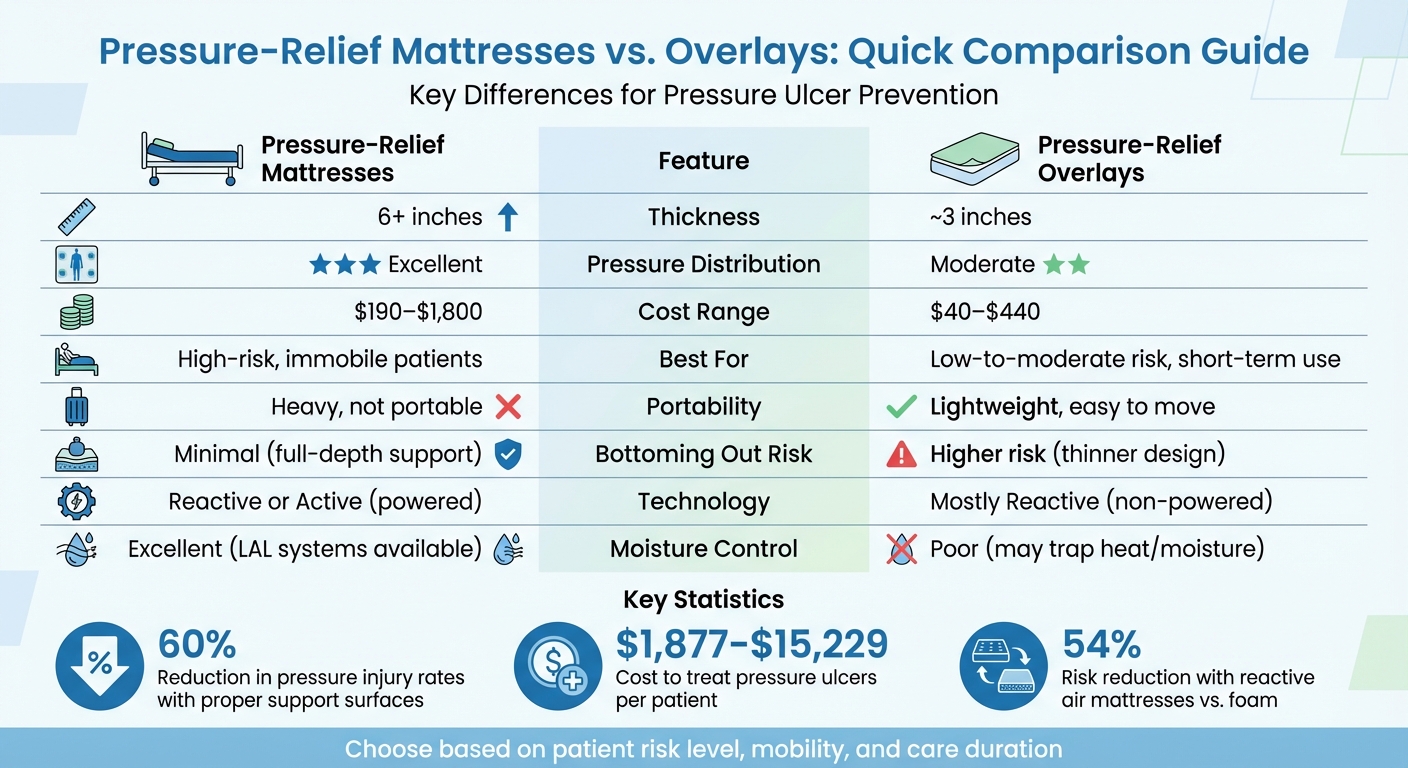
Pressure-Relief Mattresses vs Overlays Comparison Chart
Top 5 Best Pressure Relief Mattresses - Therapeutic Ulcer Prevention
What Are Pressure-Relief Mattresses?
Pressure-relief mattresses are specially designed to help prevent and manage pressure ulcers by redistributing body weight away from areas prone to sores, like the hips, heels, and spine [4]. Unlike overlays, these mattresses are full-depth and provide complete support, focusing on reducing pressure points.
These mattresses work through immersion and envelopment, meaning they allow the body to slightly sink in while conforming to its shape. This spreads out the pressure across a larger area, minimizing force on any single spot [8][9].
There are two main types: reactive mattresses, which use materials like foam, gel, or static air to provide constant pressure distribution, and active mattresses, which use powered systems to cycle air bladders every 10 minutes, ensuring no part of the body stays under pressure for too long [4].
Some advanced models go a step further with features like low air loss technology. This involves air flowing through tiny holes to keep the skin cool and dry. These mattresses are also designed to prevent "bottoming out", where pressure points sink too far and touch the hard surface beneath [4].
"A pressure relief mattress is designed to protect against pressure ulcers... It provides support for the head and body, and it redistributes a person's weight, which reduces the amount of pressure applied to any single area of the body." - Megan Smith, PT [4]
These features are what make pressure-relief mattresses stand out, as explored in the benefits below.
Features and Benefits
One of the biggest advantages of these mattresses is their ability to redistribute weight, significantly lowering the risk of pressure injuries - by as much as 60% [8]. Research shows that foam mattresses can reduce the risk of pressure ulcers with a risk ratio of 0.40, while reactive air mattresses may lower that risk by roughly 54% compared to foam options (RR 0.46) [3][1].
Preventing bottoming out is another critical benefit. Full-depth mattresses provide enough support to keep pressure points from pressing against the hard surface underneath. This is especially important for patients who spend long hours in bed, as pressure injuries can develop in as little as one hour [8].
For patients who cannot move on their own, powered mattresses offer an added advantage. They automatically cycle air bladders to mimic natural body movements, reducing the need for frequent repositioning by caregivers [4].
Materials also play a key role. Cross-cut foam reduces shear and friction by allowing the mattress surface to move with the patient. Gel-infused options keep the surface cooler, while memory foam uses heat and pressure to contour to the body for added comfort [4][9]. Many advanced covers are designed to prevent infections by being vapor-permeable, water-resistant, and antimicrobial.
These features highlight the difference between pressure-relief mattresses and overlays, which provide a more basic level of support.
When to Use Pressure-Relief Mattresses
Pressure-relief mattresses are indispensable in hospitals and long-term care facilities, especially for patients who are immobile. A 2019 Medline study of over 33,000 nursing home mattresses and 5,200 acute care mattresses found that more than half needed immediate replacement due to issues like holes, stains, thinning, and compression [8].
In home care, these mattresses are vital for high-risk patients - those who cannot reposition themselves, have advanced pressure ulcers (Stage 3 or 4), or score poorly on risk assessments like the Braden Scale [8][4]. For completely immobile or bedridden patients, powered mattresses are often a necessity [4].
"Since a bedsore can develop when blood supply to the skin is cut off for more than two to three hours, anyone who spends the majority of the day in bed... is at risk." - Megan Smith, PT, Rehabmart [4]
Prices for pressure-relief mattresses vary based on their technology. Entry-level foam mattresses cost around $190–$325, mid-range therapeutic foam options range from $400–$460, and high-tech powered systems with alternating pressure or low air loss can cost $1,700–$1,800 or more [4][5]. While the upfront cost is higher compared to overlays, these mattresses can save money in the long run by preventing pressure injuries, which can cost between $1,877 and $15,229 per patient to treat [6].
These features and benefits provide a solid foundation for comparing pressure-relief mattresses with overlays in greater detail.
What Are Pressure-Relief Overlays?
Pressure-relief overlays are designed to sit on top of an existing hospital bed or standard mattress, offering extra comfort and redistributing body weight effectively. Unlike full mattresses, which provide complete support, overlays serve as a supplementary layer tailored for specific care needs. They come in various materials, including foam (like egg-crate or memory foam), air-filled bladders (static or alternating), gel polymers, or low-air-loss technology that circulates air through tiny holes to enhance user comfort [7][10][13].
These overlays are typically about 3 inches thick [11][4]. Their lightweight and portable design makes them easy to transport, especially air-filled models, which can be deflated, rolled up, and moved between rooms or even used on recliners and sofas [7][10].
Overlays work in two main ways: reactively or actively. Reactive overlays, made from foam or gel, conform to pressure points to relieve stress. Active overlays, on the other hand, use powered air cells that cycle every 10 minutes to shift pressure, helping to prevent prolonged stress on specific areas [7][4].
"Low air loss mattress toppers allow the user to get the same amount of relief as a low loss air mattress provides... but they cost less than their budget." - AvaCare Medical [12]
However, overlays do have a limitation. Because they're thinner than full mattresses, there's a risk of "bottoming out." This happens when pressure-prone areas sink through the overlay and rest on the hard mattress underneath, negating the pressure-relief benefits. Caregivers need to regularly check to ensure that the patient’s pressure points aren’t making contact with the firm surface below [11][13].
Features and Benefits
Pressure-relief overlays are an affordable way to enhance an existing mattress. Prices range from $39.99 for basic foam models to around $432.25 for advanced systems [14]. This makes them an appealing option for caregivers working with limited budgets who want to improve comfort without replacing the entire mattress.
Installing an overlay is straightforward. It simply sits on top of an existing mattress, requiring no heavy lifting [10]. For powered models, setup involves plugging in the pump and adjusting the settings. Another advantage is that overlays can extend the life of a mattress. If a mattress is still in good structural condition but feels too firm or uncomfortable, an overlay can adjust its feel without the expense of a full replacement [10].
Different materials cater to specific needs:
- Gel overlays offer a cooling effect and are easy to disinfect [7][13].
- Foam overlays with cross-cut designs help reduce skin shearing by allowing the surface to move with the patient [4].
- Alternating pressure overlays actively redistribute weight, simulating natural body movement for patients who can’t reposition themselves [7].
"If you're completely satisfied with your mattress, an overlay is more of a luxury than a necessity, but in other circumstances, an overlay can be a significant benefit." - Adina E, AvaCare Medical [7]
Studies show that reactive air overlays may reduce the risk of developing new pressure ulcers by 80% compared to standard foam surfaces, while reactive gel surfaces can lower the risk by 53% [1]. These statistics highlight the protective benefits of overlays, even though they’re more affordable than full mattresses.
When to Use Pressure-Relief Overlays
Overlays are best suited for individuals at low to moderate risk of developing pressure ulcers [14][4]. They’re ideal for patients who can still shift their weight or reposition themselves, even minimally. However, for completely immobile patients or those with advanced pressure ulcers (Stage 3 or 4), a full pressure-relief mattress is necessary [10].
Short-term care situations are where overlays truly shine. For example, someone recovering from surgery, dealing with a temporary illness, or needing pressure relief for a limited period can benefit from an overlay without investing in a full specialty mattress [10]. This makes them popular in both home recovery scenarios and acute care settings.
"A mattress overlay is an affordable alternative to the full size specialty mattresses associated with the prevention and treatment of pressure ulcers - also known as 'bed sores.'" - NewLeaf Home Medical [14]
Considering that treating pressure ulcers can cost anywhere from $1,877 to $15,229 per patient [6], investing in an overlay is a practical preventative measure. Specialized overlays, like gel pads, are also commonly used in clinical settings, such as on operating tables, to prevent pressure injuries during lengthy surgeries [1][6].
That said, caregivers need to monitor the microclimate around the patient. Many air overlays are made from non-breathable vinyl, which can trap heat and moisture against the skin, increasing the risk of skin breakdown [11][4]. For patients prone to sweating, overlays with low-air-loss technology are a better choice, as they circulate air to keep the skin dry [7][4].
Lastly, always check the weight capacity of an overlay before purchasing. Standard models typically support up to 300 lbs, but bariatric options are available for heavier individuals [7][10][12]. Using an overlay that isn’t rated for the patient’s weight can increase the risk of bottoming out, reducing its effectiveness.
Comparing Pressure-Relief Mattresses and Overlays
When choosing between pressure-relief mattresses and overlays, it’s important to consider how they differ in design, performance, and practical use. These differences directly impact their ability to protect the skin, manage moisture, and fit into daily care routines.
Design and Technology
The most noticeable difference is thickness: overlays are typically about 3 inches thick, while full mattresses exceed 6 inches. This additional depth in mattresses allows the body to sink deeper without hitting the firm support underneath.
"Since most mattress overlays measure only three inches thick, they will not prevent a patient from bottoming out, with the body's pressure points resting on the surface underneath." - Megan Smith, PT, Rehabmart [4]
The technology used also varies. Overlays are generally reactive, relying on materials like foam, gel, or static air. In contrast, full mattresses can be either reactive or active, with powered air cells that cycle every 10 minutes to redistribute pressure [4].
| Feature | Pressure-Relief Overlays | Pressure-Relief Mattresses |
|---|---|---|
| Thickness | ~3 inches | 6+ inches |
| Immersion | Limited; higher bottoming out risk | Deep; supports full body envelopment |
| Technology | Reactive (foam, gel, static air) | Reactive (multi-layer foam/gel) or Active (alternating air) |
| Requires Power | Usually non-powered | Can be powered or non-powered |
| Portability | Lightweight and easy to move | Heavier; may need specific supports |
Advanced mattresses often include features like lateral rotation and heel slopes to protect areas prone to pressure ulcers [4][5]. These design elements directly influence their clinical effectiveness, as outlined below.
Pressure Redistribution Performance
Both overlays and mattresses outperform standard foam surfaces in preventing pressure ulcers, but full mattresses generally achieve better results. For instance, reactive air surfaces reduce the risk of developing new pressure ulcers by 54% compared to foam, while active (alternating pressure) air surfaces reduce the risk by 37%. Additionally, reactive air surfaces improve the chance of complete ulcer healing by 32%, with long-term care patients being 2.66 times more likely to heal [1].
"Compared with foam mattresses, alternating pressure air surfaces probably result in health benefits that outweigh their costs in preventing pressure ulcers." - Cochrane Database of Systematic Reviews [1]
| Surface Type | Mechanism | Clinical Effectiveness |
|---|---|---|
| Alternating Pressure (Active) | Air cells inflate/deflate cyclically | 37% reduction in ulcer risk vs. foam [1] |
| Static Air (Reactive) | Maintains constant air pressure | 54% reduction in ulcer risk; 32% better healing [1] |
| Gel/Foam Hybrid | Conforms to body shape | Reduces shear and friction; ideal for low-to-moderate risk |
| Lateral Rotation | Mechanically tilts patient | Enhances circulation and automates repositioning |
Overlays, due to their limited thickness, pose a higher risk of bottoming out, which can reduce their effectiveness. Patients who are completely immobile or have advanced-stage ulcers (Stage 3 or 4) often require the more comprehensive support of a full mattress [4].
Moisture and Temperature Control
Another key factor is how well each option manages temperature and moisture at the skin’s surface, often referred to as microclimate control. Overlays, particularly those made from non-breathable vinyl, tend to trap heat and moisture, which can lead to microbial growth and increase the risk of skin breakdown [4].
"For comfort and microclimate management, a mattress rather than an overlay is usually preferable." - Megan Smith, PT [4]
Full mattresses, especially Low Air Loss (LAL) models, actively manage moisture and temperature by circulating air through laser-drilled holes, keeping the skin cool and dry [4]. Gel-infused foam mattresses offer additional cooling benefits by retaining less body heat than traditional memory foam [4][5].
| Factor | Overlays | Mattresses (Advanced) |
|---|---|---|
| Breathability | Often low due to vinyl covers | High, with breathable and moisture-resistant covers |
| Moisture Management | Poor; may trap perspiration | Excellent in Low Air Loss (LAL) models |
| Temperature Control | Tends to retain body heat | Gel-infused or LAL systems provide cooling |
For caregivers, these distinctions are crucial, especially when managing patients prone to sweating or incontinence. A moist environment not only raises the risk of infection but also makes the skin more vulnerable to friction and shearing forces [4].
sbb-itb-45288fe
Cost and Practical Considerations
Upfront Costs vs. Long-Term Value
The cost of overlays ranges from $71.95 to $439.95, while full mattresses fall between $191.16 and $1,781.81. Among overlays, alternating pressure models start at $71.95, gel/foam options range from $139.95 to $327.95, and low air loss overlays cost $248.95 to $439.95 [15]. On the other hand, basic therapeutic foam mattresses are priced between $191.16 and $325.52, while advanced alternating pressure mattresses can cost $1,721.06 to $1,781.81 [16].
Though overlays are initially more affordable, treating pressure ulcers can add $1,877 to $15,229 in medical expenses, making full mattresses a smarter investment for high-risk patients [6]. Patients with Stage II or higher pressure ulcers often experience hospital stays that are 4 to 8 days longer than those without ulcers [6].
"Compared with foam mattresses, alternating pressure air mattresses or overlays probably result in health benefits that outweigh their costs in preventing pressure ulcers." – Cochrane Library [1]
Maintenance and operational costs also play a role in the decision. Powered systems, which require electricity, may need backup batteries and occasional repairs, and their pumps or compressors can be noisy [16]. Non-powered foam and gel surfaces, being free of mechanical components, are quieter and eliminate electricity expenses, though they require caregivers to reposition patients more frequently [16]. In long-term care, reactive air surfaces may add an extra $26 per ulcer-free day during the first year compared to standard foam options [1][2].
| Feature | Overlays | Mattresses |
|---|---|---|
| Initial Investment | $71.95 – $439.95 | $191.16 – $1,781.81 |
| Long-Term Value | Best for short-term or low-risk prevention | Ideal for long-term care and advanced ulcer management |
| Practical Risk | Risk of bottoming out | Designed to minimize bottoming out |
These financial and practical differences make overlays and full mattresses suited to different care needs.
Home Care vs. Professional Care Settings
The choice between overlays and full mattresses also depends on the care setting. Overlays are well-suited for home care because they are lightweight, easy to fit, and minimally disruptive to daily routines. They even allow partners to continue sharing the same bed [17]. However, overlays can increase bed height, which may pose safety risks for patients using bed rails or those with mobility challenges [17].
Full mattresses, by contrast, are better for professional care facilities. These systems often include integrated features, such as "turn assist", which help caregivers reposition patients and handle linen changes. However, their bulkiness makes them impractical for most home setups [17]. Gel mattress overlays are popular in professional settings because they resist bacterial growth and are easy to clean, though some specialized surfaces may require off-site decontamination between uses [7][17].
Incontinence and perspiration can further complicate care, increasing the workload for caregivers. Disposable bed sheets from PeelAways provide a practical solution. With a patented multi-layer design, these sheets allow caregivers to peel away the top layer when soiled, revealing a clean, waterproof layer underneath. This eliminates the need for laundering and reduces the risk of cross-contamination. PeelAways sheets are available in sizes ranging from Crib-A-Peel to King, with prices starting at $30.99 [18].
"In a home-care setting, an overlay placed on one side of the bed may also allow partners to continue sharing the same bed." – Liz Ovens, Clinical Service Lead Tissue Viability [17]
When deciding between overlays and full mattresses, consider the patient's risk level and check insurance coverage. Medicare Part B policies categorize products into Group I (overlays and basic foam for prevention) and Group II/III (powered mattresses for advanced treatment) [6]. For patients who cannot be manually repositioned every two hours, a powered alternating pressure mattress may offer better long-term value by automating this process [16].
Conclusion: Choosing the Right Solution
Deciding between a pressure-relief mattress and an overlay depends on factors like patient mobility, risk level, and the care environment. For patients who can reposition themselves, a foam or gel overlay might provide enough protection. On the other hand, patients who are completely immobile often require a powered alternating pressure mattress, which redistributes weight automatically - especially crucial when caregivers can't reposition the patient every two hours [16].
The level of risk is another key consideration. Reactive surfaces, such as foam or static air overlays, work well for patients at low risk or those with mild Stage 1-2 pressure sores. However, patients at higher risk or dealing with severe Stage 3-4 ulcers need active therapy from alternating pressure or low air loss mattresses [16] [8]. Studies show that using the right support surface can lower pressure injury rates by up to 60% [8]. A proper risk assessment is critical to ensuring the patient gets adequate support.
Before settling on an overlay, perform a quick hand check: slide your hand under the patient’s heaviest area. If you can feel their body through the overlay, it’s too thin to prevent bottoming out. Most overlays are only about 3 inches thick, which limits their effectiveness [16].
Overlays are a practical choice for home care due to their portability and lower upfront cost, making them a good option for families on tight budgets. However, full mattresses offer better long-term value by preventing expensive wound treatments, which can cost anywhere from $1,877 to $15,229 [6]. When choosing a solution, consider the patient’s specific needs, ensure compatibility with the bed, and confirm that powered systems have reliable electrical access, including battery backups for uninterrupted therapy [16]. Selecting the right support surface is not just about comfort - it’s a vital step toward patient safety and reducing long-term healthcare costs.
Related Articles
When it comes to managing care at home or in professional settings, having the right bedding solutions can make a world of difference. These articles dive into specific aspects of caregiving, offering practical strategies to improve patient care and ease caregiver responsibilities.
5 Benefits of Using Disposable Bed Sheets in Home Care highlights how multi-layer disposable sheets, like PeelAways, can simplify caregiving. With their peel-away design that takes less than a minute to change, these sheets help maintain hygiene and reduce caregiver workload. They also feature a breathable membrane to manage moisture, addressing common concerns with foam mattresses and overlays.
How to Reduce Caregiving Stress with Simple Bedding Solutions tackles the challenges of frequent sheet changes and heavy laundry loads. This article offers tips for caregivers managing patients on pressure-relief surfaces, showing how to maintain medical-grade cleanliness without the hassle of constant laundering.
Top Tips for Preventing Pressure Ulcers at Home serves as a guide to preventing pressure ulcers through proper skin care, repositioning routines, and choosing the right support surfaces. With the potential to lower pressure injury rates by up to 60%, this article provides actionable advice to maximize the effectiveness of your mattress or overlay while ensuring daily care routines are on point.
FAQs
What are the benefits of choosing a pressure-relief mattress instead of an overlay?
Pressure-relief mattresses are specially designed to provide even, full-surface support, helping to distribute weight more effectively. By minimizing pressure, friction, and shear, these mattresses play a key role in both preventing and managing pressure ulcers. Unlike overlays, which are placed on top of an existing mattress, pressure-relief mattresses replace the entire sleeping surface. This ensures consistent support, regardless of the condition of the original mattress.
Many pressure-relief mattresses feature advanced technologies such as custom foam densities, alternating pressure systems, or low-air-loss designs. These features enhance their ability to redistribute pressure more reliably and for longer periods. While overlays may be a more budget-friendly option, they only enhance part of the existing mattress. This makes them less suitable for individuals who are fully immobile or at a higher risk of developing pressure-related injuries. For those requiring long-term care and comprehensive protection, a pressure-relief mattress is the better option.
How do pressure-relief overlays prevent pressure ulcers despite being thinner than mattresses?
Pressure-relief overlays work by spreading pressure over a broader surface area, rather than depending solely on thickness. These overlays often incorporate features like air-filled cells or segmented foam that mold to the body's shape, helping to minimize pressure points that could harm tissue. When used alongside a supportive mattress, they prevent "bottoming out", a situation where the body comes into direct contact with the mattress, ensuring steady pressure relief.
Many of these overlays also utilize alternating-pressure technology, which inflates and deflates small air bladders in cycles. This movement mimics the body's natural micro-adjustments, helping to avoid sustained pressure on any one spot. Despite their slim and lightweight design, these overlays offer reliable protection and are simple to handle.
When is a pressure-relief overlay a better choice than a full mattress?
A pressure-relief overlay works well when someone already has a solid, supportive mattress but wants an affordable way to boost comfort and ease light pressure points. These overlays are particularly suited for individuals at a lower risk of pressure ulcers or for short-term needs, such as during recovery periods.
Another advantage is their portability. Unlike full pressure-relief mattresses, overlays are easier to transport and set up, making them a practical choice for temporary or additional support.
Comments
0



SAVE MONEY & WATER
Professionals & Institutions save a fortune on labor/laundry.

SUPERIOR COMFORT
The first thing our customers notice is how soft our sheets are.

100% WATERPROOF
Each layer is 100% Waterproof, perfect for spills and accidents

SAVE TIME
Change the sheet in under 1 minute without stripping the bed.

Leave a comment