
Ultimate Guide to Balancing Caregiving and Work

Balancing caregiving and work is a challenge faced by 29 million Americans, with 61% of family caregivers juggling both roles. Many deal with stress, burnout, and workplace challenges, as 67% report struggling to maintain a healthy work-life balance. This guide offers practical strategies to help you manage these responsibilities, protect your well-being, and maintain your career.
Key takeaways include:
- Time management tips: Use time-blocking, batch tasks, and digital tools like shared calendars and apps to stay organized.
- Employer support: Learn how to request flexible work options and understand your legal protections under FMLA and ADA.
- Building support networks: Delegate caregiving tasks to family, friends, or professional services, including respite care and adult day centers.
- Self-care strategies: Prioritize your health with stress management techniques, short breaks, and boundary-setting.
With the right tools and resources, you can reduce stress, avoid burnout, and create a more manageable routine for caregiving and work.
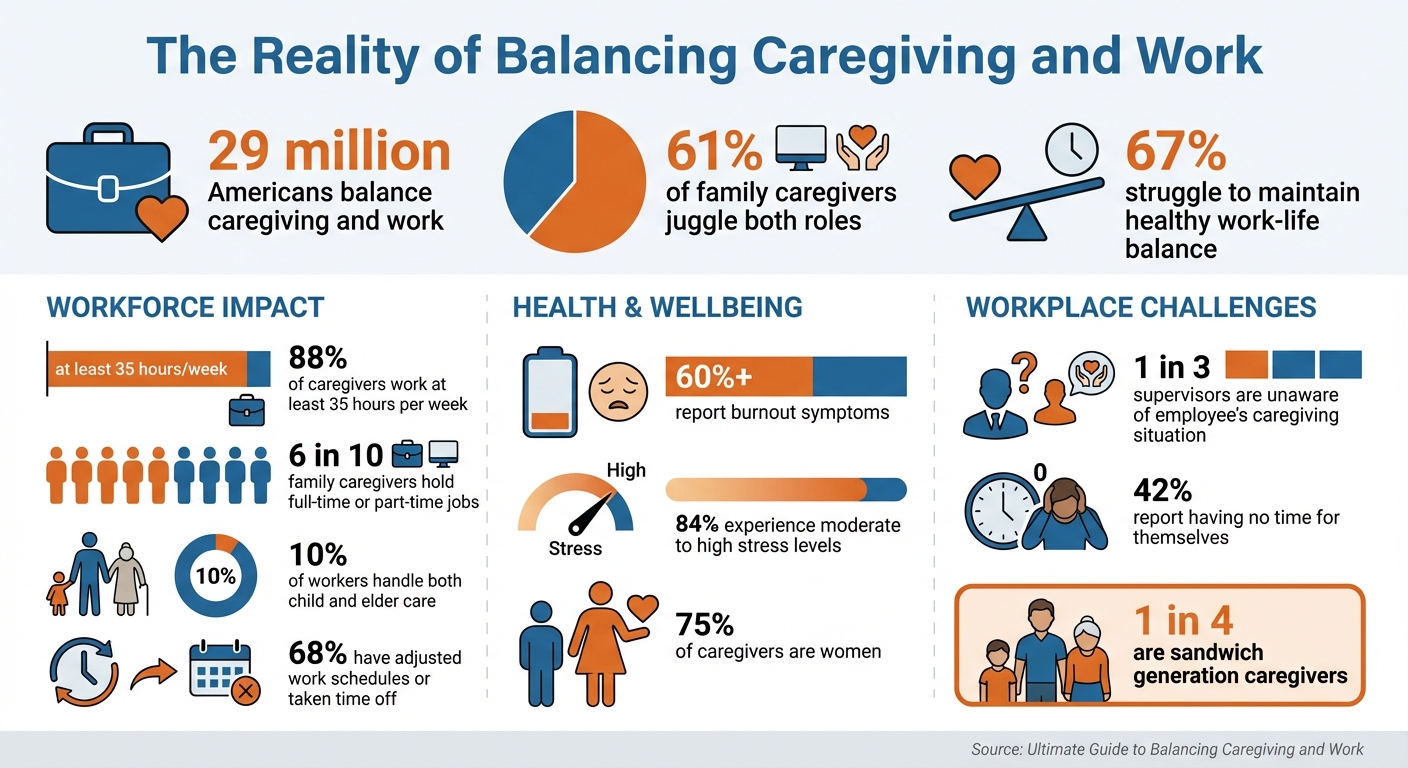
Caregiving and Work Statistics: The Reality of Balancing Both Roles
40: Working While Caregiving with Liz O'Donnell
The Reality of Caregiving While Working
Juggling caregiving with a full-time job often feels like managing two demanding careers at once. The statistics are striking: 88% of those caring for an ill or disabled relative work at least 35 hours a week [6]. Additionally, 6 in 10 family caregivers for adults aged 50 and older hold either full-time or part-time jobs [1]. This "double shift" means your day is packed with responsibilities - scheduling doctor appointments, managing bills, preparing meals, ensuring hygiene - all while meeting workplace deadlines. You might find yourself researching medical conditions during work hours, stepping out for urgent calls, or dashing out mid-afternoon to handle emergencies. For some, the challenge is even greater: 10% of workers are responsible for both child and elder care [6].
This relentless balancing act doesn’t just stretch your time - it takes a serious toll on your well-being.
Health Risks and Burnout
The physical and emotional impact of caregiving is undeniable. Over 60% of caregivers report symptoms of burnout [9], and they are far more likely to experience depression compared to those without caregiving duties [10]. Studies also link caregiving to chronic health issues like diabetes and heart disease [10]. The warning signs can sneak up on you: frequent illnesses, disrupted sleep, weight changes, irritability, or feelings of resentment [9][11].
"Burnout feels like a candle that ran out of a wick - it doesn't have what it needs to continue to provide light." - Cleveland Clinic [9]
The overlap between caregiving and work responsibilities only amplifies the risk of burnout [9]. Emotional investment in your loved one can lead to compassion fatigue, where you begin to internalize their struggles as your own [9][11]. And when dealing with unpredictable conditions like dementia or cancer, even basic planning - whether for work or personal time - can feel impossible [3]. The result? A constant cycle of stress with little room for recovery.
Obstacles Caregivers Encounter
The challenges go far beyond a packed schedule. Many caregivers face rigid workplace policies, including inflexible hours, mandatory overtime, and the absence of paid leave [2][6]. Workplace bias can also add to the burden. Caregivers, particularly women, are often unfairly perceived as less committed or capable than their peers without caregiving duties [6]. This bias disproportionately affects women of color, who are part of the 75% of caregivers who are women. They not only experience higher levels of emotional and physical strain but also face greater financial challenges than their male counterparts [10].
Logistical hurdles further complicate the picture. Caregivers often navigate intricate medical schedules, struggle to find affordable eldercare services, and deal with gaps in emergency care [2][1]. Social isolation is another hidden cost of caregiving. Many find themselves withdrawing from community activities or sacrificing time with friends and family just to keep up with their responsibilities [2].
Acknowledging these challenges is the first step toward finding solutions. In the upcoming sections, we’ll explore practical strategies to help you maintain your health, manage your career, and provide the care your loved ones need - all without losing yourself in the process.
Time Management for Caregivers
With 84% of caregivers reporting that their responsibilities significantly impact their daily stress levels [7], finding practical ways to manage time is essential. A few smart strategies can make a big difference.
Time-Blocking Techniques
Time-blocking is a method that organizes your day into dedicated segments, giving structure to what might otherwise feel overwhelming. For example, set up a "Telephone Hour" during your lunch break to handle calls with doctors, insurance companies, or family members [12][1]. This keeps caregiving-related communications from disrupting your workday.
You can also assign specific time blocks for your care recipient and other family members [12]. This ensures they each receive your undivided attention during designated periods. For tasks requiring focus, like researching medical conditions or care options, reserve evening research blocks after work hours so you can maintain productivity during the day [1].
Another helpful tip is batching errands and appointments into single time slots [12]. Instead of making separate trips for groceries, prescriptions, and doctor visits, combine them into one afternoon. Similarly, use weekend preparation blocks to cook and portion meals into dated, microwavable containers - saving you from scrambling on busy weeknights [7].
If your employer offers flexible work arrangements, use them strategically. For instance, you can block out time to take your loved one to appointments and then make up those work hours later [3]. This is especially relevant since 68% of caregivers have had to adjust their work schedules or take time off to manage caregiving duties [1].
Leveraging Digital Tools for Scheduling
Shared digital calendars are an excellent way to keep everyone on the same page. A family calendar can display doctor appointments, meal plans, and daily activities, reducing the need for constant phone calls and avoiding scheduling conflicts [1].
Apps like CaringBridge and Caring Village allow you to delegate tasks like grocery shopping, transportation, or meal delivery to your support network of friends and family [5][2]. These tools streamline coordination, making it easier to share responsibilities.
For additional peace of mind, consider using remote monitoring technology or wearable devices. These tools let you check on loved ones from your desk, reducing the need for frequent physical check-ins during work hours [7]. Digital planners can also centralize key information - insurance details, medical contacts, and service providers - so you’re not relying on memory during stressful moments [12].
Your workplace may offer an Employee Assistance Program (EAP) that provides free referrals for eldercare services and time-management counseling [3]. Since one in three employed caregivers say their supervisor is unaware of their caregiving situation [7], accessing these resources discreetly can be a helpful option.
Finally, try keeping a one-word journal. At the end of each day, jot down a single word that reflects how you felt - like "hopeful", "exhausted", or "frustrated" [7]. This simple habit, whether digital or on a physical calendar, can help you track emotional trends and identify patterns of stress without the time commitment of traditional journaling.
Getting Support from Your Employer
Requesting Flexible Work Options
Start by reviewing your employee handbook to check for policies on telecommuting, flextime, or Employee Assistance Programs (EAPs) [15]. This will help you build a solid case when discussing flexible work arrangements.
When making your request, focus on how these changes can improve your productivity and focus [15]. For instance, explain how flexible hours or working from home will help you manage stress and maintain your work performance while handling caregiving responsibilities. If you're asking to work remotely, be specific about the tools you'll use - like Zoom, email, or phone - to stay connected and effective [15]. This demonstrates that you’ve considered the practical aspects.
Here are some common flexible work options:
| Flexible Option | Description |
|---|---|
| Flextime | Adjust your start and end times (e.g., 8:00 AM–4:30 PM instead of 9:00 AM–5:30 PM) [6] |
| Compressed Workweek | Work the same total hours over fewer days [6] |
| Telecommuting | Work remotely to reduce commuting time and increase caregiving availability [6] |
| Job Sharing | Split one full-time position between two employees [6] |
| Reduced-Time | Shift to part-time hours with proportional pay and benefits [6] |
If you need time off for planned medical treatments or surgeries, provide at least 30 days' notice to your employer [13]. For recurring appointments, such as weekly therapy sessions, consider asking about intermittent leave so you can take smaller blocks of time off rather than full weeks [13]. Remember, you’re not required to disclose your loved one’s specific medical diagnosis - just enough information to confirm the leave qualifies under your employer’s policies [13].
Being proactive with your employer can make a world of difference in managing your responsibilities. Combine these flexible work options with legal protections to secure your job while caregiving.
Legal Protections for Caregivers
The Family and Medical Leave Act (FMLA) is a key federal law that provides up to 12 workweeks of unpaid, job-protected leave to care for a spouse, child, or parent with a serious health condition [14][19]. To qualify, your employer must have at least 50 employees within a 75-mile radius, and you must have worked at least 1,250 hours in the past year [16][20].
If you're caring for a servicemember, you may be eligible for military caregiver leave, which extends up to 26 workweeks in a single 12-month period [16][19]. While FMLA leave is unpaid, you can often use accrued paid time off (PTO) or sick leave, and your employer is required to maintain your group health insurance [13].
Nearly 69% of Americans who care for a parent or in-law are also employed [15], but many don’t realize they’re protected from workplace retaliation. Employers cannot interfere with your FMLA rights, deny your leave, or retaliate against you for using it [13]. Additionally, some states, such as California, New York, and Washington, offer state-level paid family leave programs that provide partial wage replacement on top of federal protections [17][20].
The Americans with Disabilities Act (ADA) also has an "association provision" that protects employees from discrimination because of their relationship with someone who has a disability [18]. While this doesn’t require employers to provide specific accommodations for caregivers, it ensures you’re treated equally to other employees who request flexibility for personal reasons [18]. Similarly, Title VII of the Civil Rights Act protects against sex-based discrimination, such as assumptions that female caregivers are less committed to their jobs or that male caregivers don’t have significant caregiving responsibilities [6].
Creating Your Support Network
You don’t have to handle caregiving on your own. Around 1 in 4 caregivers are part of the "sandwich generation", juggling responsibilities for both children and aging parents or partners. Trying to manage everything solo can lead to burnout. Building a dependable support network - including family, friends, and professional services - can help you provide quality care without neglecting your own well-being or career [21]. Establishing this network lays the groundwork for practical strategies like dividing tasks and seeking professional assistance when needed.
Sharing Tasks with Family and Friends
Start by organizing a family meeting or group call. Waiting until a crisis hits often leads to confusion and frustration. Use this time to outline caregiving needs, assign tasks based on individual strengths, and designate one primary caregiver to centralize communication. For example, a tech-savvy family member might handle scheduling and digital calendars, while someone good with finances could take care of bills and insurance claims. A relative who lives nearby might manage errands or transportation, while someone farther away could provide emotional support or research resources [21].
"No one can be expected to do everything. Be gentle with yourself and realistic about how much you can do and what you are willing to do."
– National Institute on Aging [21]
When asking for help, be specific. Instead of a vague request like, "Can you help sometime?" try something concrete, such as, "Can you stay with Mom on Thursday from 1:00 PM to 4:00 PM so I can go to an appointment?" This makes it easier for others to say yes. Keep everyone organized with a central caregiving notebook - whether digital or paper - containing essential details like medical information, contact numbers, insurance policies, and schedules. Apps like CaringBridge or Caring Village can also simplify task coordination and updates for your support circle.
Regular check-ins are essential to reassess how responsibilities are shared since caregiving needs often evolve. If disagreements arise about your loved one’s care, consider involving an impartial third party, like a social worker or geriatric care manager, to provide an objective assessment [24, 25].
Professional Care Options
Sometimes, family support isn’t enough, and professional care becomes necessary. In fact, 76% of working caregivers rely solely on themselves and their families [4]. Professional services can help fill the gaps. For instance, respite care provides short-term relief - whether for a few hours or several days - through in-home aides, volunteer programs, or adult day centers. These breaks allow you to recharge or handle work commitments [23].
Adult day centers offer safe environments with social and therapeutic activities during work hours [4]. Meanwhile, home health aides can assist with personal care tasks like bathing, dressing, and managing medications [4]. To find trustworthy services, start with resources like the Eldercare Locator or your local Area Agency on Aging (n4a.org) [1, 29]. Your employer’s Human Resources department or Employee Assistance Program (EAP) might also provide referrals for care managers or subsidized services [5, 6].
When hiring professional caregivers, request a free in-home assessment to create a tailored care plan [26, 27]. Ensure the caregiver’s expertise matches your loved one’s needs, whether it’s Alzheimer’s care, mobility assistance, or medical monitoring. For private hires, check references, run background checks, and confirm that your homeowners insurance covers household employees [4].
| Service Type | Best For | Key Features |
|---|---|---|
| Respite Care | Preventing burnout | Temporary relief from caregiving duties |
| Adult Day Centers | Working caregivers | Social and therapeutic activities during work |
| Home Health Aides | Medical/Personal care | Help with bathing, dressing, and medications |
| Geriatric Care Manager | Complex medical needs | Coordination and oversight of care plans |
"In order for a caregiver to take care of a loved one they need to prioritize self-care. One way to take care of yourself as a caregiver is to take a break. Sometimes these short breaks are called respite and allow the caregiver to get away for a few hours or for a few days."
– Kristen Fleming, Caregiving Expert and Education Coordinator [22]
If you’re hesitant about bringing in outside help, start small. Even a few hours of respite care each week can make a noticeable difference in your energy and focus [26, 29].
sbb-itb-45288fe
Tools and Products That Help Caregivers
Finding the right tools can make a world of difference for caregivers juggling demanding responsibilities. With 84% of working caregivers reporting moderate to high stress levels [7], practical solutions that save time and energy aren't just nice to have - they're essential.
Simplifying Bedding Changes with PeelAways

Late-night bedding changes can be a nightmare for caregivers. The process of lifting heavy mattresses, wrestling with fitted sheets, and dealing with endless laundry can easily take 10 to 15 minutes. PeelAways disposable bed sheets offer a game-changing alternative with their patented multi-layer design. Each sheet set includes 5 to 7 waterproof layers that you simply peel away when soiled, revealing a fresh, clean sheet underneath.
Here’s the best part: the entire process takes less than a minute. No mattress lifting, no laundry, and minimal risk of cross-contamination. The sheets feature a 100% waterproof barrier to block liquids, while the soft bamboo-blend top surface ensures comfort and quietness [8].
Caregivers love the convenience. With over 12,000 happy customers and a 4.61/5 rating, PeelAways are often described as "sanity-saving." Jalene Stanger, a satisfied customer, shared:
"These have saved my sanity! ... No more 15 loads of laundry and wet mattresses!" [8]
PeelAways are available in all standard sizes, from Crib ($30.99) to King ($53.99), making them ideal for elder care, special needs care, or medical recovery situations where frequent bedding changes are unavoidable [24].
Apps and Online Resources
Beyond physical tools, digital solutions can also ease the caregiving load. Apps like CaringBridge and Caring Village help coordinate caregiving tasks by allowing you to assign responsibilities to family and friends while keeping everyone updated on your loved one’s condition [2].
For staying organized, the Digital Caregiver Planner ($25.00) provides templates for tracking medical information, medication schedules, and daily care routines [8]. If you’re looking for personalized support, CareNav from the Family Caregiver Alliance offers a free dashboard that connects you with resources tailored to your specific caregiving needs [4].
Smart home monitoring devices and wearable alert systems add another layer of reassurance, enabling caregivers to check on loved ones remotely during work hours [7]. Additionally, many employers offer Employee Assistance Programs (EAP) that provide eldercare referrals and flexible work arrangements [3].
For local support, the National Association of Area Agencies on Aging (n4a.org) connects caregivers with community services, while AARP’s private Facebook groups and caregiving forums create a space for sharing advice and experiences with peers [1][2].
Taking Care of Yourself
To care for others effectively, you need to care for yourself first. It's a simple truth, yet one that's often overlooked. With 84% of working caregivers experiencing high levels of stress, prioritizing self-care isn't just helpful - it's necessary [7]. The CDC puts it clearly: "To be an effective caregiver, you must take care of yourself. The person you are caring for is counting on you" [25].
Stress Management Techniques
Stress can creep up on you, but recognizing the signs early can make all the difference. Exhaustion, irritability, trouble sleeping, withdrawal, and headaches are all red flags that you're pushing yourself too hard [23][22]. It's important to distinguish between stress and burnout. Stress is typically tied to specific situations and can improve with breaks, while burnout is a deeper, more serious state of physical and emotional exhaustion that can lead to depression if ignored [22].
Start with the basics: aim for 7–9 hours of sleep each night and try to get at least 30 minutes of exercise daily [23][22]. Sunlight exposure is another simple yet effective way to naturally boost your mood. Incorporating breath awareness into your day can also help. Spend 10 minutes focusing on your breathing - inhale for 5 counts, hold for 5, and exhale for 5. Over time, try extending your exhale to 10 counts for a calming effect [26].
A creative approach to managing stress is one-word journaling. At the end of each day, jot down a single word that captures how you felt. Over time, you'll notice patterns that can help you pinpoint stress triggers unique to your daily life [7]. You might also find mindfulness practices, meditation, yoga, or even lighting an aromatherapy candle to be helpful tools [23][22].
Kristen Fleming, a caregiving expert, highlights the importance of self-care:
"In order for a caregiver to take care of a loved one they need to prioritize self-care" [22].
Don't hesitate to delegate tasks like laundry, cleaning, or meal prep to carve out time for yourself [7][3]. These small adjustments can help you maintain the balance needed to juggle caregiving and work.
Making Time for Yourself
Stress management is just one piece of the puzzle. Protecting your personal time is equally critical. A common pitfall is that 42% of caregivers report feeling they have no time for themselves, often using all their paid time off (PTO) for caregiving responsibilities [22][7].
To avoid this, take intentional steps to guard your personal time. Respite care can be a game-changer - schedule specific breaks and be clear with your requests. For example, saying, "Can you sit with Mom for two hours on Saturday morning?" is much more effective than a vague plea for help [27].
Dr. Wayne Jonas explains that even a 20-minute self-care break can improve productivity [28]. Whether it's stepping outside for fresh air or enjoying a meal without interruptions, give yourself permission to take these small but impactful moments. During particularly challenging days, even a 15-minute pause can help you reset [28]. It’s also a good idea to inform your doctor about your caregiving role - they can connect you with support groups or mental health resources [25][23].
Just as technology can simplify caregiving tasks, setting boundaries and scheduling breaks can simplify your path to better well-being. Practicing self-compassion is another key element. Author Cindy Eastman suggests:
"You should literally pat yourself on the back at the end of each day and remind yourself out loud: 'I'm doing a great job!'" [7].
It's completely normal to feel guilt, sadness, or frustration. The key is to acknowledge those feelings and practice self-forgiveness. Remember, taking care of yourself isn't selfish - it's the only way to ensure you can continue caring for others in the long run.
Conclusion
This guide has explored strategies like time-blocking, digital scheduling, open communication with employers, building support networks, and leveraging tools like PeelAways to simplify daily responsibilities. These approaches can help create a routine that balances both your professional life and caregiving duties.
The numbers highlight the challenge: nearly 60% of the 48 million U.S. caregivers are managing work alongside caregiving, and 67% report struggles with work-life balance. Data also shows that flexible workplace policies can deliver real benefits, with returns as high as $4.45 for every dollar spent [5][29].
By incorporating even small changes into your routine, you can reduce stress and improve productivity. Remember, your well-being is the foundation for successfully managing both caregiving and career. As the CDC emphasizes: "To be an effective caregiver, you must take care of yourself. The person you are caring for is counting on you" [25]. Whether it’s scheduling respite care, using apps to coordinate with others, or simplifying tasks like bedding changes, every adjustment matters.
You don’t have to tackle everything at once. Start with one or two changes that address your biggest challenges. Maybe that means arranging a meeting with your supervisor to discuss flexible hours or connecting with your local Area Agency on Aging to discover available resources. As Ellen Bravo, Cofounder of Family Values @ Work, wisely notes: "We need people to know what their rights are under the law, and we need companies to change their culture, because companies can always be more generous than the law" [5]. The first step is yours to take - start today.
Related Articles
If you're looking to explore caregiving strategies further, these articles provide helpful, focused advice to support your journey toward balancing caregiving and work:
- How PeelAways Simplifies Elder Care: Learn how PeelAways makes bedding changes quicker and easier, giving you more time for yourself and your professional life.
- Top Tips for Managing Incontinence Care at Home: Get practical tips on managing incontinence, from setting up a toileting schedule to making home adjustments. Plus, find suggestions for discussing flexible work options with your employer.
- Stress-Free Bedding Solutions for Caregivers: Discover how disposable bedding can reduce physical demands, freeing up time and energy for your work commitments.
FAQs
How can I discuss my caregiving responsibilities with my employer effectively?
To communicate your caregiving needs effectively, start by putting together a clear summary of your responsibilities. This could include tasks like attending medical appointments or managing daily caregiving duties, along with how these affect your schedule. Use this summary to discuss practical adjustments, such as flexible hours, remote work options, or temporary changes to your workload. Setting up a dedicated meeting with your manager or HR ensures the conversation stays professional and focused.
When you meet, explain how these adjustments can help you maintain productivity and stay on top of your work. For example, using tools like PeelAways disposable bed sheets can make caregiving tasks more manageable, freeing up time to balance both work and care more effectively. After the meeting, follow up with an email to confirm the agreed-upon adjustments and keep communication open for any future needs. It’s important to know that under U.S. laws like the Family and Medical Leave Act, you’re entitled to request accommodations without the risk of retaliation.
How can I tell if I’m experiencing caregiver burnout?
Caregiver burnout can manifest in a variety of emotional and physical ways. Emotionally, you might find yourself feeling overwhelmed, frustrated, or constantly on edge about your caregiving duties. It’s not unusual to experience social withdrawal, pulling back from hobbies, activities, or relationships that once brought you joy. On top of that, persistent fatigue, trouble sleeping, or difficulty concentrating can signal that burnout is taking hold.
Physically, the signs are just as telling. You might feel completely drained, adopt unhealthy coping mechanisms like drinking or smoking more than usual, or notice you’re getting sick more often. If you’re losing patience easily or struggling to manage your emotions, it’s a clear indication that it’s time to focus on self-care and seek support.
How do I create a strong support system as a caregiver?
Building a reliable support system begins with leaning on trusted family members, friends, or neighbors who can help share caregiving responsibilities or simply offer emotional support. Local communities and organizations often host caregiver-specific groups or online forums where you can connect with others facing similar challenges, exchange advice, and find understanding.
Don’t overlook your workplace as a potential ally. Reach out to your HR department to explore options like flexible work schedules, caregiver-friendly policies, or employee assistance programs that could help ease your stress.
On top of that, simplify your daily routines with tools designed to make caregiving more manageable. For instance, PeelAways disposable bed sheets can save time by eliminating the need for laundry while also reducing the risk of cross-contamination. By combining personal relationships, community resources, workplace support, and practical tools, you can build a dependable network to support both you and your loved one.
Comments
0



SAVE MONEY & WATER
Professionals & Institutions save a fortune on labor/laundry.

SUPERIOR COMFORT
The first thing our customers notice is how soft our sheets are.

100% WATERPROOF
Each layer is 100% Waterproof, perfect for spills and accidents

SAVE TIME
Change the sheet in under 1 minute without stripping the bed.

Leave a comment