
What Home Health Agencies Should Know About Disposable Fitted Sheets

It’s 2 a.m. The sheets are soaked again. Your client is embarrassed, your back hurts, and you still have three more tasks before you can sit down.
Disposable fitted sheets can make home care easier when bed changes happen often. For the right client, they can cut a bed change from 15–20 minutes to about 60 seconds, cut laundry by 50–80%, and lower the amount of lifting, rolling, and cleanup you deal with. One option many families and agencies end up using is PeelAways, which comes with 5–7 waterproof layers per set, fits beds from crib to king, and has 28,000+ reviews with a 4.8-star rating.
- Best for clients with frequent overnight accidents, drainage, or low mobility as part of a broader incontinence training strategy
- Look at fit, waterproof coverage, absorbency, and change time
- Layered sheets can help with dignity, staff strain, and laundry volume
- PeelAways is built for single-layer removal instead of a full bed remake
If you’re deciding whether disposable fitted sheets belong in a care plan, start with how often the bed gets soiled and how much time each recovery bed reset takes.
How Peelaways Waterproof Disposable Fitted Sheets Help Caregivers Change Beds In Seconds

sbb-itb-45288fe
Why this problem is harder than people realize
When a bed gets wet in home care, it’s not just a laundry issue.
It’s time.
It’s sleep loss.
It’s back pain.
It’s a client feeling exposed while you strip a bed in a tight room.
For an agency, those sheet changes add up fast. A PubMed-cited study in the source article says 46% of 2,866 older adults receiving home care had urinary incontinence. That means this is not a once-in-a-while problem. It’s part of the weekly workload.
What stands out to me is the math behind the routine:
- A full bed change can take 10–20 minutes
- A peel-away layer can take about 60 seconds
- In one cited care setting, each wet-linen episode took about 12 minutes
- Labor in the source example came to about $6.25 per full change vs. about $0.42 for a 1-minute layer removal
That time gap matters when you’re short-staffed, driving between homes, or trying not to wake someone all the way up.
And there’s another part people miss: dignity.
The longer the cleanup, the more exposed and uncomfortable the person in bed feels.
What to look for before buying
I’d keep the checklist simple.
First: fit.
If the corners slip off, the sheet fails. Measure mattress length, width, and depth before ordering. This matters even more with hospital and adjustable beds.
Second: waterproof coverage.
You want a barrier that covers the sleep surface well, not something that leaks at the edges.
Third: absorbency and incontinence care.
Match the sheet to the amount of urine, drainage, or overnight wetting you’re dealing with.
Fourth: change method.
If changing it still means lots of rolling, lifting, and tucking, you haven’t fixed the hard part.
Fifth: stack count.
Layered products help most when there are enough sheets in place to get through several incidents before a full reset.
A simple at-home test helps:
- Put the sheet on
- Reposition the client
- Lift the head of the bed to about 30–45 degrees
- Check for bunching, loose corners, and wrinkles
If it shifts, keep looking.
PeelAways
PeelAways is the option the article keeps coming back to, and I can see why.
It’s a fitted sheet system with 5–7 layered waterproof sheets stacked on the mattress. When the top layer gets soiled, you peel it off and there’s another clean one underneath. No full strip. No lifting the mattress. No wrestling corners back into place.
That one change in workflow is the whole point.
What I’d note from the source:
- Bed change in about 60 seconds
- 5–7 layers in one setup
- Crib to king sizing
- Built for incontinence, bedwetting, post-op drainage, and low-mobility use
- Sold on PeelAways shop and Amazon
- Backed by 28,000+ reviews and a 4.8-star rating
What I like most is not the product pitch.
It’s the labor it removes.
You don’t have to carry wet fitted sheets through the house.
You don’t have to start laundry at 2 a.m.
You don’t have to keep rolling someone who already hurts.
If you want to read more from the brand site, the source article also points readers to other posts on peelaways.com about overnight accidents and laundry stress during home care.
Comparison table
| Feature | Standard bed change | PeelAways |
|---|---|---|
| Change time | 15–20 minutes | About 60 seconds |
| Laundry | High | Much lower |
| Mattress lifting | Often yes | No |
| Repositioning | More | Less |
| Soiled linen handling | More | Less |
| Best fit | Planned linen changes | Repeat wet-bed incidents |
FAQ
Are disposable fitted sheets worth it for every home health client?
No. They make the most sense when the bed gets soiled often, such as with incontinence, drainage, or bedwetting.
Do they replace pads or disposable sheets?
Not always. In many cases, they work as a backup layer with those products, not a total replacement.
Will they fit hospital beds?
Some will, some won’t. You need to measure mattress depth and check the size range before ordering.
How much laundry can disposable vs. washable bed sheets cut?
The source article says 50–80% less laundry in the right setup, especially when wet bedding is a repeat issue.
Why do agencies care about change time so much?
Because a 1-minute reset is very different from a 15–20 minute bed remake when visits are short and staff are stretched.
Bottom line
If I were advising a home health agency, I’d keep it plain: disposable fitted sheets make sense when bed soiling is frequent enough to drain staff time, pile up laundry, and wear down the person in the bed. Using specialized incontinence bedding solutions can help maintain comfort and dignity.
That’s where PeelAways stands out.
You get 5–7 waterproof layers, crib-to-king sizes, a 60-second change, and social proof from 28,000+ reviews and a 4.8-star rating. If you use diapers or incontinence pads, this is the kind of backup layer that can save your night.
You can check it here:
- PeelAways shop
- PeelAways on Amazon
- More reading on PeelAways blog
- More care tips on PeelAways articles
Making aging and caregiving easier, one bed at a time.
Blog readers save 10% with code BLOGS10 at checkout. Available on peelaways.com and Amazon. Free shipping on orders over $100.
When Do Disposable Fitted Sheets Make Sense in Home Care?
It’s 2am. The bed is wet again. You’re trying not to wake them all the way up, your back is already barking, and the thought of stripping the whole bed feels like too much.
Disposable fitted sheets make sense when someone needs frequent changes, solid mattress protection, and as little disruption as possible - especially if you’re working alone or only there for a short shift. They’re a smart pick when incontinence or drainage leads to more than three sheet changes a week. Each PeelAways layer is made to stay in place for 7–10 days if it isn’t soiled, so the stack is there when you need it.
The best way to judge whether they make sense is to look at the person in the bed, not just the sheet.
Which Patients Benefit Most from Disposable Fitted Sheets?
Some people feel the difference right away. Elderly clients with urinary or fecal incontinence, post-surgery patients, bedridden people, and children with nighttime bedwetting all benefit from bedwetting hygiene and bed changes that are less disruptive.
This comes up in home care more often than people think. In one study of community-dwelling older adults receiving home care, 46% had urinary incontinence, and caregivers report that 53% of homebound older individuals are incontinent. In plain English: bed soiling is a common part of the job.
The clearest use cases are:
- Elderly clients with incontinence: Frequent overnight accidents make fast, low-disruption changes matter for comfort and sleep.
- Post-surgery or post-hospital discharge patients: Wound drainage, catheter leaks, or IV line issues can cause sudden soiling. Repeatedly rolling a post-op patient to strip a bed can hurt and may strain a healing incision.
- Bedridden or mobility-impaired clients: People recovering from stroke, living with advanced neurologic conditions, or dealing with severe frailty often need a lot of repositioning for a standard bed change. A peel-away layer cuts down on that movement and the strain that comes with it.
- School-age children with nighttime bedwetting: Mornings are hard enough. A soiled layer can come off in under a minute, be bagged, and thrown away without stripping the mattress or piling on more laundry.
"Great product for supporting our home care client with incontinence and limited mobility." - Reather Kujori, Home Care Provider
How Disposable Fitted Sheets Support Dignity and Reduce Caregiver Stress
A lot of dignity in home care comes down to time and exposure. How long is someone left uncovered? How drawn-out does the cleanup feel? A standard bed change takes longer and puts the mess front and center. A peel-away change lets the person stay covered, stay in place, and avoid sitting through a full wet-linen routine.
And for the person doing the care, the strain is no small thing. A 2024 study found that urinary or fecal leakage from absorbent products was the most common physical burden named by family caregivers, reported by 46.5% of respondents. Less bending. Less tucking. Less lifting. That can mean less strain on the back and shoulders, and less wear-and-tear that builds into caregiver fatigue and turnover over time.
If you’re moving from home to home on a packed shift, those saved minutes and fewer heavy bed changes add up fast. That’s usually when fit, absorbency, and ease of use start to matter even more.
How Agencies Should Evaluate Fit, Absorbency, and Ease of Use
The bed shifts. The corner slips loose. Now your client is uncomfortable, the sheet is wrinkled under them, and you’re watching the clock during a short visit. That’s the kind of small problem that turns into a long, exhausting one fast.
Choosing the right disposable fitted sheet comes down to three plain questions: Does it stay on the mattress? Can it handle the client’s level of leakage? And can someone change it fast without extra lifting or repositioning? In home care, all three matter. Start with fit. Then match absorbency to the leak level. Then make sure the sheet can be changed without turning one task into three.
What to Look for in Mattress Fit and Sheet Security
Measure the mattress length, width, and depth before you order. If the sheet is too shallow, the corners can pop off during repositioning. If it’s too deep, it can bunch under the client and create pressure points. That’s the last thing you want for someone spending long hours in bed.
Hospital beds and adjustable beds can make this trickier. Some have shallow or mid-depth mattresses, so size selection needs to account for that. PeelAways lists sizes from crib to King, with depths up to 12 inches.
It also helps to look for 360-degree elastic hems instead of elastic only at the corners. On articulating hospital beds, where the head or foot of the bed moves often, a full elastic hem helps keep the sheet snug through movement. If the client needs frequent repositioning or uses bed rails, clips or straps can help hold the corners in place.
A simple fit test can save a lot of trouble later. Have a caregiver do a log-roll, then raise the head of the bed to 30–45 degrees. After that, check two things:
- Are the corners still anchored?
- Is the sleep surface still smooth?
If the answer is no, the sheet isn’t the right fit.
Once the sheet stays put, the next issue is absorbency.
How Much Absorbency and Waterproof Protection Do Clients Need?
Absorbency should match the amount of leakage. Light leaks call for light-to-moderate absorbency. Overnight wetting calls for high absorbency. Heavy drainage may need maximum absorbency, and sometimes a high-capacity underpad too.
But absorbency alone doesn’t tell the whole story. The waterproof barrier matters just as much as the top layer. Go with a fully waterproof barrier, not a water-resistant one. And make sure that barrier covers the full sleep surface, including the edges and corners.
PeelAways uses a 100% waterproof, breathable barrier that protects the mattress without trapping heat. That last part matters more than people think. A non-breathable barrier can hold in heat and moisture, which can be rough on a client who is bedbound for long stretches.
After absorbency, the last test is simple: can a caregiver change the sheet fast, without extra lifting?
How Caregivers Use PeelAways for 60-Second Bed Changes During Home Visits
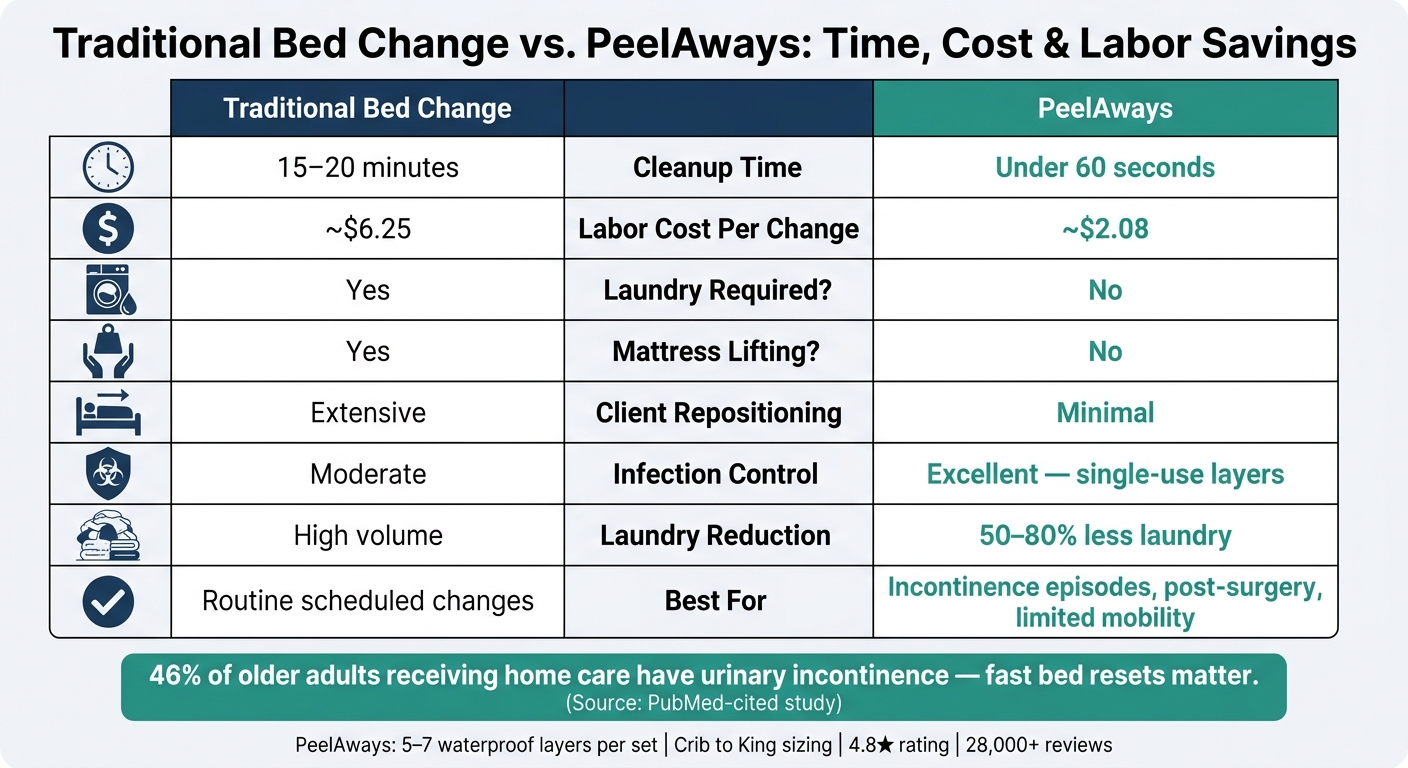
Traditional Bed Change vs. PeelAways: Time, Cost & Labor Savings
It’s 2am in your head even when the clock says 2pm. You walk into a home visit, the bed is wet, the room is tight, and there’s barely space to turn around without bumping oxygen tubing or a nightstand. In that moment, you don’t need more laundry. You need the bed clean fast.
PeelAways lets you change a soiled bed in about 60 seconds by peeling off only the top layer, without stripping the mattress or remaking the bed. That kind of speed matters most when the visit is short and the next job is infection control, not a pile of wet sheets.
How the PeelAways 60-Second Bed Change Works
PeelAways stacks 5 to 7 fitted layers on the mattress, and each layer is waterproof and absorbent. When the top layer gets soiled, you peel it away along the seam and a clean layer is already there underneath. No lifting the mattress. No fighting with corners.
"When an accident happens, simply peel away the soiled top layer in under 60 seconds to reveal a fresh, clean sheet underneath. No lifting. No wrestling with corners." - PeelAways
The fitted corners and elasticized sides help keep the stack in place during repositioning, so taking off one layer doesn’t pull the others out of place. If you’ve ever worked alone in a small bedroom with a heavy queen or king mattress, you know why that matters.
Step-by-Step Caregiver Workflow for Using PeelAways at Home
The routine is simple, which is part of the point. On a busy visit, you don’t want a system you have to think about from scratch every time.
- Prepare supplies. Bring gloves, wipes, and a trash bag. Check that the right PeelAways size is on the bed. Find the tag at the head of the mattress since it shows the correct peeling direction.
- Explain the process and offer coverage. Tell the client what you’re about to do, and offer a blanket for privacy while you work.
- Check whether the soiling is contained to the top layer. If it is, you’re ready to peel.
- Peel the soiled layer from the head of the bed, moving away from tubing, drains, and oxygen lines.
- Check the clean layer, bag the soiled sheet, then reposition the client and document the change.
Traditional Bed Change vs. PeelAways: A Side-by-Side Look
A standard bed change is a whole production. You remove soiled linens, lift mattress corners, reposition the client more than once, and bag laundry at the end. That means more bending, more reaching, and more twisting. It also means more strain on your body and more fall risk for the person in the bed.
Research on urinary incontinence in geriatric patients shows that bed and linen changes add heavily to caregiver burden and physical workload. One long-term care study found that staff do an average of 1.7 bed linen changes per shift due to wetting accidents, and each incontinence-related care episode takes about 12 minutes.
| Feature | Traditional Bed Change | PeelAways |
|---|---|---|
| Cleanup Time | 15–20 minutes | Under 60 seconds |
| Laundry Required? | Yes | No |
| Mattress Lifting? | Yes | No |
| Client Repositioning? | Extensive | Minimal |
| Labor Cost | ~$6.25 per change | ~$2.08 per change |
| Infection Control | Moderate | Excellent - single-use layers |
| Best For | Routine scheduled changes | Incontinence episodes, post-surgery, limited mobility |
In a home visit, those minutes add up fast. Less linen handling means less mess to manage, less washing to deal with later, and fewer chances for contamination. That’s why so many families turn to PeelAways after they’ve had one too many bed changes that took 15 to 20 minutes and wore everyone out.
You can find PeelAways at peelaways.com/shop and on Amazon. For more help on managing bed changes at home, see other articles on peelaways.com, including their blog posts on caregiving routines and incontinence support.
Infection Control, Laundry Reduction, and Cost Benefits for Agencies
The bed is wet again. You strip the sheets, try not to drip on the floor, and haul damp bedding down the hall while your client waits in an uncomfortable, exposed bed. That whole routine wears people down fast.
Once fit and absorbency are set, the next thing to ask is simple: what does the sheet save during repeat home visits? Disposable fitted sheets cut direct contact with soiled bedding, reduce laundry, and help keep mattress surfaces cleaner between visits. For clients dealing with frequent incontinence or post-surgical wound drainage, that means fewer contaminated linens moving through the home, less time spent washing, and less chance of cross-contamination during and after each visit.
How Disposable Fitted Sheets Support Infection Control and Cut Laundry
Each disposable layer works as a single-use barrier. When one layer is soiled, you remove it and throw it away right away. That cuts down the time pathogens can sit in fabric or on the mattress surface between visits. It also means no carrying wet sheets through the house and no sorting them into the wash. Its waterproof barrier protects the mattress.
The laundry piece matters just as much. Every incontinence episode handled with a disposable layer is one less fitted sheet, underpad, or blanket heading to the washer. That adds up. Hospital laundry research shows that even small changes in bedding routines can reduce linen volume in a big way. In one case study at Methodist Hospitals, a change in linen policy reduced laundry by 1,296 pounds per day and more than 473,000 pounds per year. Home care runs on a smaller scale, of course, but the math still holds. Fewer soiled linens mean less water, less detergent, less energy, and less staff time tied up in laundry.
How to Weigh Product Cost Against Labor Savings
At first glance, the sheet price is what people notice. A PeelAways sheet costs about $5.50 per unit. But that number lands differently when you compare it with the time a bed change takes.
A standard bed change takes about 15 minutes at $25.00 per hour, which comes to $6.25 in labor. A peel-away change takes about 1 minute, or about $0.42, for a labor savings of $5.83 per change. Traditional linen laundry adds about $0.60 per pound on top of that.
For high-need clients, those savings stack up fast over a week or month. Agencies should also factor in avoided unscheduled visits that happen only because the bed is soiled. If a family member or caregiver can peel a layer and reset the bed in about 60 seconds instead of spending 15 to 20 minutes on a full linen change, that can ease schedule pressure in a very real way. This is where PeelAways starts to make a lot of sense, especially in homes where resets happen again and again.
When Agencies Should Choose PeelAways and How to Get Started
For an agency, savings only show up if the product is assigned, stocked, and tracked the right way. PeelAways makes the most sense for clients who need frequent, fast bed resets - especially those with nighttime bedwetting, chronic incontinence, limited mobility, or post-surgical drainage. These are usually the homes where full linen changes cause the most strain, the most laundry, and the most infection-control concerns.
Start with bed size and care frequency. PeelAways comes in Twin, Twin XL, Full, Queen, and King. Then train caregivers on disposal and stack tracking. Care plans should note how many layers remain and when replacements are needed. Families should also know to roll, bag, and discard the soiled sheet right away.
If you're comparing purchase options, you can check PeelAways on Amazon and the main shop page. It also helps to look at how the product fits into daily care routines in other articles on PeelAways, like how layered bedding helps with overnight accidents and ways to cut laundry stress during home care.
PeelAways is often the one product people find after they've done the late-night sheet change too many times. The appeal is pretty plain: 5–7 layers, sizes from crib to king, a 4.8-star rating, and 28,000+ reviews. If you use diapers or incontinence pads, you may want that backup on the bed too. It's about less laundry, less disruption, and more dignity - Making aging and caregiving easier, one bed at a time.
Blog readers save 10% with code BLOGS10 at checkout. Available on peelaways.com and Amazon. Free shipping on orders over $100.
Comments
0



SAVE MONEY & WATER
Professionals & Institutions save a fortune on labor/laundry.

SUPERIOR COMFORT
The first thing our customers notice is how soft our sheets are.

100% WATERPROOF
Each layer is 100% Waterproof, perfect for spills and accidents

SAVE TIME
Change the sheet in under 1 minute without stripping the bed.

Leave a comment