
Everything Parents Need to Know About Nighttime Potty Training

Your child is mortified. You’re exhausted. And you’re both pretending this isn’t happening three times a week. It’s 2 a.m., the bed is soaked, and you’re changing sheets in the dark while trying not to wake everyone else.
About 15% of 5-year-olds still wet the bed, and many kids do not stay dry at night until later. Nighttime potty training is mostly about body readiness, not effort. You can help by watching for dry-morning patterns, keeping bedtime simple, and managing potty training accidents with fast, calm cleanup.
- Night dryness is different from daytime potty training
- Dry mornings over 2 weeks are a better sign than age
- Secondary bedwetting needs a doctor visit
- Layered bedding can cut laundry by 50%–80%
- PeelAways can turn a bed change into about 60 seconds instead of 15–20 minutes
If you’re tired of midnight sheet changes, the goal is simple: less pressure for your child, less work for you.
Nighttime Potty Training Tips WITHOUT Losing SLEEP!
sbb-itb-45288fe
Why this is harder than people think
Daytime potty training is about practice, but success often depends on effective bedwetting routines.
Nighttime dryness is more about the body catching up.
Your child has to make less urine overnight, hold it in the bladder, and wake up in time. That is a lot to ask from a sleeping kid. So if your child is dry all day and still wets the bed at night, that does not mean they are lazy or not trying.
A few facts that help:
- Bedwetting is often involuntary
- About 1 in 10 kids still wet the bed at age 7
- It is more common in deep sleepers
- Stress can play a part, but it is not the main cause in many cases
What I’d watch for is not one good night.
I’d watch for a pattern.
If your child wakes up dry on most mornings for about 2 weeks, that’s a better sign they may be ready to try underwear at night.
What to look for before buying anything
Before you spend money on new bedtime gear, check the basics first.
Your child may be ready if they:
- stay dry many mornings
- use the toilet well during the day
- notice the urge to pee
- can get to the bathroom at night
- ask to wear underwear to bed
You may want to wait if your child:
- wakes up soaked most mornings
- has daytime accidents
- fights the bedtime bathroom trip
- cannot get to the bathroom safely
- just had a big life change
And if bedwetting starts again after 6 months of dry nights, call your child’s doctor.
Same if you notice:
- pain with peeing
- daytime urgency
- heavy thirst
- constipation
- loud snoring
PeelAways
This is the thing I wish I had found sooner.
PeelAways is not about “fixing” bedwetting. It’s about making the bad nights less brutal. The set has 5–7 waterproof layers, so when the top layer gets wet, you peel it off and the next dry layer is already there.
That means a bed change can take about 60 seconds instead of 15–20 minutes.
For a tired parent, that matters.
A lot.
Why I’d look at it:
- 28,000+ verified reviews
- 4.8-star rating
- sizes from crib to king
- can cut laundry by 50%–80%
- helps protect your child from a long, upsetting cleanup
If your child wears nighttime pull-ups or training pants and leaks anyway, this kind of setup makes a hard night easier. It also helps if you want to keep the room dim and get everyone back to sleep fast.
You can check PeelAways on peelaways.com/shop or on Amazon.
If you want more help, these guides are worth reading too:
- PeelAways blog
- bedwetting hygiene and cleanup tips
Other simple things that help
You do not need a complicated plan.
I’d keep it to a few steps:
- offer most drinks earlier in the day
- slow drinks in the evening
- keep consistent potty training routines
- do one last bathroom trip before sleep
- keep clean pajamas nearby
- keep cleanup calm and short
One thing I would not do is act like every wet night is a setback.
It isn’t.
You’re looking for progress over time, not a perfect streak.
Quick comparison
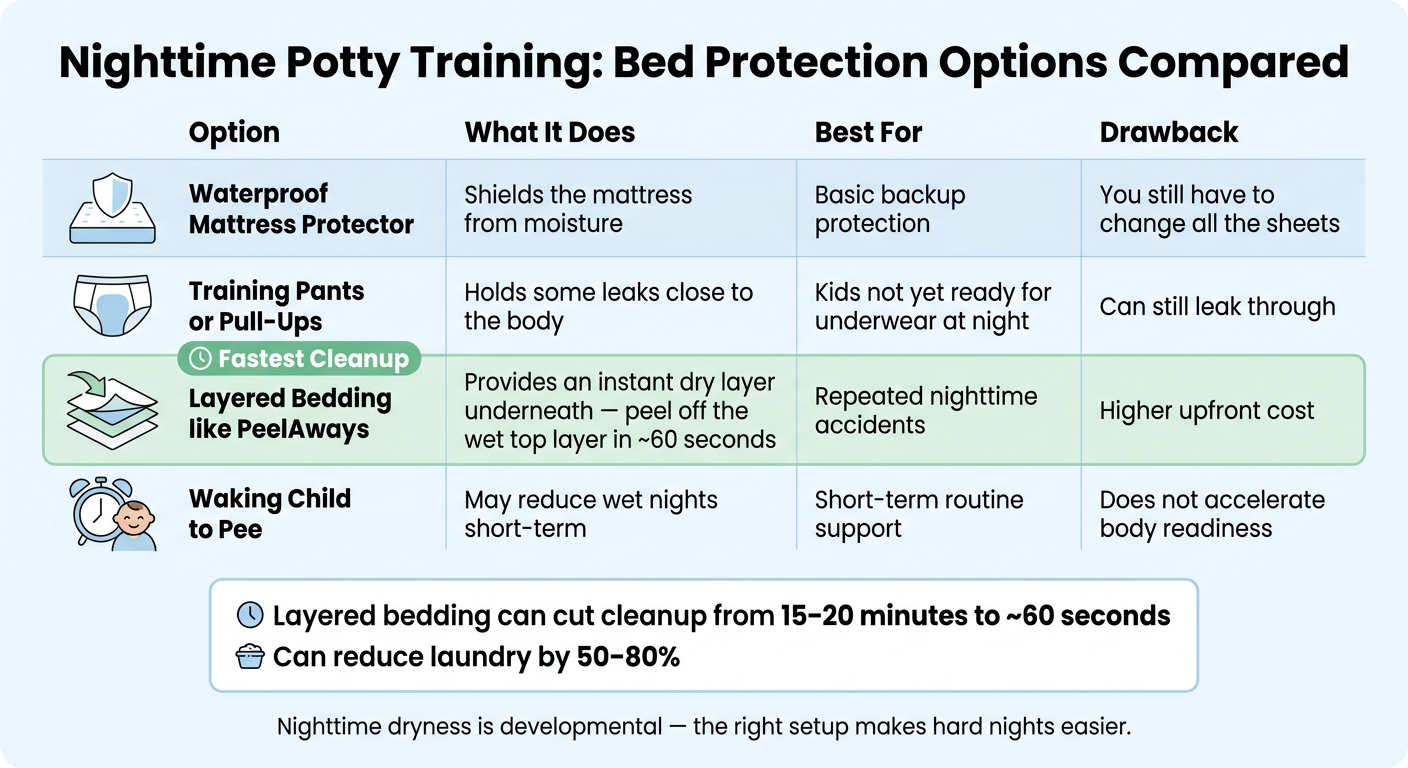
Nighttime Potty Training: Bed Protection Options Compared
| Option | What it does | Best for | Drawback |
|---|---|---|---|
| Waterproof mattress pads vs. disposable sheets | Shields the mattress | Basic backup | You still change sheets |
| Training pants or pull-ups | Holds some leaks | Kids not ready for underwear | Can still leak |
| Layered bedding like PeelAways | Gives you another dry layer right away | Repeated nighttime accidents | Higher upfront cost |
| Waking your child to pee | May cut some wet nights | Short-term routine help | Does not make the body ready sooner |
FAQ
How do I know if my child is ready for nighttime potty training?
Look for many dry mornings over 2 weeks, solid daytime toilet use, and the ability to get to the bathroom at night.
At what age should a child stay dry at night?
There is no single age. Many kids are dry by 5 or 6, but some take longer. Bedwetting can still happen at age 7, and for some, it continues into the teenage years.
Should I wake my child up to pee?
You can try it for a short time, but it does not speed up body readiness. If you do it, make sure your child is awake enough to walk and pee.
When should I call the pediatrician?
Call if bedwetting starts again after a dry stretch, lasts past age 7, or comes with pain, thirst, constipation, daytime accidents, or loud snoring.
Bottom line
If your child is wetting the bed, you do not need more pressure.
You need a setup that makes hard nights easier.
Watch for readiness. Keep the bedtime routine plain. Stay calm when accidents happen. And if you’re tired of doing a full sheet change in the middle of the night, PeelAways is worth a look. It can cut the laundry, shorten cleanup, and help your child get back to sleep with less stress.
Making aging and caregiving easier, one bed at a time.
Blog readers save 10% with code BLOGS10 at checkout. Available on peelaways.com and Amazon. Free shipping on orders over $100.
How Nighttime Potty Training Differs From Daytime Training
It’s the middle of the night. You’re pulling off wet sheets in the dark, trying not to wake your child all the way up, and both of you are tired before tomorrow even starts. If this keeps happening, it helps to know one thing right away: nighttime dryness is not the same as daytime potty training.
During the day, your child learns bladder awareness. They start to notice that full feeling, hold it long enough, and make it to the toilet. At night, the job is different. The body has to handle urine production during sleep and send a strong enough signal to wake up before the bladder empties. That’s why nighttime dryness depends more on development than practice.
Unlike daytime training, nighttime dryness depends on bladder maturity and sleep signaling.
What Causes Bedwetting at Night?
This gap in development is why bedwetting can keep happening even after daytime training is done. A child may do fine all day and still wet the bed at night. That doesn’t mean they’re doing anything wrong.
Bedwetting usually reflects deep sleep, immature bladder control, and reduced overnight urine production.
Bedwetting is not caused by laziness or defiance. That matters more than people think. Pressure usually makes a hard night feel worse. Routine helps. Shame doesn’t.
Primary vs. Secondary Bedwetting: What Is the Difference?
Once bedwetting starts to feel like a pattern, the next step is figuring out whether it’s been there all along or showed up after a dry stretch.
Primary bedwetting means a child has never had a long dry stretch. Secondary bedwetting means it starts again after at least six months of dryness.
That difference matters. Secondary bedwetting needs a pediatrician check. It can be triggered by stress, a major life change, a urinary tract infection, or, less often, another medical issue. Primary bedwetting usually calls for patience and a steady routine. Secondary bedwetting calls for a pediatrician’s review.
Signs Your Child Is Ready for Nighttime Potty Training
It’s late. You’re peeling off damp pajamas again, trying not to wake your child all the way up, and wondering if tonight was just bad luck or a sign they’re not ready yet. That guessing game wears you down fast.
Because nighttime dryness is developmental, readiness matters more than age. Some kids get there sooner. Some take longer. What helps most is watching for patterns, not chasing a magic age or a set number of dry nights.
A child is often ready when dry mornings happen more often, daytime toilet habits are steady, and they can feel the urge to go and make it to the bathroom safely on their own. Instead of focusing on one lucky dry night, pay attention to what keeps happening over time.
Signs Your Child May Be Ready
The biggest clue is waking up mostly dry on many mornings. One dry morning doesn’t mean much. A steady pattern does. A simple way to check is to track wet and dry mornings for about two weeks before making the switch.
It also helps to see a few other signs at the same time:
- Reliable daytime toilet use - your child gets to the bathroom without constant reminders
- Urge awareness - they notice when they need to go and can tell you
- Can get to the bathroom safely at night - they can get out of bed and make it there on their own in the dark
- Asks to wear underwear to bed - often a strong sign they feel ready in their own mind
When these signs start showing up together, the timing usually feels a lot less forced.
Signs It May Be Better to Wait
If your child wakes up soaked most mornings, their body may not be ready to stay dry overnight yet. That’s not a behavior issue. It’s biology. Waiting a bit can spare both of you a lot of stress and help protect their confidence.
You may also want to hold off if your child pushes back hard on the bathroom trip before bed, has frequent daytime accidents, or can’t get to the bathroom safely at night. Big life changes can throw things off too. A move, a new sibling, travel, or a shift in routine can make nighttime training harder than it needs to be.
Nighttime training usually goes more smoothly when daytime habits already feel steady. If those signs are there, the next step is putting a simple bedtime routine in place.
How to Build a Nighttime Potty Training Routine That Works
It’s late. Your child is half-asleep, the bed is wet, and you’re stripping sheets in the dark while trying not to wake everyone up. If nights have started to feel like a guessing game, a simple routine can take some of the chaos out of it.
If your child is showing signs they’re ready, keep the routine plain and repeatable. At night, the goal is consistency, comfort, and easy bathroom access. You’re not trying to force a dry night. You’re trying to make success easier.
What to Include in a Bedtime Routine
Start by moving most drinks earlier in the day. That doesn’t mean cutting back on healthy hydration. It just means offering plenty to drink during the day, then slowing things down in the evening.
Keep bedtime steady from night to night. Same general flow. Same last steps. End with one final trip to the bathroom before bed.
That kind of rhythm helps because your child knows what’s coming. And honestly, when you’re tired, predictable is gold.
Should Parents Wake a Child to Pee at Night?
Sometimes a scheduled wake-up helps for a little while. It can mean fewer wet beds in the short term. But it does not make the body ready for nighttime dryness any sooner.
If you try it, wake your child gently. They should be awake enough to walk to the bathroom and take part, not be carried there half-asleep. The point is to support the routine, not just rush through it.
How to Respond to Nighttime Accidents
When an accident happens, stay calm and move fast. Clean your child up and get them back to sleep as soon as you can. Keep the cleanup short. Less talking. Less stress. Just handle it and move on.
Praise the routine, not only the dry bed. That matters. You want your child to feel good about using the bathroom, helping with the reset, and sticking with the plan.
Then reset the bed as fast as possible. At 2 a.m., every extra minute feels long.
How to Protect the Bed and Make Nighttime Cleanup Easier
It’s the middle of the night. The bed is wet, your child is upset, and you’re trying to change sheets without fully waking everyone up. That’s the part nobody talks about enough. Not the accident itself - the cleanup after.
Even with a steady bedtime routine, accidents still happen. Bed protection won’t stop them. But it can cut cleanup time and take some of the pressure off. Once your routine is set, the next job is simple: keep the mattress dry and make midnight changes less of an ordeal.
What Bed Protection Works Best During Nighttime Potty Training
The setup that works best is pretty simple. Start with a waterproof bed protection as the base layer. Then add an easy-to-remove top layer above it. If there’s an accident, you can swap out the messy layer without pulling apart the whole bed.
Place the layered sheet right on the mattress, then cover it with a fitted sheet. Keep clean pajamas and fresh bedding close by. When everything is within arm’s reach, cleanup feels a lot less chaotic.
If you’re buying a waterproof protector, check for a breathable membrane. That helps the bed stay more comfortable through the night instead of feeling hot or plasticky.
How PeelAways Makes a 60-Second Nighttime Bed Change Possible
This is where PeelAways can make a hard night feel a little less hard.
I like it because it doesn’t ask you to strip the whole bed at 2 a.m. PeelAways gives you layered protection, so you can peel off the soiled top layer and have a fresh, dry one underneath in under 60 seconds. Each fitted sheet has multiple waterproof layers that help keep the mattress dry as you remove the top layer.
The sheets are soft and quiet too, which matters more than people think when a child is half asleep. They’re also made without Vinyl, PVC, Phthalates, or fire retardants.
If you use diapers or nighttime training pants and you’re still dealing with leaks, this kind of setup can save your back, your time, and a whole lot of laundry.
You can find PeelAways on peelaways.com/shop or on Amazon. For more help, take a look at other guides on PeelAways and bedwetting cleanup tips.
Which PeelAways Size Fits Your Child's Bed
Before ordering, match the sheet size to your child’s mattress depth. That one detail can save you a headache later.
Sizes and prices:
| PeelAways Size | Dimensions | Mattress Depth | Price |
|---|---|---|---|
| Crib-A-Peel | 52" x 28" | Stretches to 6" | $30.99 |
| Cot | 75" x 30" | 6" | $34.99 |
| Twin | 75" x 39" | 6" | $34.99 |
| Twin XL | 80" x 39" | 9" | $34.99–$41.99 |
| Full | 75" x 54" | 12" | $43.99 |
| Queen | 80" x 60" | 12" | $47.99 |
| King | 80" x 78" | 12" | $53.99 |
If accidents keep happening - or they start again after a dry stretch - the next step is knowing when to call the pediatrician.
When to Call the Pediatrician About Bedwetting
It’s the middle of the night. The bed is wet again, your child is upset, and you’re standing there half-awake trying to stay calm. If this has been dragging on - or starts up again after a dry stretch - it’s worth checking in with your pediatrician.
If your child still isn’t dry at night, or wetting starts again after they’d been dry, call the pediatrician if bedwetting returns after a dry stretch, persists past age 7, or happens with other symptoms.
Symptoms That Need Medical Attention
Talk to your child’s doctor if nighttime accidents happen alongside:
- Painful urination
- Daytime accidents or sudden urgency
- Excessive thirst or daytime urination
- Constipation
- Loud snoring or restless sleep
Conclusion: Focus on Readiness, Keep Routines Simple, and Make Cleanup Easier
If medical causes are ruled out, keep the routine simple. Less pressure. Less drama at bedtime. Just steady habits that help your child feel safe.
And on the hard nights, make cleanup easier with layered bedding. It can turn a full sheet change into a much shorter reset, which matters a lot when you’re tired and just trying to get everyone back to sleep.
Comments
0



SAVE MONEY & WATER
Professionals & Institutions save a fortune on labor/laundry.

SUPERIOR COMFORT
The first thing our customers notice is how soft our sheets are.

100% WATERPROOF
Each layer is 100% Waterproof, perfect for spills and accidents

SAVE TIME
Change the sheet in under 1 minute without stripping the bed.

Leave a comment