
Best Bedding Solutions for Assisted Living Facilities

It’s 2am. The sheets are soaked again. Your loved one is embarrassed, your back hurts, and you have to be up in four hours. If this is your night right now, I get it. I’ve stood there too, staring at the bed, already tired before the work even starts.
A bed setup that works in assisted living starts with a waterproof mattress protector, then adds the right top layer for leaks, skin comfort, and cleanup time. If accidents happen often, the best fit is usually a layered system like PeelAways, because it can turn a 15–20 minute full bed change into about 60 seconds, cut laundry by 50% to 80%, and still keep the bed feeling less harsh. It comes with 5–7 waterproof layers, has 28,000+ verified reviews with a 4.8-star rating, and is sold in sizes from crib to king.
What matters most before you buy:
- Mattress protection so leaks do not soak into the bed
- Change time when you are exhausted and the room needs to be reset fast
- Skin comfort if the person in bed is at risk for irritation or pressure sores
- Laundry load if you are already drowning in wash
- Dignity and care because no one wants a long, exposed cleanup at night
| Option | Best for | Main tradeoff |
|---|---|---|
| PeelAways multi-layer sheets | Heavy overnight accidents, low staff time | Higher per-use supply cost |
| Waterproof mattress protectors | Base mattress defense on every bed | Does not make top-sheet changes faster |
| Washable bed pads | Light to medium leaks with in-house laundry | More washing and drying |
| Disposable underpads | Fast swap with no wash | More trash and repeat supply cost |
| Moisture-wicking, low-friction sheets | Skin comfort and easier turns | Not enough for heavy wetness alone |
Here’s the short version: if you are trying to cut cleanup time, protect the mattress, and keep the person in bed from feeling exposed, the right mix matters more than any single item.
Easy Bed Sheet Change For Bed Bound Loved Ones by 1 Caregiver
sbb-itb-45288fe
Why this problem is harder than people realize
Night accidents are not rare in assisted living.
CDC numbers in the source article put the rate high enough that most rooms will deal with this at some point. And the hard part is not just the wet sheet. It’s everything that comes after:
- the smell
- the laundry
- the mattress risk
- the broken sleep
- the shame the resident may feel
- the strain on your back at 2am
That is why bedding is not a small detail.
The wrong setup turns one leak into a full-room problem.
The right one contains it.
What to look for before buying
When I look at bedding for assisted living, I keep it simple.
I want five things:
- A dry mattress by morning
- Less time spent changing the bed
- Less rubbing and dampness on skin
- Less laundry stacked up
- Less embarrassment for the person in bed
If a product misses two or three of those, it is probably not the right fit.
PeelAways multi-layer disposable fitted sheet system
This is the one I would put first for heavy overnight incontinence.
Why?
Because it deals with the ugliest part of the job: the full sheet change on an occupied bed in the middle of the night.
With PeelAways, you remove the wet top layer and there is a clean one already underneath. No pulling corners off the mattress. No full reset while the resident waits.
What stands out:
- 5–7 waterproof layers per set
- about 60-second changes
- less laundry
- less handling of the person in bed
- sizes crib to king
- 28,000+ reviews and 4.8 stars
If you want to check current options, here is the PeelAways shop and the PeelAways Amazon listing.
For me, the biggest point is dignity.
A short change means less exposure. Less talking. Less stress. Less time sitting in a wet bed.
That matters.
You can also read more here:
- bedding guide for caregivers
- PeelAways layered bed sheet system
Waterproof mattress protectors
Every bed needs one.
Not because it solves all your problems.
Because without it, one bad leak can soak into the mattress and turn into odor, staining, and a much bigger cleanup.
When comparing waterproof mattress pads vs. disposable sheets, a good protector:
- blocks fluid from reaching the mattress core
- helps with wipe-downs between bigger washes
- works under any other bedding setup
If you can choose between fitted and zippered, I would lean zippered for rooms with repeated accidents. It covers more of the mattress and leaves fewer spots exposed.
The downside is simple: it does not make top-layer changes much faster.
It protects the bed. It does not solve the midnight labor by itself. To address that, you'll need to choose bedding for incontinence care that prioritizes quick changes.
Washable bed pads
Disposable vs. washable bedding comparisons often highlight that washable pads make sense when you can keep up with laundry.
They sit over the protector and catch leaks where they happen most. If the pad is wet but the sheet is not, you may only need to swap the pad.
That can save time compared with changing the whole bed.
Why people like them:
- lower cost over time
- soft surface options
- less trash
- useful for light to medium leaks
Where they can go wrong:
- they add wash volume fast
- they take time to dry
- you need extras on hand or you run out at the worst time
If your laundry room is already backed up, washable pads can become one more thing to chase.
Disposable underpads
Disposable underpads are the fast backup layer.
You put one under the hips, change it after a leak, and throw it away. No wash cycle. No waiting for dry stock to come back.
They work best when:
- accidents happen often
- the room needs a fast reset
- laundry capacity is tight
- you need a simple overnight layer
One thing from the article is worth repeating: do not stack them.
One pad works better than a pile of pads. Stacking can trap moisture and heat under the body, which is the last thing fragile skin needs.
Moisture-wicking and low-friction sheets
These are not for big wetting episodes.
They are for comfort and skin protection.
If the resident sweats at night, has light dampness, or is at risk for friction injuries during turns, these sheets can help keep the skin less clammy and reduce drag.
That can matter a lot for someone who spends long hours in bed.
But they need backup.
For moderate or heavy incontinence, I would not rely on this layer alone, but rather look into bedding solutions for incontinence care that offer more protection. It works best over a waterproof base and with some type of absorbent protection.
Comparison table
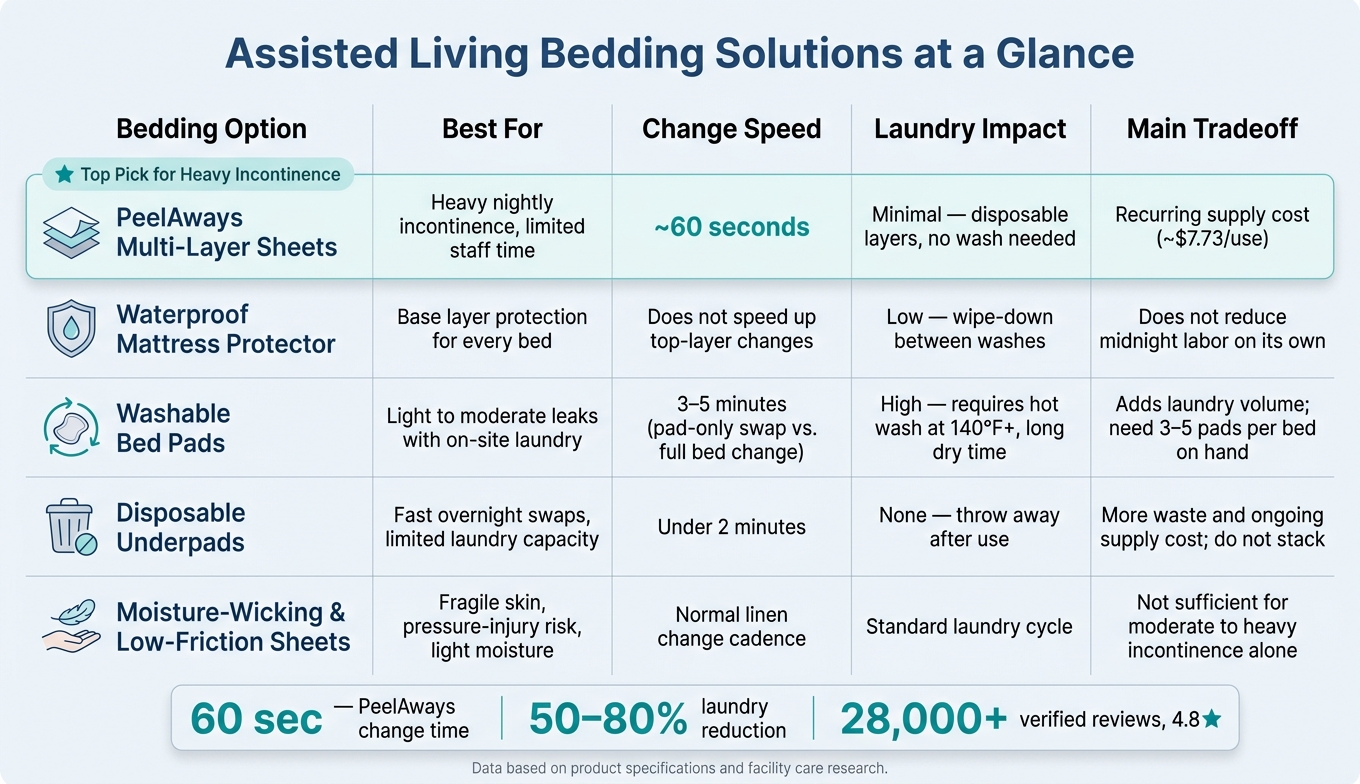
Assisted Living Bedding Solutions: Side-by-Side Comparison
| Bedding option | What I’d use it for | What to watch for |
|---|---|---|
| PeelAways | Heavy nightly incontinence, low staff time, less laundry | Repeat supply cost |
| Waterproof protector | Base layer for every bed | Does not cut change time much |
| Washable bed pad | Light to medium leaks, laundry available | More washing and drying |
| Disposable underpad | Fast overnight swaps, no laundry | More waste and repeat buying |
| Moisture-wicking sheet | Skin comfort, friction control, light moisture | Not enough for heavy leaks |
FAQ
What is the best bedding setup for heavy overnight incontinence in assisted living?
For most high-need cases, I’d start with a Peelaways vs. traditional waterproof sheets and put PeelAways on top. That gives you mattress defense plus a top layer you can remove in about 60 seconds instead of doing a full 15–20 minute sheet change.
Do washable bed pads save money?
They can, if your laundry setup can handle them. The pad itself may cost less over time than disposables, but the full cost still includes water, detergent, drying time, and staff labor.
Are disposable underpads enough on their own?
Usually not for repeated overnight accidents. They are better as a top backup layer over a waterproof protector. For heavier episodes, a layered fitted system may hold up better and cut more cleanup time.
What bedding is best for skin breakdown risk?
I would use a waterproof base, then pick a soft absorbent layer, and add moisture-wicking or low-friction sheets if the resident has fragile skin or needs frequent turning. The goal is to keep skin drier and cut rubbing.
Is PeelAways only for facilities?
No. It also fits home care. If you are changing soaked sheets at home and pads or briefs are not enough, PeelAways is one of those products that can make nights less brutal.
Bottom line
If you are tired of long nighttime bed changes, start with the setup that fixes the hard part first.
For every bed, I’d start with a waterproof protector.
For light leaks, add a washable or disposable pad. (Be sure to follow proper incontinence bedding disposal to maintain hygiene.)
But for frequent overnight incontinence, I would put [PeelAways](https://peelaways
1. PeelAways Multi-Layer Disposable Fitted Sheet System
It’s 2 a.m. again. The bed is wet, your loved one is upset, and you’re staring at another full sheet change when you barely have enough energy to stand. In that moment, speed matters. So does dignity.
First, look at the option built for the fastest overnight bed change.
PeelAways uses 5 to 7 disposable fitted layers, so staff can remove a soiled surface without stripping the bed. It’s the kind of thing that makes sense the second you see it. One layer comes off, and the clean one is already there underneath. No wrestling with corners. No full reset in the dark.
Moisture Protection
Each layer has a soft, breathable top and a waterproof backing that stops fluid before it reaches the mattress. If nighttime accidents happen often, especially in memory care, many facilities pair PeelAways with a waterproof mattress protector underneath for extra backup. That stacked setup helps keep the mattress dry even on rough nights.
Change Speed and Labor
This is where the difference hits home.
A standard linen change can take 5 to 15 minutes and may need two caregivers. PeelAways can usually be changed by one caregiver in under a minute. That can cut labor cost per change from about $6.25 to $2.08.
If you’ve ever changed soaked sheets while trying not to fully wake someone, you know how big that gap is. Sixty seconds versus a long, awkward bed change can feel like night and day.
Laundry and Ongoing Cost
The next question is whether that time savings makes up for the price.
Because the soiled layer gets thrown away, PeelAways cuts laundry volume and reduces wear on washers, dryers, and linens. The per-sheet cost is about $5.50, with a total cost per use of around $7.73. For a resident with nightly accidents, a 5-layer unit may need replacement about every five days.
Some facilities say the product ends up cost-neutral or even slightly cheaper once staff time and less laundry are counted together. That won’t look the same in every building, but the math gets more interesting when you include what a rushed overnight change actually costs.
You can see the current options on peelaways.com/shop or check the PeelAways Amazon listing. If you want more detail from people who’ve lived this mess, it also helps to read other posts on peelaways.com, like their blog articles on incontinence care and overnight bed changes.
Skin Health and Dignity
This part matters more than people admit.
The material is soft, breathable, cooling bedding, quiet, and free of vinyl, PVC, phthalates, and fire retardants. Faster changes mean less handling, less exposure, and less disruption for residents with dementia or anxiety. Staff can frame the change as freshening up the bed and finish before the resident is fully awake.
For someone already confused or embarrassed, that small shift can ease a hard moment. And for residents at high risk for pressure injuries, PeelAways should be used with a pressure-relieving mattress and a repositioning schedule.
PeelAways is also the product many family caregivers land on when diapers or incontinence pads alone aren’t enough. It’s built to cut the laundry burden, protect dignity, and turn a 15- to 20-minute struggle into a 60-second bed change. That’s a big reason it has 28,000+ reviews, a 4.8-star rating, and sizes from crib to king. The idea is simple: Making aging and caregiving easier, one bed at a time.
| Size | Layers | Price | Best Fit |
|---|---|---|---|
| Twin | 5 | $34.99 | Standard assisted living beds |
| Twin XL | 7 | $41.99 | Hospital-style beds and long-term care |
| Full | 5 | $43.99 | Wider resident beds |
| Queen | 5 | $47.99 | Larger room setups |
2. Waterproof Mattress Protectors
It’s the middle of the night. The bed is wet, the room smells like bleach and laundry, and you’re already thinking about the next load before this one is even done. When urine gets past the sheet and into the mattress, the whole night gets harder.
Under a fast-change sheet system, the mattress protector is the base layer that keeps fluids from reaching the bed itself. A waterproof mattress protector is a fitted or zippered cover that blocks fluid from reaching the mattress interior.
Moisture Protection
The design matters more than people think.
Zippered encasement protectors cover all six sides of the mattress. They give the strongest protection, especially in high-use rooms where leaks happen more often. Fitted protectors cover the top and sides, and they work well for residents with occasional accidents.
Both are much better than leaving the mattress bare. But encasements leave fewer openings where fluid can sneak into the edges or corners.
Change Speed and Labor
This is the part that’s easy to miss: waterproof protectors don’t make overnight bed changes faster by themselves.
If there’s an accident, staff still have to strip off the top sheet and replace any pad above it. The main job of the protector is to save the mattress, not cut change time. That still matters a lot. It helps prevent mattress scrubbing, drying time, and early replacement after leaks.
Laundry and Ongoing Cost
One reason these protectors help is simple: they don’t need to go through the wash after every incident.
For minor surface contact, a wipe-down with a facility-approved disinfectant is often enough between full wash cycles. That keeps the laundry pile from growing even more. Facility-grade waterproof protectors usually cost $20–$60 per twin or full-size bed, depending on the material and design.
If you’re dealing with frequent incontinence, a durable medical-grade protector can pay for itself over time.
Skin Health and Dignity
Not all protectors feel the same. And when someone is sleeping on them every night, that matters.
Old-school vinyl protectors do block fluid, but they can be noisy, hot, and uncomfortable. You hear that crinkle when a person turns over, and sometimes that alone is enough to disturb sleep. Breathable fabric-backed protectors block liquid while cutting down heat and noise.
For residents with fragile skin, dementia, or pressure injury risk, that added comfort can make the emotional challenges of incontinence feel a little less harsh. For daily use, breathable medical-grade protectors are the better pick.
For direct surface protection, the next layer sits above the protector.
3. Washable Bed Pads
It’s 2am. You feel that cold, damp spot through the sheet, and your stomach drops because you already know what comes next. You don’t want to wake them fully. You don’t want another full bed change. You just want something that keeps the mattress safe and makes this whole mess less brutal.
Washable bed pads sit above the mattress protector and catch leaks before they reach the mattress. Most have a stay-dry top, an absorbent middle, and a waterproof back layer. On their own, they absorb leaks. Paired with a mattress protector, they give you more complete overnight coverage.
Moisture Protection
A good washable bed pad can absorb about 1 to 2 liters of fluid, depending on its size and how it’s made. If your loved one has moderate to heavy overnight wetting, pads that are at least 34 x 36 inches tend to work better. A polyurethane waterproof backing is usually the better pick over vinyl. It’s quieter, bends more easily, and allows more airflow. Pads with tuck-in wings can also help keep the pad in place if the person shifts a lot in bed.
That said, movement still matters. If someone rolls around during sleep, fluid can reach parts of the bed the pad doesn’t cover. That’s why these pads work best with a waterproof mattress protector underneath.
Change Speed and Labor
This is where washable bed pads can take some pressure off.
Instead of stripping the whole bed and starting over, you may only need to swap the pad. In day-to-day use, moving from full linen changes to pad-only changes cut nighttime change time from about 10 to 15 minutes down to 3 to 5 minutes.
That’s a big deal when you’re tired, your back already hurts, and you still have the rest of the night ahead of you.
One problem does come up, though: if every pad is in the wash, you’re stuck. Keeping 3 to 5 pads per bed on hand helps avoid that scramble.
Laundry and Ongoing Cost
Washable bed pads usually cost about $15 to $35 up front and can last 150 to 300 wash cycles. That brings the cost down over time. In long-term care settings, economic modeling suggests that moving heavy users from disposable products to reusable pads can cut per-resident incontinence bedding costs by 30% to 60% over a year.
But the savings don’t come free.
These pads add to the laundry load. They need hot-water washing at 140°F or higher to meet infection-control standards, and they often take longer to dry than regular sheets. So the full picture includes water, power, detergent, and staff time for sorting and washing. Following a laundry hygiene guide can help maintain these standards efficiently. Many facilities handle this with pad-only laundry cycles and color-coded pads by unit.
Skin Health and Dignity
The top layer matters more than people think.
Washable pads with brushed cotton or soft polyester surfaces are easier on thin, fragile skin. Better moisture control can help lower the risk of incontinence-associated dermatitis when the pad is used along with regular repositioning and barrier creams. But timing still matters. If a wet pad stays under someone too long, that trapped moisture can lead to skin breakdown.
There’s also the human side of it. A quilted pad in a neutral color tends to blend in under the top sheet, which can help your loved one feel less exposed and less marked by the problem.
For short-term leaks and faster turnover, disposable underpads serve a different role.
4. Disposable Underpads
It’s the middle of the night. There’s another leak, the bed is damp, and you’re already bracing for the work that comes next. When you need something fast and clean without adding one more load of laundry, disposable underpads can take a lot off your plate.
When reusable pads aren’t the right fit, disposable underpads handle the same leaks without the wash cycle. They pull in moisture fast, go straight in the trash after use, and tend to work best for frequent overnight accidents.
Moisture Protection
Look for overnight-rated pads with three basic parts: a soft topsheet, an absorbent core, and a leak-resistant backing. If your loved one has heavy overnight incontinence, larger sizes like 30" × 36" or 36" × 36" usually give better coverage across the hips and sacral area. That extra space can help stop side leaks before they soak the fitted sheet.
One rule matters here: use one pad, not a stack. A long-term care bed-setup study found that switching to overnight-rated disposable underpads and increasing single-layer use from 10.1% to 44.5% improved moisture management from 65% to 84%. Stacking pads may seem like a safe bet, but it can trap heat and moisture, throw off pressure spread, and raise the risk of skin damage.
Change Speed and Labor
A soiled disposable underpad can often be pulled out and replaced in under 2 minutes. That’s much faster than stripping the bed and doing a full linen change.
It also helps when the setup stays simple. Standard placement means centering the pad under the hips and running it from mid-back to mid-thigh. A stocked bedside cart makes the whole job smoother when you’re tired and trying to move fast.
Laundry and Ongoing Cost
The big upside is simple: disposables cut out laundry for that layer of bedding. No washing. No drying. No sorting. No extra wear on machines.
If you’re comparing costs in a facility, the math should include more than the pack price. You also have to count:
- Water
- Electricity
- Detergent
- Machine upkeep
- Staff time spent processing linens
Some places land on a mixed approach. They use disposable underpads overnight or for higher-risk residents, then switch to washable pads during the day or for lighter use.
Skin Health and Dignity
Even the best pad can become a problem if it sits wet too long. A damp surface under the body can lead to skin maceration, more pressure injury risk, and plain old discomfort, whether the pad is disposable or washable.
For thin or fragile skin, softer materials matter. Pads with soft nonwoven topsheets and breathable-backed designs can feel gentler for someone who spends long hours in bed.
And then there’s dignity, which people don’t talk about enough. A pad changed right away, tucked discreetly under the top sheet, and handled without making it a big scene helps keep the focus where it belongs: on the resident, not the accident. Staff should explain what they’re doing in plain language and keep the change as private as possible.
When skin comfort matters more than absorption, low-friction sheets address a different need.
5. Moisture-Wicking and Low-Friction Sheets
It’s the middle of the night. Your loved one isn’t soaked this time, but the bed still feels damp, sticky, and uncomfortable. Then comes the turn, and even that small move can leave skin irritated and sore.
When absorbency is already taken care of, the next problem is comfort. That’s where moisture-wicking and low-friction sheets come in. They’re not for holding fluid. They’re for helping protect skin, making the bed feel less clammy, and making turns easier on both the person in bed and the person helping.
Their job is simple: pull light moisture away from skin and cut down on drag during repositioning. They do not replace waterproof protectors or absorbent pads for moderate to heavy incontinence. Their main value is skin protection, comfort, and easier movement during daily care.
Moisture Protection
These sheets help with light moisture, not heavy wetness. If your loved one sweats at night or has small leaks, moisture-wicking fabric can evaporate perspiration 40–60% faster than standard cotton. That can mean less time lying on a damp surface, which matters more than people think.
But there’s a limit. Once you’re dealing with more than light moisture, these sheets need backup. You’ll still want a waterproof mattress protector and an absorbent underpad underneath.
Change Speed and Labor
The main labor win here isn’t fewer full bed changes. It’s easier turning and repositioning. Low-friction fabric reduces tugging and bunching, so the bed works with you instead of fighting you.
If you’re turning someone more than once a night, that difference adds up. Less resistance can also mean less skin damage from friction. In long-term care, that matters. A randomized trial in long-term care with 46 residents found that silk-like low-friction sheets reduced pressure injuries over 20 weeks compared with cotton-blend linen, with a hazard ratio of 0.31 for all stages and 0.23 for Stage II+ injuries.
Laundry and Ongoing Cost
These sheets still go through normal laundry. So if you’re hoping they’ll cut the pile of wash in the laundry room, they won’t.
They do cost more up front. Still, if they hold up well under facility laundering and dry faster, that can help offset some replacement costs over time. It’s not a laundry fix. It’s more of a comfort-and-skin-protection tradeoff.
Skin Health and Dignity
Skin breakdown can start with small things. Dampness. Rubbing. A rough turn. That’s why this category matters, even though it doesn’t solve the whole incontinence problem.
In a study of 1,427 patients, synthetic silk-like bedding made to manage moisture, friction, and shear reduced facility-acquired pressure ulcers from 10.3% in the control group to 2.5% in the intervention group.
There’s also the dignity piece. Some protective bedding looks medical the second you walk into the room. A sheet that looks and feels more like normal bedding can help the bed feel like a bed again, not a setup. For many residents, that small detail carries weight.
Effective care also involves managing incontinence in elderly loved ones through proper training and support. The next step is matching each option to the care setting.
Pros and Cons by Care Setting
It’s 2am. The brief leaked, the top sheet is damp, and now you’re standing there doing mental math: full bed change, quick patch, or hope it lasts till morning. In assisted living, that choice shows up again and again, and the “best” bedding setup depends on how often accidents happen, how much laundry the building can handle, how much the resident can move, and how much you want the room to still feel like a bedroom instead of a hospital room.
Once you’ve looked at each product on its own, the next step is simple: match it to the room, the resident, and the pace of care.
| Bedding Solution | Major Advantages | Drawbacks | Ideal Use Case |
|---|---|---|---|
| PeelAways Multi-Layer Sheets | 60-second bed changes; reduces cross-contamination during layer changes; built-in waterproof barrier; no laundry needed per change | Recurring supply cost; not reusable | Best for heavy nightly incontinence; high-turnover units; residents where speed and hygiene are the top priorities |
| Waterproof Mattress Protectors | Protects mattress lifespan; durable long-term investment; protects the mattress from fluid exposure | Can feel noisy or less comfortable if not breathable; requires laundering when soiled | Best baseline layer; pairs well with any top-layer solution |
| Washable Bed Pads | Reusable; can lower cost per use over time; reduced waste | Requires laundering after each use; adds to laundry burden; best as a secondary layer for light to moderate leaks | Best for light to moderate leaks in residents already using briefs or pull-ups; chair and bed protection |
| Disposable Underpads | No laundering required; easy to swap; high absorbency per pad | Higher ongoing supply cost; generates more waste; best as an adjunct layer, not a full continence system | Best as an adjunct layer; quick overnight backup |
| Moisture-Wicking and Low-Friction Sheets | Reduces skin maceration and friction; supports pressure-ulcer prevention; less clinical look | Does not replace absorbent protection for moderate to heavy incontinence; still requires laundering | Best for pressure-ulcer risk; residents with light moisture concerns |
Which Combinations Work Best
Most assisted living rooms work better with two or three layers than with one product doing all the heavy lifting. That’s the plain truth. One layer protects the mattress. Another manages moisture and odors. Sometimes you need a top layer that can be swapped in under a minute when the night goes sideways.
For occasional nighttime leaks, a breathable waterproof mattress encasement as the base, plus a washable bed pad or one disposable underpad on top, is often enough. You protect the mattress, keep laundry from spiraling, and avoid that stiff, overly medical feel in the room.
For heavy nightly incontinence, this is where many setups fall apart. A waterproof mattress encasement paired with a multi-layer sheet system like PeelAways makes a hard job much easier. Instead of stripping the whole bed after each episode, you peel off the soiled layer and move on. That 60-second change matters when your back is tired, your resident is embarrassed, and you still have six more rooms to check. PeelAways comes in 5–7 layers, sizes crib to king, and has 28,000+ reviews with a 4.8-star rating. If you want to see the Amazon option too, here’s the PeelAways Amazon listing.
For fast-turnover units like memory care or short-stay rehab, speed and infection control sit right at the front of the line. Disposable top layers, whether that means underpads or multi-layer sheet systems, help cut cross-contamination risk and make bed turnover much less of a production. In places like that, the old 15- to 20-minute full reset adds up fast. A peel-away change doesn’t.
For residents at higher pressure-ulcer risk, the focus shifts. Now you’re thinking less about absorbency alone and more about keeping skin dry, cool, and free from rubbing. Low-friction, breathable, moisture-wicking sheets work best over a waterproof base. The goal is simple: less moisture sitting on the skin, less friction during movement, and a setup that supports repositioning instead of working against it.
If you want to dig deeper into bedding setups that cut laundry and make overnight care less brutal, the PeelAways blog is worth a look:
- https://peelaways.com/blogs/news
- https://peelaways.com/blogs/news/peelaways-layered-bed-sheet-system
PeelAways says it best: “Making aging and caregiving easier, one bed at a time”.
Final Recommendation
It’s 2am. The bed is wet again, your loved one is uncomfortable, and you’re already doing the math on how much sleep you’re about to lose. In that moment, the best bedding system isn’t the one with the fanciest claims. It’s the one that cuts the work down without making the bed feel harsh or clinical.
Using the care-setting comparison above, the simplest rule is this: start with mattress protection, then choose the top layer based on how care happens day to day and what the resident needs most.
A waterproof mattress protector is the starting point for most beds. It helps guard the mattress and makes routine infection-control wipe-downs easier. From there, the next layer depends on what your day looks like. Add washable bed pads if laundry is easy to keep up with, disposable underpads if laundry is limited, and moisture-wicking sheets if skin comfort matters most.
PeelAways multi-layer disposable sheets make the most sense when time is tight and laundry is piling up. If overnight accidents happen often, linens need to be changed again and again, or the workload is already too heavy, this setup can take a lot off your plate. You peel away the soiled layer and move on in about 60 seconds without stripping the whole bed.
That’s the part that hit me hardest when I first found them. Not because it sounded flashy. Because when you’re tired to your bones, saving 15 to 20 minutes on a bed change feels huge.
The quick match below makes that choice easier.
| Scenario | Best-Fit Option | Why It Fits |
|---|---|---|
| Protecting expensive mattresses across all rooms | Waterproof mattress protector | Baseline fluid defense; easier to sanitize |
| Light, occasional leaks with strong on-site laundry | Washable bed pad over waterproof protector | Lower ongoing supply cost; manageable laundry |
| Limited laundry capacity or outsourced laundry | Disposable underpads | No laundering; fast overnight swap |
| Residents with fragile skin or pressure-injury risk | Moisture-wicking, low-friction sheets with protective layering | Reduces shear, friction, and moisture |
| Frequent overnight incontinence, limited staff time | PeelAways multi-layer system | Fast changes; no bed stripping; less laundry |
Choose the setup that cuts labor, protects skin, and preserves dignity with the least disruption. In assisted living, the right choice is the one that lowers the total care burden while keeping comfort and dignity in place.
Comments
0



SAVE MONEY & WATER
Professionals & Institutions save a fortune on labor/laundry.

SUPERIOR COMFORT
The first thing our customers notice is how soft our sheets are.

100% WATERPROOF
Each layer is 100% Waterproof, perfect for spills and accidents

SAVE TIME
Change the sheet in under 1 minute without stripping the bed.

Leave a comment