
Why Caregiving Is Harder at Night - And What Actually Helps

It’s 2 a.m. The sheets are soaked again. Your loved one is embarrassed, your back hurts, and you have to be up in four hours. If this is your night, I know how heavy that moment feels.
A bed reset in about 60 seconds can change the whole night. What helps most is simple: cut steps, cut laundry, and keep the room safe so you can handle accidents with less lifting and less stress. I’ve found that layered waterproof bedding like PeelAways, with 5–7 waterproof layers, sizes from crib to king, and 28,000+ reviews at 4.8 stars, does that better than a full sheet change that takes 15–20 minutes.
- Best for overnight accidents: layered peel-off waterproof bedding
- Main win: about 60 seconds to reset the bed
- Less laundry: often 50–80% less
- What to keep nearby: wipes, gloves, barrier cream, sleepwear, trash bag
- Safer nights: nightlights, clear floor, steady bathroom routine
You do not need a perfect system. You need fewer steps when you are half-awake.
Caregivers Tired of Wet Beds? Try These Easy Nighttime Solutions for Aging Parents
sbb-itb-45288fe
Why this feels harder than people think
Night care is not just “one more chore.”
It hits when your body is already done.
You are lifting in the dark.
Cleaning someone you love while trying not to wake them.
Then lying back down with your mind still racing.
That emotional impact on caregivers adds up fast. One study in the article found 46.8% of caregivers had trouble falling back asleep on some, most, or every night in the last month. Another stat showed caregivers can lose 23–33 minutes of sleep a night, and sleep studies found a median of 9 wake-ups and 64 minutes lost after first falling asleep.
So the problem is not only the wet bed.
It is the repeat.
The broken sleep.
The fear of a fall on the way to the bathroom.
The shame your loved one feels, and the guilt you carry after snapping because you are tired.
What I’d look for before buying anything
If you are trying to make nights easier, I would keep it plain.
Look for bedding solutions or supplies that do these things:
- Protect the mattress
- Cut a full bed change down to one step
- Lower laundry
- Let you work with less turning and tugging
- Feel normal, not harsh or cold
- Come in the right size for your bed
- Help preserve dignity
If a product still leaves you stripping corners, hauling wet blankets, and starting wash at 2 a.m., it is not fixing the part that hurts most.
PeelAways

This is the one I would point to first because it solves the worst part of the night: the bed change.
PeelAways is a layered fitted sheet with 5–7 waterproof layers. When the top layer is wet, you peel it off and a dry layer is already there underneath. That means no full re-make in the middle of the night.
What stood out to me:
- About 60-second bed resets instead of 15–20 minutes
- 50–80% less laundry
- 100% waterproof layers
- Sizes crib to king
- 28,000+ reviews
- 4.8-star rating
If you want to check it, here is the shop link: PeelAways shop
And here is the Amazon option: Amazon
What I like most is not the sheet itself.
It is what the sheet removes.
Less lifting.
Less mess.
Less time standing there with lights on while your loved one feels awful.
If you use diapers or incontinence pads and still end up with soaked sheets, this kind of setup makes a big difference.
For setup help, these are worth reading too:
Bedside cleanup kit
The second thing I would fix is not fancy.
It is access.
Keep a small kit by the bed with:
- Wipes
- Gloves
- Barrier cream
- Clean sleepwear
- Trash bags
That way, once the bed is reset, you can focus on skin care and comfort instead of walking room to room looking for supplies.
That matters more than people think.
A calm cleanup feels less humiliating for the person in bed, and less chaotic for you.
Safer room setup
A lot of night stress starts before the accident is even cleaned up.
If your loved one tries to get to the bathroom fast, falls become part of the risk. The article noted that 63.3% of toileting-related falls in older adults happen between 12:00 a.m. and 5:59 a.m.
A few room fixes can help:
- Motion-activated nightlights
- No loose rugs or cords
- Closed-back non-slip slippers
- Grab bars near the toilet
- Bed height low enough for both feet to touch the floor when sitting on the edge
- One clear side of the bed for you to work from
These are not big changes.
But at 2 a.m., small barriers feel much bigger.
Quick comparison
| Option | Night work | Laundry load | Bed reset time | Best for |
|---|---|---|---|---|
| Regular sheets | High | High | 15–20 min | Rare accidents |
| Waterproof cover only | High | Medium | 15–20 min | Mattress protection only |
| Pads + regular sheets | Medium to high | Medium to high | Several minutes | Light leaks |
| PeelAways | Low | Low | ~60 sec | Frequent overnight accidents |
FAQ
Does PeelAways replace a mattress protector?
No. I’d still use a waterproof mattress cover under it, as multi-layer sheets simplify caregiving by working alongside existing protection. That gives you one more layer between the bed and a full soak-through.
How many layers come in one set?
Each set has 5–7 waterproof layers.
What sizes does it come in?
It comes in sizes from crib to king.
Is it only for older adults?
No. It can help with managing adult incontinence, dementia care, post-surgery recovery, and bedwetting too.
Why not just use regular waterproof pads?
Pads can shift, bunch up, or still leave you changing sheets. A layered fitted setup cuts more of the work out.
Is Amazon an option if I do not want to order direct?

Yes. You can buy on Amazon or at peelaways.com/shop. These products are essential for nighttime incontinence care.
Bottom line
Night caregiving feels worse because everything hits at once: sleep loss, keeping beds dry, safety risk, and the emotional weight of helping someone you love through a private, hard moment.
If I had to keep this simple, I’d say this:
the best fix is the one that streamlines care tasks.
That is why I keep coming back to PeelAways. It turns a full bed change into a 60-second reset, cuts laundry by 50–80%, comes with 5–7 waterproof layers, fits crib to king, and has 28,000+ reviews with a 4.8-star rating. It is not about making caregiving easy. It is about making one brutal part of it easier to carry.
Making aging and caregiving easier, one bed at a time.
Blog readers save 10% with code BLOGS10 at checkout. Available on peelaways.com and Amazon. Free shipping on orders over $100.
Why Does Caregiving Feel Most Overwhelming at Night?
It’s 2 a.m. again. The bed is wet, the room is dark, and you’re trying to change sheets without waking the whole house. At that hour, everything feels heavier than it should.
Night care hits harder for three plain reasons: you’re running on less sleep, there’s often more mess to deal with, and the chance of someone getting hurt goes up fast. Up to 76% of caregivers report poor sleep quality, with frequent night awakenings and short sleep duration. And when you’re pulled out of deep sleep, your balance, judgment, and patience all take a hit right when you need a steady hand.
Nighttime Incontinence and Bedwetting Create Urgent, Messy Cleanups
Anyone who’s dealt with a nighttime accident knows it’s almost never one small fix. It’s not just a brief. It’s wet pajamas, soaked sheets, damp blankets, and a full bed change while you’re trying to keep the person you love calm and half-asleep.
In one dementia-care study, 36% of caregivers reported urinary incontinence as a major issue, often with nighttime fallout. That tracks with real life. You’re rolling someone safely, cleaning skin so it doesn’t get irritated, pulling off wet layers, and remaking the bed. Then sometimes you do it all over again before sunrise.
And the dark makes every step harder. You’re moving fast, but not too fast. Trying to see, but not turn on every light. Trying to help, but not upset the person in bed. That’s a lot to carry in one moment.
Confusion, Mobility Issues, and Safety Risks Get Worse After Dark
Night changes people. Rooms that felt familiar at 3 p.m. can feel strange and unsafe after sunset. Sundowning - increased confusion and agitation from late afternoon into the night - is a well-documented pattern in people with Alzheimer's and other dementias.
So a simple trip to the bathroom doesn’t always stay simple. It can turn into resistance, panic, or an unsafe attempt to get out of bed alone. Then you’re in the hallway, half-awake, trying to support someone unsteady while also dealing with urgency and possible wet bedding.
One study of older adults recovering from hip fractures found that nighttime falls affected 40.6% of those with severe nocturia, compared with 20.4% of those without nocturia. That gap says a lot. When someone feels sudden urgency, they rush. And rushed movement in the dark, with sore joints, weak legs, and bad lighting, is where falls happen.
That’s why even one wake-up can leave you on edge for the rest of the night.
Broken Sleep Quickly Leads to Burnout
This part sneaks up on you. Maybe it’s 20 minutes here, 30 minutes there. It doesn’t sound like much at first. But night after night, it stacks up.
Caregivers sleep 23–33 minutes less per night than non-caregivers of the same age. Objective sleep studies show caregivers experience a median of 9 nighttime awakenings and lose a median of 64 minutes of sleep after initially falling asleep. That kind of broken sleep chips away at your mood, focus, and patience.
You start forgetting small things. You feel short-tempered and then guilty about it. Even easy choices can feel hard. That’s what chronic sleep debt does. It doesn’t just make you tired. It makes the whole job harder to keep doing.
What Actually Helps With Nighttime Incontinence Care?
It’s 2 a.m. The bed is wet again. You’re tired, your loved one feels awful, and the last thing you want is to strip sheets, start laundry, and turn a hard moment into a full-blown ordeal.
What helps most is simple: cut the work down fast. Start with the bed, because that’s what sets the pace for everything that comes next.
Use Waterproof Mattress Protection and a Layered Bedding Setup
First, protect the mattress with a waterproof cover. That keeps moisture from soaking through and causing damage.
Then put a layered sheet system on top of it. This is where things get much easier. When one layer gets soiled, you peel it away and there’s a clean, dry one underneath. Each layer is 100% waterproof, so you’re not re-making the whole bed in the middle of the night.
No stripping the mattress.
No laundry at 3 a.m.
No full reset when you’re already running on fumes.
If you use diapers or incontinence pads, this kind of setup can take a huge chunk of the nightly mess off your plate.
How 60-Second Bed Changes Work With PeelAways
A regular bed change after a nighttime accident can take 15 to 20 minutes. A layered peel-away system can take less than 60 seconds. When you’re half-awake and trying not to wake the whole house, that time gap matters.
PeelAways is the one I wish I’d found sooner. It uses 5 to 7 waterproof layers in one fitted sheet. You put it on just like a regular fitted sheet. When the top layer gets soiled, you peel it away from the corner and there’s a fresh, dry layer ready underneath.
That means:
- No mattress lifting
- No immediate laundry
- A much faster reset
PeelAways comes in sizes from crib to king, and it’s built for the kind of nights that don’t go according to plan. It has 28,000+ reviews and a 4.8-star rating, which honestly makes sense once you see how much work it saves. You can find it on peelaways.com/shop or on Amazon. For more help with setup and nighttime care, see other articles on peelaways.com, including their blog.
Keep a Bedside Essentials Kit to Make Cleanups Faster and More Dignified
Once the bed is easy to reset, the next piece is keeping what you need within reach. A small bedside kit can save you those miserable back-and-forth trips when you’re already exhausted.
Keep these close by:
- Wipes
- Gloves
- Barrier cream
- Fresh sleepwear
- A trash bag
When the bed is already handled, you can put your attention where it belongs: skin care, comfort, and helping your loved one feel less embarrassed.
That changes the whole tone of the moment. Instead of scrambling for clean linens, you can stay calm and keep moving.
Routines and Room Changes That Reduce Nighttime Caregiving Stress
It’s 2 a.m. again. You hear movement, throw off the covers, and try to get there before a small bathroom trip turns into wet sheets, a fall, or both.
Nights like this wear you down fast.
Better nights usually don’t come from one big fix. They come from a few steady changes: a set bathroom routine, a safer walk to the toilet, and a bed that can be reset without a whole production.
Set an Evening Bathroom and Fluid Routine
A steady pre-bed routine can cut down on overnight urgency. Have your loved one use the bathroom 30 to 60 minutes before bed, then one more time right before lying down. Try to shift most fluids earlier in the day and hold back on big drinks in the last 2–3 hours before sleep. Stop caffeine by mid-afternoon, and skip evening alcohol, since it can increase urine output and irritate the bladder.
The routine matters almost as much as the timing. Same steps. Same order. Same words.
That kind of repetition helps the body settle into a rhythm. It also helps you know what comes next instead of guessing your way through every night. A simple checklist by the bathroom can keep things steady. If your loved one has dementia, using the same phrases each night can make the routine feel more familiar, even when memory is slipping.
When bedtime follows a pattern, the rest of the night often feels less chaotic.
Make the Path to the Bathroom Safer and Easier
Most people don’t think of the short walk to the bathroom as dangerous until something goes wrong. But 63.3% of toileting-related falls in older adults happen between midnight and 5:59 a.m.
That makes sense, honestly. Everyone is tired. The room is dark. People move too fast because they feel rushed.
A few small room changes can help:
- Use motion-activated nightlights so the path lights up without a harsh blast of light.
- Move rugs, cords, baskets, and shoes out of the way.
- Pick non-slip, closed-back slippers.
- Add grab bars near the toilet if balance is shaky.
- In higher-risk setups, make sure the bed is at a height where both feet can rest flat on the floor when sitting at the edge.
That last point gets missed a lot. If someone has to slide down or tiptoe off the bed, the night starts with strain before they even stand up.
Once the bathroom path feels safer, the next pressure point is the bed itself.
Set Up the Bed and Bedroom for Quiet Night Care
The bedroom should help you work fast without turning every accident into a full reset.
Keep one side of the bed open. No wall. No chair shoved in the corner. No furniture boxing you in when you’re trying to help someone who’s tired, upset, or embarrassed by incontinence. If you’ve ever tried to change bedding with one arm pinned against a nightstand, you know how much that matters.
Lighter blankets help too. A heavy comforter may look nice, but at 2 a.m. it becomes one more thing to wrestle. Lightweight layers are easier to fold back and put in place during cleanup.
Lighting makes a difference as well. Soft, dimmable light works better than flipping on a bright overhead fixture. A small bedside lamp or low-watt light can give you enough to see without fully waking the room.
And then there’s the part that can save your back and your sanity: bedding that handles accidents without making the bed feel medical. Waterproof bedding that feels like a normal fitted sheet keeps things more private and less disruptive. That’s one reason I point people to PeelAways. I found it as a caregiver, not as someone looking for one more thing to buy. The idea is simple: 5–7 layers, sized from crib to king, so when there’s a nighttime mess, you peel off the top layer and reset the bed in about 60 seconds instead of spending 15–20 minutes stripping everything. That quieter reset can mean less laundry, less stress, and a lot more dignity. It’s also one of the reasons PeelAways has 28,000+ reviews and a 4.8-star rating. You can find it on peelaways.com/shop or on Amazon.
If you want more bed setup ideas, these may help too:
- https://peelaways.com/blogs/news
- https://peelaways.com/blogs/news/how-to-change-bed-sheets-with-person-in-bed
That’s why the bedding choice carries so much weight in night care.
Which Bedding Option Makes Overnight Care Easiest?
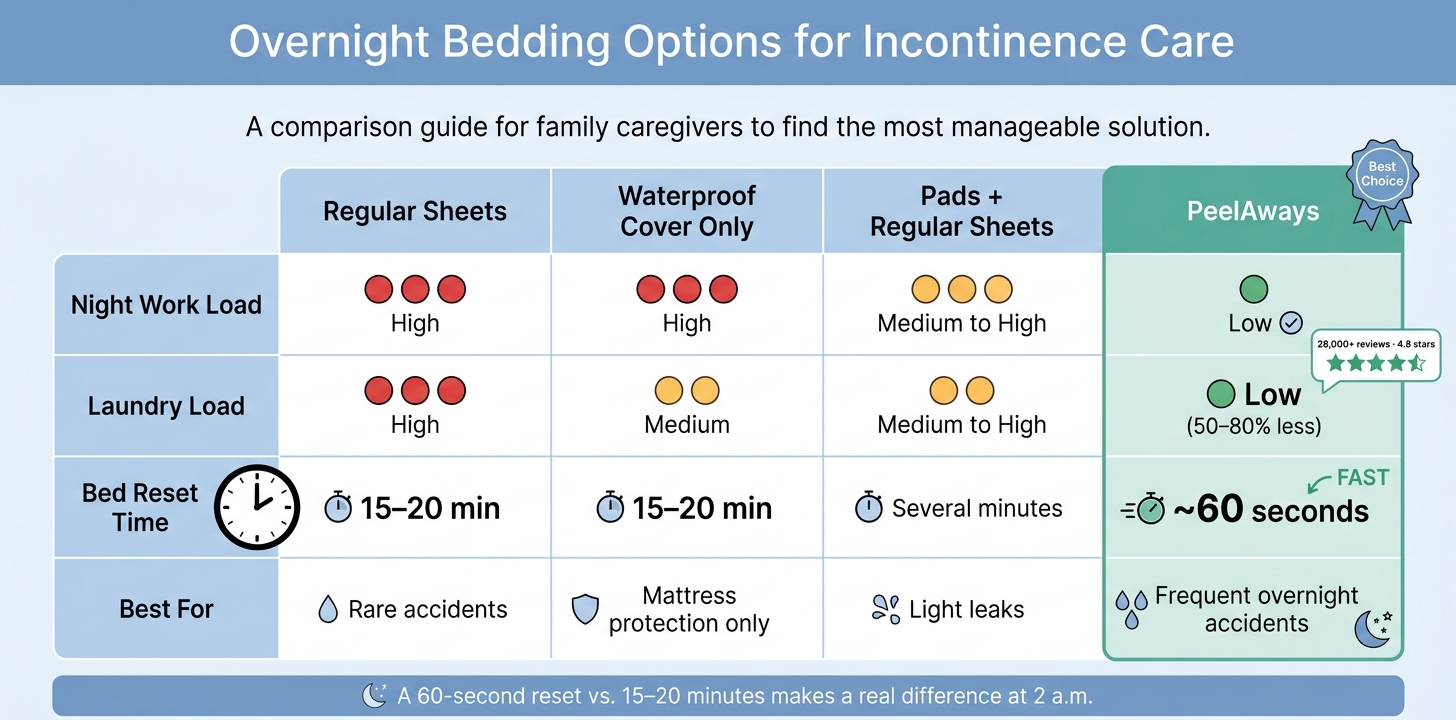
Overnight Bedding Options for Incontinence Care: Time, Laundry & Effort Compared
It’s 2 a.m. again. The bed is wet, the room is dark, and you’re trying to fix everything without fully waking the person you love. In that moment, the bedding that helps most is the one that lets you reset the bed fast and keep things calm.
Once the bed is protected, this is the next thing that matters: how many steps does cleanup take when an accident happens? The easiest overnight bedding is the kind that gets you from “everything is soaked” to “bed is dry again” in seconds, not minutes. This speed is critical for maintaining bedwetting hygiene and preventing skin irritation. For you, that usually means the setup that protects the mattress and lets you reset the bed with the least mess, the least movement, and the least stress.
Why Layered, Peel-Off Bedding Reduces Nighttime Work
PeelAways cut down cleanup because you remove the soiled layer in one step. The design is simple: when the top layer gets wet, you peel it off from the corner and throw it away. There’s already a clean, dry layer underneath, ready to go. That means no stripping the bed and no laundry at 2 a.m.
When PeelAways Makes the Biggest Difference for Caregivers and Families
PeelAways help most when accidents happen often or when the person in bed is hard to move. That can make a huge difference in the middle of the night, because repositioning is already hard enough. You’re not lifting, tugging, or fighting fitted corners in the dark.
They come in sizes from crib to king, so the same setup can work in many care situations.
And when cleanup takes fewer steps, the night feels a little less heavy.
Conclusion: Better nights start with fewer steps, less laundry, and faster bed changes
It’s 2 a.m. again. The bed is wet, your body is running on fumes, and your loved one is looking at you with that mix of apology and shame that breaks your heart every time.
When you’re this tired, even small tasks feel heavy. One more sheet to pull. One more load of laundry. One more delay before everyone can lie back down. That’s why the smallest shortcuts matter most in the middle of the night.
Protecting the mattress, pre-layering the bed, and keeping supplies within reach can turn a 15–20 minute bed change into one that takes under 60 seconds. PeelAways is made for that exact moment. One layer peels away and there’s a clean, dry sheet already underneath, so you can skip stripping the bed and avoid a 2 a.m. laundry reset.
I know how much that matters when you’re standing there half-awake, trying to move fast without making the moment feel worse for the person in the bed. Less lifting. Less mess. Less time with the lights on. Just a fast reset and a better shot at getting everyone settled again.
That’s the whole point behind PeelAways: Making aging and caregiving easier, one bed at a time.
Comments
0



SAVE MONEY & WATER
Professionals & Institutions save a fortune on labor/laundry.

SUPERIOR COMFORT
The first thing our customers notice is how soft our sheets are.

100% WATERPROOF
Each layer is 100% Waterproof, perfect for spills and accidents

SAVE TIME
Change the sheet in under 1 minute without stripping the bed.

Leave a comment