
What I Wish I Knew Before I Started Caring for My Parent at Home

It’s 2 a.m. The sheets are soaked again. Your parent is embarrassed, your back hurts, and you still have to be up in a few hours. You thought home care would be about patience and love. You didn’t know how much of it would be wet bedding, laundry, and trying to keep someone’s dignity intact when you’re both exhausted.
A bed change does not have to take 15 to 20 minutes. I wish I had known sooner that the right setup can cut that to about 60 seconds, lower laundry by 50% to 80%, and make nights feel less like a crisis. One thing that made a big difference for me was finding PeelAways: 5 to 7 waterproof layers in one fitted sheet set, crib to king sizes, and 28,000+ reviews with a 4.8-star rating.
- Protect the mattress before accidents become routine
- Keep wipes, gloves, cream, and spare clothes within arm’s reach and learn how to keep beds dry
- Pick bedding that cuts down laundry, not adds to it
- Write down the overnight plan so tired people are not guessing
- If you already use briefs or incontinence pads, PeelAways are worth a look
If you are in the thick of this right now, start with the bed. That’s where a lot of the stress begins.
Why this hits harder than you expect
The shock is not just the emotion.
It’s the repeat work.
You help with one accident. Then another. Then another two nights later.
And suddenly your life has a new loop: strip the bed, start the wash, calm your parent, find dry clothes, remake the bed, try to fall back asleep.
That’s why home caregiving can feel heavier than you expected. There is no handoff. No next shift. Just you, in the dark, doing the same hard job again.
More than 63 million unpaid caregivers in the U.S. are caring for someone they love at home. A lot of them hit the same wall: the laundry. Not because washing sheets is hard on paper. Because doing it at 2:00 a.m. breaks you down fast.
sbb-itb-45288fe
What to look for before you buy anything
Before you spend money, look at the problem in plain terms.
You need something that helps with:
- Night accidents
- Mattress protection
- Less bending and lifting
- Less laundry
- Less waiting while your parent feels exposed
What helped me most was keeping the list simple:
- A waterproof base layer
- A catch layer where leaks happen
- A backup set within reach
- Bedding I could change fast when I was half-awake
If a product saves only a little time but still leaves you with a full wash load, it may not fix the part that is wearing you down.
PeelAways

This was the first thing I found that felt built for what nights are like in real life.
PeelAways are multi-layer disposable fitted sheets. Each set has 5 to 7 waterproof layers stacked together. When the top one gets soiled, you peel it off and the next clean one is already there.
That means:
- no full strip
- no full remake
- no hauling wet sheets to the washer at 2 a.m.
For me, that was the whole point.
A bed reset with standard sheets can take 15 to 20 minutes. With PeelAways, it can take about 60 seconds.
That time gap matters when your parent is cold, tired, or embarrassed.
What I like most is that it cuts the part of caregiving that feels the most endless by reducing caregiver stress. The laundry. The dragging comforter. The wet fitted sheet that fights you from every corner.
A few details worth knowing:
- Sizes: crib to king
- Reviews: 28,000+
- Rating: 4.8 stars
- Material: soft bamboo/rayon/poly blend
- Sheet life: if the top layer stays clean, it can stay on for days
- Cost help: HSA/FSA eligible
You can find them at peelaways.com/shop and on Amazon.
If you want more detail before buying, these helped me:
- How PeelAways work
- Incontinence care and bedwetting posts
Making aging and caregiving easier, one bed at a time.
Disposable underpads
Disposable underpads can help, but I would call them a backup, not the full answer.
They are useful when:
- you travel
- you need one more layer
- accidents are less frequent
The downside is simple.
They can shift at night. They do not cover the whole bed. And if the fitted sheet is wet too, you still have a bed change on your hands.
That means you may still end up doing the part you were trying to avoid. Using time-saving tips for bedding changes can help manage these accidents more efficiently.
Washable underpads
Washable underpads can work well if you can keep 2 to 3 in rotation.
They cost less over time than disposables. They can feel softer too.
But the tradeoff is the same one many of us are already drowning in: more laundry.
If your days are already full and your nights are broken, reusable pads may save money but still cost you sleep.
Quick comparison
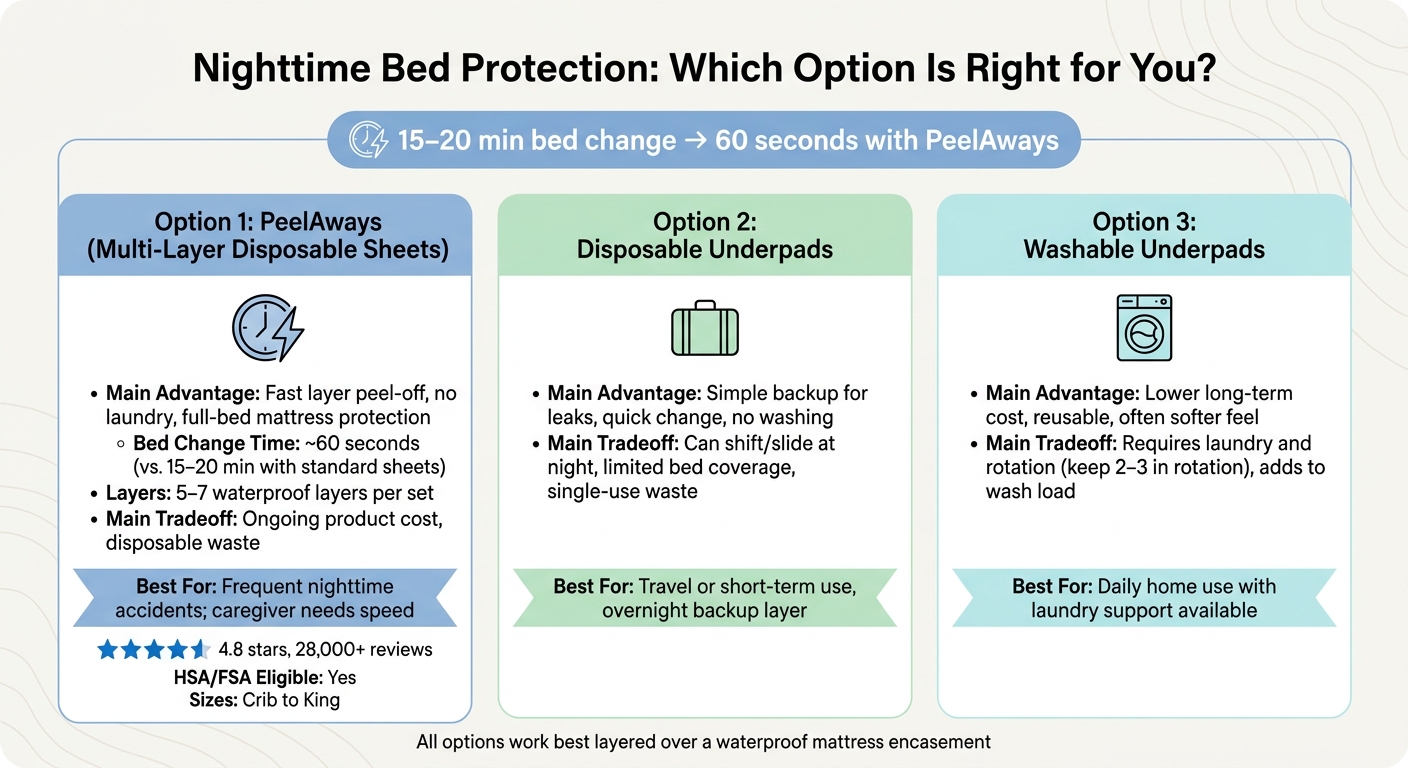
PeelAways vs. Disposable Underpads vs. Washable Underpads: Caregiver Comparison
| Option | What it helps most with | Main drawback | Best fit |
|---|---|---|---|
| PeelAways | Fast bed reset, less laundry, full-bed protection | Refill cost, more trash | Frequent night accidents |
| Disposable underpads | Simple backup for leaks | Can slide, limited coverage | Travel or short-term use |
| Washable underpads | Lower long-term cost | More washing and drying | Home use with laundry help |
FAQ
Does PeelAways replace a mattress protector?
No. I’d still put a waterproof mattress protector under it.
That gives you two layers of defense: the mattress protector underneath, and PeelAways on top.
How long does one PeelAways set last?
Each set has 5 to 7 layers. If a top layer stays clean, you do not need to remove it right away. How long it lasts depends on how often accidents happen.
Is PeelAways only for older adults?
No. It can help anyone dealing with bedwetting, incontinence, recovery after surgery, or limited mobility.
Is it worth the cost?
If your main drain is laundry and bedding care, sleep loss, and middle-of-the-night bed changes, it may be worth it fast. For me, the time and stress it saved mattered more than the price.
What should I keep by the bed?
Keep these within arm’s reach:
- gloves
- wipes
- barrier cream
- spare clothes
- clean briefs or pads
- disposal bag
- backup blanket or light layer
That setup saves steps when you are tired and your parent wants the whole thing over with.
Bottom line
What I wish I knew before caring for my parent at home is this:
The hard part is often not the love. It’s the repeat cleanup. The soaked sheets. The midnight laundry. The way a 15-minute bed change can feel like an hour when you are running on no sleep.
If you use diapers or incontinence pads, you should look at PeelAways. They turn the worst part of the night into a 60-second reset, help cut laundry, and make it easier to protect your parent’s dignity when they need you most.
Shop here:
You may also want to read:
- PeelAways blog
- More care tips from PeelAways
Blog readers save 10% with code BLOGS10 at checkout. Available on peelaways.com and Amazon. Free shipping on orders over $100.
Why Does Caring for a Parent at Home Feel Harder Than Expected?
It’s 2 a.m. The sheets are wet again. Your parent is embarrassed, you’re half-asleep, and you already know this isn’t a five-minute fix.
Caring for a parent at home feels harder than expected because there’s no handoff. No one clocks in to take the next shift. And a lot of that strain starts with the daily work itself, not just the heavy feelings that come with it.
What Daily Caregiving Realities Catch New Caregivers Off Guard?
Most people brace for the emotional side. The part that blindsides you is the physical load that starts right away.
Nighttime accidents are often the first shock, and each one can mean another full bed change. That’s when the routine hits you: strip the bed, rinse what you can, start the wash, wait for the dryer, then make the bed all over again. It doesn’t sound like much on paper. At 2 a.m., it can feel brutal.
As MC, Founder and CEO of Peel Away Labs, says, laundry is often the breaking point. That lands because it’s true. One day you’re just a son or daughter. The next, you’re handling intimate care, lifting wet bedding, and trying to protect your parent’s dignity at the same time.
What Is Caregiver Burnout?
Caregiver burnout is the kind of exhaustion that shows up when the work keeps going and rest never quite catches up. It builds slowly through broken sleep, constant watchfulness, and the sense that you can’t fully relax.
Family caregivers have no shift changes, which means recovery rarely comes. That’s why the bedroom setup matters so much.
How to Set Up a Bedroom for Incontinence, Bedwetting, and Fast Nighttime Changes
It’s 2:00 a.m. The bed is wet again. You’re half awake, your loved one is upset, and the last thing you have in you is a full strip-and-remake routine.
A good bedroom setup takes some of that pressure off. It protects the mattress, cuts down cleanup, and makes the whole thing feel less like a crisis and more like a reset.
How to Build a Layered Bed-Protection System That Works
The setup that works best usually isn’t one magic product. It’s three layers doing three different jobs.
Start with a waterproof mattress encasement or protector. That’s your base layer. It guards the mattress itself, which matters more than people think. Once a mattress gets wet, the cleanup gets bigger fast.
On top of that, place a washable or disposable absorbent underpad where leaks are most likely to happen, usually under the hips and thighs. That pad catches the moisture first, so the mattress protector underneath has a better chance of staying dry.
Then there’s the part many new caregivers miss: a clean spare set within arm’s reach. Keep a fresh fitted sheet, a clean pad, backup pajamas, gloves, wipes, and a trash bag or hamper right in the room before bedtime. At 2:00 a.m., you do not want to be digging through a closet or walking to another room. You want to reach over, swap what you need, and get everyone settled again.
One small tip that helps a lot: use light blanket layers instead of one heavy comforter. Lighter layers are easier to wash after a spill and much easier to manage when you’re tired and trying to clean up in the dark.
How a 60-Second Bed Change With PeelAways Works
A full overnight bed change with regular bedding can take 15 to 20 minutes. In the middle of the night, that can feel endless.
PeelAways multi-layer disposable sheets handle it in a much simpler way. Each fitted sheet has 5 to 7 waterproof layers stacked together. When there’s an accident, you peel off the soiled top layer, roll it inward to hold the mess, throw it away, and there’s already a fresh layer underneath. No stripping the whole bed. No remaking it. No lifting the mattress. No starting a load of laundry before sunrise. The whole change takes under 60 seconds.
"Laundry is the breaking point. It's not just washing sheets. It's discovering a soaked bed at 2 a.m. It's stripping layers while trying not to wake the person you're caring for." - MC, Founder and CEO, Peel Away Labs
That speed is the reason so many tired families stick with them. PeelAways is one of those things I wish more people heard about sooner, especially if nights are already hard enough.
A practical detail that helps: tear the top corners before bed so the top layer is ready to peel right away if you need it. The sheets are made from a soft bamboo, rayon, and polyester blend. And if a layer stays clean, it can last 7 to 10 days before you need to remove it.
If you want to look at sizes or order directly, you can find them at peelaways.com/shop or on Amazon. For more tips, see How PeelAways Work and bedwetting and incontinence care articles on PeelAways.
Which Bed-Protection Setup Is Easiest for Caregivers?
The best setup depends on a few plain-life things: how often accidents happen, whether you can get to laundry at night, and how much lifting and bending you can handle.
| Option | Main advantage | Main tradeoff | Best use case |
|---|---|---|---|
| PeelAways | Fast layer peel-off, no laundry, mattress protection | Ongoing product cost, disposable waste | Frequent nighttime accidents; caregiver needs speed |
| Disposable underpads | Quick change, no washing | Single-use waste, can shift if not secured | Travel, short-term use, overnight backup |
| Washable underpads | Lower long-term cost, reusable, often softer | Requires laundry and rotation | Daily home use |
Disposable underpads can help as a backup layer. But they can slide around during the night, and they don’t cover the full mattress.
Washable underpads can work well at home, especially if you keep 2 to 3 in rotation so one is on the bed while another is in the wash.
Once the bed setup is handled, the next piece is hygiene care that stays safe, private, and respectful.
How to Handle Hygiene and Mobility Needs Without Losing Dignity
It's the middle of the night. The bed is wet, your parent is uncomfortable, and you're trying to move fast without making them feel exposed. That mix of urgency, exhaustion, and tenderness is a lot to carry.
Once the bed is protected, the next challenge is keeping cleanup safe, quick, and respectful.
The Most Important Hygiene Routines for Incontinence Care
After each incontinence episode, gentle, steady cleanup matters more than most people think. It's one of the main ways to help prevent incontinence-associated dermatitis (IAD) and urinary tract infections (UTIs). Change wet briefs or pads within 2 hours, and change them right away after any bowel accident. Wipe front to back to help cut down bacteria spread. Use fragrance-free, pH-balanced wipes or a no-rinse cleanser on the genital and buttock area, then pat the skin dry instead of rubbing. After that, apply zinc oxide or dimethicone barrier cream to clean, dry skin.
A bedside cart can make these moments less chaotic. Keep gloves, wipes, barrier cream, clean briefs, spare pajamas, and disposal bags within reach. When everything is right there, you spend less time scrambling and more time focused on your parent.
When the bed is ready, the next task is moving your parent without hurting them or your own back.
How to Help a Parent With Limited Mobility in Bed More Safely
This is where body mechanics matter. Raise the bed to hip height, keep your feet shoulder-width apart, and bend at the knees. Don't bend at the waist, and don't pull by the arms or clothing. Use a draw sheet instead - a flat sheet folded under the torso and hips - so you can move the sheet rather than pulling on their body directly.
If your parent can help even a little, let them. Small actions count. Bending their knees, pressing their heels into the mattress, or crossing their arms over their chest can lighten the load on you. For side-lying positions, place pillows behind the back, between the knees, and under the ankles. That helps reduce pressure on bony areas. Reposition every 2 to 3 hours unless a clinician gives you a different schedule.
How to Preserve Privacy and Respect During Personal Care
Dignity doesn't usually come from one big gesture. It comes from small habits, done the same way every time.
Explain each step before you do it. "I'm going to help you change your brief now" said calmly before you begin can make the whole moment feel less abrupt. Ask permission when you can, even if your parent has some cognitive impairment. Keep the room warm. Cover the parts of their body you're not cleaning with a towel or light blanket.
Use your parent's preferred name. Avoid infantilizing language, including terms that may feel too childlike for care. And when accidents happen, keep your voice calm and plain: "This happens to many people - let's get you cleaned up and comfortable." Said often enough, that kind of response can take some of the shame out of a hard moment.
If other helpers are involved, keep the room as private as possible during personal care. Close the door. Draw the curtain. Ask extra people to step out. Those small choices send a clear message: privacy still matters.
Once personal care feels calmer, the next step is sharing the routine so you are not carrying it alone.
What Kind of Care Plan and Support System Do You Need Before Burnout Starts?
It’s 2:14am. You’re half-awake, trying to remember if the midnight meds were given, whether you already checked the bedding, and who said they could come by Thursday. When everything lives in your head, even a small handoff can feel like a mess.
A written care plan keeps medication, hygiene, repositioning, and overnight tasks out of one caregiver's head and makes handoffs faster.
Once personal care is routine, the next problem is keeping the routine written down and easy to share.
What to Include in a Simple Daily and Overnight Care Plan
Keep it plain. Keep it visible. The goal isn’t to make a perfect system. It’s to make sure the next person can step in without asking you 15 questions.
List medication times, meals, toileting, hygiene, repositioning, and bedding checks - especially overnight. Assign each overnight wake-up and change by name, not “someone should do it.” A shared care planner keeps the routine visible and easy to hand off. Schedule bedding checks as a named task so leaks are caught early.
This can be as simple as a paper chart on the fridge, a notebook by the bed, or a shared phone note. What matters is that the plan is easy to read at a glance when everyone is tired.
Who Should Be on Your Caregiver Support List?
Your support list should be honest and specific. Think about who can take on defined tasks, not just who says, “Let me know if you need anything.” That sounds nice. It doesn’t help much at 1am.
| Support Role | Specific Tasks to Delegate |
|---|---|
| Family/Siblings | Laundry, grocery runs, or specific overnight shifts |
| Paid Aides | Hygiene care, repositioning, and bed changes |
| Neighbors/Friends | Weekly check-ins, meal prep, or running errands |
| Healthcare Professionals | Watching for infection signs and managing the medical schedule |
Even one on-call night or a set block of time handled by someone else can give the primary caregiver uninterrupted sleep.
And honestly, that kind of sleep can change the whole week.
With the plan written and help assigned, the next step is avoiding the small mistakes that make home care harder.
What I Wish I Had Done Sooner to Make Caregiving Easier
It’s 2 a.m. The bed is wet again. You’re half-awake, your back is already barking, and the last thing you want is to strip the whole bed while your loved one waits, embarrassed and tired.
Once the care plan is written, the next bit of relief comes from making the bedroom easier to reset at 2 a.m.
The biggest lesson is simple: get the bedroom ready before incontinence turns into a night-after-night problem.
Common Mistakes New Family Caregivers Make
Most new family caregivers don’t see how fast the small stuff piles up. One wet night becomes three. The mattress stays unprotected until it’s already stained or damaged. Then the laundry mountain shows up out of nowhere, and suddenly every night feels harder than it should.
That’s why the best fixes don’t add steps. They cut them. If you can protect the mattress early - before accidents become routine - you can spare yourself a lot of extra washing, sheet changes, and lost sleep in that first week.
How PeelAways Can Cut Laundry, Stress, and Sleep Disruption
PeelAways multi-layer disposable sheets help with the part that wears many people down first: the middle-of-the-night bed change. I’m talking about that moment when you know a full strip-and-remake could take 15 to 20 minutes, and you just don’t have 15 to 20 minutes in you.
PeelAways are built with 5-7 layers, so when one layer is soiled, you peel it away and the next clean layer is right there. That can turn a bed change into about 60 seconds instead of a full reset. For someone juggling work, family, and home care, that matters. Less laundry. Less stress. Fewer nights blown apart.
They come in sizes from crib to king, and they have 28,000+ reviews with a 4.8-star rating. They’re made without vinyl, PVC, phthalates, or fire retardants. They’re also HSA and FSA eligible, which can help with cost.
If you want to look at them, you can find PeelAways on peelaways.com/shop and on Amazon. You may also want to read more on the PeelAways blog, like articles on incontinence care tips and caregiving support.
Start Here Before Care Becomes Daily
Start with the bed setup, the supply station, and the overnight plan before accidents become routine.
Keep it simple:
- Put a waterproof layered sheet on the mattress.
- Keep wipes, gloves, extra clothes, and cream within arm’s reach.
- Write out a basic overnight schedule so you’re not making tired decisions in the dark.
Those steps can help you avoid some of the most draining problems before they start.
Comments
0



SAVE MONEY & WATER
Professionals & Institutions save a fortune on labor/laundry.

SUPERIOR COMFORT
The first thing our customers notice is how soft our sheets are.

100% WATERPROOF
Each layer is 100% Waterproof, perfect for spills and accidents

SAVE TIME
Change the sheet in under 1 minute without stripping the bed.

Leave a comment