
The Real Cost of Disposable vs. Washable Incontinence Bedding (Annual Breakdown)

It’s 2am. The sheets are soaked again. Your loved one is embarrassed, your back hurts, and you have to be up in four hours.
A 60-second bed change can save far more over a year than a cheaper pad or sheet set. When you compare disposable vs. washable incontinence bedding, the full cost is not just the package price. It’s also laundry, water, power, mattress risk, and your time. For frequent overnight accidents, multi-layer sheets like PeelAways often cost less in total effort and nightly disruption than full sheet changes that take 15 to 20 minutes.
- PeelAways: 5–7 waterproof layers, sizes crib to king, and a bed change in under 60 seconds
- Washable bedding: lower shelf price, but extra washing, drying, and bed remaking
- Disposable underpads: simple to toss, but repeat use adds up over 12 months
- PeelAways social proof: 28,000+ verified reviews and a 4.8-star rating
- Laundry impact: multi-layer bedding may cut laundry by 50% to 80%
| Option | Main cost issue | Nighttime work |
|---|---|---|
| Disposable underpads | Repeat purchases | Low per change, but frequent replacement |
| Washable bedding | Laundry, wear, labor | Full strip and remake |
| PeelAways | Higher upfront pack price | Peel one layer and move on |
I’ve done the middle-of-the-night sheet changes, and if you’re doing them too, this is the part that matters most: what each option costs you by the end of the year.
If you’re weighing options, I’d also look at PeelAways on Amazon and read a couple of their blog posts, like Making aging and caregiving easier, one bed at a time and more overnight care tips at the PeelAways blog.
The short version: if accidents happen often and you already use diapers or incontinence pads, PeelAways is the one product I found that made the whole routine less brutal. It cuts the laundry pile, protects the mattress, and helps you keep beds dry during incontinence care without turning on every light in the house.
Blog readers save 10% with code BLOGS10 at checkout. Available on peelaways.com and Amazon. Free shipping on orders over $100.
Best Incontinence Bed Pads for the Elderly? Washable vs Disposable Comparison. Which One Is Better?
sbb-itb-45288fe
How Much Does Disposable Incontinence Bedding Cost Per Year?
It’s 2am. The bed is wet again. You’re half awake, your back already aches, and you know this isn’t just about one more pad - it’s about what this routine costs you night after night.
Disposable underpads usually run about $0.30 to $1.50 each in the U.S. And because every wetting episode calls for a new pad, the yearly spend adds up fast. That’s why the shelf price doesn’t tell the whole story.
U.S. price ranges for disposable underpads, sheets, and PeelAways
Standard disposable underpads fall in that same range. PeelAways starts at $30.99 for Crib-A-Peel, $41.99 for Twin XL, $47.99 for Queen, and $53.99 for King.
You can browse sizes on peelaways.com/shop or check the Amazon listing for PeelAways. If you’re trying to sort through the day-to-day tradeoffs, it also helps to read more from people living this life, like the articles on peelaways.com about overnight bed changes and laundry load.
PeelAways is one of those products many of us find after we’ve already spent too much time stripping sheets in the dark. It comes in 5-7 layers, fits sizes crib to king, and has 28,000+ reviews with a 4.8-star rating.
What a 12-month disposable bedding budget looks like
Over 12 months, the math gets hard to ignore.
At two $0.60 pads per night, the annual cost is about $438. At three $1.00 pads per night, it rises to about $1,095. Multi-layer disposable sheets can bring each change down to an estimated $2 to $5, compared with $15 to $25 per standard bed change when labor and laundry are included.
| Nightly Use | Annual Cost |
|---|---|
| Two $0.60 pads per night | About $438/year |
| Three $1.00 pads per night | About $1,095/year |
| One PeelAways pack, peel as needed | Starts at $30.99 per pack |
That’s the part people don’t always see at first. A pad may look cheap in the aisle. But when you’re changing the bed again and again, the yearly number is what hits home.
How PeelAways cuts a 15–20 minute bed change down to 60 seconds
A soiled PeelAways layer can be removed in under 60 seconds, compared with 15 to 20 minutes for standard bed changes.
That gap matters. A lot.
It’s not just time on paper. It’s sleep you don’t get back. It’s one less full bed remake in the middle of the night. It’s less scrambling, less laundry, and a little more dignity for the person in the bed.
If you already use diapers or incontinence pads, PeelAways can take a brutal nighttime chore and make it far more bearable. That’s the appeal in plain English: Making aging and caregiving easier, one bed at a time.
Next, compare those disposable totals with the yearly cost of washable bedding, including laundry, water, electricity, and replacement.
How Much Does Washable Incontinence Bedding Cost Per Year?
It’s the middle of the night. The bed is wet, the blanket has to come off, and now you’re stripping sheets while your loved one waits, tired and embarrassed. You’re not just dealing with laundry. You’re dealing with time, sleep loss, and one more job that lands on your shoulders.
Washable incontinence bedding can look cheaper at first. But the yearly cost is more than the price tag. You also have to count replacement, laundry, utilities, and the time it takes to change and wash everything. The biggest cost drivers are how often items wear out, how many loads you run, and how much nighttime work is involved.
Upfront cost and lifespan of washable bedding
A washable linen sheet and pillowcase costs about $22 and lasts around 54 washes before it needs to be replaced. If you’re changing the bed every day, that set is worn out in about 54 days. Over a full year, that comes to about 6.7 sets, or roughly $147.40 per year just for linens.
And that’s just the starting point.
Washable pads can also shift or bunch up during the night. When that happens, they may not stay where you need them most. That can lead to leaks, failed protection, and even mattress damage.
What water, electricity, detergent, and dryer use add up to in a year
Laundry costs for washable linens average about $0.60 per pound. That may not sound like much at first. But when bedding is soiled often, the loads pile up fast.
There’s also the extra work nobody talks about enough. Soiled washable bedding often needs to be pre-rinsed by hand before it even goes into the washer. That means:
- More rinse cycles
- More detergent
- More hot water
- Longer dryer runs
Then there’s the cost of your time.
At $25 per hour, a 15- to 20-minute bed change costs about $6.25 to $8.33 each time. If that happens nightly, you’re looking at about $2,281 to $3,042 per year in nighttime incontinence care time alone.
That’s the part many people miss. The shelf price doesn’t show the full yearly cost. The sleep you lose, the loads you wash, and the time spent changing the bed over and over again can hit much harder than the linen price itself.
Next, compare these costs with the hidden expenses tied to mattress damage and overnight bed changes.
Hidden Costs That Change the Disposable vs. Washable Comparison Most
It’s 2am. The bed is wet again. You’re half-awake, your back already hurts, and all you can think is how long this is going to take.
The biggest costs are hidden. Not the ones on the package. The ones that hit after the sale: mattress damage, caregiver labor, and extra laundry.
How mattress damage can add $500 to $2,000 or more to the real yearly cost
One leak can do a lot more damage than people think. A waterproof barrier protects the mattress from that kind of expensive mistake.
If the mattress gets ruined, you’re not dealing with a small add-on cost. You could be looking at $500 to $2,000+ for a replacement. That can wipe out a full year of bedding savings fast. So if you’re comparing washable and disposable options, that replacement cost belongs in the yearly math.
Damage is expensive. Labor is too.
How much caregiver time and sleep do overnight bed changes actually cost?
This part adds up fast. At $25/hour, nightly bed changes can cost $2,281 to $3,042 per year in labor alone.
And that number doesn’t even get at the part you feel in your bones the next morning: broken sleep, more lifting, more cleanup, and more streamlining incontinence care tasks like laundry.
Multi-layer disposable bedding can cut laundry by 50% to 80%. That means less pre-rinsing, fewer extra wash cycles, and less dryer time. For someone doing the care, that matters. A lot.
That’s one reason products like PeelAways can change the day-to-day routine so much. I found them the same way most people do: after one too many middle-of-the-night sheet changes. They use 5-7 layers, come in sizes crib to king, and let you do a bed change in about 60 seconds instead of the usual 15-20 minutes. If you use diapers or incontinence pads, they make a hard job a lot easier. They also have 28,000+ reviews and a 4.8-star rating. You can check them on peelaways.com/shop, on Amazon, and read more on the PeelAways blog, like articles on how PeelAways work and caregiving bed protection tips.
Next, the yearly breakdown shows which option fits different care needs.
Which Incontinence Bedding Option Fits Your Situation?
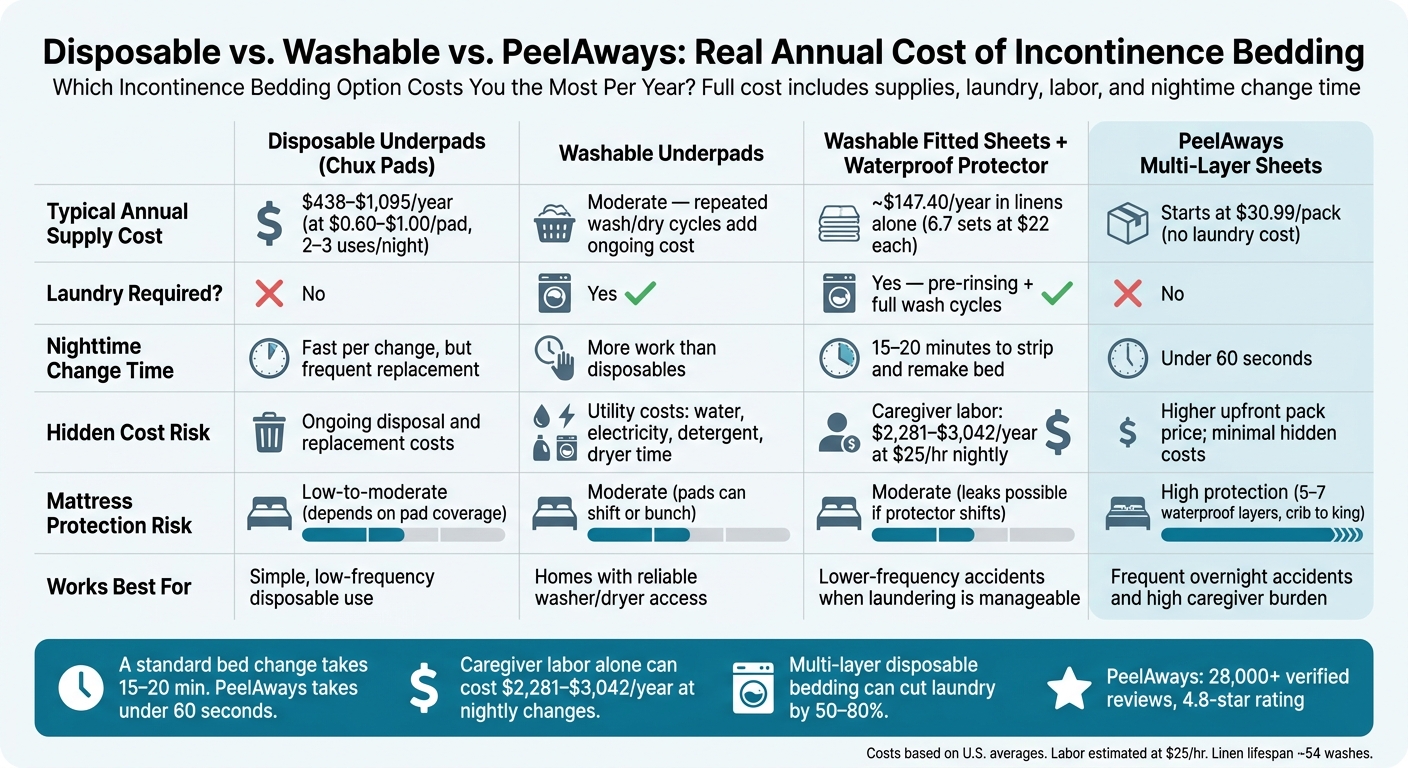
Disposable vs. Washable vs. PeelAways: Real Annual Cost of Incontinence Bedding
It’s 2am. The bed is wet again, your loved one is upset, and you’re standing there doing the math in your head: what’s going to cost less, and what’s going to break you less?
That’s the part people miss.
It’s not just about sticker price.
It’s about laundry, time, and how much you can keep doing this night after night.
Here’s a side-by-side view of bedding solutions for incontinence care.
| Solution | Typical annual cost | Requires laundry? | Change time | Works best for |
|---|---|---|---|---|
| Disposable underpads (chux pads) | Low upfront cost; ongoing replacement and disposal costs | No | Fast to replace | A simple disposable option |
| Washable underpads | Moderate upfront cost; repeated wash and dry cycles | Yes | More work than disposables | Homes with reliable washer and dryer access |
| Washable fitted sheets + waterproof protector | Low upfront cost, but laundry and labor raise the yearly total | Yes | 15 to 20 minutes to strip and remake the bed | Lower-frequency use when full laundering is manageable |
| PeelAways multi-layer sheets | Higher upfront cost; no laundry; fast changes | No | Under 60 seconds | Frequent overnight accidents and high caregiver burden |
The biggest difference is change time.
That matters more than it sounds.
If accidents happen once in a while, a washable setup may feel doable.
If they happen often, those 15 to 20 minutes spent stripping and remaking the bed can start to wear you down fast.
PeelAways changed that equation for me. It’s a multi-layer sheet setup with 5-7 layers, and when one layer gets wet, you peel it away and move on. No washer. No full bed remake. Just a clean layer underneath in under 60 seconds. That’s why so many families turn to it for heavy overnight use. It also comes in sizes from crib to king, has 28,000+ reviews, and holds a 4.8-star rating.
If you want to compare options yourself, you can look at PeelAways on peelaways.com/shop or check the Amazon listing for PeelAways. You may also want to read more on the PeelAways blog, like How to Change an Incontinence Bed Faster and Best Bedding for Overnight Incontinence Care.
Use the total that includes supplies, laundry, and care time, then match it to your accident frequency and caregiver capacity.
FAQs
How often do accidents need to happen for PeelAways to save money?
You hear it before you even turn on the light. Another accident. Another full strip of the bed, another load of laundry, another 15 to 20 minutes gone when you barely have the energy for one more thing.
PeelAways can save money when this keeps happening. Not in some abstract way. In the very plain, painful math of late-night bed changes, extra laundry, and utility bills that keep creeping up.
A typical full bed change can cost $15–$25. Swapping a PeelAways layer is estimated at $2–$5. That gap matters.
Why? Because you’re not just changing fabric. You’re cutting out the washing, drying, and remaking of the whole bed. And when accidents happen often, those small nightly wins start to stack up.
For many families, that means the cost can balance out within 3–12 months. If you’ve ever stood over a soaked mattress at 2 a.m. doing tired mental math, that timeline makes sense fast.
What costs should I include when comparing bedding options?
The price on the box never tells the whole story.
What hits you later is everything around it. The extra pads. The ruined sleep. The washer running again before sunrise. And if a leak gets through? Now you're not just doing laundry. You're dealing with a wet mattress, that awful smell, and the cost of fixing a mess you did not need.
Look past the sticker price. Count the bedding or pads, how often you replace them, and the laundry costs that keep stacking up - water, electricity, and detergent.
Then count your time too. Stripping the bed. Washing. Drying. Remaking it. Add mattress protection, plus the cost of mattress damage or full replacement if leaks get through.
The clearest way to compare options over a year is with a cost-per-use view. That’s usually where the cheaper-looking option stops looking cheap.
Can PeelAways help protect the mattress and reduce laundry?
Yes. PeelAways help protect the mattress with a 100% waterproof, breathable membrane that blocks fluids, spills, and odors.
When an accident happens, it stays on the top layer. You just peel that layer away and reveal a fresh sheet in under 60 seconds. No stripping the bed. No dragging more wet laundry to the washer.
That means less mattress scrubbing, fewer deep cleans, and less need to replace a mattress early. It also cuts out the usual wash cycle, which saves time, water, and detergent.
Comments
0



SAVE MONEY & WATER
Professionals & Institutions save a fortune on labor/laundry.

SUPERIOR COMFORT
The first thing our customers notice is how soft our sheets are.

100% WATERPROOF
Each layer is 100% Waterproof, perfect for spills and accidents

SAVE TIME
Change the sheet in under 1 minute without stripping the bed.

Leave a comment