
PeelAways vs. Traditional Waterproof Mattress Pads: Honest Comparison

It’s 2 a.m. The sheets are soaked again. Your loved one is embarrassed, your back hurts, and you have to be up in four hours. If that is your night right now, I know how heavy that moment feels.
A 60-second bed change can make the difference between getting back to sleep and losing the rest of the night. If you are comparing PeelAways vs. a waterproof mattress pad, here is the short answer: PeelAways fit frequent accidents better because you peel off one soiled layer and keep a dry bed underneath, while a standard pad still means a full strip, wash, dry, and remake that can take 15 to 20 minutes. PeelAways also cut laundry by 50% to 80%, come with 5 to 7 waterproof layers per set, fit sizes crib to king, and have 28,000+ verified reviews with a 4.8-star rating.
- Best for frequent accidents: PeelAways
- Best for occasional accidents: reusable waterproof mattress pad
- Main difference: 60 seconds vs. 15 to 20 minutes after an accident
- Laundry difference: PeelAways can cut washing by 50% to 80%
- What stands out: less lifting, less bed remaking, less waiting in a wet bed
| Option | Best use | Bed change time | Laundry | Setup |
|---|---|---|---|---|
| PeelAways | Nightly or repeated accidents | ~60 seconds | Lower | 5–7 layers ready at once |
| Waterproof mattress pad | Once-in-a-while accidents | 15–20 minutes | Higher | One reusable layer |
I would choose based on what your nights look like when something goes wrong, not just what looks cheaper on day one.
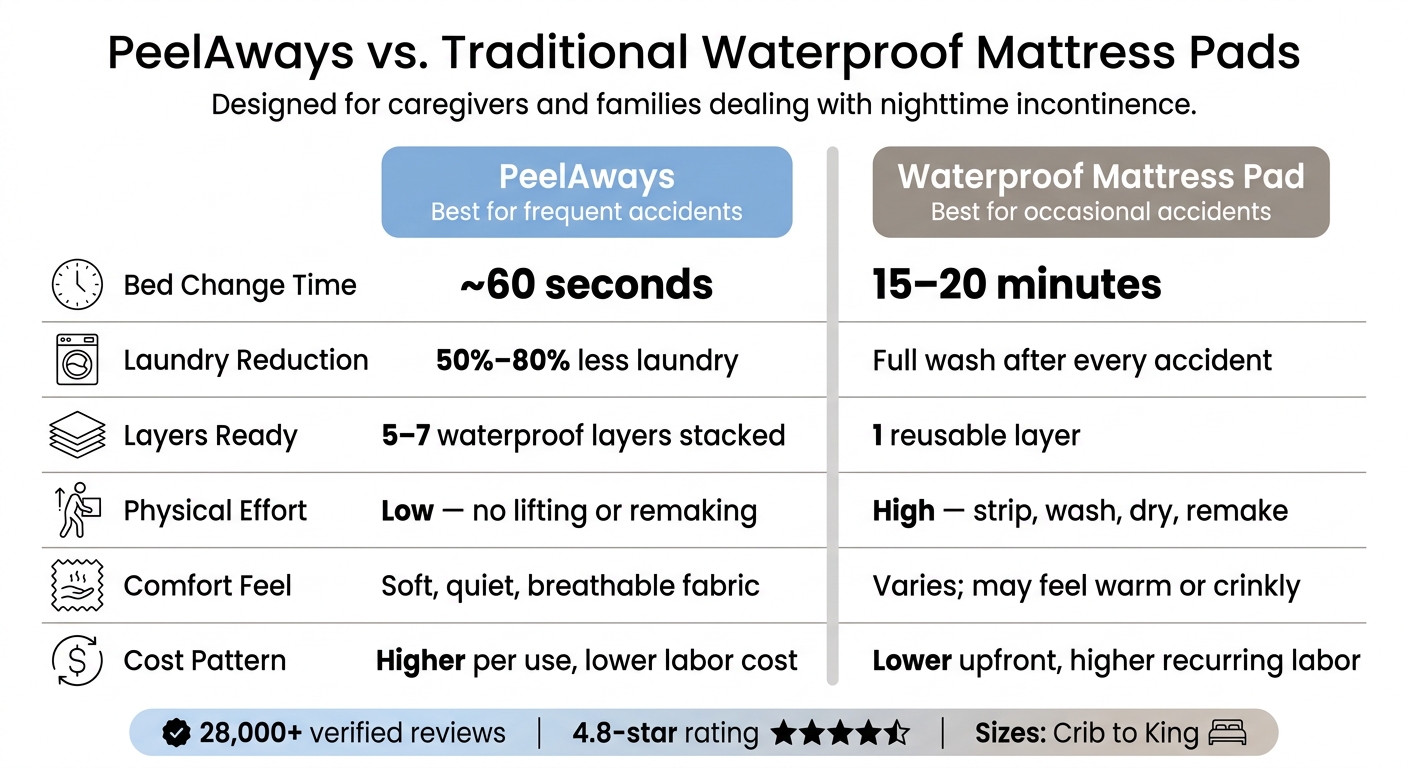
PeelAways vs. Waterproof Mattress Pads: Side-by-Side Comparison
Peelaways Waterproof Disposable Bed Sheets | Absorbent Wellness Sheets for Elderly & Travel
sbb-itb-45288fe
What are PeelAways and waterproof mattress pads?
It’s the middle of the night. The bed is wet again, your loved one is upset, and you already know this isn’t a two-minute fix. In moments like that, the difference between PeelAways and a waterproof mattress pad gets painfully clear.
In day-to-day care, the biggest gap shows up after an accident. PeelAways use stacked disposable waterproof layers. A waterproof mattress pad uses one reusable waterproof layer. That one design choice affects cleanup time, laundry, and how much work falls on you.
How PeelAways work and what a 60-second bed change looks like
When the top layer of a PeelAways sheet gets soiled, you peel it away. Under it, there’s already a clean, dry layer fitted to the mattress. The top layer comes off in about 60 seconds, so you’re not stripping the whole bed and making it again from scratch.
That matters more than it sounds. At 2 a.m., a one-minute change can feel like a lifeline.
Each layer stays separate until you remove it, which helps cut down on mess during the change. And the surface feels like fabric, not stiff plastic.
How waterproof mattress pads work and how they are used
A waterproof mattress pad goes over the mattress like a fitted sheet. It has a soft fabric top and a polyurethane waterproof backing underneath.
After an accident, you still have to take it off, wash it, dry it, and put it back on the bed. Reusable pads can hold up through hundreds of washes, which is good if you want something that lasts. But the cleanup job doesn’t get easier the fifth time or the fiftieth. It’s still the same strip, wash, dry, and remake routine every time.
Which care situations each option is used for
Both are used in the same kinds of care:
- Elderly incontinence
- Nighttime bedwetting
- Post-surgery recovery
- Potty training
Here’s how those differences play out in daily life.
| Feature | PeelAways | Waterproof Mattress Pad |
|---|---|---|
| Design | 5–7 stacked waterproof layers | Single-layer reusable fitted cover |
| Change time | ~60 seconds | 10–20 minutes |
| Laundry required | None | After every accident |
| Physical effort | Low - no mattress lifting | High - strip, wash, dry, remake |
| Material feel | Soft, breathable fabric | Fabric top with polyurethane backing |
| Cross-contamination | Each layer stays separate until removed | More handling steps during removal and laundering |
How PeelAways and waterproof mattress pads compare day to day
It’s 2am. The bed is wet again, your shoulders are tight, and the last thing you want is to strip everything off and start from scratch. In that moment, the big difference isn’t theory. It’s how much work is standing between you and a dry bed.
Here’s what changes in real care.
Once the bed is made, the real test is what happens after the first accident.
Setup, overnight accidents, and cleanup time
PeelAways are set up once and stay ready for more than one accident. A waterproof mattress pad gets set up once too, but after the first accident, you’re back at square one: strip it, wash it, dry it, and remake the bed.
That gap hits hardest overnight, when every minute matters and moving someone in bed can turn into a whole production. With PeelAways, there’s no full bed remake. A clean, dry layer is already there underneath. With a waterproof mattress pad, a middle-of-the-night accident means a full reset before the bed is protected again.
If your loved one is healing from surgery or has limited mobility, that extra repositioning isn’t a small thing. It can be uncomfortable, tiring, and upsetting. PeelAways says caregivers using the layered system can save between 53.92 and 346.75 hours per year compared with old-school sheet changes, depending on how often accidents happen.
Laundry load, comfort, and mattress protection
This is where the weekly grind shows up.
PeelAways can cut laundry by 50% to 80% because the soiled layer is thrown away instead of washed. For families dealing with frequent accidents, that can take a real bite out of the laundry pile. A waterproof mattress pad has to be washed and fully dried before it’s ready to go back on the bed.
Comfort matters too, maybe more than people admit. Some waterproof and hypoallergenic bedding options feel stiff, warm, or crinkly, depending on what they’re made from. PeelAways use a soft, breathable rayon blend that feels closer to regular sheets and stays quieter and cooler.
Both options protect the mattress with a 100% waterproof barrier. The day-to-day difference is how that protection shows up. PeelAways give you 5 to 7 layers at once. A mattress pad gives you one reusable barrier, and it only keeps doing its job if you wash it and get it back on the bed.
Comparison table: PeelAways vs. waterproof mattress pads
These differences are easiest to see side by side.
| Feature | PeelAways | Waterproof Mattress Pad |
|---|---|---|
| Overnight response | Clean layer ready | Full strip, wash, dry, remake |
| Laundry load | Less washing | More washing |
| Caregiver effort | Low | High |
| Comfort | Soft, quiet, breathable | Varies; may feel warmer or crinkly |
| Cost pattern | Higher per use, lower labor | Lower upfront, higher recurring labor |
Which option fits caregivers, families, and frequent bed accidents better?
It’s 2 a.m. again. The bed is wet, your loved one is half-awake and upset, and you’re standing there doing the math in your head: strip the bed, lift, wipe down, remake, start laundry, try to get everyone back to sleep. That’s the moment this choice stops being about bedding and starts being about how much more your body can take.
After the setup and cleanup differences, this comes down to who’s doing the work and how often. Learn how to choose bedding for incontinence care based on accident frequency, caregiver effort, and laundry load. PeelAways are the better fit for frequent, high-strain care. A waterproof mattress pad can still make sense when accidents are occasional and laundry isn’t wearing you down.
When PeelAways are the better fit
PeelAways make more sense when accidents happen often and nighttime resets need to be fast and easy on your back. If your loved one has nightly incontinence, is healing after surgery, lives with dementia, or has limited mobility, the difference between peeling off a layer and doing a full bed change is not small. It can be the difference between getting through the night and hitting a wall.
The person in bed stays put during the change. You don’t have to lift, turn, or reposition them. That alone can change the whole night. PeelAways also help when laundry is already piling up, because they remove laundry for the fitted-sheet layer. And if a layer stays dry, it can stay on the bed for 7 to 10 nights before you need to peel it away.
When nighttime changes keep happening, the main issue is caregiver strain. If accidents are rare, that pressure drops, and the simpler option may be enough.
When waterproof mattress pads still make sense
A waterproof mattress pad works better for occasional accidents and homes where laundry is easy to stay on top of. If there’s less urgency and less physical strain, a reusable pad can do the job. Premium reusable pads can hold up through as many as 500 washes, which makes them a solid pick for long-term, light-use protection. If keeping costs down over time or cutting waste matters most, that can tip the scale toward a reusable pad.
The catch is simple: once accidents become nightly, all that washing, drying, and remaking adds up fast.
A short checklist for choosing the right waterproof bedding
Use these questions to match the bedding to your care routine:
- How often do accidents happen? Nightly or several times a week points to PeelAways. Occasional accidents point more toward a reusable pad.
- Can you handle a full bed change at 2 a.m.? If not, PeelAways are the lower-strain option.
- Is laundry already backing up? If yes, cutting out laundry for the fitted-sheet layer helps right away.
- Does your loved one react to heat, noise, or stiff fabric? PeelAways use a soft 55% rayon, 45% polyester blend that stays quiet and breathable.
Conclusion: The honest bottom line on PeelAways vs. traditional waterproof mattress pads
It’s 2am. The bed is wet again. You’re tired, your loved one feels awful, and the last thing you want is another full sheet change before morning.
That’s the trade-off.
Traditional waterproof mattress pads can make sense when accidents don’t happen often and you want a reusable option with a lower ongoing cost. But PeelAways are made for the nights that wear you down fast. You peel off the soiled layer and there’s a clean one underneath in about 60 seconds, without the middle-of-the-night laundry scramble.
That kind of speed matters. Not just for your back. Not just for your sleep. For dignity and care too. The less time your loved one has to wait in a wet bed, the easier the whole moment feels.
PeelAways is something many of us find after hitting that breaking point where “wash it in the morning” stops being good enough. If you use diapers or incontinence pads, this setup just makes life simpler. It comes in 5–7 layers, sizes from crib to king, and it’s backed by 28,000+ reviews with a 4.8-star rating. The whole idea is simple: Making aging and caregiving easier, one bed at a time.
Next steps if you want a simpler waterproof bedding solution
If accidents are frequent and nights are already hard, go with the option that cuts cleanup and helps you get back to bed fast. If accidents only happen once in a while, a reusable pad may be enough.
Match the bedding to your real life:
- How often accidents happen
- How much laundry you can handle
- How much energy you still have at the end of the day
If you want to look at PeelAways, you can find them on peelaways.com/shop and on Amazon. You may also want to read more on the PeelAways blog, including articles on incontinence bedding help and caregiving sleep support.
Blog readers save 10% with code BLOGS10 at checkout. Available on peelaways.com and Amazon. Free shipping on orders over $100.
FAQs
How many accidents can one set handle?
Each PeelAways sheet comes with 5 to 7 waterproof, absorbent layers built right in.
So when there's an accident, you don't strip the whole bed. You just peel off the soiled top layer and there's a clean, dry one underneath.
That's the part that changed everything for me.
Depending on the product, one fitted sheet setup can give you several fresh sleep surfaces in a row, ready when you need them.
Will PeelAways feel hot or noisy at night?
No. You roll over and expect that awful plastic heat. That sticky, sweaty feeling. The kind that wakes your loved one up and leaves you changing everything before sunrise.
PeelAways don’t feel like that.
They’re made from a soft, breathable blend of bamboo, rayon, and polyester, which helps with temperature control and keeps the bed cooler and more comfortable.
They also use a quiet, breathable HydroShield membrane instead of stiff, crinkly material. So the bed feels much more like regular bedding while still being 100% waterproof and odor-locking.
How do I know if PeelAways are worth the cost?
It’s 2am. The bed is wet again, your back is barking, and you’re staring at one more full sheet change when you barely have the energy to stand. If that’s your night, the math starts to look different.
It depends on what matters more to you: lower long-term cost, or less work when you’re already running on empty.
PeelAways do cost more over time than reusable options. That part is plain. But they can cut a bed change from up to 20 minutes to under 60 seconds, and they take laundry out of the equation.
If you’re dealing with frequent nighttime accidents, that time savings can stack up fast, as much as 346 hours saved per year. And if you’ve ever changed soaked sheets in the dark while trying not to wake or embarrass your loved one, you know those hours aren’t just numbers.
You may also be able to bring the price down with subscriptions or bundle discounts.
Comments
0



SAVE MONEY & WATER
Professionals & Institutions save a fortune on labor/laundry.

SUPERIOR COMFORT
The first thing our customers notice is how soft our sheets are.

100% WATERPROOF
Each layer is 100% Waterproof, perfect for spills and accidents

SAVE TIME
Change the sheet in under 1 minute without stripping the bed.

Leave a comment