
Mattress Protector vs. Disposable Sheet Layers: What Works Better at 2am

It’s 2 a.m. The sheets are soaked again. Your loved one is embarrassed, your back hurts, and you have to be up in four hours. If that’s your night right now, I know how long one wet bed can feel.
A peel-away disposable sheet system works better at 2 a.m. if your main problem is the full bed change. A mattress protector helps protect the mattress, but it does not spare you from stripping wet sheets and remaking the bed. A layered system like PeelAways can cut that reset from 15–20 minutes to about 60 seconds.
Here’s the short version:
- Mattress protectors: best for mattress-only protection among bedding solutions for incontinence care
- Disposable sheet layers: best for fast overnight resets
- PeelAways: 5–7 waterproof layers per set
- Laundry impact: some care settings report 50%–80% less laundry
- Social proof: 28,000+ reviews and a 4.8-star rating
- Sizes: from crib to king , making them ideal for managing potty training accidents or adult care
| Option | Main Job | Bed Change Time | Laundry |
|---|---|---|---|
| Mattress protector | Keeps fluid off the mattress | 15–20 minutes | More |
| Disposable sheet layers | Gives you a clean layer under the wet one | About 60 seconds | Less |
That’s the split that matters when you’re half-awake and standing next to a wet bed.
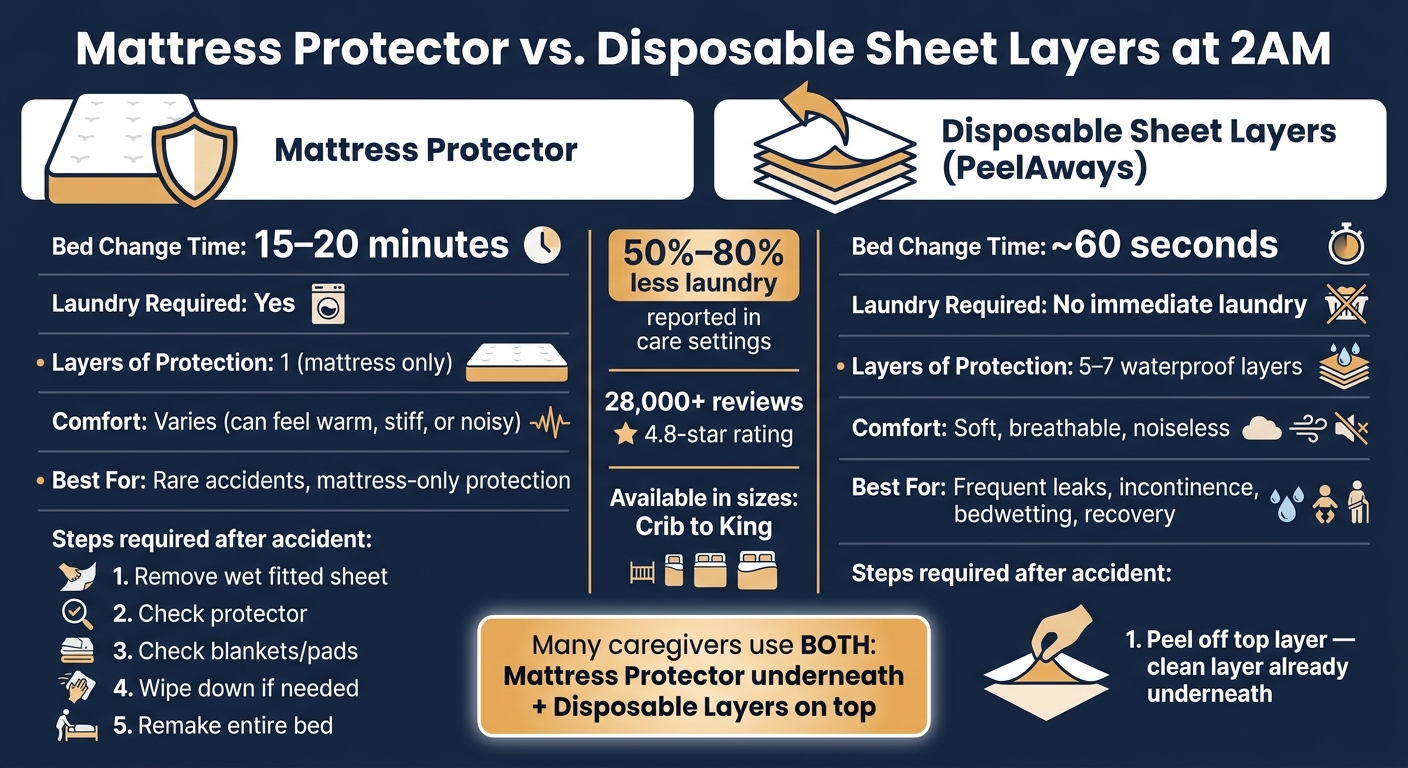
Mattress Protector vs. Disposable Sheet Layers: 2AM Bed Change Comparison
Caregivers Tired of Wet Beds? Try These Easy Nighttime Solutions for Aging Parents
sbb-itb-45288fe
Why this feels harder than people think
People talk about waterproof bedding like the main job is saving the mattress.
At 2 a.m., that’s not the main job.
The main job is getting the person clean, dry, and back to sleep with as little movement as possible.
That’s why this choice hits so hard.
A mattress protector can stop damage to the bed itself.
But you still have to deal with the wet top layers.
And that means:
- pulling off wet sheets
- checking what soaked through
- remaking the bed in the dark
- calming someone who may feel cold, sore, or ashamed
I’ve done that tired shuffle to the linen closet.
I’ve fought fitted corners half-asleep.
And I’ve learned the hard way that mattress protection and bed-change speed are not the same thing.
What I’d check before buying anything
Before you buy, I’d ask four plain questions.
1. How often is this happening?
If leaks are rare, a mattress protector may be enough.
2. What part is breaking you down?
If the hard part is laundry, lifting, and full sheet changes, multi-layer sheets simplify caregiving and make more sense.
3. Can the person in bed move easily?
If not, less handling matters. A fast top-layer removal is much easier on both of you.
4. Are you already using pads or diapers?
If yes, and leaks still happen, a layered sheet setup can close the gap those products don’t catch.
That’s the lens I’d use.
Not what sounds nice on paper.
What gets you through the night. For many, reducing caregiver stress is the ultimate goal.
Mattress protectors: what they do well, and what they don’t
A mattress protector has one clear job: (as part of a broader bedding strategy for caregivers)
Keep fluid off the mattress.
That matters. Mattresses are expensive. Odor and staining are hard to fix.
If accidents happen once in a while, a protector is a simple base layer. It stays on the bed and gives you a waterproof barrier under your fitted sheet.
But here’s the part that matters at 2 a.m.:
It does not remove the full bed change.
After a leak, you still need to:
- remove the wet fitted sheet
- check blankets and pads
- wipe down if needed
- put fresh bedding back on
That’s where the time goes.
So if you’re comparing these two options, I wouldn’t treat them like direct replacements. A mattress protector protects the mattress. It does not give you a fresh sleep surface in one pull.
Disposable sheet layers: why they change the night
Disposable sheet layers do a different job.
They are not just a barrier under the bed.
They are the sleep surface you remove when it gets wet.
That’s why they can save so much time.
With PeelAways, you get 5–7 waterproof layers in one fitted setup. When the top layer gets soiled, you peel it off at the seams. There’s already a clean, dry layer underneath.
No hunting for fresh linens.
No full remake.
No wet fitted corners to fight.
That’s the part that stood out to me.
Not hype. Just relief.
If you want to look at the product itself, you can check the PeelAways shop or the Amazon listing for PeelAways. If you want more detail first, the PeelAways blog also covers how PeelAways work and other help for night care on peelaways.com. This includes nighttime incontinence care tips for caregivers.
And if you’re wondering whether people stick with it, the product has 28,000+ reviews and a 4.8-star rating.
That tells me a lot of tired families found the same pain point.
Quick comparison
This is the cleanest way to look at it:
| Option | Best Use | Change Time | Protection | Feel | Best Fit |
|---|---|---|---|---|---|
| Mattress protector | Protecting the mattress from leaks | 15–20 minutes with sheet change | Mattress only | Varies by brand | Rare accidents |
| Peel-away disposable sheet layers | Fast overnight cleanup | About 60 seconds | Top waterproof layer plus layers below | Soft and quiet | Frequent leaks, incontinence, bedwetting, recovery |
If your top goal is mattress safety, start with the protector. Knowing how to choose bedding for incontinence care can help you balance protection with comfort.
If your top goal is getting back to sleep fast, layered sheets win.
A lot of people use both:
- a mattress protector underneath
- disposable peel-away layers on top
That setup gives you the mattress barrier and the fast reset.
FAQ
Do I still need a mattress protector if I use PeelAways?
I’d still keep one underneath if you want backup mattress coverage. The two products do different jobs.
Are disposable sheet layers only for older adults?
No. They can help with elderly incontinence, post-surgery leaks, bedwetting, potty training, and group care settings.
How much laundry can layered sheets cut?
Some care settings report 50%–80% less laundry, which can mean fewer overnight wash loads and less lifting.
How many layers come in a PeelAways set?
Each fitted set has 5–7 waterproof layers.
What sizes are available?
They come in sizes from crib to king.
Where can I buy PeelAways?
You can shop on peelaways.com/shop or find them on Amazon.
Bottom line
If you’re asking what works better at 2 a.m., my answer is simple:
Disposable sheet layers work better for the wet-bed moment.
Mattress protectors work better as the base layer that protects the mattress with waterproof bedding.
So if accidents are rare, a mattress protector may be enough.
If leaks happen often, and you need better strategies for keeping beds dry, if you already use pads or diapers, or if the bed change itself is what’s wearing you down, I’d look at PeelAways first. It’s one of those products I wish I had found sooner: 5–7 layers, crib to king, 28,000+ reviews, 4.8 stars, and a bed reset in about 60 seconds instead of 15–20 minutes.
That’s not small when you’re exhausted.
Making aging and caregiving easier, one bed at a time.
Blog readers save 10% with code BLOGS10 at checkout. Available on peelaways.com and Amazon. Free shipping on orders over $100.
How Mattress Protectors and Disposable Sheet Layers Handle Urgent Nighttime Accidents
It’s 2 a.m. The bed is wet, your hands are moving on autopilot, and all you want is to get your loved one dry without turning the whole room upside down. In that moment, the only thing that matters is this: are you facing a full bed reset, or one quick peel?
How a Mattress Protector Works During a Real Bed Change
A mattress protector keeps fluids from soaking into the mattress. That matters. Nobody wants a ruined mattress.
But here’s the hard part people don’t say out loud: it doesn’t cut down the nighttime work.
After an accident, you still have to pull off the wet sheet, check the protector, and make the bed again. In real life, that usually takes 15–20 minutes - right in the middle of the night.
How Multi-Layer Disposable Sheets Like PeelAways Work in 60 Seconds
PeelAways uses 5 to 7 waterproof sheet layers in one fitted setup. Each layer is sealed at the corners and edges with tear seams, so when the top layer gets soiled, you just grab the seams and peel it off.
Underneath, there’s already a clean, dry, waterproof layer in place. Fitted. Smooth. Ready to go.
It feels like a regular sheet, not plastic. No lifting the whole bed. No digging through a linen closet. No full remake. The reset takes about 60 seconds.
I remember the first time I saw something like this work. It didn’t feel dramatic. It felt like relief. One less long, messy middle-of-the-night change.
That’s the real difference here. One option protects the mattress. The other changes what the cleanup looks like when time is tight.
If you want to see PeelAways, you can find it on peelaways.com/shop or on Amazon. You can also read more on the PeelAways blog, like how layered bed sheets help with overnight incontinence care and tips for faster nighttime bed changes.
What Changes After a Nighttime Accident With Each Option
After an accident, one setup means a full reset. The other means a single peel.
With a standard mattress protector, you’re often dealing with wet layers, extra laundry, and a person lying there cold and tired while you fix the bed. With a peel-away setup, you remove one layer and there’s already a clean bed underneath. In many cases, the person can stay right where they are.
A lot of people use both at the same time:
- A mattress protector for long-term mattress coverage
- Disposable sheet layers for the fast overnight change
That’s where PeelAways stands out for me as a caregiver find, not just another product on a shelf. It’s built for the part nobody wants to deal with: the 2 a.m. cleanup. 60 seconds instead of 15–20 minutes. That’s a big deal when you’re exhausted. PeelAways comes in sizes from crib to king, has 28,000+ reviews, a 4.8-star rating, and stays ready with 5–7 layers in one fitted system.
Making aging and caregiving easier, one bed at a time.
Next comes the real-world tradeoff: cleanup time, laundry, comfort, and leak protection.
Cleanup Time, Laundry, Comfort, and Leak Protection: A Side-by-Side Look
It’s 2 a.m. The bed is wet, your loved one is half-awake, and you already know this isn’t just a quick fix. It’s a whole disruption, and in that moment, the thing that matters most is how fast you can get the bed dry and everyone back to sleep.
At this hour, the real difference comes down to what has to happen next: how much of the bed needs to be stripped, how long the person has to stay up, and how much work lands on you.
Cleanup Time and Sleep Disruption: Which Option Gets Everyone Back to Bed Faster?
A mattress protector setup often sounds simple on paper. In real life, it usually means pulling off wet bedding, checking whether the barrier held, and remaking the bed. That takes about 15 to 20 minutes.
Peel-away layers change that math. You peel off the soiled top layer, smooth the next one into place, and you’re done in under 60 seconds.
That gap matters when someone is tired, sore, embarrassed, or confused. Fifteen to twenty minutes can feel endless in the middle of the night. Under a minute feels like mercy.
Speed is one part of it. The next part is what the cleanup leaves behind.
Laundry Load, Cost, and Physical Effort: Which Setup Is Easier to Live With?
A mattress protector can save you from doing a wash cycle at 2 a.m., but the laundry still shows up later. Wet sheets, blankets, and extra bedding don’t wash themselves.
Disposable layers skip that wash cycle, which can be a huge relief when your back already hurts and your day is already full. The tradeoff is repeat product cost. In long-term care, that can add up to $500 to $1,000 a year.
So this isn’t just about money. It’s also about labor. It’s about whether you’d rather pay at checkout or pay with more loads of laundry, more lifting, and more interrupted sleep.
Comfort, Leak Protection, and Dignity: Which Option Feels Better and Protects Better?
This part gets overlooked way too often.
Some mattress protectors can feel warm, stiff, or noisy. If you’ve ever helped someone settle back into bed and heard that crinkly sound every time they shift, you know how much it can matter. PeelAways layers are soft, breathable, and noiseless.
That softer, quieter feel can help the person stay calm while you change the bed. And when someone already feels exposed, small things like texture and sound aren’t small at all.
Each layer is 100% waterproof, so fluids do not reach the mattress or lower layers. They can also stay tucked under regular sheets, which helps children or older adults deal with accidents without the whole ordeal of stripping the entire bed.
Here’s the side-by-side view:
| Solution | Cleanup Time | Laundry Required? | Comfort | Leak Protection | Best For |
|---|---|---|---|---|---|
| PeelAways Disposable Sheet Layers | Under 60 seconds | No immediate laundry | Soft, breathable, noiseless | Each layer is 100% waterproof | Frequent accidents, caregiving, overnight care |
| Mattress Protector + Fitted Sheet | About 15–20 minutes | Yes, after an accident | Can feel warm, stiff, or noisy | Baseline mattress protection | Long-term mattress safety |
The better fit depends on what you’re dealing with - elderly care, nighttime potty training regression, recovery, or a busy care setting. If you’re in the thick of night changes, that time gap alone can say a lot.
If you want to see PeelAways for yourself, you can find them on peelaways.com/shop or on Amazon. You can also read more on the PeelAways blog, including posts like How to Change a Bedridden Patient’s Bed Quickly and Best Bedding for Incontinence Care.
Which Option Fits Your Situation: Elderly Incontinence, Bedwetting, Recovery, or Potty Training?
It’s 2 a.m. again. The sheets are wet, your loved one is tired and embarrassed, and you’re standing there knowing this will turn into a full bed strip unless you’ve got a better setup. That moment is where the right option starts to matter.
Once you know the tradeoffs, the next question is fit: who is in the bed, and how often does it happen? The best choice depends on accident frequency, fluid volume, and how hard each bed change is on you.
What Works Best for Elderly Incontinence and Post-Surgery Recovery?
For older adults and people healing after surgery, the main goal is simple: less movement, less stress, less sleep lost. A mattress protector can help guard the mattress, but it still means pulling everything off and remaking the bed after an accident. At 2 a.m., that’s a lot. It’s slow. It’s hard on your back. And for someone with limited mobility, it can feel like too much.
That’s where PeelAways can change the whole rhythm of the night. Instead of doing a full strip and remake, you remove the soiled top layer and move on. For someone who can’t shift easily, that makes a nighttime accident far less disruptive.
Wet bedding can also irritate skin and slow recovery. PeelAways layers are hypoallergenic and free from Vinyl, PVC, and Phthalates, which makes them a better fit for sensitive skin.
In care settings, fewer full bed changes also means less labor and less laundry. And if you’ve ever hauled a pile of soaked sheets to the washer before sunrise, you already know why that matters.
The same issue shows up in a different way with children. The need for speed is still there, but now sleep and confidence matter just as much.
What Works Best for Kids' Bedwetting and Potty Training Accidents?
With kids, you’re not just dealing with a wet bed. You’re dealing with a sleepy child, maybe some tears, maybe embarrassment, and the hope that everyone can get back to sleep fast.
Disposable layers help keep that moment short. The mattress stays dry. The change stays quick. Your child can stay in bed, and the bed can be ready again in under a minute. That’s a big deal when you’re trying not to fully wake them up.
During potty training, this setup helps even more. If you already have multiple layers in place, you can get through several accidents before you need to reset the whole bed. That can save you from doing the same draining routine over and over in one night.
If you use diapers or incontinence pads and still deal with leaks, PeelAways is the kind of thing many families end up wishing they’d found sooner. It comes in 5-7 layers, sizes crib to king, and it’s backed by 28,000+ reviews with a 4.8-star rating. I came across it the same way a lot of people do: not from an ad, but from another tired caregiver who just wanted one part of the night to get easier.
You can see the full range at peelaways.com/shop, check the Amazon listing for PeelAways, and read more on the PeelAways blog, including other posts on bedwetting and incontinence support.
What Healthcare Facilities and Group Homes Should Prioritize
In a facility or group home, every minute counts. Staff need a setup that cuts time per change, lowers laundry volume, and works the same way across many beds, night after night.
A full bed change in a professional setting takes about 15 minutes. A PeelAways change takes about 5 minutes. That 10-minute gap adds up fast when staff are moving room to room.
Laundry is another major pressure point. Facilities using multi-layer disposable sheet systems report a 50% to 80% reduction in laundry volume. The return on investment usually comes within 3 to 12 months.
There’s also the hygiene piece. Because each layer is single-use and fully waterproof, the system helps cut fluid transfer between residents. For any care team trying to keep things cleaner while easing the load on staff, that matters.
If you want more detail, PeelAways has more information on peelaways.com/shop, the Amazon listing for PeelAways, and related articles on peelaways.com that dig into bed changes, nighttime leaks, and caregiver stress. The whole idea is pretty simple: Making aging and caregiving easier, one bed at a time.
Bottom line: which option should caregivers choose?
It’s 2 a.m. again. The bed is wet, your loved one is tired and embarrassed, and you’re standing there knowing this could turn into another 15 to 20 minutes of stripping sheets, wiping down the bed, and starting over. If that’s been your night lately, the right choice comes down to one thing: how often you need a fast reset.
After comparing cleanup time, laundry, comfort, and leak protection, the answer is pretty simple. A mattress protector works best for rare accidents. Disposable multi-layer sheets make more sense when frequent accidents, limited mobility, or repeat middle-of-the-night changes make speed the top concern.
When a mattress protector makes the most sense
A mattress protector is a good fit when accidents only happen once in a while and your main goal is protecting an expensive mattress from stains and odors. It does that job well.
But here’s the hard part: it protects the mattress, not the whole cleanup. You still have to do a full bed change.
If accidents are rare, that may be enough. If they keep happening, the mattress stays safe, but you’re still stuck doing the same long reset.
When disposable sheet layers make the most sense
Disposable sheet layers make more sense when the main problem isn’t the mattress. It’s the full bed change.
When one layer gets soiled, you peel it away and there’s a clean, dry layer underneath in under 60 seconds, without stripping the whole bed. For elderly incontinence, post-surgery recovery, or repeat bedwetting, that time gap matters. A lot.
This is the kind of thing you don’t fully get until you’ve done it half-asleep with a sore back. Saving those extra minutes can mean less stress for you and more dignity for the person in the bed.
Why consider PeelAways next?
PeelAways multi-layer disposable sheets are made for exactly this kind of night. Each set has 5 to 7 fully waterproof layers, and they come in sizes from crib to king. If you use incontinence pads or diapers, they fit right into that routine and make the bed side of care much easier.
What stood out to me is how simple the idea is. One layer gets wet, you remove it, and you move on. No full strip. No pile of laundry waiting for morning.
PeelAways has 28,000+ reviews and a 4.8-star rating, which tells you a lot of tired families have landed in the same place. If your measure of success is how fast you can get someone clean, dry, and back to sleep, this is the option worth looking at next.
You can shop PeelAways on peelaways.com/shop or find them on Amazon. If you want more help sorting through nighttime care, read how PeelAways work and other caregiving tips from PeelAways.
Making aging and caregiving easier, one bed at a time.
Blog readers save 10% with code BLOGS10 at checkout. Available on peelaways.com and Amazon. Free shipping on orders over $100.
Comments
0



SAVE MONEY & WATER
Professionals & Institutions save a fortune on labor/laundry.

SUPERIOR COMFORT
The first thing our customers notice is how soft our sheets are.

100% WATERPROOF
Each layer is 100% Waterproof, perfect for spills and accidents

SAVE TIME
Change the sheet in under 1 minute without stripping the bed.

Leave a comment