
How to Change a Bed in Under 60 Seconds - The Caregiver's Guide

It’s 2 a.m. The sheets are soaked again. Your loved one is embarrassed, your back hurts, and you have to be up in four hours. If this is your night, you do not need more advice. You need a bed change that takes about 60 seconds, not 15 to 20 minutes.
A fast bed change works when you set up the bed ahead of time with 5 to 7 waterproof layers and peel off the top soiled layer when there is a leak. That means less rolling, less laundry, and less stress in the middle of the night. PeelAways is the setup I wish I had found sooner: it has 28,000+ reviews, a 4.8-star rating, and sizes from crib to king.
- Best for: urine leaks and surface-level messes
- Main time difference: 60 seconds vs. 15–20 minutes
- Laundry impact: reported 50% to 80% less laundry
- Setup: layered disposable fitted sheets with waterproof backing
- Best fit: if you already use diapers, pads, or underpads at night
If you are tired of stripping the whole bed at 2 a.m., this is the setup I would look at first.
The Secret to Senior Adult Diaper and Bed Pad Changes for Family Caregivers
Why this is harder than people think
Nighttime bed changes are not only about wet sheets.
They are about sleep loss, back strain, and that awful pause when someone you love looks at you like they did something wrong.
A standard occupied-bed change can take 15 to 20 minutes. That means rolling, untucking, wiping down the bed, changing layers, and starting laundry when you barely have the energy to stand.
That is why a peel-away setup matters.
It cuts out the worst part of the job: the full reset.
And if you are doing this more than once a week, that time adds up fast.
What I would look for before buying
If you are comparing bed-change products, I would keep it simple.
Look for:
- Multiple waterproof layers, not one pad at a time
- A fitted design that stays in place
- Enough coverage to protect the mattress
- Sizes that match your bed, from crib to king
- A setup that works with your current nighttime routine
I would also think about the mess itself.
If the leak stays on the top layer, a peel-away setup makes sense.
If stool, wound drainage, or heavy soaking gets through to the lower layers, you still need a full sheet change.
PeelAways
This is the one that stands out to me because it solves the 2 a.m. problem in the most direct way.
PeelAways are disposable fitted sheets stacked in 5 to 7 waterproof layers. When the top layer gets wet or soiled, you peel it off and the next clean layer is already in place.
That is the whole point.
No corners. No full remake. No extra laundry load before sunrise.
A few details matter:
- 28,000+ verified reviews
- 4.8 stars
- Sizes from crib to king
- Price range: $30.99 to $53.99
If you use diapers or incontinence pads, this kind of setup can take a rough night from chaos to something you can handle half-awake.
You can find it on the PeelAways shop and the PeelAways Amazon listing.
If you want more help on overnight care, these reads are worth saving:
Chux pads and washable underpads
These can help, but they do not solve the whole job.
A pad may catch some moisture, but once it shifts, bunches, or leaks through, you are still dealing with the fitted sheet underneath. That means more cleanup and more laundry.
Washable underpads can save money over time, but they add one more thing to wash, dry, fold, and restock.
That is fine during the day.
At 2 a.m., it is often not enough.
Standard fitted sheets
This is what most of us start with.
And it is rough.
When the bed gets wet, you are doing a full change. You are pulling corners, rolling your loved one, fixing blankets, and hoping the mattress protector did its job.
It works.
It is just slow, tiring, and hard to repeat night after night.
Quick comparison
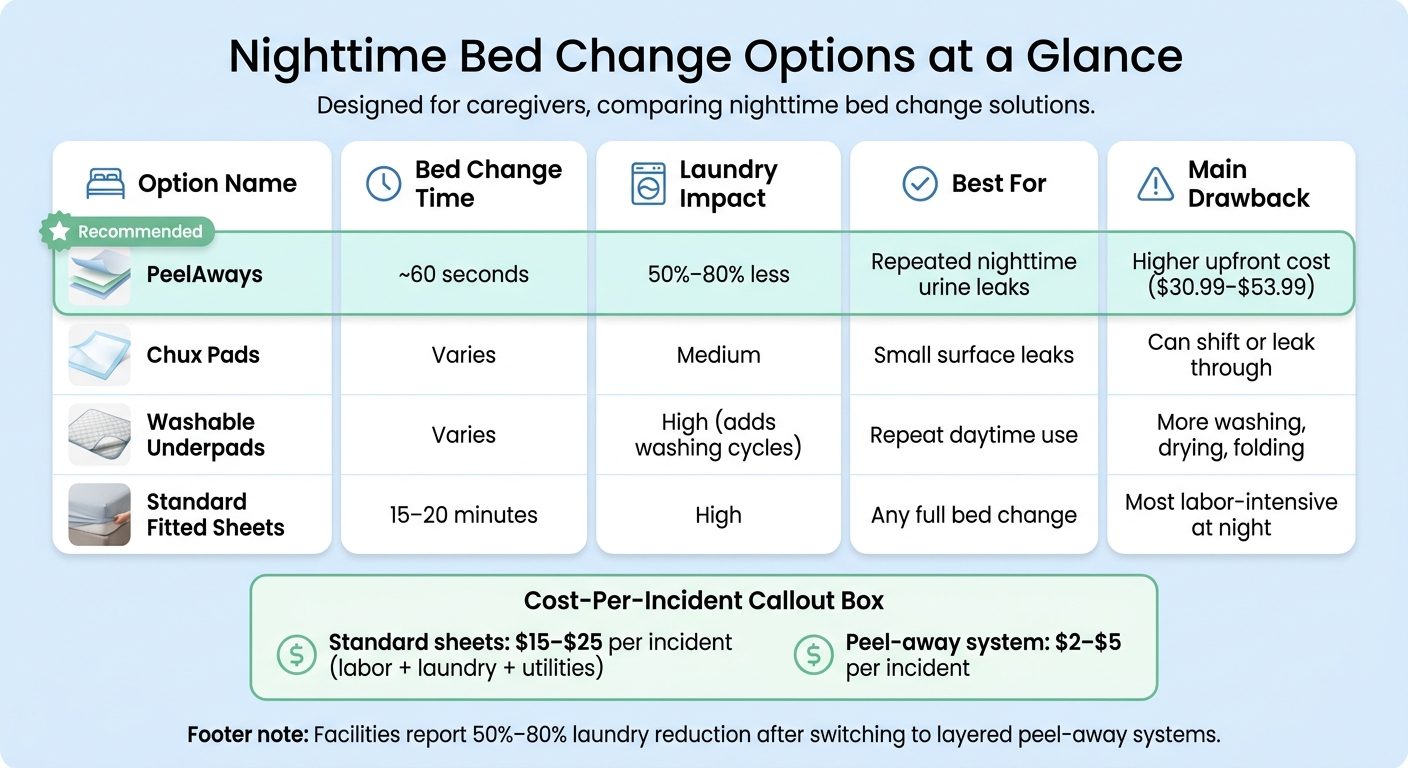
Nighttime Bed Change Options: Speed, Laundry & Cost Compared
| Option | Bed change time | Laundry | Best for | Main drawback |
|---|---|---|---|---|
| PeelAways | About 60 seconds | 50%–80% less | Repeated nighttime leaks | Higher upfront cost |
| Chux pads | Varies | Medium | Small surface leaks | Can shift or leak |
| Washable underpads | Varies | High | Repeat use | More washing |
| Standard fitted sheets | 15–20 minutes | High | Any full bed change | Most work at night |
FAQ
Can you change a bed in under 60 seconds?
Yes, if the bed is already layered and the mess is only on the top waterproof sheet. The time comes from prep, not rushing.
sbb-itb-45288fe
When does a peel-away bed change work best?
It works best for urine leaks and other surface-level messes that do not soak through to the fitted sheet or mattress protector.
When do you still need a full bed change?
You need a full change when moisture reaches the lower layers, or when stool, wound drainage, or spread-out messes are involved.
Do PeelAways work with mattress protectors?
Yes. You can place them over a mattress protector for added backup.
Are PeelAways only for hospital beds?
No. They come in sizes from crib to king, so they work for home beds too.
Bottom line
If you are changing wet sheets in the middle of the night, the hard part is not the bedding.
It is the repeat work. The laundry. The lifting. The way it wears you down.
That is why I keep coming back to PeelAways.
You get 5 to 7 waterproof layers, a clean layer ready underneath, and a bed change that can take about 60 seconds instead of 15 to 20 minutes. With 28,000+ reviews, a 4.8-star rating, and sizes from crib to king, it is one of the few products that speaks to what this job is actually like.
PeelAways: Making aging and caregiving easier, one bed at a time.
Shop here: peelaways.com/shop
Amazon: PeelAways on Amazon
Blog readers save 10% with code BLOGS10 at checkout. Available on peelaways.com and Amazon. Free shipping on orders over $100.
What supplies should caregivers keep within reach for fast bed changes?
It’s 2 a.m. again. You’re half asleep, the bed is wet, and the last thing you want is to start hunting for wipes in a drawer while your loved one lies there waiting.
Fast bed changes start with one simple thing: a small bedside kit you can reach without taking a step.
How to build a bedside incontinence care kit
Keep gloves, wipes, barrier cream, an underpad, a trash bag, and a clean blanket in one bedside caddy. That setup matters more than people think. When everything is right there, you don’t have to bend, dig through cabinets, or leave the bedside in the middle of cleanup.
That saves time. It also helps you keep the moment calmer and less upsetting for your loved one.
With the bedside kit ready, the bed itself becomes the next time-saving step.
How PeelAways fits a 60-second bed-change routine
PeelAways are patented multi-layer disposable fitted sheets with 5 to 7 waterproof layers stacked together. When the top layer is soiled, peel it away to reveal a clean layer underneath. It’s one of those things that sounds almost too simple until you do it once in the dark and realize it just works.
A helpful trick: pre-rip the top corners before bed so the layer pulls free fast at night.
Once the layers are prepped, the bed is ready for a fast peel-and-replace change.
How to layer the bed for speed, comfort, and mattress protection
Place PeelAways on the mattress or over a mattress protector, with the tag or green stitching at the head. Each clean layer holds up for 7 to 10 days if not soiled.
That means you’re not starting from scratch every time. You’re setting up the bed once, then making each cleanup much easier after that.
With supplies within reach and the bed layered, the actual change is quick.
How to change a bed in under 60 seconds, step by step
It’s 2 a.m. again. The bed is wet, your loved one is tired and embarrassed, and you’re trying to move fast without making the moment feel worse.
Once the bed is staged, stick to the same three-step rhythm: prepare, peel, then smooth and check.
Step 1: Prepare the person and the space safely
This is where the setup pays off. Wash your hands, put on gloves, lock the bed wheels, and lower the rail on your side before you start.
Tell your loved one what you’re about to do in a calm, simple voice. That small step matters. It helps them feel less startled and more at ease. Keep them covered with a blanket or bath sheet as much as you can to protect privacy.
Step 2: Clean the soiled area and peel away the top sheet layer
Gently clean the soiled skin with wipes, then pat it dry. Quick skin care helps cut down irritation and lowers the risk of pressure injuries. Place a clean pad under the hips.
If you need to roll the person, keep one hand on them for support while you peel with the other. Then do the fast part: pull from the pre-ripped corners and peel along the seams toward the foot of the bed. Fold the used layer inward as you go so moisture stays contained. Use a gentle side roll. Don’t lift or tug. Roll the used layer into the disposal bag.
Step 3: Smooth the clean layer and do a final comfort check
Flatten the clean layer all the way. Smooth out every wrinkle. Even small folds can bother fragile skin.
Run your hand across the surface. Check that the corners are snug. If needed, use sheet clips to keep the bed flat.
Then put pillows and blankets back in place. Check comfort, warmth, and privacy before you step away. Set water, a call device, or anything else they need back within reach.
Use this method when the bed is pre-layered and cleanup needs to stay fast. Next, match this quick-peel method to the situation.
When to Use a Quick-Peel Bed Change Instead of a Full Sheet Change
It’s 2am. The top layer is wet, your loved one is half-awake, and you’re standing there doing the math in your head. Can you fix this in one minute and keep everyone calm, or are you about to do the whole bed?
Once the bed is pre-layered, that’s the next call to make. A quick peel works only when the mess stays above the fitted sheet.
Situations Where a 60-Second Bed Change Works Best
Use quick-peel when the mess is surface-level and contained. In plain English, that means the moisture has not soaked through to the fitted sheet or mattress protector. This usually covers overnight urine leaks and light incontinence.
This is also where PeelAways can make a hard night a little easier. If your loved one has limited mobility, has dementia, or is recovering from surgery, less rolling matters. Less repositioning matters. Less hands-on bed work matters. You peel off the wet top layer, and there’s a clean layer right underneath.
That’s the whole point: less movement, less disruption, less stress.
If you can remove the wet top layer without touching the fitted sheet or mattress protector, quick-peel is enough. If the wetness got below that top layer, it’s time for a full change instead.
When a Full Occupied-Bed Change Is Still the Right Call
Sometimes the mess goes deeper, and there’s no shortcut around it. A full bed change is needed when moisture has reached more than the top layer, including the underpad, fitted sheet, or mattress protector. If the blankets, pillows, or positioning aids are soiled too, those need to be changed as well.
The simplest rule is still the best one:
- Use quick-peel when only the top layer is soiled.
- Use a full occupied-bed change when leakage reaches the underpad, fitted sheet, or mattress protector.
- Use a full change for stool, wound drainage, or spread-out contamination that can create skin or infection risk.
That last part matters. When the mess is more than a small urine leak, this stops being just a laundry issue. It becomes a comfort, skin, and hygiene issue.
PeelAways vs. Chux Pads, Washable Underpads, and Standard Fitted Sheets: A Side-by-Side Look
For surface-level accidents, quick-peel is the faster, lower-strain option.
How a Faster Bed-Change System Affects Caregiver Stress, Laundry, and Cost
It’s 2 a.m. again. The bed is wet, your loved one feels awful, and you’re staring at one more full sheet change when you barely have the energy to stand. That kind of night doesn’t just tire you out once. It chips away at you over time.
Repeated nighttime bed changes wear caregivers down, plain and simple. A layered system cuts that burden. Facilities that switch to faster bed-change systems report laundry volume drops of 50% to 80%.
How Faster Bed Changes Reduce Burnout at Home and in Care Settings
Once the bed is pre-layered, the payoff isn’t only speed. It’s less physical strain every single time there’s an accident.
A peel-away change takes away much of the lifting and tucking. No fighting with fitted corners. No dragging sheets off the bed while half awake. No emergency laundry at 2 a.m.
That’s where the relief starts to show. Not only on one rough night, but across weeks and months. If you’re the one doing the cleanup, you feel that difference in your back, your sleep, and your patience. At home or in a care setting, less repeated labor can mean less burnout.
Sizes and Pricing
That time savings also cuts the hidden cost of repeated laundry, extra supplies, and mattress damage.
PeelAways comes in sizes from Crib-A-Peel through King, with prices ranging from $30.99 to $53.99. In a care setting, a bed change with standard sheets costs about $15 to $25 per incident when labor, laundry, and utilities are included. A layered peel-away system is estimated at $2 to $5 per incident.
For home caregivers, the math shows up in everyday life:
- Fewer laundry cycles
- Lower water and power bills
- Less wear on bedding
- Fewer mattress replacements, which can cost $500 to $3,000
When you step back and look at the whole picture, it’s not only about buying sheets. It’s about cutting the repeat work that keeps piling up night after night.
Conclusion: The Simplest Next Step for Easier Nighttime Bed Changes
The fastest change starts before the accident. Keep the bed layered and ready.
PeelAways multi-layer disposable sheets are built around that idea. You peel away the soiled layer in under 60 seconds, and a clean, waterproof layer is already there underneath. That means a nighttime accident can turn into a fast, calm reset instead of a full-blown mess.
You can buy PeelAways on Amazon or at PeelAways.com.
Comments
0



SAVE MONEY & WATER
Professionals & Institutions save a fortune on labor/laundry.

SUPERIOR COMFORT
The first thing our customers notice is how soft our sheets are.

100% WATERPROOF
Each layer is 100% Waterproof, perfect for spills and accidents

SAVE TIME
Change the sheet in under 1 minute without stripping the bed.

Leave a comment