
Hospital Level Care at Home: Products That Make a Difference

It’s 2am. The sheets are soaked again. Your loved one is embarrassed, your back hurts, and you have to be up in four hours. You’re not looking for fancy gear. You’re looking for anything that makes this easier tonight.
A home bed can work a lot more like a hospital bed when you layer the right products in the right order. The best setup helps you change a wet bed in about 60 seconds instead of 15–20 minutes, cuts laundry by 50%–80%, and keeps skin and the mattress drier. One product that stands out is PeelAways: a multi-layer waterproof fitted sheet with 5–7 layers, 28,000+ reviews, a 4.8-star rating, and sizes from crib to king.
- PeelAways multi-layer disposable sheets for fast bed resets
- Waterproof mattress protectors to keep the mattress dry
- Absorbent underpads to catch leaks before they spread
- Incontinence supplies to keep moisture off skin
- Mobility items to make transfers safer
- Bedside tools so you’re not searching in the dark
Knowing how to replace sheets on an occupied bed is essential for safety. If you’re doing bed changes, skin checks, and nighttime cleanup, this is the setup that helps most.
Using bed and chair protection when living with incontinence
sbb-itb-45288fe
Why this problem is harder than people realize
The hard part is not one accident.
It’s the repeat.
The wet sheets at night.
The smell.
The load of laundry you did yesterday that is back again tonight.
I know how small those moments can look from the outside. But at 2:00 a.m., they feel big. They cost sleep. They wear down your back. They chip away at your patience, even when you love the person in that bed more than anything. Managing the emotional challenges of caregiving is just as critical as the physical tasks.
That’s why “hospital level care at home” is not about making your room look medical. It’s about making cleanup shorter, keeping skin dry, and keeping your loved one from feeling exposed every time something leaks.
What to look for before buying
Before you buy anything, I’d check for five things:
- Fast changes: Can you swap the wet part without remaking the whole bed?
- Waterproof protection: Will it stop moisture before it reaches the mattress?
- Skin comfort: Is the top layer soft and breathable?
- Less strain: Does it cut bending, lifting, and extra laundry?
- Easy setup: Can you keep it stocked and ready at the bedside?
If a product misses those points, it may add one more job instead of taking one away.
PeelAways multi-layer disposable waterproof bed sheets
If you use diapers, briefs, or incontinence pads, you should look at PeelAways.
This was the first product in the article that felt like it was built by someone who had done this before. It’s a fitted sheet with 5–7 waterproof layers stacked together. When the top layer gets wet, you peel it off and there’s a clean one underneath.
That means:
- No full bed remake
- No lifting the mattress
- No stripping everything off at 2am
- No extra load of laundry right then, using time-saving tips for bedding changes
The biggest difference is time. A full sheet change can take 15–20 minutes. PeelAways can get you back to a dry bed in about 60 seconds.
That gap matters when you’re tired and your loved one is lying there waiting.
A few facts that help:
- 28,000+ verified reviews
- 4.8-star rating
- Sizes crib to king
- Made for repeat overnight bed changes
You can check PeelAways on peelaways.com/shop or the Amazon listing for PeelAways.
If you want more details, these are worth reading too:
- PeelAways blog
- PeelAways care guides and articles
Waterproof mattress protectors
A waterproof mattress pad or protector does one job: it keeps liquid out of the mattress.
That sounds simple. But if you’ve ever had urine soak past the sheet, you know how bad it gets once the mattress is involved. Now you’re not just changing bedding. You’re cleaning odor, trying to dry foam, and hoping the smell does not stick.
A good protector should be:
- Waterproof
- Quiet
- Breathable
- Fitted tight enough that it does not bunch up
I’d keep one on the bed all the time. It’s the base layer. Everything else works better because this layer is there. Knowing how to choose bedding for incontinence care ensures you have the right system in place.
Absorbent underpads
Underpads catch leaks closer to the body.
That’s their whole job.
You put them where leaks happen most often, usually under the hips and lower back. When one gets wet, you remove the pad instead of changing the whole bed.
That can save you a lot of work.
For many homes, the best split is:
- Reusable pads for daytime or lighter use
- Disposable pads for overnight, travel, or heavier leaks
A good underpad helps with:
- Less spread
- Less odor
- Less sheet washing
- Less moisture on skin
It also gives you one more layer between “small leak” and “full bed problem.”
Incontinence care supplies
The best bed protection still works better when the body protection is right.
That means keeping the basics close:
- Briefs or protective underwear
- Gloves
- Wipes
- No-rinse cleanser
- Barrier cream
- Disposal bags
The goal is simple: stop as much moisture as you can before it reaches the bed.
For someone who stays in bed most of the time, tab-style briefs are often easier to change than pull-ons. For someone who still walks to the bathroom, pull-on styles may feel more normal.
And after each change, skin care matters.
A quick clean, a dry pat, and a thin barrier cream can help lower rash and skin breakdown.
Mobility-support items
A wet bed is hard enough.
A wet bed plus a hard transfer is where your back pays for it.
Mobility items help with bed-to-chair moves, standing, turning, and repositioning. The article covered:
- Gait belts
- Transfer boards
- Slide sheets
- Stand-assist or full-body lifts
You do not need every item at once. But if transfers feel shaky, this is where I’d look next.
These tools help by:
- Cutting down on awkward lifting
- Making turns smoother
- Lowering slip risk
- Helping your loved one feel more steady
Even small items can help if they stop one bad twist of your lower back.
Bedside setup tools
Sometimes the problem is not the product.
It’s that the wipes are across the room.
A good bedside setup saves steps and saves energy. Keep a tray, cart, or basket stocked before bed so you can reach what you need with one hand.
My short list would be:
- Gloves
- Wipes
- Barrier cream
- Spare underpads
- Spare briefs
- Disposal bags
- Flashlight or motion light
- Hamper or lined trash can nearby for proper bedding disposal
This is the part people skip because it looks too simple.
Then 2am comes, and they’re digging through drawers in the dark.
Quick comparison
| Product | What it does best | Best for |
|---|---|---|
| PeelAways | Fast top-layer bed changes | Night accidents, heavy leaks, post-surgery care |
| Mattress protector | Keeps liquid out of mattress | Every care bed |
| Underpads | Catches leaks in one area | Bedbound care, backup leak control |
| Incontinence briefs/pads | Stops leaks before bedding | Daily wear and nighttime protection |
| Mobility items | Safer turning and transfers | Bed-to-chair moves, repositioning |
| Bedside tools | Cuts searching and extra steps | Night care and fast cleanup |
FAQ
What is the best way to protect a bed for incontinence at home?
I’d layer it like this: mattress protector first, then PeelAways, then an underpad where leaks happen most. That gives you mattress protection, a fast-change top layer, and spot absorbency.
Are disposable vs. washable bed sheets worth the investment?
If you are changing wet beds often, yes. The big reason is time. About 60 seconds for a reset can beat 15–20 minutes for a full sheet change.
Do I still need a mattress protector if I use PeelAways?
Yes. PeelAways protects the sleep surface and helps with fast changes. A mattress protector is still your backup layer under everything.
What helps cut laundry the most?
A layered setup usually helps most: body protection, underpads, a waterproof base, and PeelAways on top. That can cut laundry by 50%–80% for some homes.
What size does PeelAways come in?
Sizes run from crib to king, so it can work for child, twin, full, queen, and king beds.
Bottom line
If you’re exhausted and doing repeated bed changes, the best home setup is simple: use bedding solutions for incontinence to protect the mattress, catch leaks early, keep supplies by the bed,
What Hospital-Level Care at Home Actually Looks Like
It’s 2am. The bed is wet again, your loved one is tired, and you’re trying to change everything without hurting your back or waking the whole house. In that moment, “care at home” doesn’t feel simple. It feels like a job built on speed, safety, and keeping someone’s dignity intact.
Hospital-level care at home means setting up your space so cleanup is fast, transfers are safer, and skin stays protected even when no nurse is standing nearby. It comes down to a steady routine and the right products in the right places.
The same idea used in care settings works at home too: layered waterproof protection and absorbent pads let you remove one soiled layer and reset the bed in minutes. That matters when you’re exhausted and trying to get your loved one clean, dry, and settled back down without a full linen change every time.
Transfers are where a lot can go wrong for both you and the person you’re helping. A bed rail, a non-slip mat, and a clear path to the bathroom may sound small, but they can turn a shaky, stressful move into something more planned and less risky. When everything is set up before you need it, you’re not scrambling in the moment.
Skin care is tied to all of this. If skin stays in contact with moisture for too long, pressure sores and rashes can start. That’s why the basics matter so much: change wet items fast, use breathable waterproof layers, and check skin every day. Nothing fancy. Just the kind of habits that save you trouble later.
And the strain is real. Research shows that 77.3% of caregivers report physical burden and 78.1% report emotional burden when managing incontinence and toileting at home. A layered bedside setup - with supplies close by and protection already in place - can cut cleanup time and take some of that weight off your shoulders. Next comes the first layer that matters most: the bed sheet itself.
1. PeelAways Multi-Layer Disposable Waterproof Bed Sheets
It’s 2 a.m.
The bed is wet again.
You’re tired, your back already hurts, and the last thing you want to do is strip the whole bed while your loved one waits, embarrassed and half-awake.
The first layer to get right is the sheet itself.
PeelAways solves one of the hardest parts of home care: changing a wet bed fast. I remember the first time I saw it and thought, where has this been all my life? It’s a disposable fitted sheet with multiple peel-off layers. When one layer gets soiled, you peel it away and a clean, dry sheet is already underneath. No lifting the mattress. No full bed remake.
It’s the kind of fix that makes sense the second you see it.
How the Layer System Works
Each layer peels away cleanly, and the waterproof barrier stops moisture from reaching the next layer. The surface is soft, breathable, quiet, and comfortable, which matters more than people think at night.
PeelAways comes with 5–7 layers, depending on the product, so you’re not starting from scratch after every accident. That’s a big deal when nights feel long and sleep is already hard to come by.
Less Back Strain
Repeated sheet changes mean repeated bending, lifting, and tucking. That adds up fast. PeelAways cuts that work down by making each reset take about 60 seconds, instead of the 15–20 minutes a full sheet change can take.
That time gap is not small when you’re exhausted.
A faster change also means skin stays wet for less time, which helps with comfort and dignity. It keeps the bed looking neat. It helps your loved one stay settled instead of fully waking up for a long cleanup.
It’s available in common bed sizes - from crib to king - and made for repeated overnight use. It also has 28,000+ reviews and a 4.8-star rating, which gave me a little peace of mind the first time I looked into it.
If you want to see the options, you can check PeelAways on peelaways.com/shop or the Amazon listing for PeelAways. For more help on keeping beds dry during incontinence care, see other articles on peelaways.com and the PeelAways blog.
Once the sheet is covered, the next layer is mattress protection.
2. Waterproof Mattress Protectors
It’s 2am. The sheet is wet, your loved one is half-awake, and the last thing you need is moisture soaking all the way into the mattress. In that moment, a waterproof mattress protector isn’t a nice extra. It’s the layer that keeps a hard night from turning into a full-blown mess.
A waterproof mattress protector is the always-on barrier between the mattress and moisture. It helps stop urine, sweat, and spills from soaking into the mattress itself. That means less deep cleaning, less odor, and a bed that lasts longer. It sits under the fitted sheet, so the mattress stays covered between changes.
How It Reduces Cleanup Time
Without a protector, a nighttime accident doesn’t stop at the sheets. You’re dealing with the mattress too, and that’s where the job gets heavier.
A waterproof protector keeps moisture on a removable layer instead. So cleanup is often limited to washing or swapping out the protector. That matters most overnight, when every minute counts and the mattress needs to stay dry. Mold can begin growing inside a damp mattress within 24–48 hours, so stopping moisture here helps protect the bed over time.
How It Blocks Moisture and Odor
Most protectors use a soft fabric top with a waterproof polyurethane backing. That backing blocks liquid while still letting air move through. The result is a sleep surface that stays cooler and drier.
That airflow also helps cut down on trapped heat and odor over time. And if you’ve ever walked into a room and caught that stale, damp smell, you know how much that matters.
How It Supports Skin Health
Damp bedding against the skin for hours can lead to irritation and pressure injuries. For someone who spends a lot of time in bed, a dry sleep surface matters.
Materials also make a difference. Hypoallergenic, vinyl-free, PVC-free, and phthalate-free options tend to be a better pick for sensitive skin.
How It Eases Caregiver Workload
Put the protector directly on the mattress, then place the fitted sheet on top. If you add a disposable top layer above that, you get another line of defense without making the bed feel bulky.
That setup helps keep the mattress covered while making nighttime cleanup easier. Less laundry. Fewer full bed remakes. Less work when you’re already running on fumes. Understanding the factors for choosing bedding can help you find the right balance of comfort and protection.
Choose a fitted, quiet, breathable protector that stays snug under the sheet. Next comes absorbent bed pads and underpads for extra protection on top.
3. Absorbent Bed Pads and Underpads
It’s 2am. There’s that damp spot again. You don’t need a full bed disaster for your whole night to go sideways.
Even with a waterproof mattress protector on the bed, you still need something that catches moisture before it spreads. That’s where absorbent bed pads and underpads come in. They sit right on top of the sheet, usually under the hips or lower back, where leaks tend to happen first. The protector guards the mattress. The underpad handles the mess closer to the body. That one layer can save you from redoing the entire bed.
How They Cut Cleanup Time
This is the part that matters when you’re half-awake and running on fumes.
Unlike a mattress protector, an underpad is made for fast spot changes. When it’s soiled, you lift out one pad instead of stripping sheets and starting over. Roll it inward to contain the moisture, take it away, and lay down a clean one. That’s it. No full bed remake. No dragging out the whole routine in the middle of the night.
How They Manage Moisture and Odor
Most absorbent underpads have several layers: a soft top sheet, an absorbent core, and a waterproof backing. The core pulls fluid away from the surface, which helps keep skin drier. That matters more than people think. Less moisture sitting on the skin often means less odor too.
For overnight use, high-absorbency pads can handle heavy output. Some home-care pads around 36" x 24" are rated to absorb 1,200–1,800 mL.
### How They Protect Skin and Dignity
When skin stays damp for long stretches, it can soften and start to break down. That risk is higher for older adults who spend a lot of time in bed. A pad with a soft, nonwoven top layer can wick fluid away fast and help keep the skin drier between changes.
There’s also the human side of this. Leaks don’t just create laundry. They create stress, embarrassment, and that awful feeling that the bed is never quite safe. A pad you can trust takes some of that pressure off.
How They Lower Caregiver Strain
Changing a pad is a lot easier on your back than changing sheets. So if you use them, keep clean ones within reach. That small habit helps more than you’d think. You can also use a checklist for streamlining incontinence care to stay organized.
A lot of families do best with a mix:
- Reusable pads for day-to-day use
- Disposable pads for heavier nights or times when fast, hygienic cleanup matters most
Individual reusable pads can cost as little as $9–$13.99 and last through dozens of wash cycles.
The next layer is incontinence care supplies for daily comfort and protection.
4. Incontinence Care Supplies
It’s 3 a.m. again. The bed is damp, your loved one is embarrassed, and you’re trying to change everything without waking them all the way up. This part of caregiving can wear you down fast.
Incontinence affects an estimated 13 million people in the United States, and about 53% of homebound older adults are incontinent. If underpads protect the bed, incontinence supplies protect the person and make the change itself much easier.
How They Speed Up Cleanup
The biggest time-saver is simple: stop the leak before it reaches the sheets.
High-absorbency tab-style briefs with leak guards can mean changing one garment instead of stripping the whole bed. That alone can cut cleanup time in a big way. And when you’re half-awake, that matters.
Keep the basics close by:
- briefs
- disposable gloves
- no-rinse cleanser
- wipes
No walking across the house. No digging through drawers. No standing there at 3 a.m. wondering where the wipes went.
How They Control Moisture and Odor
Modern absorbent briefs use superabsorbent polymer cores that pull fluid away from the skin fast. That helps keep skin drier between changes and can reduce odor.
A diaper pail with a lid also helps. You can seal soiled items right away instead of carrying them through the house each time. It’s one small thing, but it makes the room feel more settled.
How They Protect Skin and Dignity
IAD, or skin irritation from prolonged moisture, is a real risk when skin stays damp for long stretches, especially for older adults who spend a lot of time in bed.
After each episode, the routine should be gentle and simple. Clean the skin with a pH-balanced no-rinse cleanser, add moisturizer, then apply a thin barrier cream or film with zinc oxide or dimethicone to high-risk areas.
This isn’t just about skin. It’s also about dignity. A calm, clean change helps your loved one feel cared for, not rushed or exposed.
How They Reduce Caregiver Strain
Good supplies and a steady routine take some of the chaos out of the job.
Pull-on protective underwear can work well for adults who are still mobile. Tab-style briefs are usually a better fit for someone who is bedbound, because you can change them without fully undressing the person. That makes the process easier on your back and less stressful for the person in bed.
And if you’re already using briefs or pads, this is where PeelAways can help even more. I wish I’d found them sooner. Instead of dealing with a full sheet change after every leak, you can peel away the top layer and have a clean bed ready in about 60 seconds. That’s a huge shift from the usual 15 to 20 minutes it can take with the old routine. They come in 5–7 layers, sizes crib to king, and they’ve earned 28,000+ reviews with a 4.8-star rating. You can take a look at peelaways.com/shop, check the Amazon listing for PeelAways, and read more on the PeelAways blog, like how PeelAways work and tips for easier bed changes.
Making aging and caregiving easier, one bed at a time.
Once the body is protected and changes are easier, the next priority is safer movement in and out of bed.
5. Mobility-Support Items
Your loved one needs to get from the bed to the chair. You brace your back before you even start. One bad shift of weight, one slippery pivot, and now both of you are scared.
This part of caregiving is hard in a way people don't always see. Safe bed-to-chair moves and in-bed repositioning can wear you down fast. The right tools don't just make transfers easier. They help prevent spills, skin injury, and that drained, full-body strain that comes from doing too much with your own hands.
How They Speed Up Transfers
Gait belts, transfer boards, and slide sheets turn clumsy lifting into more controlled movement. A gait belt helps with standing and pivots. A transfer board helps with bed-to-wheelchair moves. A slide sheet cuts friction when you need to turn or reposition someone in bed.
That change matters. Instead of grabbing at arms or trying to dead-lift body weight, you have a better way to guide the move. It feels calmer. It also sets up the rest of the day, because when movement goes better, everything after it usually does too.
How They Reduce Caregiver Strain
This is where your own body comes into the picture. Transfer injuries happen a lot, and these tools help cut down on lifting, twisting, and doing the same hard motion over and over. According to CDC data, 42% of home care worker emergency department-treated injuries are linked to lifting and moving tasks. NIOSH recommends no more than 35 lbs of manual lifting per caregiver during transfers.
If you've ever felt that pull in your lower back during a bad transfer, those numbers don't feel abstract. They feel like a warning.
How They Protect Patient Safety and Dignity
Slide sheets let someone move with a smoother gliding motion instead of being dragged across the bed. That helps protect fragile skin and can make repositioning hurt less. Transfer belts give you a safer place to hold, so you're not pulling on arms or clothing. Stand-assist devices guide sit-to-stand movement with handles and knee supports, which helps at the point where balance is most likely to go wrong.
And there’s another part of this that matters just as much: dignity. When a transfer feels steady and respectful, the person you're helping usually feels less exposed and less afraid.
Choose the Right Tool
| Item | Best Use | Main Limitation |
|---|---|---|
| Gait belt | Standing, pivoting, short assisted walks | Not a substitute for a lift when the person cannot bear weight |
| Transfer board | Bed-to-wheelchair lateral moves | Works best when both surfaces are stable and similar in height |
| Slide sheet | In-bed repositioning and turning | Not for major transfers |
| Stand-assist/full-body lift | Heavy or non-weight-bearing transfers | Costly and harder to learn |
A simple place to start:
- Use a gait belt for standing and pivots.
- Keep slide sheets nearby for turning and repositioning in bed.
- Add a transfer board for bed-to-wheelchair moves.
- Move to a stand-assist device or full-body lift when transfers go past one caregiver's safe limit.
Before any transfer, lock the brakes, clear the path, and explain the move.
Once movement gets safer, the next thing that helps is having the bedside supplies you use most right where you need them.
6. Bedside Setup Tools
It’s 2am. You’re half asleep, the room is dark, and now you’re reaching for wipes with one hand while trying not to wake your loved one all the way up. That’s the moment when a simple bedside setup can save your back, your time, and a lot of stress.
Keep a bedside station stocked with the things you reach for most. Once the bed is protected, this is what stops cleanup and toileting from turning into a tired lap around the room.
How Organization Cuts Response Time
When gloves, wipes, barrier cream, underpads, and a spare set of incontinence briefs are all within arm’s reach, a nighttime accident is a task - not a scramble. Keep everything in a tray or rolling cart before bed, with the items you use first on top and backup supplies underneath.
That small bit of prep matters more than people think. At night, even one extra trip across the room can feel like ten.
Keeping Hygiene Supplies Within Reach
Set up the cart so clean and soiled items stay apart. Keep clean supplies - gloves, wipes, and fresh underpads - on one side, and place a lined trash can on the other. Put a laundry hamper next to the bed so soiled linens don’t end up on the floor or in your walking path. That helps cut mess, strain, and cross-contamination.
If you’re already using layered bed protection like PeelAways, this kind of setup makes changes even easier. You strip the dirty layer, toss it, and move on without digging through drawers in the dark.
Reducing Physical Effort Overnight
Night care is hard enough without poor lighting and extra bending. Use a motion-activated floor light or a bedside flashlight for toileting at night. Keep a bedside commode close by if mobility is limited, and store a grabber or reacher within arm’s reach for dropped items.
Put together, these tools create a bedside response system that makes nighttime toileting faster and safer. And when movement is easier, bed changes get easier too - especially with a layered setup that can be changed in about 60 seconds instead of the usual 15 to 20 minutes.
For more on making night care less exhausting, see PeelAways on Amazon and read other tips on the PeelAways blog, like how layered bed sheets help with incontinence care and ways to make overnight cleanup easier at home.
Staying Organized Across Caregivers
If more than one person helps with care, a little structure goes a long way. Keep a written care log for turns and fluid intake. Use a weekly pill organizer so doses don’t get missed or doubled. And place a call bell or phone within reach so your loved one can ask for help fast.
These simple tools help everyone stay on the same page. When that happens, care feels less chaotic and a lot more doable.
With the bedside station set, the next step is knowing which bedding layer handles which job.
Sheets vs. Protectors vs. Underpads: A Side-by-Side Look
It’s the middle of the night. The bed is wet, your loved one is upset, and you’re standing there doing tired math in your head about sheets, pads, and how much laundry you can handle before morning. In that moment, you don’t need more stuff. You need each layer to do its job.
With the bedside station ready, the next question is which bedding layer does what job.
Each product has a different role. A mattress protector keeps moisture from reaching the mattress. An underpad catches leaks in one area. A multi-layer disposable sheet replaces the top sleeping layer, so cleanup is much faster. When accidents happen at night, the goal isn’t only protection. It’s faster cleanup, less laundry, and less strain on your back and your nerves.
Here’s a simple side-by-side comparison:
| Product Type | Best at | Best Caregiving Situation | Care Needed |
|---|---|---|---|
| Multi-layer disposable sheets | Fast-reset sleeping layer; peel one layer to reveal a clean one underneath | Frequent nighttime accidents or post-surgery recovery | Low: No laundry; discard the soiled layer and move on |
| Waterproof mattress protector | Base layer protection against fluid damage | Baseline protection for any home care bed | Medium: Requires removal, laundering, drying, and refitting - more disruptive if soiled at night |
| Absorbent underpads | Absorbs leaks in one spot under the hips and lower body | Bedbound or incontinent patients; localized leaks; backup layer on top of sheets | Variable: Washable pads add a small laundry load; disposable pads are single-use with no washing but ongoing cost |
That difference matters more than people think. Most caregiver stress doesn’t come from one accident. It comes from having to do the same cleanup over and over again. Once leakage hits the bedding, the whole job gets harder. One study found that urinary and fecal leakage was the most frequent physical burden reported by family caregivers, affecting 46.5% of those surveyed. That’s a lot of people losing sleep, changing beds, and carrying the mess alone.
This is why layering works better than depending on one product to do everything.
Use them this way: Put a mattress protector on first as the base. Add a multi-layer disposable sheet on top. Then place an underpad where leaks happen most often. That setup gives you a much better shot at handling a nighttime accident by removing one soiled layer instead of stripping and remaking the whole bed.
Next: how to layer them into one reliable bedside setup.
How to Layer These Products for a Reliable Bedside Setup
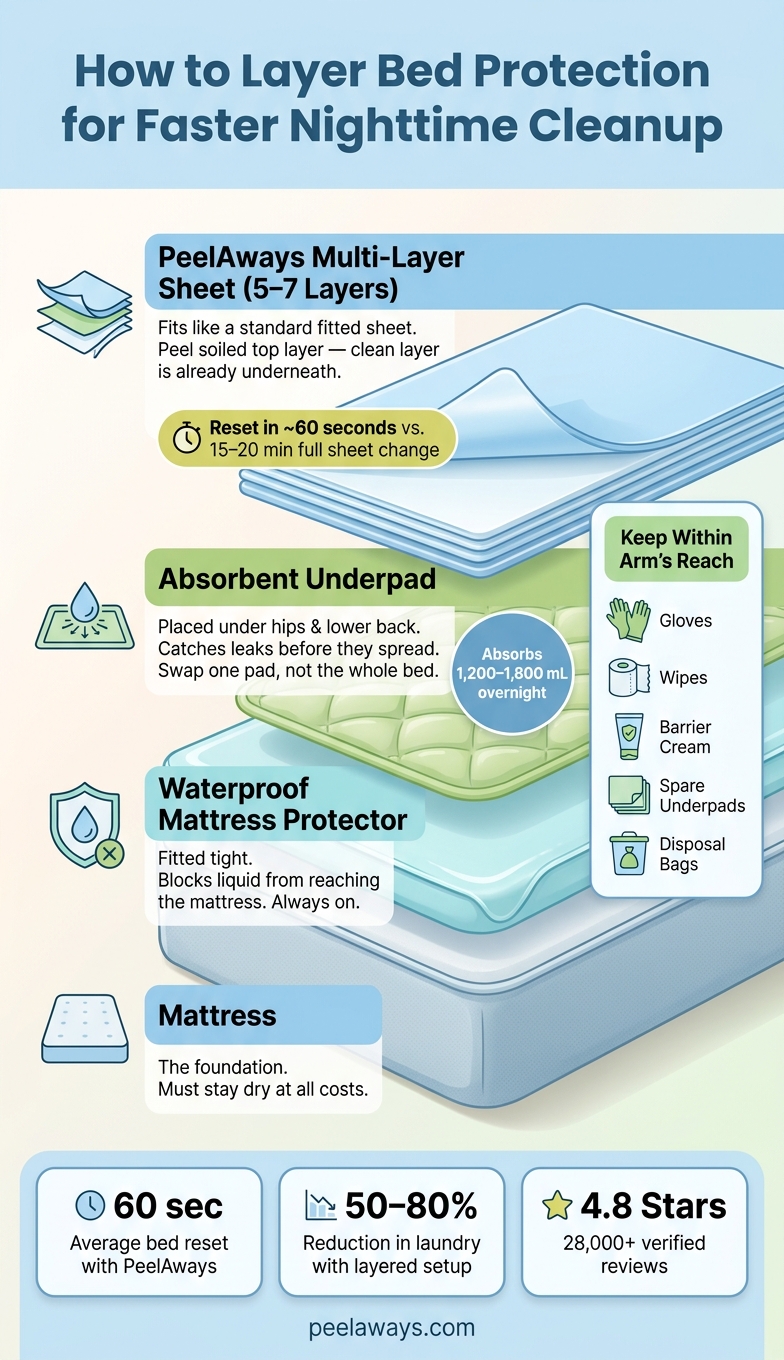
How to Layer Bed Protection for Faster Nighttime Cleanup
It’s 2 a.m. again. The bed is wet, your loved one is embarrassed, and you’re trying to fix everything without fully waking them up.
This is where the setup matters.
Once your bedside station is ready, the bed needs that same stacked, ready-to-go approach. The order matters more than people think, because the right layers can turn a 15- to 20-minute cleanup into something much faster.
Start with a fitted waterproof mattress protector. That goes on first, under everything else, so the mattress stays dry even if the top layers fail.
Next, place an absorbent underpad under the hips and upper thighs. That’s usually where leaks show up first, so don’t just toss it anywhere and hope for the best. Center it where it can do its job.
Then add a PeelAways multi-layer disposable sheet on top. It fits over the mattress like a standard fitted sheet, which is one of the reasons it makes such a difference. When one layer gets soiled, you peel it away in about 60 seconds, and there’s already a clean layer underneath. No full bed remake. No stripping everything down in the middle of the night.
Keep a few things within arm’s reach so you’re not scrambling in the dark:
- Gloves
- Wipes
- Barrier cream
- Spare underpads
- A disposal bag
When these layers are set up the right way, nighttime care gets faster and a lot less disruptive. The goal is simple: change one layer fast and leave the rest of the bed in place.
Conclusion
It’s the middle of the night. The bed is wet, the room is quiet, and you’re trying to fix everything without fully waking the person you love. In moments like that, the right setup can mean the difference between a long, draining cleanup and getting everyone settled again fast.
Once the bed, supplies, and bedside tools are in place, caregiving gets a little easier. The work is still hard. But the right products make the hardest moments shorter, cleaner, and less exhausting.
When you have a waterproof mattress protector, absorbent underpads, incontinence supplies, mobility aids, and a well-stocked bedside station, you’re not just getting ready for accidents. You’re protecting dignity, easing strain, and making the next incident less overwhelming. That’s what hospital-level care at home looks like in real life.
In that setup, PeelAways stands out because it lets you peel away a soiled layer in about 60 seconds without stripping the bed or starting a load of laundry. I know how much that matters at 2 a.m. when your back already hurts and you’re running on fumes. The goal is simple: fewer emergencies, faster cleanup, and calmer nights.
You can buy PeelAways at PeelAways.com or browse the full shop at peelaways.com/shop. It’s also available on Amazon. If you want more tips, take a look at other articles on PeelAways blog and PeelAways care guides.
Blog readers save 10% with code BLOGS10 at checkout. Available on peelaways.com and Amazon. Free shipping on orders over $100.
Comments
0



SAVE MONEY & WATER
Professionals & Institutions save a fortune on labor/laundry.

SUPERIOR COMFORT
The first thing our customers notice is how soft our sheets are.

100% WATERPROOF
Each layer is 100% Waterproof, perfect for spills and accidents

SAVE TIME
Change the sheet in under 1 minute without stripping the bed.

Leave a comment