
Best Waterproof Sheets That Don't Feel Like a Hospital Bed

It’s 2am. The sheets are soaked again. Your loved one is embarrassed, your back hurts, and you have to be up in four hours.
The best waterproof sheets that don’t feel like a hospital bed are soft, quiet, and easy to reset fast. If you want the least laundry and the fastest cleanup, I’d put layered fitted sheets like PeelAways at the top. They come with 5–7 waterproof layers per set, fit crib to king, and can cut a bed change to about 60 seconds instead of 15–20 minutes.
A lot of waterproof bedding fails for one reason: it protects the mattress but makes the bed feel hot, stiff, or noisy. The better picks use softer fabrics and a thin waterproof backing, so you get protection without that plastic-bed feel.
- Best for fastest cleanup: PeelAways multi-layer disposable fitted sheets
- Best for normal sheet feel: TPU-backed fitted waterproof sheets
- Best for full mattress backup: Waterproof mattress protectors
- Best for spot coverage: Washable bed pads
- Best for no-wash backup: Disposable underpads
- Best for potty training: Fitted waterproof sheets or layered crib/twin options
| Option | Best For | Main Tradeoff |
|---|---|---|
| PeelAways | Nightly accidents, elder care, potty training | You keep buying refills |
| TPU-backed fitted sheet | Soft feel, light leaks | Full wash after each accident |
| Mattress protector | Backup mattress safety | Still means stripping the bed |
| Washable bed pad | Small wet zone | Pads can shift |
| Disposable underpad | No laundry that night | Less secure fit |
I know this choice is not about bedding on paper. It’s about what you can deal with at 2am without losing the rest of your night.
Quiet & Soft Bed Protection for Bedwetters
sbb-itb-45288fe
Why this problem hits harder than people expect
The hard part is not just the wet bed.
It’s the whole chain reaction.
Wet pajamas.
Wet sheets.
Wet mattress worry.
Laundry before sunrise.
And someone you love feeling ashamed while you try to stay calm.
That’s why feel matters just as much as protection when choosing bedding solutions for incontinence care. Old vinyl and PVC covers can feel stiff and sound crinkly. Newer options with TPU or PU backing tend to feel softer and quieter.
And if you’re doing this more than once a week, laundry becomes the whole story.
That’s where layered sheets changed things for me. I found PeelAways after too many middle-of-the-night bed changes. The idea is simple: peel off the wet top layer and there’s a clean one already under it. No full remake. No washer at 2am. (Check out these time-saving tips for bedding changes for more ways to simplify your routine.) The brand says many families see about 50%–80% less laundry, and I can believe it.
They also have 28,000+ verified reviews and a 4.8-star rating, which gave me some peace before ordering. If you shop on Amazon, you can also check the PeelAways Amazon listing.
What I’d check before buying
Before you buy anything, I’d look at four things:
1. The barrier material
Skip vinyl if comfort is your top concern. Look for TPU or PU.
2. The top fabric
Bamboo, rayon, cotton terry, and Tencel usually feel softer than stiff synthetic tops.
3. How much of the bed it covers
Waterproof mattress pads vs. disposable sheets offer different levels of coverage; pads protect one spot, while fitted sheets protect more. Protectors sit under the sheet as backup.
4. What cleanup looks like at night
This is the one that matters most when you’re tired.
A washable vs. disposable bed sheet comparison shows that while a washable product may feel soft, the maintenance cost in time is higher.
But if every accident means wash, dry, and remake, that cost shows up in your sleep.
PeelAways multi-layer disposable fitted sheets
If you need the fastest reset, this is the one I’d look at first.
PeelAways gives you 5–7 fitted waterproof layers in one setup. When the top layer is wet, you peel it off and the next clean layer is ready underneath. That cuts the change to about 60 seconds instead of the usual 15–20 minutes.
That difference sounds small until you’re half-awake and changing a bed alone.
What stood out to me:
- Soft bamboo, rayon, and polyester blend
- Breathable waterproof layer
- No full load of wash after each leak
- Sizes from crib to king , making them ideal for managing potty training accidents
- Strong social proof: 28,000+ reviews, 4.8 stars
Prices in the source article start around $30.99 and go up by size.
If you use diapers or incontinence pads and still get leaks, this setup makes the most sense to me. It protects the full bed and cuts the part that wears you down most.
You can see sizes and pricing at peelaways.com/shop. For more tips, I’d also read How to Keep an Elderly Person’s Bed Dry at Night and Best Bedding for Incontinence Care.
Making aging and caregiving easier, one bed at a time.
TPU-backed fitted waterproof sheets
If your top goal is a bed that feels close to normal, TPU-backed fitted sheets are a solid pick.
These usually have a soft top fabric and a thin waterproof layer under it. That means less noise and less of that plastic feel people hate.
I’d pick this type if:
- Accidents are not happening every night
- You want a standard sheet look and feel
- You don’t mind the wash cycle after a leak
The tradeoff is simple: comfort is good, but cleanup is still a full process. You’re still washing, drying, and putting the sheet back on. This is why many caregivers use a checklist for streamlining incontinence care to manage the workload.
Waterproof mattress protectors
A mattress protector is your backup layer.
It goes under the fitted sheet and keeps the mattress safe if something leaks through. I like these as part of a setup, but not as the only answer if accidents happen a lot.
What they do well:
- Protect the mattress surface with waterproof hypoallergenic bedding
- Stay mostly out of sight
- Feel less plastic-like than older covers
What they don’t fix:
- You still strip the bed after an accident
- You still have wash and dry time
- Full encasements can be a pain to remove
If you want mattress insurance, this is a good base layer. If you want less work at 2am, it won’t solve that by itself. For more help, see our nighttime incontinence care tips.
Washable bed pads
Choosing the right bedding for incontinence care often involves washable pads when the wet area is usually in one spot.
You place the pad where leaks happen most often, then swap the pad instead of the whole sheet. That can save time and spare the mattress if the accident stays in that zone. This is a key part of keeping beds dry during incontinence care.
I’d choose these when:
- Leaks are small or localized
- You want to spend less per use
- You can keep extra pads washed and ready
The downside is movement. Pads can bunch up or shift, especially if the sleeper moves a lot.
Disposable underpads
Disposable underpads are the low-effort backup for nights when you just can’t face more laundry.
They’re easy: remove, toss, replace.
That’s the whole appeal.
Still, they have limits:
- They often cover only part of the bed
- They can slide out of place
- They can look and feel more medical
I’d keep them as a backup, travel option, or short-term fix. I would not count on them alone for active sleepers or frequent heavy leaks.
Waterproof sheets for kids and potty training
For kids, comfort and reset time matter most.
If the bed feels strange, loud, or hot, your child notices. And once they’re fully awake, getting them back down is its own battle.
For potty training or bedwetting, I’d think about two paths:
- Peelaways vs. traditional waterproof sheets can help you decide between a soft fitted option if you want the bed to feel as normal as possible
- Layered fitted option like PeelAways if you want the shortest cleanup
For toddlers who move a lot, fitted coverage usually works better than loose pads. And for rough weeks, the peel-away setup can save your night.
You can also read How to Change a Bedridden Patient’s Sheets Alone and Best Bedding for Incontinence for setup ideas that also help with kids and overnight care.
Quick comparison
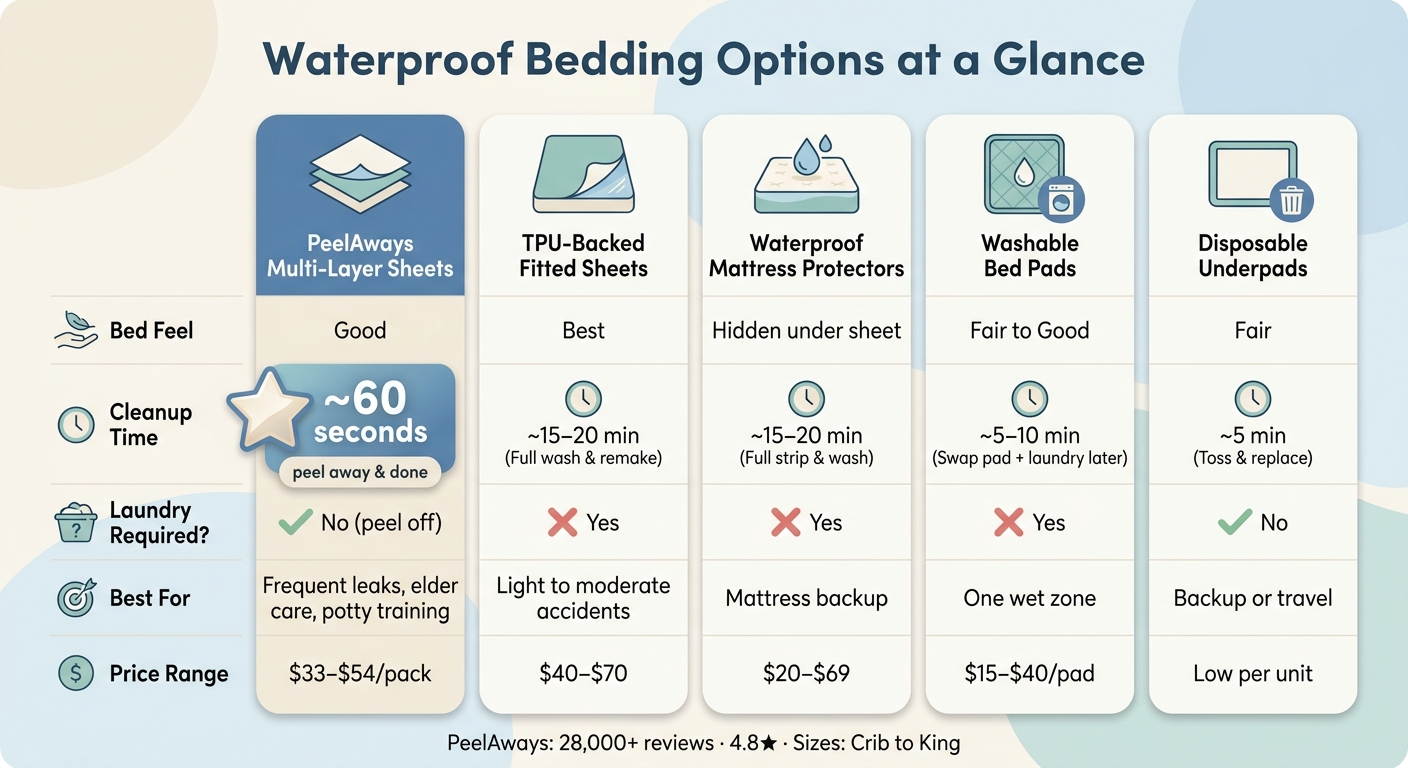
Waterproof Bedding Comparison: Comfort, Cleanup & Cost
| Bedding type | Feels most like a normal bed | Cleanup after accident | Best pick for |
|---|---|---|---|
| PeelAways layered fitted sheets | Good | About 60 seconds | Frequent leaks, elder care, potty training accidents |
| TPU-backed fitted sheets | Best feel | Full wash and remake | Light to moderate accidents |
| Mattress protectors | Hidden under sheet | Full strip and wash | Mattress backup |
| Washable bed pads | Fair to good | Swap pad, then do laundry later | One wet zone |
| Disposable underpads | Fair | Toss and replace | Backup or travel |
FAQ
Do waterproof sheets always feel plastic-like?
No. The better ones use TPU or PU under softer
1. PeelAways Multi-Layer Disposable Waterproof Fitted Sheets
It’s 2am. The bed is wet, your loved one is upset, and you’re standing there half-asleep knowing a full sheet change could take 15 to 20 minutes. When you’re tired down to your bones, that kind of cleanup feels endless.
PeelAways was the first thing I found that made this part of caregiving feel less brutal. Instead of stripping the whole bed, you get layered disposable fitted sheets with 5 to 7 fitted layers. When the top layer gets soiled, you peel it off in under 60 seconds and there’s a clean sheet already waiting underneath.
Comfort and Breathability
This is the part that matters more than people think. If a bed feels stiff, loud, or hospital-like, your loved one feels it too.
PeelAways is made from a blend of bamboo, rayon (viscose), and polyester fibers. The brand says the sheets are soft and noiseless, and says they are 32% softer than standard hospital sheets. Each layer uses a breathable PU laminate that blocks liquid while still letting air move through.
There’s also no vinyl, PVC, phthalates, or fire retardants. That matters when someone is spending long hours in bed and comfort is not a small thing.
Protection Coverage
PeelAways gives you full-bed protection, not just a pad in one spot. The sheets fit sizes from Crib to King, with mattress depths from 6 inches for Crib, Cot, and Twin up to 12 inches for Full, Queen, and King.
If you need the fit a little tighter, you can use sheet straps or clips.
Nighttime Cleanup
This is where PeelAways stands out. When there’s an accident, you peel away the soiled top layer and the clean one underneath is ready to go.
No full bed remake.
No digging for linen in the dark.
No starting over from scratch.
The unused layers stay in place on the bed until you need them. If you use diapers or incontinence pads and still deal with leaks, this kind of setup can save your back and your sanity.
Pricing
Prices start at $30.99 for Crib-A-Peel , which is helpful for managing nighttime potty training regression and go up to $53.99 for King.
PeelAways is available in sizes from crib to king, has 28,000+ reviews, a 4.8-star rating, and it’s easy to see why so many tired families keep coming back to it. You can shop it on peelaways.com/shop or check the Amazon listing for PeelAways. For more help on bed protection and cleanup, see the blog at peelaways.com, including articles like How to Keep an Elderly Person’s Bed Dry at Night and Best Bedding for Incontinence Care.
Making aging and caregiving easier, one bed at a time.
2. Soft Waterproof Fitted Sheets with TPU Backing
It’s 2am. The bed is wet again, and you’re peeling back layers in the dark, trying not to wake the person you love any more than they already are. You want something that protects the mattress but still feels like a normal bed.
For families who want a washable option that doesn’t feel stiff or plastic-like, TPU-backed fitted sheets are usually the closest match.
TPU is a thin waterproof membrane bonded to soft top fabrics like cotton, Tencel, or bamboo blends. In plain English, you get a fitted sheet that feels more like standard bedding while still putting a waterproof barrier between the accident and the mattress.
Comfort and Breathability
The top fabric matters most here. If the TPU backing is paired with cotton terry or Tencel, the sheet can feel a lot like regular bedding, with the waterproof layer sitting quietly underneath. It blocks liquid while still letting air and moisture vapor move through, which can help with heat buildup during the night.
If your loved one sleeps hot, Tencel or bamboo is often the better pick. Those fabrics tend to wick moisture better than standard polyester. That may not sound like a big deal on paper, but in real life, a cooler bed can mean less tossing, less discomfort, and one less thing to fight with at bedtime.
Soft TPU-backed fitted sheets can feel close to normal bedding when they use cotton terry, Tencel, or bamboo on top. But there’s still the same hard part after an accident: the whole sheet has to be washed, dried, and put back on.
Protection Coverage
Most TPU-backed fitted sheets protect the top and sides of the mattress, which makes them easier to remove and replace than a full encasement. That’s helpful when you’re tired and just trying to get the bed reset without turning it into a full project.
Nighttime Cleanup
Here’s the part people don’t talk about enough: cleanup is still a chore. Every accident means washing, drying, and remaking the bed. And at 2am, that’s the part that wears you down.
If you’ve lived through enough middle-of-the-night bed changes, you know the math. A fitted sheet like this can protect the mattress, but it doesn’t take away the laundry burden. That’s why some families eventually switch to layered options like PeelAways, which were made to cut bed changes down to about 60 seconds instead of the usual 15–20 minutes. It’s one of those things I wish I’d found sooner. You can also check the Amazon listing for PeelAways if that’s where you usually shop. They come in 5–7 layers, sizes from crib to king, and they’ve earned 28,000+ reviews with a 4.8-star rating.
If you want to compare more bed protection setups before you decide, it also helps to read through other guides on PeelAways and bedwetting and overnight cleanup options.
3. Waterproof Mattress Protectors
It’s 2am. You feel that awful damp spot through the sheet, and your stomach drops because you already know what comes next. Not just cleanup. The whole bed.
A waterproof mattress protector goes under your fitted sheet and over the mattress. It’s the layer that stays put night after night, quietly guarding the mattress without changing how the bed looks.
Comfort and Feel
Most newer protectors feel much better than the old plastic covers people still picture. The top layer is often made from soft fabric like cotton terry, Tencel, or bamboo blends, while the waterproof barrier sits underneath.
That matters because the protector stays hidden under your bedding. So your loved one isn’t lying on something that feels stiff or obvious. The mattress stays protected, and the bed still feels like a normal bed.
Noise and Breathability
Older vinyl or PVC covers had that crinkly, sweaty feel nobody wants. Newer protectors usually use thin TPU or PU membranes instead, which tend to be quieter and let more air move through.
If your loved one sleeps hot, that can make a big difference. Some protectors also use cooling fabrics to help cut down on heat buildup during the night.
Protection Coverage
Not all protectors cover the mattress the same way.
- Five-sided protectors cover the top and sides, kind of like a fitted sheet. They’re simpler to take off and wash.
- Full encasements zip around the whole mattress for 360-degree coverage against bedbugs and allergens, but they’re more of a hassle to put on and remove.
For incontinence or nighttime accidents, a five-sided protector is usually the more practical pick. It protects the part of the mattress most at risk, without turning every wash day into a wrestling match. If you want full mattress coverage without changing the feel of the bed too much, this is usually where people start.
Nighttime Cleanup
Here’s the hard part: even with strong mattress protection, cleanup still means stripping the bed, washing the protector, and making the bed again.
So yes, the mattress is safe. That’s a huge relief.
But when an accident happens, you’re still doing a full bed change. If you’ve ever changed wet sheets while someone is tired, sore, or embarrassed, you know that’s no small thing. That’s why washable bed pads come up so often next. They can make cleanup less of an ordeal.
4. Washable Incontinence Bed Pads
It’s 2am. The wet spot is right in the middle of the bed again. You don’t want to strip everything if you can help it, and honestly, that’s where washable bed pads can make the night a little less brutal.
When full-sheet protection feels like too much washing and too much setup, washable pads keep the job smaller. They sit on top of your fitted sheet, protect the spot that gets wet most often, and swap out fast when accidents keep happening.
Comfort and Feel
A lot of washable pads are much softer now than people expect. Instead of stiff PVC, newer options usually use a soft fabric top with a thin TPU backing. Good ones often pair that waterproof layer with cotton terry, bamboo, or Tencel on top, so the pad feels much closer to normal bedding and less like something cold or medical-looking.
Noise and Breathability
Nobody wants a pad that crinkles every time your loved one shifts.
Washable pads tend to stay quiet when they use soft top fabrics and a thin waterproof layer underneath. Cotton and bamboo blends help cut down on rustling. TPU or PU backing keeps liquid from soaking through while still letting some air pass, which can help with heat during the night. If the person in bed sleeps hot, bamboo or Tencel blends are often a better bet.
Protection Coverage
This is the tradeoff.
Washable pads protect the wettest area, not the whole bed. That smaller coverage is exactly why they’re easier to pull off and replace than a full fitted sheet or a full mattress protector. You’re dealing with one zone, not the entire mattress.
Nighttime Cleanup
After an accident, you can remove the wet pad and put down a clean one without stripping the whole bed. That alone can save your back on a rough night.
The hard part is what comes after. You still need extra pads washed, dried, and ready to go. And when accidents happen a lot, that laundry stack starts creeping up fast. If washing is the part that’s wearing you down, disposable underpads are usually the next thing to look at.
5. Disposable Underpads and Bed Pads
It’s 2 a.m. again. The pad is soaked, the laundry pile is already staring at you, and you do not have the energy for one more load before morning.
That’s where disposable underpads can take one job off your plate. When washing pads is the part that keeps wearing you down, disposables skip the laundry step completely. You pull off the wet pad, toss it, and keep going. No trip to the washing machine. No waiting for a dryer cycle while everyone is tired and upset.
Comfort, Feel, and Noise
A lot of people still picture the old crinkly kind. The newer ones are better.
The softer options use a non-woven blend of bamboo, rayon (viscose), and polyester, so they feel less plastic-like against the skin. That matters more than people think, especially when your loved one is already uncomfortable or embarrassed. Maintaining comfort and dignity in incontinence bedding is essential for their well-being.
It also helps to look for a PU backing instead of PVC or vinyl. PU blocks liquid but still lets air move through, which can help the bed feel cooler and less noisy at night, making it one of the top cooling bedding options for seniors. Small thing. Big difference when every rustle wakes someone up.
Protection Coverage
This is where fit starts to matter.
Flat underpads only cover part of the bed, and they can slide around overnight. They’re fast to swap out, sure, but they’re not always steady through a long night. One shift in sleep, one missed angle, and now you’re doing a full bed change anyway.
Fitted-style disposable sheets stay put better. That can lower the odds of one wet spot turning into a mattress problem or a complete sheet change.
Nighttime Cleanup
The main draw is simple: cleanup stays fast because there’s no wash step. For some nights, that alone is enough reason to keep them nearby.
The trade-off is that you’ll spend more over time and throw more away. Still, when you’re worn out and just trying to get your loved one clean, dry, and back to sleep, having disposable pads on hand can feel like a lifeline.
For kids and potty training, smaller beds need that same fast cleanup, just with a better fit.
6. Waterproof Sheets for Kids and Potty Training
It’s 2 a.m. again. Your child wakes up crying, the pajamas are wet, the bed is soaked, and now you’re standing in the dark trying to fix everything without fully waking them. That kind of night wears you down fast.
For kids, the best pick is usually the one that keeps bedtime feeling normal and cleanup short. Establishing bedwetting routines and potty training is hard enough without turning every accident into a full sheet-changing event. The goal isn’t just to protect the mattress. It’s to cut down on wakeups, stress, and that middle-of-the-night scramble.
Comfort Feel
Will your child notice it?
That part matters more than people think. Soft bamboo, rayon, and polyester blends feel closer to a regular fitted sheet. If your child is already upset from waking up wet, a rough or crinkly surface can make a bad moment worse.
Noise and Breathability
Will it wake them up more, or make them hot?
Some waterproof sheets have that stiff, plasticky sound. And once a child hears or feels that, they’re fully awake. Softer, quieter surfaces help the bed feel more like their normal bed, which can make it easier for them to settle back down.
Breathability matters too. A cooler bed is often a calmer bed. Breathable PU laminates block liquids while still allowing air to circulate, helping the bed stay cooler.
Protection Coverage
Does it stay put when your toddler rolls, kicks, and spins all over the bed?
For active toddlers, fitted waterproof sheets or five-sided protectors usually stay in place better than pads. They also cover more of the mattress. That extra coverage helps a lot when accidents happen often and never seem to land in the same spot twice.
Nighttime Cleanup
How fast can you reset the bed?
This is where the whole thing can fall apart - or get much easier. A multi-layer disposable sheet lets you peel off the soiled layer in under 60 seconds, with a fresh one underneath. That means no stripping the bed, no digging through the linen closet, and no starting laundry in the middle of the night.
If you’ve ever changed a wet bed while half asleep, you know how big that time gap feels: under 60 seconds versus 15 to 20 minutes.
That’s one reason many tired parents and family caregivers end up looking at PeelAways, a layered sheet I wish I’d known about sooner. It comes in 5-7 layers, sizes from crib to king, and it’s built for fast bed resets without the usual chaos. You can also check the PeelAways listing on Amazon and read more on the PeelAways blog, including posts like How to Change a Bedridden Patient’s Sheets Alone and Best Bedding for Incontinence. With 28,000+ reviews and a 4.8-star rating, it’s one of those products people tend to talk about after a rough night, not before.
The aim is simple: reset the bed fast and help your child get back to sleep.
Pros and Cons of Each Waterproof Bedding Type
It’s 2 a.m. again. The bed is wet, your loved one is upset, and you’re standing there doing tired math in your head: strip the bed, start laundry, remake everything, try not to wake them all the way up.
That’s the real decision at night.
Not just what works on paper - but what lets you reset the bed fast without making it feel cold or hospital-like.
Each waterproof bedding type gives you a different mix of comfort, cleanup, and cost.
After the product-by-product breakdown, this chart shows the trade-offs side by side.
| Bedding Type | Main Advantage | Main Drawback | Best For | Price |
|---|---|---|---|---|
| Multi-Layer Disposable Sheets (PeelAways) | Bed reset in under 60 seconds; no laundry | Recurring purchase cost | Caregivers, potty training, limited mobility | $33–$54 per pack |
| Soft Waterproof Fitted Sheets (TPU-Backed) | Soft, quiet feel | Full laundry cycle after every accident | Light incontinence, occasional spills | $40–$70 |
| Waterproof Mattress Protectors (5-Sided) | Durable; good mattress coverage | Still needs washing | Kids, general mattress protection | $20–$69 |
| Washable Bed Pads | Reusable; targeted protection | Can shift; adds laundry | Frequent but localized accidents | $15–$40 per pad |
| Disposable Underpads | No laundry | Shift easily; look clinical | Travel or temporary use | Low per unit; higher long-term |
What matters most at 2 a.m. is simple:
Does the bed stay soft?
Does it stay quiet?
And how fast can you reset it?
That’s where the trade-off shows up. Faster cleanup often means a higher ongoing cost. Lower cost often means more laundry, more lifting, or more time spent changing the bed when you’re already worn out.
Use this snapshot to narrow your options by cleanup speed, laundry load, and comfort. Next, match those trade-offs to your situation.
Which Waterproof Sheet Works Best for Your Situation?
It’s 2am. The bed is wet again. You’re tired, your loved one feels awful, and the last thing you want is another full sheet change in the dark.
That’s why this choice matters so much.
Not just what protects the mattress.
What helps you get the bed clean and reset with the least stress.
The best option depends on three things: how often accidents happen, how much laundry you can handle, and how fast you need the bed ready again.
Use the trade-offs above to match each bedding type to the care situation below.
| Care Scenario | Best Bedding Type | Why It Works |
|---|---|---|
| Elderly parent (frequent overnight incontinence) | PeelAways Multi-Layer Sheets | Best when nightly cleanup speed matters most. |
| Child with recurring bedwetting | Soft waterproof fitted sheet (TPU-backed) | Best when comfort and a normal bed feel matter more than instant cleanup. |
| Toddler in potty training | PeelAways Crib-A-Peel or Twin size | Best for frequent, short-term accidents during potty training. |
| Short-term recovery (post-surgery or illness) | PeelAways Multi-Layer Sheets | Best when a fast reset and mattress protection are the priority. |
If you’re dealing with frequent accidents, PeelAways usually makes the hardest nights easier. You strip off one layer and move on. No full bed remake. No dragging yourself to the laundry room before you can lie back down.
If comfort and a more standard sheet feel matter most, a soft waterproof fitted sheet may make more sense. You’ll still have laundry, but the bed may feel more like it always has.
Choose the option that best matches cleanup speed, comfort, and laundry load.
Comments
0



SAVE MONEY & WATER
Professionals & Institutions save a fortune on labor/laundry.

SUPERIOR COMFORT
The first thing our customers notice is how soft our sheets are.

100% WATERPROOF
Each layer is 100% Waterproof, perfect for spills and accidents

SAVE TIME
Change the sheet in under 1 minute without stripping the bed.

Leave a comment