
Best Waterproof Bedding for Cerebral Palsy Caregivers

It’s 2 a.m. The sheets are soaked again. Your loved one is embarrassed, your back hurts, and you have to be up in four hours. If this is your life right now, you do not need more theory. You need bedding that makes the next bed change less brutal.
A 60-second bed reset can change the whole night. For cerebral palsy care, the best waterproof bedding is the setup that keeps the mattress dry, cuts cleanup, and asks for the least lifting when someone is half-asleep and uncomfortable. From what I’ve seen, that usually means a layered setup, with PeelAways at the top for the mess you need to fix right now.
What matters most:
- PeelAways multi-layer fitted sheets: 5–7 waterproof layers, 50–80% less laundry, sizes crib to king
- Waterproof mattress protectors: protect the mattress, but still need washing after leaks
- Absorbent bed pads: help with spot messes, but can slide or bunch
- Waterproof pillow protectors: help with drool, reflux, and sweat
- Mattress encasements: zip around the whole mattress for full coverage underneath
| Option | Best use | Main drawback |
|---|---|---|
| PeelAways | Frequent overnight accidents | Refill cost and trash |
| Mattress protector | Base mattress protection | Full wash after accidents |
| Bed pad | Small, targeted leaks | Can shift at night |
| Pillow protector | Drool and sweat | Some run hot |
| Mattress encasement | Full mattress seal | Slow to remove |
That’s the short answer. Now here’s what I’d want to know before buying anything.
Why this problem is harder than people realize
People hear “waterproof bedding” and think mattress protection.
That’s only part of it.
When you care for someone with cerebral palsy, the bed can take hits from incontinence, drooling, reflux, sweat, feeding spills, and meds. And the hard part is not just the leak. It’s what comes after.
You are:
- waking up fast
- trying not to fully wake them
- moving someone who may have pain, stiffness, or limited mobility
- stripping wet bedding in the dark
- starting laundry when you should be sleeping
That is why the best bedding is not always the one with the strongest barrier.
Sometimes it is the one you can change with the least drama.
And if you already use diapers or incontinence pads, you still may need a better bed layer. Pads and briefs help. They do not catch everything.
What to look for before buying
I’d keep it simple.
Look at these five things first:
1. Change time
If a leak happens at night, how long until the bed is usable again?
There is a big difference between about 60 seconds and 15 to 20 minutes.
2. Full-surface coverage
A spot pad helps in one area. A fitted waterproof layer covers the whole bed.
3. Noise and heat
Some waterproof products feel hot or make that plastic sound every time someone moves.
4. Laundry load
If you are already washing clothes, towels, and pads, more wet bedding adds up fast.
5. Movement required
The more you have to roll, lift, or shift your loved one, the harder the cleanup gets.
That last point matters more than most product pages admit.
PeelAways multi-layer disposable fitted sheets

This is the product I would put first for frequent overnight accidents.
PeelAways are fitted sheets with 5–7 waterproof layers built in. When the top layer gets wet, you peel it off and there is a clean layer underneath.
That means:
- no full sheet change
- no lifting the mattress
- no hunting for corners in the dark
- no wet sheet going straight to the washer
The biggest win is time.
A layer change takes about 60 seconds. A full sheet change can take 15 to 20 minutes. At 2 a.m., that gap feels huge.
The other big win is laundry.
PeelAways can cut laundry by 50–80%, which matters if your washer already feels like part of the care team.
A few facts worth knowing:
- 28,000+ reviews
- 4.8-star rating
- sizes from crib to king
- Twin XL starts at $41.99
- sold on PeelAways shop and Amazon
If you want more background, I’d also look at the PeelAways blog and pages like How PeelAways Work and other caregiving articles on PeelAways.
Tagline says it well: “Making aging and caregiving easier, one bed at a time.”
Waterproof mattress protectors
A waterproof mattress protector is a solid base layer.
It goes over the mattress and under the sheet. Its job is simple: stop liquid before it reaches the mattress.
That helps with:
- urine leaks
- drool
- sweat
- spills
Most newer ones use a PU-backed layer instead of old vinyl. That usually means less noise and less heat.
Still, this is the catch:
When it gets wet, you still have to remove it and wash it.
So it protects the mattress.
It does not fix the middle-of-the-night labor problem.
I’d use one as part of a system, not as the only answer for frequent accidents.
Absorbent bed pads and underpads
Bed pads help when leaks happen in one spot.
They can work well for:
- daytime seated care
- drooling
- light overnight leaks
- times when you want a replaceable top layer
The upside is simple: you can swap the pad without remaking the whole bed.
The downside is just as simple: pads can move.
If the person tosses, shifts, or is repositioned a lot, the pad may bunch up or slide away from the wet area. Then you still end up changing more bedding than planned.
Pads also do not cover the full sleep surface.
So I see them as a helper layer, not the whole setup.
Waterproof pillow protectors
This one gets missed all the time.
If drooling, reflux, or sweating reaches the pillow, the pillow itself breaks down faster and starts to hold odor.
A waterproof pillow protector keeps the pillow core dry.
That means:
- fewer soaked pillows
- less washing
- less replacing pillows before you should have to
Look for one that feels soft and quiet.
Some are fine.
Some feel like sleeping on a snack bag.
If face heat is already a problem, pay attention to fabric feel before you buy.
Waterproof mattress encasements
A mattress encasement zips around the whole mattress.
It gives the most complete protection at the mattress level, which is why I think of it as the bottom defense layer.
If leaks get through everything else, the mattress still has coverage.
That part is good.
The bad part is night cleanup.
Encasements are slow to remove, slow to put back on, and a pain if you are doing this while someone is waiting in a wet bed.
So I would not depend on an encasement alone for active nighttime care.
I’d use it under a faster top layer.
Quick comparison
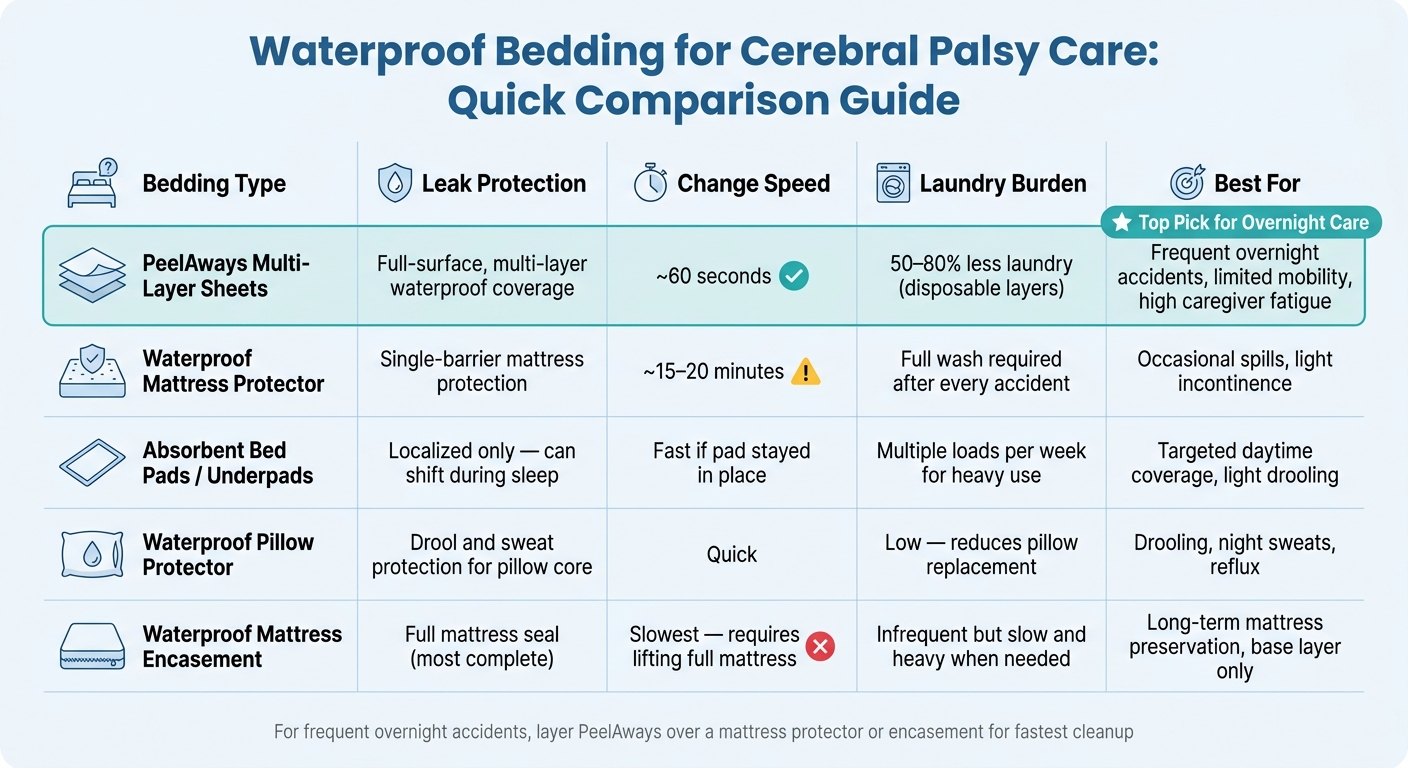
Waterproof Bedding for Cerebral Palsy Care: Quick Comparison Guide
Here is the plain-English version:
| Bedding type | What it does well | What makes it hard |
|---|---|---|
| PeelAways | Fast bed resets, less laundry, full-bed coverage | Costs more over time, creates trash |
| Mattress protector | Shields mattress from leaks | Still needs washing after each accident |
| Bed pad | Easy for small messes | Can shift, does not cover whole bed |
| Pillow protector | Keeps pillow dry from drool and sweat | Some feel hot or noisy |
| Mattress encasement | Covers entire mattress | Slowest layer to remove and wash |
If your nights are rough on a regular basis, the part that matters most is not just leak control.
It is how fast you can get the bed dry again.
sbb-itb-45288fe
FAQ
What is the best waterproof bedding for cerebral palsy care at night?
If accidents happen often, I’d put PeelAways first because the top layer peels off in about 60 seconds. I’d still use a mattress protector or encasement underneath.
Do I still need a mattress protector if I use PeelAways?
Yes, I would. PeelAways help with the top mess and cut laundry. A mattress protector or encasement adds backup protection underneath.
Are washable bed pads enough for overnight incontinence?
Sometimes for light leaks. Not always for heavy or repeated overnight accidents. Pads can shift, and they only cover one area.
Do waterproof products sleep hot?
Some do. Newer PU-backed products usually feel better than old vinyl covers, but heat still varies by fabric and room temperature.
Is PeelAways only for older adults?
No. If you are caring for someone with cerebral palsy and dealing with nighttime leaks, drool, sweat, or spills, the setup can help at any age
1. PeelAways Multi-Layer Disposable Fitted Sheets
It’s 2am. The bed is wet again, your loved one is half-awake, and you’re trying to fix everything without turning on every light in the room. That’s the moment PeelAways made sense to me.
PeelAways are multi-layer disposable fitted sheets that sit right on the mattress. When the top layer gets soiled, you peel it off and there’s a clean, dry layer underneath.
If you need the fastest possible bed reset, this is where PeelAways stand out. They’re built for speed, mess control, and comfort in one setup.
Leak Protection
Each layer has a waterproof membrane that helps hold overnight leaks, drooling, sweat, and spills so they don’t reach the mattress.
That matters more than people think. It’s not just about saving the bed. It’s about skipping the full cleanup spiral that starts with one leak and turns into stripped sheets, extra laundry, and a tired person standing in the dark.
Change Speed
When a layer is soiled, you peel it away from the corner and expose a fresh layer in about 60 seconds. No full sheet change. No lifting the mattress. No wrestling fitted corners back into place.
And when someone is barely sleeping as it is, that minute can make all the difference. You’re done fast, and they can settle back down without a long disruption.
Breathability and Comfort
The fabric is soft and breathable, which helps cut down on heat and crinkly noise during sleep while still blocking liquid.
That combo is a big deal. A lot of waterproof bedding feels like sleeping on a tarp. PeelAways don’t have that same feel, so the bed stays more comfortable and less distracting at night.
Laundry Burden
Each soiled layer gets peeled off and thrown away. No washing. No drying. No folding.
For a tired caregiver, that’s huge. PeelAways can cut household laundry by 50–80%. If you’ve ever stared at a pile of wet sheets before sunrise, you already know why that matters.
Sizing and pricing: PeelAways come in sizes from crib to king. A Twin XL 7-layer set starts at $41.99, and there are subscription, bundle, and HSA/FSA savings available.
If you want to see the size options or buy directly, you can check the PeelAways shop. They’re also available on Amazon. For more help on nighttime cleanup and bedding choices, take a look at other articles on peelaways.com, including their blog.
2. Waterproof Mattress Protectors
It’s the middle of the night.
You feel that damp spot before you even turn on the light.
Now you’re stripping the bed, trying not to wake them all the way, and hoping the mattress didn’t get hit too.
If you want mattress-level protection without changing your top bedding system, a waterproof protector is the next layer to look at.
A waterproof mattress protector is a fitted layer that goes over the mattress and under the sheet to stop liquid from soaking into the bed. In cerebral palsy care, that matters for incontinence, drooling, sweat, and everyday spills.
Leak Protection
Most newer protectors use a PU laminate as the waterproof barrier. That layer helps block perspiration and other liquids before they reach the mattress.
Breathability and Comfort
A lot of people worry these protectors will feel hot or sound crinkly. The better ones use breathable PU laminates that cut down on heat and noise while keeping more of the mattress feel underneath.
Change Speed and Laundry Burden
Here’s the hard part: a waterproof protector helps at the mattress level, but it doesn’t make cleanup fast.
After a leak, you still have to remove it and wash it. A full bed change can take about 15 minutes. At 2 a.m., that can feel like forever. It’s more work for you, more lost sleep, and more disruption for the person in bed.
So yes, a waterproof protector is a solid base layer. But after a leak, it still has to come off and go into the laundry.
If leaks happen a lot or show up with no warning, the next option adds a disposable absorbent layer on top.
3. Absorbent Bed Pads and Underpads
It’s 2am. You finally got your loved one settled, and then you feel that damp spot under your hand. Now you’re peeling back layers, trying not to wake them all the way, and hoping the mattress stayed dry.
If the mattress protector is the base layer, an absorbent pad is the fast-change layer on top. It sits above the sheet and catches liquid before it spreads.
Leak Protection
Pads use an absorbent core to pull liquid off skin and lock it in. A breathable PU backing helps stop soak-through to the sheet or mattress below.
That’s the good part.
The hard part is what happens after the leak. Even with a pad in place, you still have to remove it, get a clean one down, and shift the person enough to make that happen. If they’re fragile, sore, or half-asleep, that small job can feel a lot bigger than it sounds.
Breathability and Comfort
Breathable backings can help cut down on heat and sweating during long stretches in bed.
And when someone is already spending hours in one position, that matters. A bed that feels hot or damp can make sleep worse fast. It can also leave skin sitting in moisture longer than you want.
Change Speed and Laundry Burden
This is where a lot of people hit the wall.
After a leak, the pad still has to come off and be replaced. That means repositioning the person and handling wet material. Washable underpads can add multiple laundry loads each week. Every extra wash means more interruption and less rest.
If you’ve done this night after night, you know the issue isn’t just absorbency. It’s the whole chain reaction. Wet pad. More laundry. More lifting. Less sleep.
To help the pad stay in place, use sheet straps or clips. Bunching is common, and a shifted pad can leave skin and bedding exposed.
When drooling or reflux reaches the pillow, pillow protection becomes part of the same system.
4. Waterproof Pillow Protectors
It’s the middle of the night. The pillow is damp again, your loved one is uncomfortable, and now you’re stripping one more thing you hoped would last until morning. In cerebral palsy care, that kind of small mess adds up fast.
Pillows soak up drool, sweat, and spills almost right away. If you’re dealing with drool or reflux, the pillow needs protection too, not just the mattress and pads. Without it, the pillow stains, starts to smell, and wears out much sooner.
Leak Protection
Modern pillow protectors often use a breathable PU laminate to make a 100% waterproof barrier against drool, sweat, and spills. That means the moisture stays out of the pillow itself, which helps prevent fluid damage and keeps the pillow drier through the night.
Breathability and Comfort
Protection matters. But so does sleep.
Breathable materials help cut down on heat and moisture buildup. Soft, quiet fabrics also make a big difference. They feel better against the skin and help avoid that annoying crinkly sound some waterproof covers make.
Change Speed and Laundry Burden
A washable protector keeps fluids off the pillow core and cuts down on laundry. That may sound like a small thing, but when you’re already washing sheets, pads, and clothing, one less soaked pillow can save you time and hassle.
For broader overnight protection, the next step is sealing the mattress itself.
5. Waterproof Mattress Encasements
It’s 2am. The bed is wet clear through, and now you’re not just changing sheets - you’re worrying about the mattress too. That extra layer of stress hits hard when you’re already tired and trying to keep your loved one comfortable.
After pillow protection, the last layer is the mattress itself.
A waterproof mattress encasement is a full-zip cover that goes around the whole mattress and seals it from leaks, sweat, and incontinence.
Leak Protection
This is the part that does the heavy lifting underneath everything else.
Most encasements use a PU laminate to block liquid while still letting the bed breathe. That means protection from incontinence, drooling, and everyday spills. Keeping the mattress dry also helps support skin health and may help cut down on irritation.
Breathability and Comfort
If you’ve ever dealt with an old plastic-backed cover, you know the feeling. It traps heat. It makes noise. It can make sleep harder than it already is.
Encasements made with PU laminates work in a different way. They help move heat and moisture through the fabric instead of locking everything in. It also helps to look for options made without vinyl, PVC, and phthalates, since those materials can add odor and may irritate sensitive skin.
Change Speed and Laundry Burden
Here’s the catch: mattress encasements protect well, but they’re slow to take off and put back on. And when someone is waiting in a wet bed, speed matters.
That’s why an encasement makes the most sense as your base layer, not your fast-change layer. Put it on the mattress first, then add something quicker on top for cleanup that doesn’t turn into a 15- to 20-minute job. If you’ve found PeelAways through another caregiver, this is exactly where it fits - over the encasement, ready for a bed change in about 60 seconds, with 5-7 layers available in sizes from crib to king. It’s one of those things that can make the night feel a little less impossible.
Making aging and caregiving easier, one bed at a time
For many families, that setup is the difference between protecting the mattress and protecting your own energy too. You can see PeelAways at peelaways.com/shop, find it on Amazon, and read more on the PeelAways blog, including articles like How PeelAways Work and caregiving tips on PeelAways. With 28,000+ reviews and a 4.8-star rating, it’s easy to see why tired caregivers keep talking about it.
How Each Option Holds Up in Daily and Overnight Care
It’s 2am. The bed is wet, your loved one is half-awake, and you’re trying to fix everything without making the night feel even harder. In that moment, the bedding that looks fine on paper can feel useless if it turns one small accident into a 15-minute mess.
No single bedding type works best in every care situation. Heavy overnight incontinence needs full leak coverage and fast changes. Lighter drooling or sweat shifts the focus to airflow and surface comfort. And when mobility is limited, the best bedding is usually the one that protects the bed without forcing a full transfer just to clean up. At night, that’s the part that matters most.
Leak protection changes from one layer to the next. Encasements seal the whole mattress. Pads catch mess in one area. Protectors add a single barrier. Pillow covers help with drool and sweat. PeelAways do something different: they cover the full bed surface and keep clean layers tucked under the soiled top layer, ready for the next change.
Change speed is where you feel the gap fast. PeelAways take less than 60 seconds for a layer change, while a fitted sheet change takes about 15 minutes. That’s not a small difference when you’re tired, your back already hurts, and someone is waiting on you. Absorbent bed pads can also be changed fast, but only if they stayed put through the night.
Laundry is its own headache. Reusable bedding means more loads, more drying, and more folding when you already have too much on your plate. Disposable layers cut down cleanup time and shrink the pile.
The table below lays out the trade-off between mattress protection, change speed, comfort, and laundry.
| Criterion | PeelAways Multi-Layer Sheets | Waterproof Mattress Protector | Absorbent Bed Pads | Waterproof Pillow Protector | Waterproof Mattress Encasement |
|---|---|---|---|---|---|
| Leak Protection | Full-surface, multi-layer waterproof coverage | Single-barrier mattress protection | Localized coverage, can move during sleep | Drool and sweat protection | Full mattress seal |
| Change Speed | Fastest overnight reset | Moderate | Fast if still in place | Quick | Slowest |
| Breathability | High | Low to moderate | Moderate | Depends on fabric | Low |
| Best For | Overnight incontinence with limited mobility | Everyday mattress protection | Targeted daytime coverage | Drooling and night sweats | Long-term mattress preservation |
The next section breaks these trade-offs into clear pros and cons.
Pros and Cons of Each Bedding Type
It’s 2 a.m. again. The bed is wet, your loved one is half awake, and you’re trying to change everything without turning the whole night into a full-blown ordeal.
That’s why this part matters.
Every bedding type does something well. But every option also asks something from you in return. The goal isn’t to pick what sounds best on a sales page. It’s to pick what makes your night less brutal.
For one exhausted caregiver, the best choice is usually the one that cuts disruption at 2 a.m. - not just the one that blocks liquid. And in cerebral palsy care, that tradeoff is often simple: faster cleanup vs. more complete mattress protection.
| Bedding Type | Main Advantages | Main Tradeoffs | Best-Fit Care Situation |
|---|---|---|---|
| PeelAways Multi-Layer Sheets | Fast layer changes; no mattress lift; waterproof; soft, quiet fabric | Ongoing replacement cost; disposable waste | Frequent overnight accidents; limited mobility; high caregiver fatigue |
| Waterproof Mattress Protectors | Budget-friendly; available in breathable materials | Requires full laundry cycle after every accident; can trap heat; may shift under the fitted sheet | Occasional spills; light incontinence |
| Absorbent Bed Pads and Underpads | Quick to replace for localized leaks; no full bed change needed; useful for daytime seated use | Can shift during sleep; frequent leaks can mean multiple changes a day; does not protect the full bed surface | Localized leaks; daytime care; heavy drooling |
| Waterproof Pillow Protectors | Protects the pillow core from saliva and sweat | Some materials feel noisy or crinkly; can trap heat against the face | Managing drooling, night sweats, or reflux |
| Waterproof Mattress Encasements | Full mattress protection against fluids | Slow to remove and wash; requires lifting the entire mattress | Long-term hygiene; total mattress preservation |
A few patterns stand out fast.
PeelAways Multi-Layer Sheets are built for speed. If you’re dealing with frequent overnight accidents, limited mobility, or pure exhaustion, a 60-second bed change can feel like getting your life back. That’s the big reason so many families land here. You’re not lifting the mattress. You’re not stripping the whole bed. You’re peeling one layer and moving on.
Waterproof mattress protectors help when accidents are less frequent. They cost less up front, and plenty come in breathable fabrics. But when there’s a full overnight accident, you’re still stuck doing the whole laundry routine. At 2 a.m., that can be the dealbreaker.
Absorbent bed pads and underpads work best for smaller, more localized messes. They’re handy for daytime care too, especially if drooling or seated leaks are part of the picture. The hard part? They can bunch up or slide at night, and they don’t cover the whole sleep surface.
Waterproof pillow protectors matter more than people think. If saliva, sweat, or reflux is soaking the pillow, protecting that inner pillow core saves you from replacing it over and over. Still, some covers feel hot or make that annoying crinkly sound right by the face, which isn’t ideal when sleep is already hard to come by.
Waterproof mattress encasements give the most complete mattress coverage. If your top goal is keeping the mattress sealed off for the long haul, they do that job. But they’re also the slowest to deal with when something goes wrong. And yes, lifting the whole mattress in the middle of the night is exactly as miserable as it sounds.
The big thing caregivers tend to care about most is cleanup speed. Not in theory. In the middle of the night, when everyone is tired and embarrassed and just wants the bed fixed fast. Again and again, faster changes and less laundry come up as the main win.
Use the table above to match each bedding layer to the kind of nighttime care you’re handling.
Conclusion
It’s 2 a.m. again. The bed is wet, your loved one is tired and upset, and you’re standing there knowing this could turn into another full sheet change when you barely have the energy to move.
After looking at the main bedding options, the choice comes down to one plain thing: how much cleanup, lifting, and laundry you can keep doing night after night. Cerebral palsy care is already heavy. You don’t need extra work in the middle of the night.
The right waterproof bedding helps protect the mattress, cuts down on disruption, and gives your loved one a little more dignity in a hard moment.
For lighter leaks, a mattress or pillow protector may be enough.
For smaller messes in one spot, bed pads can help.
For frequent overnight accidents, limited mobility, or pure caregiver exhaustion, PeelAways makes the most sense.
I say that because it was built for the nights when cleanup can’t wait. You need the bed changed fast, with as little movement and stress as possible. That’s where PeelAways stands out. It lets you do a bed change in about 60 seconds, not 15 to 20 minutes with the usual full-strip routine. And when you’re running on fumes, that time matters.
If your home is dealing with frequent overnight changes, PeelAways can cut laundry, save time, and make the night feel a little less brutal.
The best pick is the one that helps overnight care feel faster, calmer, and less disruptive.
Comments
0



SAVE MONEY & WATER
Professionals & Institutions save a fortune on labor/laundry.

SUPERIOR COMFORT
The first thing our customers notice is how soft our sheets are.

100% WATERPROOF
Each layer is 100% Waterproof, perfect for spills and accidents

SAVE TIME
Change the sheet in under 1 minute without stripping the bed.

Leave a comment