
Best Sheets for Parkinson's Patients - Easy Changes, Less Disruption

It’s 2 a.m. The sheets are soaked again. Your loved one is stiff, tired, and embarrassed, and you’re standing there knowing a full bed change could take the rest of the night out of both of you.
A 60-second bed reset can change the whole night. For Parkinson’s patients, the best bedding setup usually combines easy turning, strong moisture protection, and less laundry. The main options are PeelAways multi-layer disposable fitted sheets, satin repositioning sheets, cotton or Tencel fitted sheets, waterproof mattress covers, and underpads.
- PeelAways: 5–7 waterproof layers, fast overnight changes, 50%–80% less laundry
- Satin repositioning sheets: lower friction for turning, but no leak protection
- Cotton or Tencel sheets: softer feel and airflow, but still need backup layers
- Waterproof protectors: protect the mattress, not the top sheet
- Underpads: add spot protection, with disposable pads cutting cleanup time
| Option | Main job | Best fit |
|---|---|---|
| PeelAways | Fast full-surface sheet changes | Frequent nighttime wetness |
| Satin/Repositioning Sheets | Easier turning in bed | Stiffness and hard transfers |
| Cotton/Tencel Sheets | Comfort and airflow | Everyday comfort |
| Waterproof Protectors | Mattress defense | Base layer under everything |
| Underpads | Spot leak control | Backup protection |
I’ve learned the hard way that the best sheet is not the softest one on the shelf. It’s the one that makes 2 a.m. less brutal.
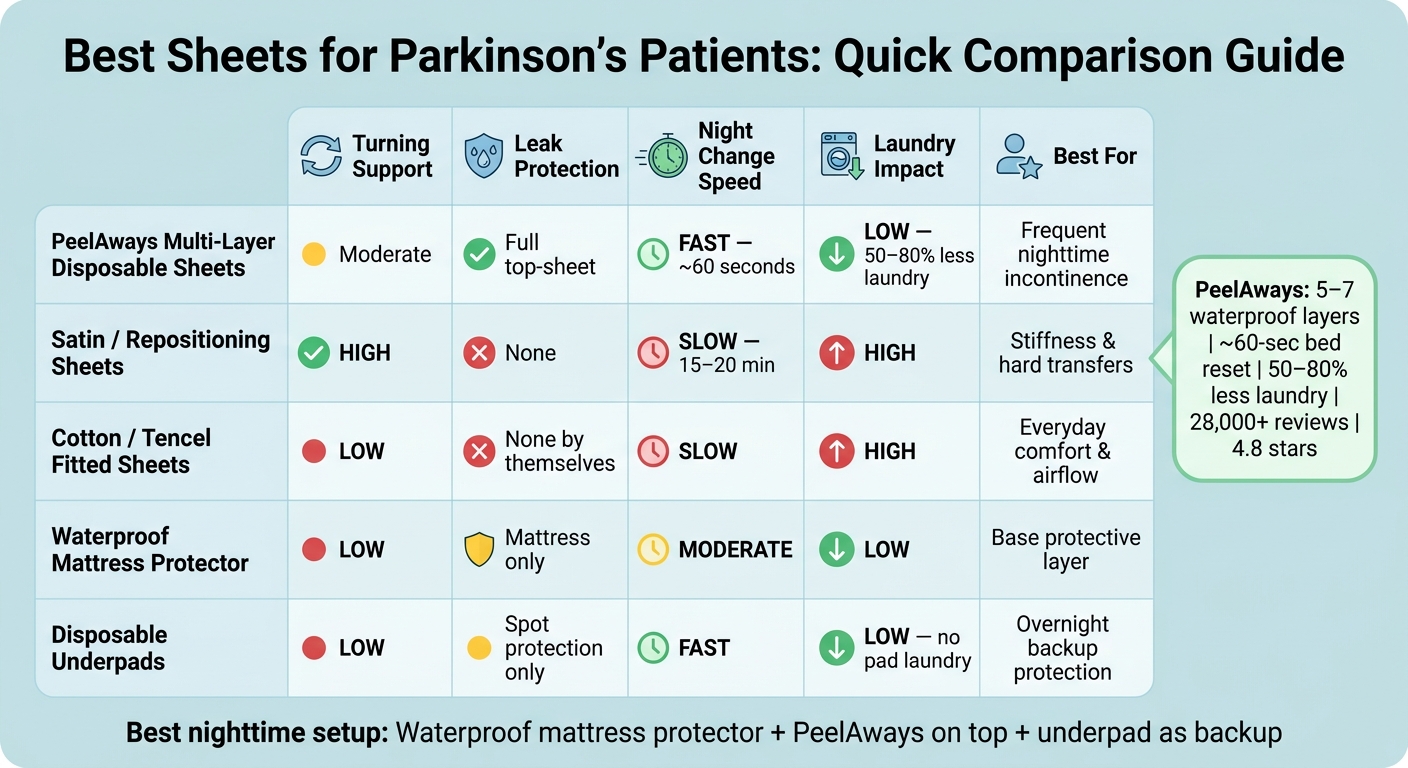
Best Sheets for Parkinson's Patients: Quick Comparison Guide
Why this is harder than it sounds
Parkinson’s at night is not just “trouble sleeping.”
It can mean:
- stiffness that makes turning hard
- slow movement that turns a small cleanup into a long one
- tremor or pain that makes bed changes rough
- urgency or incontinence that keeps waking both of you up
That’s why bedding matters.
When the bed is wet, the problem is not only moisture. It’s also:
- how much you have to move them
- how long they stay uncomfortable
- how much laundry piles up by morning
- how much sleep both of you lose
A sheet choice can either add work or cut it down.
What I’d check before buying
Before I buy anything for a Parkinson’s bed setup, I’d look at five things:
- Turning support: Does it help the person move with less pulling?
- Moisture control: Does it stop leaks from hitting the mattress?
- Change time: Can I fix the bed fast at 2 a.m.?
- Laundry load: Will this cut wash loads or add more?
- Comfort: Will it feel soft, quiet, and not obvious?
If nighttime wetness happens more than once in a while, I would not rely on one layer alone.
I’d build a stack:
- waterproof base
- top layer that is easy to change
- backup absorbent layer if needed
PeelAways multi-layer disposable fitted sheets

This is the one I wish I had found sooner.
If you use diapers or incontinence pads and the sheets still get wet, PeelAways goes straight at the biggest problem: the full bed remake.
Each set has 5–7 fitted waterproof layers.
When the top one gets soiled, you peel it off and the clean one is already underneath.
That means:
- about 60 seconds to reset the bed
- instead of 15–20 minutes for a full change
- with 50%–80% less laundry
That time gap matters when someone is stiff and hard to move.
What stands out to me:
- full fitted-sheet coverage, not just a small pad area
- breathable waterproof barrier
- less handling during changes
- sizes crib to king
- 28,000+ reviews and a 4.8-star rating
If your nights keep getting wrecked by wet sheets, this is the one I’d put at the top of the list.
You can see it here:
And if you want more setup ideas:
- PeelAways blog
- PeelAways care articles
Tagline says it best: Making aging and caregiving easier, one bed at a time.
Low-friction satin or repositioning sheets
These are for the nights when the main fight is turning, not wetness.
A satin or repositioning sheet can lower drag, which means:
- less force to turn someone
- less pulling on sore skin
- less strain on your back and shoulders
That part can help a lot.
But they do not solve the leak problem.
If the bed gets wet, you still have to change the sheet.
So I’d think of satin sheets as a movement aid, not a cleanup fix.
They make sense when rigidity and slow movement are the main issue.
Breathable cotton or Tencel fitted sheets

These are the comfort pick.
Cotton feels familiar.
Tencel tends to feel smoother and cooler.
Both can help the bed feel less sweaty and less irritating over a long night. But neither one is enough by itself if wetness is part of the picture.
I’d use them when:
- accidents are less common
- you already have a waterproof layer under them
- comfort matters more than fast change speed
They help the bed feel better.
They do not make 2 a.m. cleanup much easier.
Waterproof mattress protectors and encasements
This layer does one job: save the mattress.
That matters more than people think.
Once urine reaches the mattress, you’re dealing with:
- smell
- stains
- hard cleanup
- a bed that never feels fully clean again
A good waterproof protector should be:
- soft on top
- quiet
- breathable
- snug enough not to bunch
I’d keep this under any main sheet setup.
It won’t cut top-sheet change time, but it stops a bad night from turning into mattress damage.
Washable and disposable underpads
Underpads are backup.
They protect one area, not the whole bed.
That means they work best as an extra layer, not the only plan.
Washable underpads
- softer feel
- often stay in place better
- add to laundry
Disposable underpads
- easier to remove at night
- no pad-related washing
- may wrinkle or shift
If I were dealing with overnight accidents, I’d lean disposable for night use and washable for daytime chairs or lighter leaks.
Quick comparison
| Option | Turning help | Leak protection | Night change speed | Laundry |
|---|---|---|---|---|
| PeelAways | Moderate | Full top-sheet protection | Fast | Low |
| Satin/Repositioning Sheets | High | None | Slow | High |
| Cotton/Tencel Sheets | Low | None by themselves | Slow | High |
| Waterproof Protector | Low | Mattress only | Moderate | Low |
| Disposable Underpads | Low | Spot protection | Fast | Low |
sbb-itb-45288fe
FAQ
What sheets are best for Parkinson’s patients who can’t turn easily?
If turning is the biggest problem, low-friction satin or repositioning sheets can help. If wetness is also part of the night, I’d add a waterproof base and look hard at PeelAways.
What helps most with overnight incontinence?
For frequent wetness, PeelAways stands out because you can peel off the soiled layer and keep the clean one underneath. That can mean 60 seconds instead of 15–20 minutes.
Do waterproof mattress covers make the bed hot?
Some do. I’d look for a soft fabric top with a thin waterproof backing instead of stiff plastic-style covers.
Are underpads enough by themselves?
Usually no. They protect one area, but leaks can spread past the pad. I’d treat them as backup, not the whole setup.
Are cotton or Tencel sheets good for Parkinson’s patients?
Yes, for comfort. They feel better night after night, but they do not solve hard turning or repeated overnight wetness on their own.
Bottom line
If the main problem is turning, go with a low-friction repositioning sheet.
If the main problem is comfort, cotton or Tencel is fine.
If the main problem is wet sheets, lost sleep, and too much laundry, I’d go with PeelAways first.
That’s because it fixes the part that breaks you down fastest: the 2 a.m. full sheet change.
You get:
- 5–7 waterproof layers per set
- about 60-second changes
- 50%–80% less laundry
- sizes crib to king
- 28,000+ reviews and 4.8 stars
If you’re exhausted and using diapers or incontinence pads but still changing wet sheets, this is the setup I’d try first:
- waterproof mattress protector
- PeelAways on top
- underpad only
1. PeelAways Multi-Layer Disposable Fitted Sheets
It’s 2am. The bed is wet again, your loved one is stiff and hard to move, and you’re standing there half-awake knowing a full sheet change could eat up the next 15 minutes. If that’s your night, PeelAways makes a brutal moment a lot easier.
PeelAways fit this kind of Parkinson’s night well: a wet bed, limited movement, and a caregiver who needs a fast reset. Each set comes with 5 to 7 fitted layers. Peel one away, and there’s already a clean layer underneath.
Change Speed
This is the part that hits hardest when you’re tired.
A full bed change can be done in under 60 seconds. No lifting the mattress. No fighting the corners. No trying to remake the whole bed while someone is uncomfortable and waiting. For families dealing with frequent accidents, that can mean the difference between a long, draining cleanup and getting back to sleep fast. A standard change can take about 15 minutes.
When someone can’t shift easily in bed, that time gap matters.
Repositioning Support
PeelAways also helps when the person needs to stay in bed during the change. The usual method is simple: roll them to one side, peel the used layer toward the center, roll them back, then remove the rest from the other side.
One small trick helps a lot: pre-rip the top corners before bed.
If you’ve ever changed sheets around someone with stiffness or low mobility, you know how much even a small step matters. This setup makes those nighttime changes less hard on your back and less upsetting for the person in the bed.
Moisture Protection
Each layer has a waterproof, breathable barrier that blocks liquid while still letting air move through. The sheets are soft and quiet, and they’re free from vinyl, PVC, phthalates, and fire retardants.
That matters more than it sounds. Older waterproof bedding can feel cold, noisy, and obvious. PeelAways avoids that crinkly feel, which helps with comfort and dignity at the same time.
And every leak that stays contained is one less full cleanup.
Laundry Reduction
This is where PeelAways can feel like getting part of your week back.
Because the layers are disposable, you’re not washing a fitted sheet after every accident. PeelAways can cut laundry by 50% to 80%, which works out to about 4 to 6 loads a week for families dealing with regular incontinence. If a layer stays clean, it can last 7 to 10 days.
If you use diapers or incontinence pads and still end up changing wet sheets, this is the kind of fix that goes straight at the mess, the lost sleep, and the constant pile of laundry.
PeelAways is one of those things many families find after they’ve already tried to tough it out. It comes in sizes from crib to king, has 28,000+ reviews and a 4.8-star rating, and the whole point is simple: Making aging and caregiving easier, one bed at a time.
You can see it here: peelaways.com/shop and on Amazon. For more help on nighttime cleanup and bedding choices, see PeelAways blog and PeelAways care articles.
2. Low-Friction Satin or Repositioning Sheets
It’s 2am. You’re trying to turn your loved one without waking them all the way, and your shoulders are already screaming. The bed feels stuck. So do you.
If turning is harder than cleanup, low-friction satin or repositioning sheets go after the movement problem first.
They can help when stiffness, limited mobility, or plain caregiver exhaustion make every turn feel like a whole event. The smoother surface cuts down on drag, so repositioning takes less force. That can mean less strain on your back and less pulling on their skin.
But here’s the hard part: they don’t stop moisture. If the bed gets wet, you’re still dealing with a full sheet change.
Repositioning Support
A low-friction repositioning sheet can make turning and adjusting someone in bed easier. The slick surface helps the body move with less resistance during turns.
Some versions include straps or clips to keep the sheet snug, which matters more than people think. If the sheet slides too much or isn’t secured well, it can shift under the person and feel unsteady. That’s the last thing you want when you’re already tired.
Moisture Protection
Standard satin or repositioning sheets do not have a waterproof layer built in. That means you’ll usually need a waterproof mattress protector underneath and a disposable underpad on top if you need spot protection for leaks.
So yes, they can help with movement. They just won’t handle the moisture side of the problem on their own.
Change Speed
Because these sheets aren’t waterproof, a wet sheet still needs to be removed and replaced.
That means the turning may be easier, but the cleanup routine doesn’t get much shorter.
Laundry Reduction
If accidents happen often, you’re still looking at more loads of laundry.
This option makes sense when turning is the main problem. If nighttime leaks are also part of the picture, you’ll need to add waterproof protection.
3. Breathable Cotton or Tencel Fitted Sheets
It’s the middle of the night. You’ve already cleaned up once, your loved one is finally settled, and the last thing you want is to strip the whole bed because the sheet feels damp again. In that moment, the top sheet matters more than people think.
When movement is already handled by another layer, cotton or Tencel fitted sheets help keep the bed cooler and more comfortable. They’re the comfort layer in a Parkinson's bed: soft, breathable, and best used with waterproof protection underneath.
Repositioning Support
Tencel has a smoother feel and tends to glide more easily than cotton. That can help a little with comfort during movement.
Still, neither fabric replaces a true repositioning sheet. If turning or shifting in bed is hard, these sheets alone won’t fix that.
Moisture Protection
In a layered bed setup, cotton or Tencel can help with heat and light dampness. But if there’s a leak, you still need a waterproof protector underneath.
For Parkinson's patients dealing with nocturia or urgency, pair these sheets with a waterproof encasement or protector. That extra layer is what keeps a small problem from turning into a full mattress cleanup.
Change Speed
Deep pockets and side labels can make the bed a bit easier to remake. That helps, especially when you’re tired and working fast.
But a full sheet change still takes time. Most people save that for daytime and use layered systems overnight, so a small accident doesn’t mean changing the whole bed.
Laundry Reduction
When you pair cotton or Tencel fitted sheets with a waterproof mattress encasement and absorbent underpads, the fitted sheet can often stay on the bed for several days between washes. That’s because many small accidents get stopped before they ever reach the sheet.
Cotton usually handles hotter wash cycles and tougher stain treatment better. Tencel often dries faster, but it needs gentler care.
Used with waterproof protection and absorbent layers, these sheets become the breathable base of a low-disruption bed.
4. Waterproof Mattress Protectors and Encasements
It’s 2 a.m. again. The bed is wet, your loved one is upset, and the last thing you need is a soaked mattress that turns one accident into a full laundry disaster.
A waterproof mattress protector or encasement is the first layer that saves you from that mess. It keeps urine, sweat, and spills from getting into the mattress, which helps prevent odor and expensive damage. Once that base layer is doing its job, the fitted sheet and absorbent layers on top can catch the rest without letting moisture seep all the way down.
Repositioning Support
If your loved one has rigidity or tremor, this part matters more than people think. The protector needs to guard the mattress without making the bed slick, loud, or hard to move on.
Go for a soft fabric-top protector with a thin TPU backing. The older plastic-style covers can feel crinkly, stiff, and rough during turns. A soft top, thin waterproof layer, and snug fit help the bed stay smooth and flat when you’re helping someone reposition.
Moisture Protection
If accidents happen often, a six-sided zippered encasement gives fuller coverage. If you need something easier to pull off and wash, a five-sided fitted protector may be the better pick.
And yes, it needs to be actually waterproof. Not “water-resistant.” Not “mostly fine.” Poor seams can leak, so seam quality matters.
The National Association for Continence advises that if caregivers do nothing else, they should at least use a zippered waterproof mattress cover as the final barrier.
Change Speed
Here’s where this layer earns its keep. You leave the encasement on the mattress and change only the top layers after an accident.
That means the encasement stays put while you swap the fitted sheet and underpads above it. No wrestling with a full zippered cover in the middle of the night. No stripping everything down unless you have to. With the mattress already protected, cleanup is about the top layers, not the whole bed.
Laundry Reduction
When the mattress is sealed off, the laundry usually stays to smaller, lighter pieces instead of heavy bedding and mattress cleanup. That can make the wash load easier to handle and shave time off an overnight change.
5. Washable vs. Disposable Underpads
It’s 2 a.m. again. The pad is wet, your loved one is uncomfortable, and you’re trying to fix the bed without fully waking them up or throwing your own back out.
Once the mattress is covered, the next choice is the layer on top. And at that hour, the only thing that matters is this: what can you change fastest with the least disruption?
Underpads sit on top of the fitted sheet and catch leaks before they reach the mattress. Washable and disposable pads do the same job in two very different ways. Washable pads lean toward comfort and repeat use. Disposable pads lean toward speed and easy cleanup. That difference hits hardest at night, when a full sheet change can turn a rough moment into a full-blown ordeal.
Repositioning Support
Washable underpads often have a softer, cloth-like surface with a bit more grip. In practice, that means they tend to stay put better and move with the patient during turns.
Disposable pads are usually thinner. If they aren’t set well, they can bunch up or slide. At 2 a.m., even that small shift can become one more thing to fix.
Moisture Protection
Disposable underpads often use superabsorbent polymer cores that lock in liquid fast and help keep the surface drier after a bigger accident. That quicker lock-in can cut down the time skin stays wet, which matters a lot for someone with limited mobility.
Washable pads use absorbent fabric layers instead. They work well for light to moderate leaks, but after a heavier episode, they may stay damp longer.
Change Speed
This is where disposable pads usually make night care easier.
You can roll your loved one slightly to one side, pull out the soiled pad, and slide in a clean one with less handling. That matters when the person in bed is stiff from rigidity, dealing with tremors, or hitting that stretch when medication is wearing off and every extra movement feels like too much.
Washable pads take more steps. You have to remove them, set them aside, and send them to the laundry. It’s not hard in theory. It just takes more time and causes more disruption when everyone is already worn down.
Laundry Reduction
Disposable pads cut laundry. Washable pads add to it, and they often need hot wash cycles.
| Washable Underpads | Disposable Underpads | |
|---|---|---|
| Repositioning Support | Better - softer, cloth-like top; more stable | Variable - can wrinkle or shift |
| Moisture Protection | Good for light to moderate leaks | Better for heavy or frequent accidents |
| Change Speed | Slower - more steps and more handling | Faster - minimal handling |
| Laundry Impact | Adds to wash load | Eliminates pad-related laundry |
| Best Use | Daytime, chairs, routine protection | Overnight, high-risk periods, travel |
That tradeoff is what the next section breaks down by care need.
Pros and Cons of Each Option by Care Need
It’s 2am. You’re half awake, the bed is wet, and your loved one needs help turning without pain. You’re not thinking about bedding categories. You’re thinking, what gets us through this with the least mess and the least stress?
Now that each option is clear, here’s the fastest way to match bedding to the problem in front of you.
Pick the layer that solves the biggest issue first: turning, wetness, quick cleanup, or laundry. That’s usually where the night starts to fall apart.
For easiest turning in bed, repositioning sheets help cut down drag, so moving someone feels less like wrestling the mattress. Pair them with a waterproof protector underneath. Straps or clips can help keep the sheet from sliding around.
For frequent overnight wetness, PeelAways is the fastest reset for repeat overnight accidents. It’s the one I wish I’d found sooner when every soaked bed meant starting over from scratch. Instead of a full strip-and-remake, you peel away the top layer and keep going. That’s the whole point. A bed change in about 60 seconds instead of 15 to 20 minutes. If you use diapers or incontinence pads, this kind of setup makes a hard night a little more bearable. PeelAways comes in 5 to 7 layers, sizes crib to king, and has 28,000+ reviews with a 4.8-star rating. You can find it on peelaways.com/shop and on Amazon.
For reducing laundry, cotton and Tencel feel soft and familiar, but after accidents, they still go straight into the wash.
| Bedding Option | Pros | Cons | Best for |
|---|---|---|---|
| PeelAways Disposable Sheets | Fast bed reset; full-surface waterproof protection; cuts overnight laundry | Ongoing cost; waste | Frequent nighttime incontinence; reducing caregiver burnout |
| Low-Friction Satin/Repositioning Sheets | Reduces friction for easier turning; can be paired with straps or clips | No moisture protection; may shift without secure fastening | Patients with stiffness or rigidity who need help moving in bed |
| Breathable Cotton or Tencel Fitted Sheets | Soft, familiar feel for everyday use | Needs washing after accidents | Daytime use; lighter incontinence needs |
| Waterproof Mattress Protectors/Encasements | Protects the mattress long-term; works under any top sheet | Doesn't speed up bed changes; may trap heat if not breathable | Protective base layer |
| Washable Underpads | Reusable; easy to swap for minor leaks | Adds to laundry | Light leak backup |
| Disposable Underpads | Fast to replace; no laundry | Can bunch or shift; only protects a small area | Overnight backup; high-risk periods; supplemental protection |
The setup that tends to work best is layered: a waterproof base, a fast-change top, and a secure fit. If you want to see how that kind of setup works in daily care, you can also read more on PeelAways blog and PeelAways care articles.
Bed Setups That Reduce Nighttime Disruption
It’s 2:07 a.m.
The bed is wet, your loved one is half-awake, and you’re trying to change sheets without fully waking them up. Your arms are tired. Your patience is thin. And all you want is a setup that makes this part easier.
Once you know which sheet materials feel best, the next step is picking the bed stack that matches the problem you deal with most. Maybe turning is hard. Maybe wetness keeps happening. Maybe you’re just worn down from doing this over and over. In most Parkinson’s care situations at home, four simple setups cover what you need.
Comfort-first works best when symptoms are still mild and accidents don’t happen often. A soft cotton or Tencel fitted sheet over a waterproof mattress protector keeps the bed feeling normal. That matters more than people think. If the bed feels familiar, the night often goes a little smoother.
If turning in bed is the bigger struggle, comfort alone may not cut it. Mobility-support swaps the top layer for a low-friction fabric like satin. Put it over a waterproof base, then secure it with sheet straps or clips so it doesn’t bunch up. For someone who can’t turn easily, that smoother surface can mean less pulling, less effort, and less strain on both of you.
When wetness is the problem that keeps wrecking the night, Incontinence-focused is where PeelAways fits right in. You stack 5 to 7 waterproof layers at the start of the week. Then, if there’s an overnight accident, you roll your loved one gently to one side, peel off the soiled top layer, and the clean one is already there underneath. No full bed remake. No hunting for linens in the dark. Just peel away the mess and keep moving.
Laundry-light uses that same PeelAways stack, but the goal here is less work for you. Not just accident control. If you’re drowning in wash loads or losing sleep over sheet changes, this setup takes a huge chunk of that off your plate. The change takes under 60 seconds, and there’s no middle-of-the-night laundry.
The table below makes it easier to see which setup solves the biggest problem with the least extra work.
| Bed Setup | Ease of Turning | Protection Level | Change Time | Laundry Impact | Best For |
|---|---|---|---|---|---|
| Comfort-First | Standard | Low | Slow | High | Mild symptoms & sensory needs |
| Mobility-Support | High | Low | Slow | High | Difficulty turning in bed |
| Incontinence-Focused | Moderate | Full waterproof | Fast | Low | Frequent or heavy nighttime accidents |
| Laundry-Light | Moderate | Full waterproof | Fast | None | Caregiver burnout & limited time |
If wetness is the main thing breaking up sleep, the incontinence-focused or laundry-light setup with PeelAways usually cuts the most disruption. And if you’re dealing with both turning trouble and wetness, add a waterproof mattress protector under PeelAways for another layer underneath. That gives you full surface coverage, fast resets, and no 2 a.m. laundry session.
If you want to see how PeelAways works in practice, you can check the product at peelaways.com/shop or on Amazon. For more help with setup ideas, see other guides on PeelAways as well.
Comments
0



SAVE MONEY & WATER
Professionals & Institutions save a fortune on labor/laundry.

SUPERIOR COMFORT
The first thing our customers notice is how soft our sheets are.

100% WATERPROOF
Each layer is 100% Waterproof, perfect for spills and accidents

SAVE TIME
Change the sheet in under 1 minute without stripping the bed.

Leave a comment