
Best Sheets for Children With Disabilities and Nighttime Incontinence

Your child is mortified. You’re exhausted. And you’re both pretending this isn’t happening three times a week. It’s 2 a.m., the bed is wet again, and you need the fastest fix you can manage without turning the whole night into a full reset.
If you’re looking for the best sheets for children with disabilities and nighttime incontinence, the shortest answer is this: a layered bed setup works best. I’d start with a zippered mattress encasement under everything, then add either a waterproof fitted sheet or PeelAways, plus an absorbent pad where leaks usually happen. For frequent accidents, PeelAways stands out because you can change one wet layer in about 60 seconds instead of spending 15–20 minutes remaking the bed.
A few numbers matter right away:
- 5–7 waterproof layers per PeelAways set
- 50%–80% less laundry in many homes
- 28,000+ reviews and a 4.8-star rating
- Sizes from crib to king
- Often less lifting than a full sheet change
Here’s the short version of what each option does:
- PeelAways: best when accidents happen often and night changes need to be fast
- Waterproof fitted sheets: best for mattress protection, but not fast to change
- Washable absorbent pads: good for adding absorbency on top
- Disposable underpads: low laundry, but they can slide around
- Zippered encasements: best as a stay-on backup layer
- Top-only protectors: simpler than encasements, but less edge protection
| Option | Best use | Main tradeoff |
|---|---|---|
| PeelAways | Fast overnight changes | Repeat purchase cost |
| Waterproof fitted sheet | Full-surface waterproof base | Full bed change after leaks |
| Washable bed pad | Absorbency with lower per-use cost | More wash loads |
| Disposable underpad | Fast cleanup, no washing | Can bunch or shift |
| Zippered encasement | Protecting the whole mattress | Hard to remove |
| Top-only protector | Simple mattress-top barrier | Sides stay exposed |
That’s the big picture. What matters now is which setup gives you less lifting, less laundry, and less stress at 2 a.m. (see our disposable vs. washable bed sheets comparison for more help deciding).
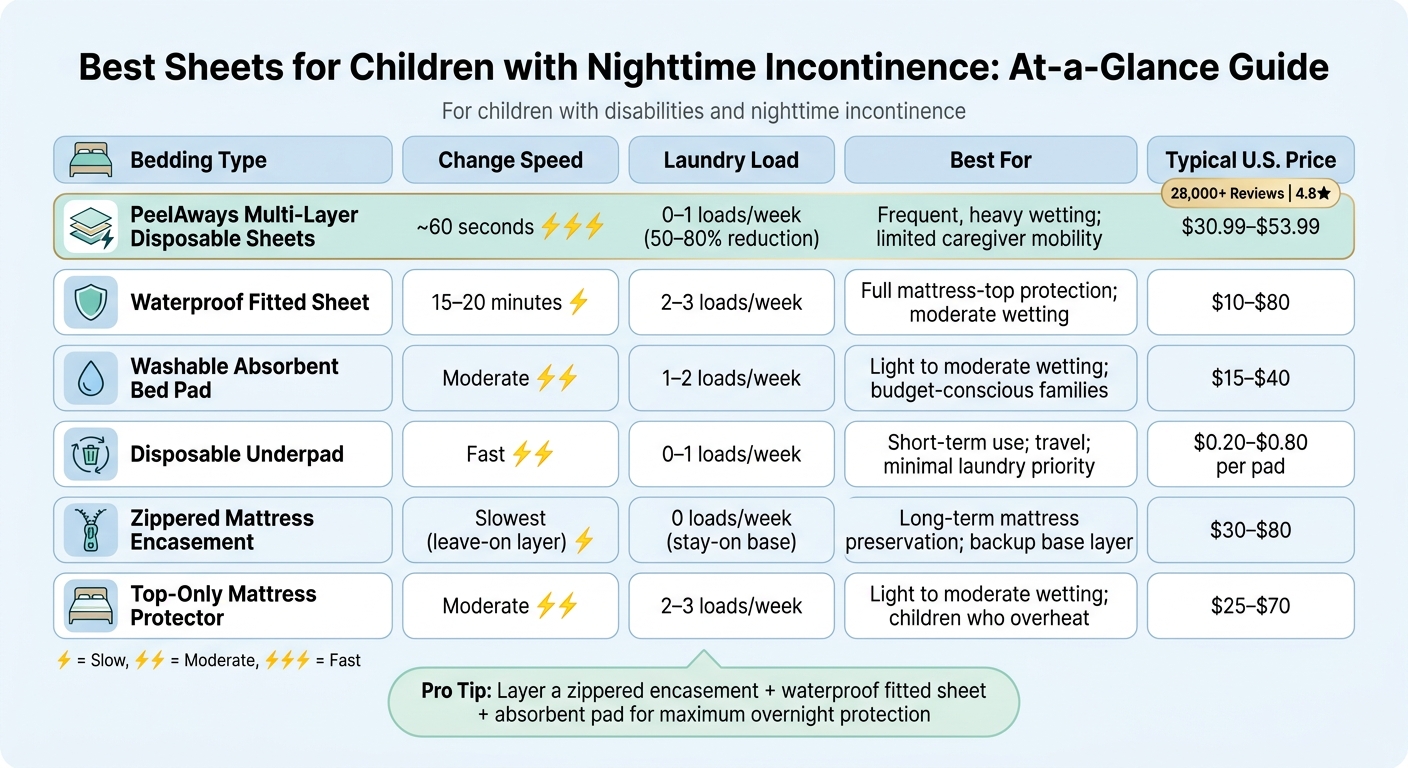
Best Waterproof Bedding for Kids with Nighttime Incontinence: Quick Comparison
Why this problem is harder than people realize
Nighttime incontinence is hard on its own.
Add autism, ADHD, cerebral palsy, spasticity, sensory issues, or limited mobility, and the bed itself becomes part of the problem.
I’m not just talking about leaks.
I’m talking about:
- a child who wakes up from the sound of a crinkly pad
- skin that gets irritated by heat or trapped moisture
- a bigger child who can’t roll easily for a sheet change
- a parent doing all of this half-awake with a sore back
- the quiet shame that can hang over the whole moment
That’s why waterproof pads or disposable sheets alone aren’t enough.
You need bedding that deals with four things at once:
- leak control
- comfort
- change time
- wash load
Miss one of those, and the whole setup can fall apart by the second wet night.
sbb-itb-45288fe
What to look for before buying
Before I buy anything for nighttime wetting, I ask a few plain questions:
-
How often is the bed getting wet?
Once a month needs a different setup than every night. -
Where does the wetness land most?
Center of the bed, hip area, or near the edge all matter. -
Can my child tolerate texture, seams, heat, or noise?
Some products feel fine to me and awful to a child with sensory issues. -
How much lifting is part of the change?
A product can look fine online and still be rough at 2 a.m. -
How much laundry can I keep up with each week?
This part wears people down fast. -
Do I need a base layer, a top absorbent layer, or both?
Most homes need both.
If your child uses diapers or incontinence briefs and the bed is still getting wet, I’d think in layers, not single products.
PeelAways multi-layer disposable waterproof fitted sheets
This is the one I would look at first if bed changes are what break your night.
PeelAways are fitted disposable sheets with 5–7 waterproof layers built into one set. When one layer gets wet, you peel it off and there’s a clean one underneath.
That’s the whole point.
Not a full bed remake.
Not wrestling mattress corners.
Just remove the soiled layer and move on.
What stands out most:
- bed change in about 60 seconds
- less lifting than a full fitted sheet swap
- soft rayon feel instead of stiff plastic feel
- lower wash load in many homes
- sizes from crib to king
The laundry piece matters too. In some homes, PeelAways cuts washing by 50%–80%. If you’re already washing pajamas, blankets, and backup clothes, that can take some pressure off the week.
It’s not the cheapest route up front. And yes, it’s a repeat purchase. But if your child wets often, or if changing sheets is rough on your back, I can see why so many people stick with it.
It also helps that PeelAways has 28,000+ reviews and a 4.8-star rating. If you want to check it yourself, you can look at the shop page or the Amazon listing.
If you want setup ideas, these two reads are worth your time:
- PeelAways blog
- More PeelAways articles on easier sheet changes and bed protection
Making aging and caregiving easier, one bed at a time.
Waterproof fitted sheets
Waterproof fitted sheets do one job well.
They keep urine out of the mattress. (See common questions about waterproof bed protection for more on mattress longevity.)
That matters. A mattress is expensive, hard to clean, and hard to replace.
But they don’t absorb much on their own. So if your child has a bigger accident, the wetness may sit on the surface until you catch it.
That means the mattress is protected, but your child may still be lying in a wet spot.
What I like about them:
- full-surface mattress-top protection
- reusable
- easy to find in many price ranges
- good as a base layer under pads
What wears me out about them:
- full sheet changes take time
- corner removal can be rough in the dark
- more lifting than top-pad swaps
- more washing after accidents
If you choose this type of bedding for incontinence care, I’d keep two or three in rotation and put an absorbent pad on top so you’re not changing the full bed every time.
Washable absorbent bed pads
Washable bed pads are the middle ground a lot of people land on.
They sit on top of the fitted sheet and absorb urine where it usually happens. They can help keep wetness off the skin longer (essential for bedwetting hygiene) than a waterproof hypoallergenic bedding, and they’re easier to swap than stripping the whole bed.
This is what I’d want from one:
- soft quilted top
- quiet backing
- enough size for the wet zone
- tuck-in flaps or non-slip backing if your child moves a lot
Why they work:
- lower cost per use over time
- easy to layer over a waterproof base
- softer feel than many disposable pads
- less work than full bed changes
Where they fall short:
- they still need washing
- they can take longer to dry
- they can bunch up
- they may not be enough for heavy wetting on their own
For many kids, this works well as part of a setup, not the whole setup.
Disposable underpads
Disposable underpads are about one thing:
less washing.
If laundry is the part pushing you over the edge, these can help. You place one on top of the sheet, and when it’s wet, you toss it.
That can make managing overnight accidents much easier.
The problem is that some of them slide, wrinkle, or make noise. If your child is an active sleeper or has sensory issues, that can become its own mess.
Good points:
- no washing
- easy to keep extras nearby
- simple to swap in the dark
- decent for short-term use or travel
Hard parts:
- repeat cost adds up
- cheaper ones feel plasticky
- may shift out of place
- not my first pick for kids who move a lot
If you use them, I’d still keep a waterproof layer under them.
Zippered mattress encasements
A zippered encasement is what I think of as the leave-it-on layer.
It covers the whole mattress, including sides and bottom. That matters if leaks run off the edge, or if the mattress is one you cannot afford to ruin.
I wouldn’t count on this as the only product on the bed surface. It protects the mattress core, but it doesn’t save you from changing wet bedding on top.
Why I like it:
1. PeelAways Multi-Layer Disposable Waterproof Fitted Sheets
It’s 2am. The bed is wet again, your child is half-asleep, and you’re trying to fix it all without turning the whole night upside down. That’s where PeelAways can make life a lot easier.
PeelAways are multi-layer disposable fitted sheets made for faster overnight changes and less sleep disruption. When your child needs a quick change in the middle of the night, that speed matters. Each sheet has 5 to 7 layers, depending on the size and product version. When one layer gets soiled, you peel it off and there’s a clean one right underneath. No stripping the whole bed. No lifting the mattress.
Overnight Containment
Each layer is fully waterproof, so moisture stays off the mattress. Each clean layer can stay on the bed for 7 to 10 nights. That means one five-layer pack can give you up to 50 nights of clean sleep surfaces.
Skin and Sensory Comfort
If your child is sensitive to feel or sound, this part matters. PeelAways use a soft, breathable rayon fabric that feels closer to a normal sheet than a plastic cover. It’s quiet too, which helps at night when every little sound feels louder.
The material is made without vinyl, PVC, phthalates, or fire retardants. The breathable design helps limit heat buildup and may help cut down on skin irritation overnight.
Change Speed and Lifting Required
When a child has limited mobility or needs frequent nighttime changes, the usual routine can take 15 to 20 minutes. That’s a long time in the middle of the night. A soiled PeelAways layer can be removed in under 1 minute, with no mattress lifting and no full bed stripping.
You can even do it one-handed, which, honestly, can be the difference between a manageable night and a miserable one.
Cost and Laundry Load
U.S. prices start at $30.99 for Crib-A-Peel and go up to $53.99 for King sizes. PeelAways can cut laundry by 50% to 80%, which may mean 4 to 6 fewer loads per week.
If you’re already washing pajamas, blankets, and backup bedding on repeat, that kind of break matters. It saves time, cuts down the mess, and takes some pressure off nights that already feel too long.
2. Waterproof Fitted Sheets
It’s 2am. The bed is wet again. You’re stripping corners off a mattress in the dark, trying not to wake your child all the way, and wishing this took one minute instead of fifteen.
If you want a reusable base layer instead of a multi-layer disposable system, bedding solutions for incontinence care often include waterproof fitted sheets as a primary option.
They do one job well: they protect the mattress.
Most waterproof fitted sheets use a PU or TPU backing to block moisture. But they don’t absorb urine. That’s the tradeoff. You get strong mattress protection, but cleanup is slower, and they don’t give you much help with overnight wetness.
Overnight Containment
A waterproof fitted sheet keeps urine from soaking into the mattress, which matters. No one wants to scrub or replace a mattress after one rough night.
But here’s the hard part: the liquid often stays on the surface. That means your child may still be lying in a wet spot until you catch it. With heavier wetting, that can turn into a bigger middle-of-the-night cleanup.
Putting an absorbent pad on top of the sheet helps with that. The sheet protects the mattress underneath, and the pad handles the wetness above.
Skin and Sensory Comfort
Not all waterproof sheets feel the same.
PU- and TPU-backed sheets are usually quieter and more breathable than vinyl. That matters if your child is sensitive to sound, texture, or heat. A soft cotton or knit top layer feels closer to regular bedding, which can make bedtime less of a fight and help cut down on heat overnight.
If you’ve ever heard that stiff plastic-sheet crinkle every time someone rolls over, you already know why this matters.
Change Speed and Lifting Required
This is where waterproof fitted sheets can get tiring fast.
A full sheet change in the middle of the night is slow. It can also be hard on your back, especially if your child has limited mobility or needs help turning. Pulling off a fitted sheet, wiping things down, and remaking the bed is a lot when you’re half awake.
A simpler setup is to leave the waterproof fitted sheet on the bed and place a smaller absorbent pad on top. Then, during the night, you only remove the pad. The full sheet change can wait until morning.
That small change can save a lot of effort.
Cost and Laundry Load
In the U.S., waterproof fitted sheets usually cost $10 to $80, depending on quality.
The catch is laundry. After each accident, you’ll often need to wash the fitted sheet along with any wet blankets or top layers. That adds up fast.
A couple of things help:
- Keep two waterproof fitted sheets in rotation
- Use an absorbent pad on top to cut down on full-sheet changes
That way, you’re not washing and remaking the whole bed every single time.
When mattress protection alone isn’t enough, the next options put absorbency on top.
3. Washable Absorbent Bed Pads
It’s the middle of the night. The bed is wet, your child is half asleep, and you’re trying to fix the mess without fully waking them up. When you just need to stop urine from getting down to the mattress, washable absorbent bed pads can help.
Washable absorbent bed pads sit on top of the fitted sheet, absorb urine, and shield the mattress below. They add a second layer between your child and the bed. That can mean less skin contact with wetness and a simpler cleanup and incontinence bedding disposal when you’re tired and moving on autopilot.
Overnight Containment
Many washable pads hold about 8 cups of fluid, and some can handle 10 cups across a full night. For moderate-to-heavy bedwetting, that’s often enough. It helps to match the pad size to the main wet area, such as 34 in × 52 in for a twin or full bed.
If your child rolls, kicks, or shifts a lot, the pad staying in place matters almost as much as absorbency. Contoured pads with tuck-in flaps can anchor under the mattress edges, which helps keep them from bunching up. A non-slip backing adds one more layer of security.
Skin and Sensory Comfort
This part gets overlooked a lot. Some kids won’t sleep on anything that feels crinkly, stiff, or hot.
Most washable pads have a soft quilted top that feels closer to regular bedding. They’re usually quiet too, which can make a big difference for children with sensory sensitivities. Breathable TPU waterproof backings may also help cut down on heat buildup.
If your child has eczema or fragile skin, look for pads with Oeko-Tex® certification. That means the fabric has been tested for harmful chemicals. The absorbent core also helps pull moisture away from the skin, which supports skin health and better sleep.
That mix of softness and absorbency is why many families keep one of these pads on top of a waterproof layer underneath.
Change Speed and Lifting Required
A wet pad is still one more thing you have to change at night. But it’s usually faster than remaking the whole bed.
For children with limited mobility or spasticity, swapping the pad may still mean one or two turns. It’s not a no-lift fix. Still, it’s less work than stripping sheets, replacing layers, and settling your child back in from scratch. Keeping a clean spare pad within reach can make those overnight changes go a little smoother.
It’s a middle-ground option: less work than changing the full bed, but more hands-on than a peel-away setup.
Cost and Laundry Load
A washable pad usually costs $15 to $35, and sets of two or three often cost about $60.
The tradeoff is laundry. These pads can hold a lot, which also means they’re bulky. They often take longer to dry than regular sheets. A three-pad rotation tends to work best:
- one on the bed
- one in the wash or dryer
- one clean and ready
Most pads are rated for 300 or more wash cycles before absorbency starts to drop, so the cost per use can end up very low over time. A big part of the savings comes from protecting the mattress and avoiding full-bed washes.
If your main goal is cutting down laundry, disposable underpads are the next thing to look at.
4. Disposable Underpads
It’s 2am. The bed is wet again. You’re trying to fix it in the dark without fully waking your child, and all you can think is: please let this be fast.
If washing reusable pads is the part that’s breaking you, disposable underpads can take that job off your plate. You use them once, toss them, and move on.
Disposable underpads, often called chux, are single-use absorbent pads with a waterproof backing that sit on top of the fitted sheet. When they’re wet, you throw them away. That can make overnight cleanup much faster.
Overnight Containment
Some large disposable underpads hold up to 3,000 mL of fluid, or about 101 oz.
That sounds great on paper. The problem is what happens when your child moves.
Because these pads don’t attach to the mattress corners, they can slide out of place during the night. If your child is an active sleeper, or has a movement disorder, that’s a common headache. A few pads come with adhesive strips on the back to help them stay put. It also helps to put a waterproof mattress protector underneath, so you still have backup if the pad shifts.
Skin and Sensory Comfort
This is where the gap between one pad and another gets pretty obvious.
Lower-cost pads can feel plasticky, stiff, and noisy. If your child has sensory sensitivities, that can be a dealbreaker. Sometimes the crinkling sound alone is enough to disturb sleep or turn bedtime into a fight, especially for children with autism or sensory processing differences.
Look for a pad with a soft, cloth-like top layer and a non-slip backing. That usually feels better and helps with leak control too. If the surface still bothers your child, a thin cotton layer on top can help, as long as it’s thin enough not to block absorbency.
Change Speed and Lifting Required
This is the big win with disposable underpads: they’re fast.
When there’s a nighttime accident, you can gently roll your child to one side, pull out the wet pad, slide in a clean one, and roll them back. No stripping the bed. No changing the fitted sheet. No turning a quick cleanup into a 15-minute ordeal.
If your child has limited mobility, that lower level of disruption matters. So does the drop in physical strain on your back.
One small thing makes a big difference here: keep a stack of clean pads within arm’s reach before bed. When you’re half asleep, that setup can save you.
Cost and Laundry Load
The tradeoff is cost.
At about $0.20 to $0.80 per pad, nightly use can add up fast. Disposable underpads cut laundry down close to zero when the pad catches the wetness, but they do come with a steady out-of-pocket cost compared with reusable setups.
If that constant buying starts to wear on you, I’d look at layered bed systems too. That’s actually how I first came across PeelAways, which are built to make bed changes take about 60 seconds instead of 15 to 20 minutes. They come in 5-7 layers, sizes from crib to king, and they’ve got 28,000+ reviews with a 4.8-star rating. You can also find them on Amazon. For more on setup ideas, see other articles on peelaways.com, like their blog posts on keeping beds dry during incontinence care and easier sheet changes.
If you want a fixed barrier under everything, the next option is a zippered mattress encasement.
5. Zippered Mattress Encasements
It’s the middle of the night. The top layer is wet again, and all you can think is, please don’t let it soak into the mattress. That fear is real, especially when the mattress was expensive or hard to get in the first place.
If you want protection that stays underneath everything else, move the barrier to the mattress itself. A zippered mattress encasement covers all six sides and zips fully closed. That sealed layer helps keep urine out of the mattress core, which means less cleanup stress and better long-term protection for the sleep surface.
A waterproof membrane keeps fluid from reaching the mattress from any side, including the bottom and edges. Use it as your base layer, then put an absorbent pad or waterproof fitted sheet on top.
Quality makes a big difference here, especially if your loved one is a light or sensitive sleeper. Cheap vinyl or stiff plastic encasements can feel hot. They can sound crinkly. Some also have a strong smell right out of the package. Softer options tend to use a knit or brushed microfiber surface bonded to a thin waterproof layer, so they feel more like regular bedding and stay much quieter. Washing before first use can help with odor. If heat or smell is already a problem, look for a vinyl/PVC-free option.
This part matters: encasements are not meant to be changed after every accident. They work best when you leave them on the mattress and only swap out the layers above them. If the encasement itself gets dirty, changing it is a bigger job. You usually have to lift or roll part of the mattress to get it off, and that can be rough with a larger child or a heavy specialty mattress. That’s why this type of protection makes more sense as a backup layer, not the one you deal with most often.
Where it helps most is simple. It protects a mattress that would be costly or hard to replace. And because it usually stays put through most accidents, it doesn’t add much to your regular laundry load.
One small detail can save you a headache later: measure the mattress depth with care. If the encasement is too loose, it can bunch up and create pressure points.
If you need something easier to handle on the bed surface every day, the next option is a lighter protector.
6. Top-Only Mattress Protectors
It’s 2am. The top sheet is wet, your child is half asleep, and you’re trying to change the bed without fully waking them up. You don’t need one more thing that fights you in the dark.
If a full encasement feels too bulky, top-only protectors are a simpler layer to deal with. They sit under the regular sheet as a removable waterproof barrier. You still get protection across the sleep surface, and they come off much faster than a zippered encasement. The tradeoff is simple: they don’t cover the sides or bottom of the mattress. That makes them a good fit when you want easier changes without giving up mattress protection.
Overnight Containment
Top-only protectors tend to work best for light to moderate bedwetting. The weak spot shows up with bigger accidents or when a child sleeps near the edge. Moisture can pool, then run off the sides, which leaves the mattress edges exposed. If your child has heavy or frequent incontinence, it helps to put a zippered encasement underneath as a backup layer.
Comfort and Dignity in Incontinence Bedding Solutions
This part matters more than people think. Stiff plastic can feel crinkly, hot, and just plain upsetting at bedtime. Breathable TPU or PU membranes are usually quieter and cooler, and a soft cotton, bamboo, or brushed microfiber top feels much closer to normal bedding.
For children with autism, ADHD, or sensory processing differences, that small detail can make bedtime go smoother. Go with a soft surface and a quiet membrane if your child is sensitive to texture or sound.
Change Speed and Lifting Required
Top-only protectors come off like a fitted sheet, which makes middle-of-the-night cleanup much less of a production. That alone can save your back. And if you pair one with a washable bed pad, most accidents get even easier to handle. You can often remove just the pad, keep the protector dry underneath, and get the bed reset with less disruption.
Ongoing Cost and Laundry Load
With each accident, you’re usually washing one protector and one sheet. It helps to keep 2–3 protectors per bed so you’re not waiting on the dryer when you need a clean one fast. Unlike disposable options, there’s no per-night item to keep buying, so the upfront cost gets stretched over months of use.
How These Bedding Types Compare Across Protection, Comfort, and Caregiver Workload
It’s the middle of the night. The bed is wet again, your child is half-asleep, and you’re trying to fix everything without fully waking them. In that moment, you’re not thinking about product categories. You’re thinking about one thing: what gets everyone back to sleep with the least mess and stress?
No bedding type wins every category. The right choice depends on wetting frequency, sensory sensitivity, and how much lifting you can handle. For families, the real question is which option protects sleep and dignity with the least disruption.
With the basics covered, the comparison below shows which tradeoffs matter most in real life.
Overnight Containment
PeelAways give full fitted coverage with fully waterproof layers, so moisture stays on the current layer. That matters when wetting is heavy or happens night after night. Instead of losing the whole bed, you remove one layer and keep going.
Waterproof fitted sheets cover the full sleep surface and do a good job with moderate to heavy wetting. The downside is simple: once they’re soaked, the whole sheet has to come off.
Washable absorbent bed pads and disposable underpads protect one main zone, usually the hips or torso. They can work well for lighter accidents, but they can also shift during the night, which leaves more of the mattress open.
Zippered encasements protect the mattress best from all sides. That’s great for long-term mattress care, but they don’t keep the top sleep surface dry on their own.
Top-only protectors cover the top of the mattress well for light to moderate wetting. During heavier accidents, the sides of the mattress can still get wet.
Coverage is only part of the job. If bedding moves around at night, that changes everything.
| Bedding Type | Coverage Area | Best For |
|---|---|---|
| PeelAways Multi-Layer | Full fitted surface, all sizes | Heavy, nightly wetting |
| Waterproof Fitted Sheet | Full top surface | Moderate to heavy wetting |
| Washable Absorbent Bed Pad | Targeted (hips/torso) | Light to moderate wetting |
| Disposable Underpad | Targeted (hips/torso) | Light wetting |
| Zippered Mattress Encasement | Full mattress (all sides) | Long-term mattress preservation |
| Top-Only Mattress Protector | Full top surface | Light to moderate wetting |
Skin and Sensory Comfort
If your child is sensory-sensitive, this part is a big deal. A bedding product can look fine on paper and still get kicked off the bed by morning.
Soft, cloth-like tops and quiet waterproof backings, like those found in cooling bedding for seniors, are usually easier to sleep on. Crinkly, stiff, or vinyl-like surfaces tend to bother kids more, especially if they already struggle with texture, sound, or temperature.
Change Speed and Lifting Required
This is where the 2 a.m. reality hits hard. Some bedding protects well but turns every accident into a full bed remake.
PeelAways are the fastest. Washable pads and disposable underpads usually come next. Waterproof fitted sheets and top-only protectors take more time because you have to strip the bed and put it back together.
That difference matters most when your child has limited mobility or when you’re doing the change alone, in the dark, with a tired back.
Ongoing Cost and Laundry Load
Cost is more than the sticker price. What drains you over time is the mix of reordering, rewashing, and keeping enough clean bedding ready for the next night.
| Bedding Type | Typical U.S. Price | Est. Weekly Laundry Loads Added | Cost Pattern |
|---|---|---|---|
| PeelAways Multi-Layer | About $34.99–$53.99 depending on size | 0–1 | Recurring purchase cost; lower laundry burden |
| Waterproof Fitted Sheet | $20–$60 per sheet | 2–3 | Lower upfront; recurring laundry adds up |
| Washable Absorbent Bed Pad | $15–$40 per pad | 1–2 | Low upfront; moderate laundry |
| Disposable Underpad | Usually bulk-priced per pad | 0–1 if it contains the accident | Recurring purchase cost for frequent use |
| Zippered Mattress Encasement | $30–$80 | 0 | One-time mattress-preservation purchase |
| Top-Only Mattress Protector | $25–$70 | 2–3 | Lower upfront; recurring laundry adds up |
PeelAways cut laundry by 50–80%, saving families an estimated 4–6 loads per week. Reusable options can cost less per use, but they usually mean keeping multiple sets in rotation and staying on top of more wash cycles.
The next section turns these comparisons into clear pros and cons.
Pros and Cons of Each Bedding Type
It’s the middle of the night. The bed is wet, your loved one is upset, and you’re doing that tired mental math: Do I strip the whole bed, swap a pad, or just pray this holds until morning? That choice feels small on paper. At 2 a.m., it doesn’t.
Building on the comparison above, this table makes the tradeoffs easier to see at a glance.
| Bedding Type | Key Pros | Key Cons | Best-Fit Scenario |
|---|---|---|---|
| PeelAways Multi-Layer Disposable Sheets | Fast layer changes; soft, sheet-like feel; fully waterproof per layer; cuts down contact with soiled bedding | Recurring purchase cost; disposable waste | Frequent heavy wetting; limited caregiver mobility; short-term use when quick cleanup matters |
| Waterproof Fitted Sheet | Protects the mattress well; long-lasting | Requires stripping the bed after each accident | Moderate wetting; families comfortable with full bed changes after leaks |
| Washable Absorbent Bed Pad | Lower cost over time ($15–$40 per pad); targeted absorbency; washable | Can shift or bunch during sleep; requires washing; less effective for heavy wetting | Light to moderate wetting; families focused on lower recurring cost |
| Disposable Underpad | No laundry; easy disposal; high absorbency | Crinkly texture can bother sensory-sensitive children; shifts on the bed; recurring cost | Short-term use when quick cleanup matters |
| Zippered Mattress Encasement | Full mattress protection on all sides | Harder to remove, wash, and put back on; can be noisy or stiff if lower quality; doesn't keep the sleep surface dry on its own | Long-term mattress preservation |
| Top-Only Mattress Protector | Less heat buildup; easier to wash than encasements | Sides of the mattress can still get wet during heavier accidents | Light to moderate wetting; children who overheat easily |
The right pick comes down to the part that wears you down most at home: laundry, lifting, sensory comfort, or keeping the mattress dry.
If bed changes are what break your night, PeelAways stands out for one plain reason: you can remove one soiled layer and get the bed ready again in about 60 seconds, instead of spending 15–20 minutes on a full change. That matters when your back hurts, your person is half-awake, and you just need the moment to be over. It’s one of those products I wish I’d found sooner.
PeelAways comes with 5–7 layers, works in sizes from crib to king, and has 28,000+ reviews with a 4.8-star rating. If you use diapers or incontinence pads, it makes a lot of sense to look at something that also takes the laundry burden down. You can see the full line at peelaways.com/shop, check the Amazon listing for PeelAways, and read more on the PeelAways blog, including How to Change an Adult Bed in Under a Minute and Best Bedding for Incontinence Care at Home.
Making aging and caregiving easier, one bed at a time.
Conclusion
It’s 2am. The bed is wet, your child is half-asleep, and you’re trying to change sheets without fully waking them up. Your hands are moving fast, but your brain is already thinking about the laundry waiting for you in the morning.
The best setup depends on a few plain things: how often accidents happen, how your child handles different textures, and how fast you need to get the bed changed at night. For most families, layers make life easier. A zippered encasement stays on as the base, a waterproof fitted sheet goes on top, and an absorbent pad adds protection where you need it most.
When accidents happen a lot, or full bed changes are just too hard on your back, PeelAways can sit in that middle layer and make the whole process much easier. You peel away the soiled sheet in under a minute instead of stripping the bed and starting from scratch. That’s the kind of thing that matters when you’re exhausted and just want everyone back to sleep.
If you already use diapers or incontinence pads, PeelAways makes even more sense. It’s one of those things I wish I’d found sooner. Making aging and caregiving easier, one bed at a time. With 28,000+ reviews, a 4.8-star rating, 5-7 layers, and sizes from crib to king, it’s built for the kind of nights people don’t talk about enough.
You can find PeelAways on peelaways.com/shop or on Amazon. For more help, read other guides on peelaways.com, like this blog article and this one.
Blog readers save 10% with code BLOGS10 at checkout. Available on peelaways.com and Amazon. Free shipping on orders over $100.
FAQs
How do I build the best layered bed setup?
It’s 2am. The bed is wet again. You’re tired, your loved one feels awful, and the last thing you want is to strip the whole bed from corner to corner.
Use a two-part setup. Put a waterproof mattress protector right on the mattress. Then add a multi-layer disposable sheet like PeelAways on top.
That combo does two jobs at once. The protector helps guard the mattress itself. The top sheet lets you deal with an accident in under 60 seconds by peeling off the soiled layer and moving on.
That means less laundry. Less nighttime chaos. And no full bed remake in the dark unless you need one.
If you’ve ever spent 15 to 20 minutes changing sheets while everyone is half asleep, you already know why this matters. PeelAways was one of those things I found as a fellow caregiver and immediately wished I’d had sooner. It’s built with 5-7 layers, comes in sizes from crib to king, and has 28,000+ reviews with a 4.8-star rating. You can find it on peelaways.com/shop and Amazon.
One small thing, but it matters: make sure your fitted sheets match your mattress depth. If they’re too shallow, they’ll pop off when you need them to stay put.
What bedding works best for sensory-sensitive kids?
The bed is finally made. The room is quiet. Then your child shifts in the night, hears that crinkly mattress cover, and now everyone's wide awake again. If you've been there, you know how small things can feel huge at bedtime.
For kids with sensory sensitivities, bedding needs to feel soft, stay cool, and make as little noise as possible. A lot of standard plastic or vinyl mattress protectors do the opposite. They crinkle. They hold heat. And that can turn an already hard bedtime into a long night.
PeelAways sheets were a relief in our house for that reason. They're free from vinyl, PVC, phthalates, and fire retardants. The bamboo-blend layers feel soft, breathe well, and help with odor too. The result is a quieter, more comfortable sleep setup that doesn't add one more thing for your child to fight against.
How many backup layers or pads do I need?
With a multi-layer fitted sheet system like PeelAways, 5 to 7 waterproof layers are already on the bed. That means you don't have to strip the whole bed and put on new sheets nearly as often.
I wish someone had told me about that sooner. On the hard nights, even one less sheet change can feel like a small miracle.
If you're also using standalone waterproof bed pads, keep enough extras nearby so a clean pad is always ready right after an accident. The right number depends on what your nights look like and how often changes happen.
If you want to see PeelAways on Amazon too, here's the Amazon listing for PeelAways. For more tips that come from the day-to-day reality of bed changes and incontinence care, you can also read other articles on PeelAways blog and their care guides.
Comments
0



SAVE MONEY & WATER
Professionals & Institutions save a fortune on labor/laundry.

SUPERIOR COMFORT
The first thing our customers notice is how soft our sheets are.

100% WATERPROOF
Each layer is 100% Waterproof, perfect for spills and accidents

SAVE TIME
Change the sheet in under 1 minute without stripping the bed.

Leave a comment