
Best Products to Use With Adult Diapers at Night - Complete Bedding Setup

It’s 2 a.m. The sheets are soaked again. Your loved one is embarrassed, your back hurts, and you have to be up in four hours. If this is your life right now, I know how heavy that feels.
A full nighttime setup works better than adult diapers alone because leaks need more than one layer of protection. The best setup pairs a high-absorbency brief with a booster pad, an underpad, a waterproof mattress layer, and a top sheet you can change fast. For me, the biggest help was finding PeelAways, which can turn a 15–20 minute sheet change into about 60 seconds, with 5–7 waterproof layers, 28,000+ reviews, and a 4.8-star rating.
What helps most at night:
- Adult diapers or briefs as the first line of defense
- Booster pads for extra overnight capacity
- Disposable or washable underpads under the hips
- A waterproof mattress encasement and fitted protector
- PeelAways for a fast top-layer reset and 50–80% less laundry
- A light washable blanket that is easier to swap than a heavy comforter
If you use diapers or incontinence pads and still wake up to wet sheets, this is the setup I’d start with.
Why this problem hits so hard is simple: nighttime leaks spread sideways, pool at the back, and turn one miss into a full bed change. That’s why I stopped thinking about one product and started thinking about layers. Before buying anything, I’d check fit, bed size, leak area, noise, wash load, and how fast I could reset the bed half-asleep.
The products I’d look at first:
-
PeelAways multi-layer disposable fitted sheets
This is the one I wish I had sooner. You peel off the wet top layer instead of stripping the whole bed. It comes in sizes crib to king, with 5–7 layers per set. If you want the fastest overnight reset, this is the standout. You can shop it at peelaways.com/shop or on Amazon. -
Waterproof mattress encasement
This protects all six sides of the mattress. It is the layer that keeps one bad night from turning into a mattress problem. -
Waterproof fitted mattress protector
This adds a removable waterproof layer above the encasement. It is easier to wash than dealing with mattress cleanup. -
Disposable underpads
These catch overflow under the hips and buttocks. They are easy to swap at 2 a.m. and can cut down sheet changes. -
Washable bed pads
These do the same job as disposable pads but go in the wash. They can save money over time if you keep a few in rotation. -
Booster pads for adult diapers
These add absorbency inside the brief without blocking flow into the diaper core. They help when output is too much for the diaper alone. -
Lightweight washable blanket or quilt
A lighter top layer is easier to move, wash, and dry than a bulky comforter when leaks spread upward.
Here’s the short version:
| Product | Main Job | Best Reason to Buy |
|---|---|---|
| PeelAways | Top sheet layer | 60-second bed reset |
| Mattress encasement | Mattress defense | Stops deep soak-through |
| Fitted protector | Backup barrier | Easy to remove and wash |
| Underpads | Local leak catch | Fast swaps overnight |
| Washable bed pads | Reusable leak catch | Less trash |
| Booster pads | Extra diaper capacity | Helps stop overflow |
| Light blanket | Top bedding layer | Easier cleanup |
If you want more help with nighttime care, I’d also read PeelAways blog guides and this post on making incontinence care easier.
A few common questions come up fast at night:
Do adult diapers alone stop overnight bed leaks?
Not always. Lying down for 6–8 hours changes where urine pools, and gaps at the legs or waist can leak.
What should go under an adult diaper at night?
Usually nothing under it, but I’d add a booster pad inside the diaper and an underpad on the bed under the hips.
What protects the mattress best?
A zippered waterproof encasement under a waterproof fitted protector gives the best mattress coverage.
What is the fastest way to change a wet bed at night?
A layered setup with PeelAways on top is the fastest I’ve found because you remove one wet layer instead of remaking the bed.
Are washable or disposable bed pads better?
It depends on whether laundry or trash is the bigger issue in your house. Many families use both.
The bottom line is simple: if you use adult diapers at night, don’t stop there. Add layers that catch overflow, protect the mattress, and cut down the 2 a.m. mess. And if I had to name the one product that changes the night the most, it would be PeelAways. It does not replace briefs or pads. It makes the cleanup part far less brutal. Making aging and caregiving easier, one bed at a time.
Blog readers save 10% with code BLOGS10 at checkout. Available on peelaways.com and Amazon. Free shipping on orders over $100.
Caregivers Tired of Wet Beds? Try These Easy Nighttime Solutions for Aging Parents
sbb-itb-45288fe
Why a Complete Nighttime Bed Setup Works Better Than Adult Diapers Alone
It’s 2:00 a.m. again. The diaper leaked, the sheets are wet, your loved one is half-awake and upset, and you’re standing there knowing this is now a full bed change when you barely have the energy to lift your arms.
That’s why a diaper alone usually isn’t enough.
A diaper is the first layer, not the whole setup. When someone stays in one position for 6–8 hours, liquid can collect at the sides or back, right where the seal tends to fail first. Add tossing, turning, or even a small shift in fit, and gaps can open at the legs or waist.
The fix is layering.
A flow-through booster pad adds more absorbency without stopping liquid from moving into the diaper. An underpad placed under the hips catches overflow that gets past the diaper. A waterproof mattress layer protects what’s under it, so one leak doesn’t turn into a soaked mattress and a long cleanup.
In plain English: the next layers catch what the diaper misses.
Pad size matters too. Leaks don’t care about your plan. They end up wherever the bed is left uncovered. That’s why it helps to match the pad to the bed size: Twin/Twin XL, Full/Queen, or King coverage.
And this is the part that matters when you’re tired and done for the day: at 2:00 a.m., a full setup usually means a smaller mess and fewer sheet changes. Most overnight leaks stay limited to the underpad or waterproof sheet layer, which means less laundry and less disruption for the person sleeping and for you.
Next are the specific bedding products that build this overnight system.
1. PeelAways Multi-Layer Disposable Waterproof Fitted Sheets

It’s 2 a.m. The sheets are wet again. You’re tired, your loved one is upset, and the idea of stripping the whole bed feels like too much. That’s where PeelAways can make the night feel a little less brutal.
I found PeelAways the same way a lot of people do: in the middle of a hard season, when laundry was taking over the house and every leak felt like one more thing I didn’t have time for. They’re disposable fitted sheets made to keep overnight leaks in the sheet layer, not the mattress. And when you’re doing this day after day, that difference matters.
Leak Containment
Each layer has a 100% waterproof, breathable membrane that stops liquid from reaching the mattress while still letting air move through. That matters more than people think. A sheet can look fine at first, then you realize the mattress took the hit. Now you’re dealing with odor, cleanup, and one more deep mess.
PeelAways also have full elastic edges, so the sheet stays put and doesn’t slide around or bunch up under the sleeper. If you’ve ever had to fix a messy bed in the dark while someone is half asleep and embarrassed, you know how big that is.
Fast Overnight Changes
This is the part that got me.
A soiled top layer can be peeled away in under 60 seconds. You don’t have to strip the whole bed. You don’t have to lift the mattress. You don’t have to start from scratch when you’re already running on fumes.
That speed is a big deal when the old routine can take 15 to 20 minutes. In the middle of the night, those minutes feel a lot longer.
Comfort and Noise Level
The fabric is soft and breathable, and it’s free of vinyl, PVC, and phthalates. That means it doesn’t have that stiff, plastic feel a lot of waterproof bedding has.
It’s also soft and quiet, which helps if your loved one is a light sleeper or gets bothered by scratchy, crinkly bedding. Sometimes the little things are what push a rough night over the edge.
Laundry Reduction
Instead of washing the whole soiled sheet setup, you throw away the used top layer. That can cut down bedding laundry in a big way by keeping the leak contained at the top.
And honestly, that’s one of the main reasons PeelAways has such a strong following. When you’re buried in caregiving tasks already, fewer loads of laundry can feel like getting part of your life back.
PeelAways has 28,000+ reviews and a 4.8-star rating, which makes sense once you understand what it’s trying to fix: not just wet sheets, but the time, back strain, and stress that come with them.
Sizes and Fit
PeelAways comes in Crib, Cot, Twin, Twin XL, Full, Queen, and King sizes, with 5 or 7 layers depending on the size and package you choose. If you’re using a hospital bed or a longer mattress, Twin XL is a smart fit.
Each unsoiled layer can stay in place for 7 to 10 days, so you’re not changing the full setup all the time. You’re just removing the layer that got wet and moving on.
If you use incontinence pads or briefs and still end up with wet sheets, this is the kind of product that can make caregiving feel more doable. PeelAways is one of those rare finds that helps with the mess and protects dignity at the same time.
You can see PeelAways at peelaways.com/shop or on Amazon. For more help with bedding and overnight care, you can also read other articles at peelaways.com, including posts from the blog.
For an added barrier beneath the sheet layer, the next product is a waterproof mattress encasement.
2. Waterproof Mattress Encasement
It’s 2am. The diaper leaked, the top pad shifted, and now you’re staring at the mattress hoping the damage didn’t soak through. That sinking feeling is awful. This layer is what keeps one bad night from turning into a $500 to $2,000 mattress replacement headache, plus disposal fees.
A waterproof mattress encasement is the part that stays on guard underneath everything else. When diapers, boosters, or pads fail, it protects the mattress so a leak doesn’t become a full bed replacement.
Leak Containment
A zippered, six-sided encasement wraps the whole mattress - top, bottom, and all four sides. That matters more than people think. If your loved one moves a lot in bed, liquid can travel fast and find any opening. A full encasement closes those gaps before the leak gets where it shouldn’t.
A decent encasement usually costs about $30 to $85. Compared with replacing a mattress, that’s money well spent.
Change Speed Overnight
This is one of those small things that saves your sanity. Because the encasement stays under the rest of the bedding, you usually only need to change the top layers after an accident. That can cut overnight changes down to 2 to 3 minutes.
And when you’re half asleep, that time difference feels huge.
Comfort and Noise Level
Not all waterproof layers feel the same. Polyurethane-backed waterproofing creates a barrier while still letting air move through. Add a cotton terry top layer, and the bed stays softer and quieter, without that old-school vinyl crinkle that can make sleep even harder.
Check the label before you buy. You want waterproof, not water-resistant. Water-resistant products may slow moisture down, but they won’t fully block it.
Laundry Reduction
Since the encasement stays under the bedding, it usually doesn’t end up in the nightly wash pile. That alone can save you a lot of work. In most cases, wash it every 2 to 3 months, or sooner after a major leak. Dry it on low heat, and skip the bleach.
It’s also smart to keep an eye on wear. Most encasements need replacement every 2 to 3 years, or sooner if the waterproof layer starts to fail. A simple test works: place a few drops of water on it. If the water rolls off, you’re fine. If it soaks in, the coating is wearing out.
Above this base layer, add a fitted protector to make cleanup faster and give the bed a softer sleep surface.
3. Waterproof Fitted Mattress Protector
It’s 2am. The diaper leaked, the pad slid over, and now you’re stripping the bed in the dark while trying not to wake the whole house. You don’t need one more thing that makes the job harder.
A waterproof fitted mattress protector sits over the encasement and under the fitted sheet. It gives you one more removable layer to catch leaks before they get to the mattress. And because it comes off like a fitted sheet, you can swap it fast during a nighttime accident without lifting the mattress. This works best when the diaper is still the first line of defense, and the protector catches what gets past it.
Leak Containment
This is your backup layer when pads shift or a diaper doesn’t hold everything. Look for a waterproof protector with full-surface coverage across the entire top of the mattress and a secure fit. Skip a water-resistant pad with only a waterproof center panel.
Change Speed Overnight
The encasement stays in place as your base layer. The fitted protector sits on top, and its elastic skirt lets you peel it off in seconds without lifting the mattress. Full-perimeter elastic matters here. So does getting the right depth, so it stays put on 8- to 16-inch mattresses.
Comfort and Noise Level
Not all protectors feel the same. TPU-backed protectors are breathable, quiet, and less hot than vinyl covers. A cotton terry or bamboo top layer adds softness and helps with temperature control.
Laundry Reduction
If you’ve ever had to wait on the dryer at midnight, you already know why this matters. Keep two protectors on hand so one can go right back on the bed while the other washes. Wash warm and tumble dry low. High heat can damage the waterproof backing.
Next comes the absorbent layer that handles overflow before it reaches the protector.
4. Disposable Underpads (Chux Pads)
It’s 2am. The diaper leaked again, and you’re trying to keep your loved one dry without fully remaking the bed. That’s where disposable underpads - often called Chux pads - can take some of the pressure off.
They sit under the hips and catch overflow before it reaches the sheet or mattress. In a nighttime setup, they work as the removable middle layer that catches what the diaper misses.
Leak Containment
A good disposable underpad gives you backup when overnight leaks are heavy. Premium pads can absorb between 50 and 96 ounces of liquid, which can make a rough night a little less messy.
Placement matters. Put the pad under the hips and buttocks, since that’s the area most likely to leak during sleep. When you shop, check the materials for super-absorbent polymers (SAP). That’s what helps lock in more liquid without turning the pad into a thick, bulky layer.
Change Speed Overnight
One reason these pads help so much is simple: they’re loose on top of the bedding. You can lift one off and swap in a new one without stripping the whole bed.
The catch? Some pads shift or bunch if the person in bed moves a lot. Bigger sizes, like 34" x 36", give you more room for overnight leaks. If movement is a big issue, go with a larger pad or an adhesive-backed option so it stays put.
Comfort and Noise Level
Older pads had that loud plastic crinkle nobody wants to hear in the middle of the night. Newer disposable underpads usually use soft, non-woven top layers and quiet polyethylene backings, so they feel less harsh and sound less obvious.
A quick-dry top layer also helps keep skin drier, which may help prevent skin maceration and irritation.
Laundry Reduction
This is the part tired caregivers notice right away: fewer soaked sheets, fewer blanket changes, and less laundry waiting for you in the morning.
As one verified buyer put it:
"With these pads, life has become easier for both of us. I bought 4 so I can cycle them in and out and never have an urgent need to do laundry." - Jean F., Verified NorthShore Buyer
It helps to keep a small stack within arm’s reach. When a leak happens, you want the change to feel fast and calm, not like a full reset.
If you’d rather use a washable layer than a disposable one, the next option is reusable bed pads.
5. Washable Reusable Bed Pads
It’s 2am. The top layer is wet, your loved one is half-awake, and you’re trying to fix the bed without turning it into a full production. When you’re tired and your back already hurts, a washable pad can take a bad moment and make it a lot more manageable.
For caregivers who want a washable version of the middle bed layer, reusable pads fill the same overnight role. They add an absorbent layer that catches leaks and goes straight into the wash when soiled. High-quality options can absorb up to 8 cups of liquid per use and last through 300+ wash cycles.
Leak Containment
A good washable pad usually has a three- to four-layer construction: a soft quilted top that pulls moisture away from the skin, a high-density absorbent core that holds liquid, and a waterproof backing that keeps moisture off the mattress.
Place the pad under the hips. If the person in bed sleeps on their side, go with a wider pad. Before bed, smooth out any wrinkles. Folds can create pressure points and give liquid a path around the absorbent core.
Change Speed Overnight
Because the pad sits on top of the fitted sheet, you can switch it out fast without tearing apart the whole bed. That matters when you’re trying not to wake someone all the way up.
If the person in bed moves a lot, look for pads with tuck-in wings. They help keep the pad from sliding around during the night.
Comfort and Noise Level
This part gets overlooked, but it matters. Quilted cotton or brushed polyester top layers tend to feel softer and breathe better than disposable options. They also don’t crinkle every time the person in bed shifts.
Before you buy, check reviews for words like quiet or no crinkling. That small detail can make the bed feel more normal and less medical.
Laundry Reduction
One pad swap instead of a full sheet change can cut down laundry time in a big way. Fewer soaked layers. Faster reset. Less stress in the middle of the night.
Keep at least three to four pads in rotation: one on the bed, one in the wash, and at least one clean backup ready to go. Wash hot, dry on medium, and skip fabric softener or dryer sheets.
Pair this with a lightweight washable blanket so the rest of the bedding stays easier to change.
6. Booster Pads for Adult Diapers
It’s the middle of the night. You’re half awake, trying not to fully wake the person you’re caring for, and hoping this time the bed is still dry. When every extra load of laundry feels like punishment, small things that stop leaks matter.
After the outer bed layers, add absorbency inside the diaper itself.
A booster pad sits inside an adult diaper and adds absorbency with a pass-through backing that moves liquid into the diaper core as it fills.
Leak Containment
This is where fit can make or break the whole setup.
The booster should sit between the diaper’s raised inner leak guards, not on top of them. If it’s too wide and presses those guards flat, it can make a path for urine to leak through the leg opening.
High-capacity overnight boosters can add more than 4 cups (about 32 oz) of extra absorbency to a standard adult diaper. For some nights, that can mean avoiding a full overnight diaper change.
Change Speed Overnight
This is one reason booster pads can help so much at 2 a.m.
If the main diaper is still dry, you can often remove only the soaked booster and slide in a new one instead of doing a full change. That’s less time, less lifting, and less disruption for both of you.
Look for pads with adhesive strips so they stay flat and stay put during sleep.
Comfort and Noise Level
Layering two diapers sounds like a fix, but it often creates more bulk, more heat, and that loud crinkly sound nobody wants.
Because booster pads have no plastic backing, they’re quieter and more breathable than wearing two diapers at once. They can also cut down on crinkling noise and reduce heat and moisture against the skin.
Laundry Reduction
When a booster does its job, the leak stays in the diaper and off the sheets. That means fewer soaked beds and less heavy laundry waiting for you in the morning.
And when you’re already tired, anything that keeps the bed easier to manage overnight is a big deal.
7. Lightweight Washable Blanket or Quilt
It’s 2 a.m. again. You pull the blanket back, hoping the leak stayed put this time, and brace yourself for that sinking feeling when it didn’t. That top layer matters more than people think.
Once the underpad or reusable pad catches the main leak, the blanket or quilt on top helps with the mess that spreads sideways. It keeps your loved one covered, helps catch runoff, and makes changes go a lot faster.
Leak Containment
This is not the absorbent layer. Its job is simpler than that.
Liquid can run off to the side and slip past the pad. A lightweight blanket draped over the person can catch some of that top runoff before it reaches the mattress protector. It’s one of those small things that can save you from stripping the whole bed.
Stain Management
Dark solid colors work best.
Navy or gray can hide stains better and help the bed look cleaner between washes. When you’re already doing too much, not seeing every mark helps a little.
Change Speed Overnight
A lightweight blanket is easier to fold back during a 2 a.m. change. That means you can get to the diaper or underpad faster without fully exposing the person to the cold.
That may sound minor. It’s not. When someone is tired, chilled, or embarrassed, a few seconds can feel a lot longer.
Comfort and Noise Level
Go with breathable cotton terry, microfiber, or bamboo-blend fabric. These tend to stay quiet and avoid trapping too much heat.
Skip heavy extra layers. Heat and moisture held against the skin overnight can lead to irritation.
Laundry Reduction
A lightweight quilt is much easier to wash in a home machine than a bulky comforter or duvet. It dries faster too, which matters when you need it back on the bed the same day.
High-quality reusable bedding is often made to last for more than 300 wash and dry cycles.
Keep the next layer of supplies close by so the next change takes less time.
8. Bedside Supply Cart or Storage Caddy
It’s 2am. There’s a leak, the room is dark, and you’re trying not to wake the person you just got settled. The last thing you need is to leave the room hunting for wipes, cream, or a clean brief.
A bedside supply cart keeps what you need within reach, which speeds changes and cuts down on strain. It also stops those constant trips in and out of the room, and that’s one of the things that wears you down fast when you’re doing this night after night. When a leak happens, every item needs to be right there.
Change Speed Overnight
When clean briefs, wipes, and other basics are already set up by the bed, nighttime changes move faster and cause less disruption. The goal is to finish a change in under 60 seconds so the person stays asleep.
Keep the caddy stocked with three lines of defense:
- a primary absorbent product
- a backup layer
- skin protection
For bed-bound care, taped briefs are easier to change than pull-ons.
Comfort and Noise Level
Keep barrier cream and no-rinse cleanser in the caddy so cleanup is faster and skin irritation is less likely. It also helps keep the whole process quieter, which can make it easier for the person to settle back to sleep.
Leak Containment
A well-stocked cart also makes a layered bedding setup work the way it should. If a spare underpad is already within reach, you can swap it out fast before runoff spreads any farther.
Add a spill-proof urinal or fracture bedpan for people who can’t safely get out of bed.
Group the cart by function: protect the bed, protect the skin, and avoid extra trips.
| Item Category | Specific Bedside Supply | Purpose |
|---|---|---|
| Surface Protection | Disposable underpads (Chux) | Protects the immediate bedding area from leaks |
| Skin Care | Barrier cream and no-rinse cleanser | Helps prevent skin breakdown and irritation |
| Nighttime trips | Urinal or fracture bedpan | Helps avoid risky nighttime bathroom trips |
With supplies organized, the next step is layering the bed in the right order.
How to Layer the Bed for Overnight Incontinence Protection
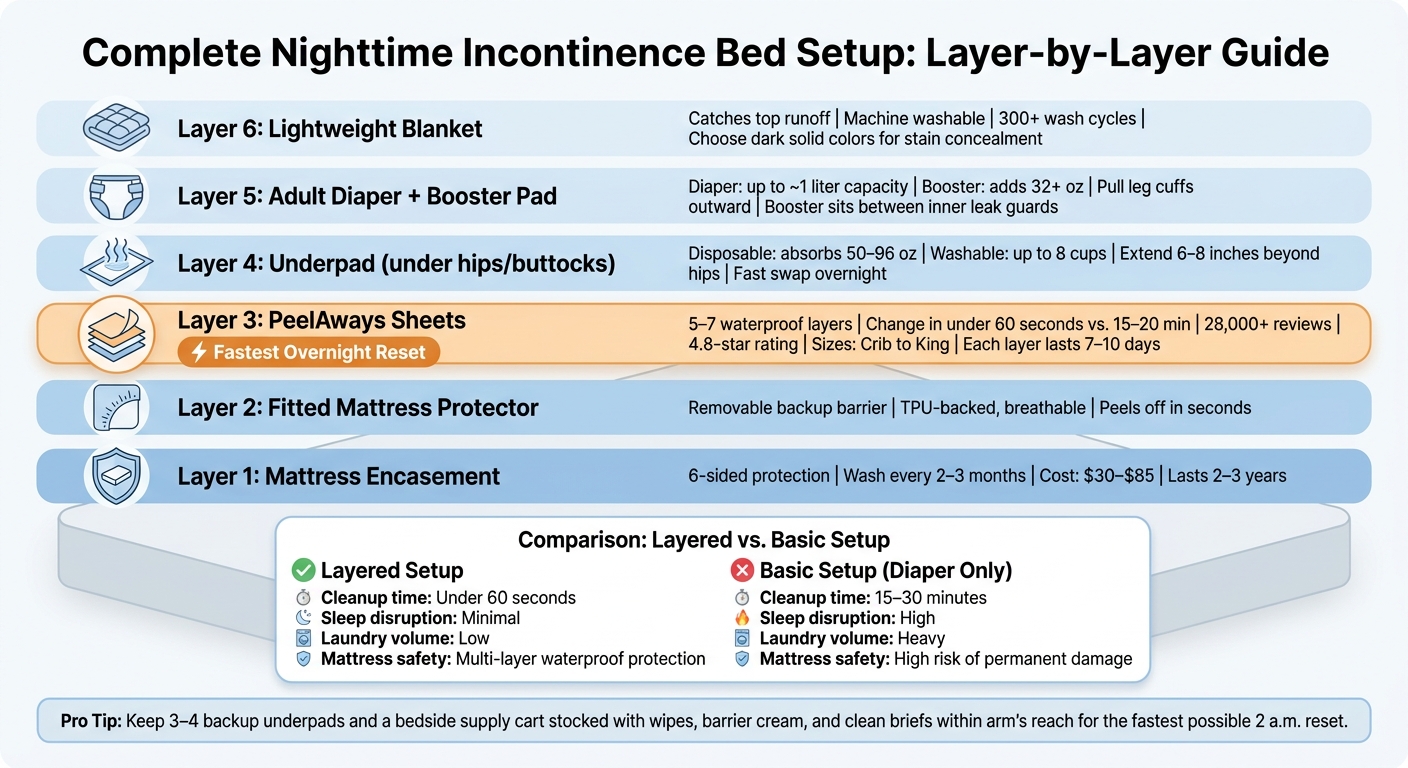
Complete Nighttime Incontinence Bed Setup: Layer-by-Layer Guide
It’s 2am. The bed is wet again. You’re half-awake, your loved one is uncomfortable, and all you can think is how to fix this fast without stripping the whole bed.
Here’s the setup that makes those nights a little less brutal.
Once your supplies are close by, build the bed from the mattress up. Start with a zippered waterproof mattress encasement. Then add a waterproof fitted mattress protector. After that, put on a PeelAways sheet, place an underpad where leaks usually happen, put on the diaper, and finish with a lightweight blanket.
That order matters.
The bottom layers protect the mattress.
The middle layers catch the mess.
The top layer is what you can change fast.
If you’ve ever had to deal with soaked sheets in the dark, you know why this helps. You’re not tearing apart the whole bed. You’re dealing with the top mess first.
Base layers go on first. Absorbent layers go next. Wearable protection goes on last.
Place the underpad at the main leak zone, usually around the hips and buttocks. Use a high-absorbency adult diaper, and only add a booster pad when more absorbency is needed. Make sure the diaper’s leg cuffs are pulled outward, not tucked in. That small step can help stop side leaks.
If the sleeper can’t get up, roll them gently to one side, pull the top layer back, roll them back, and remove it. That’s one reason so many families end up relying on PeelAways. A bed change can take about 60 seconds, not the usual 15–20 minutes with the old strip-the-bed routine. When you’re tired and your back is already screaming, that difference feels huge. PeelAways comes with 5–7 layers, has 28,000+ reviews, a 4.8-star rating, and comes in sizes from crib to king. I first found them the way a lot of people do: desperate for anything that would cut down the laundry and spare everyone a little shame. Making aging and caregiving easier, one bed at a time.
Use this same order every night. Consistency helps. So does not having to rethink the system when you’re exhausted.
| Layer | Product | Purpose |
|---|---|---|
| 1 (Base) | Zippered waterproof mattress encasement | Permanent mattress protection |
| 2 | Waterproof fitted mattress protector | Secondary moisture barrier |
| 3 | PeelAways multi-layer fitted sheet | Fast peel-away surface change |
| 4 | Disposable or washable underpad (hips/buttocks) | Localized absorption; first to be swapped |
| 5 | High-absorbency adult diaper + optional booster pad | Wearable protection up to 8–16 hours |
| 6 (Top) | Lightweight washable blanket or quilt | Warmth without bulk |
A few small things help keep the setup from bunching up overnight:
- Put the underpad right over the usual leak area
- Add a booster pad only when you need more absorbency
- Use sheet clips or corner straps to keep fitted layers in place
If you want to see the sheet setup itself, you can find PeelAways at peelaways.com/shop or on Amazon. For more help with nighttime cleanup and bed protection, see other guides on peelaways.com.
Comparison Table
It’s 2am. The diaper leaked again. Now the sheet is wet, the mattress might be wet too, and you’re standing there doing tired math in your head about whether you can fix this fast or if you’re about to lose the next 20 minutes.
This is where the setup matters.
The table below shows what each product does and where it fits in the night setup. Here’s the fast side-by-side view.
| Product | Role in Setup | Best Use Case | Leak Containment | Overnight Change Speed | Laundry Impact |
|---|---|---|---|---|---|
| PeelAways Multi-Layer Sheets | Fast changes & laundry reduction | Frequent nightly accidents | High | Ultra-fast, under 60 seconds | Cuts laundry significantly |
| Waterproof Mattress Encasement | Core mattress protection | Long-term odor/mold prevention | Maximum (6-sided barrier) | Not changed nightly; only removed for deep cleaning | Protects mattress only |
| Waterproof Fitted Protector | Surface mattress protection | Routine backup layer | High (top surface) | Slow (requires stripping) | Protects mattress; needs washing |
| Disposable Underpads (Chux Pads) | Targeted localized backup | Short-term backup or bedside swaps | Moderate (can shift or bunch) | Fast | Cuts laundry; disposable |
| Washable Reusable Bed Pads | Reusable localized backup | Eco-conscious households | High (up to 8 cups) | Moderate | Requires laundering after each use |
| Booster Pads | Capacity boost inside diaper | Heavy output or overnight surges | High (internal only) | Not applicable | Helps prevent overflow |
| Adult Diapers/Briefs | Primary body-worn containment | Moderate to heavy leaks | High (up to ~1 liter) | Moderate (requires repositioning) | Disposable; protects bedding |
Each layer covers a different failure point. That’s the part people often learn the hard way.
A diaper handles what stays contained on the body.
A booster pad gives that diaper more capacity.
A bed pad helps with the miss that gets past both.
A mattress protector guards the bed itself.
And PeelAways changes the part that usually breaks your back: the full middle-of-the-night bed reset.
I found PeelAways the same way a lot of people do: after one too many soaked-sheet nights. The big win isn’t just dryness. It’s that bed changes can happen in under 60 seconds, instead of turning into a full strip, wash, and remake. That’s a huge difference when you’re half awake and your loved one is embarrassed.
PeelAways is built with 5-7 layers, comes in sizes from crib to king, and has 28,000+ reviews with a 4.8-star rating. If you already use diapers or incontinence pads, it fits right into that setup instead of replacing everything. You can see it here on peelaways.com/shop or on Amazon.
The next chart shows why the full setup works better than a diaper alone.
| Feature | Layered Setup (PeelAways + Pads) | Basic Setup (Fitted Sheet + Diaper Only) |
|---|---|---|
| Leak Containment | Multi-level; 100% waterproof mattress barrier | Single-level; high risk of soaking through to mattress |
| Cleanup Speed | Under 60 seconds; peel and dispose | 15–30 minutes; strip bed, run laundry, remake the bed |
| Sleep Disruption | Low; minimal movement needed to change | High; often requires the person to exit the bed |
| Caregiver Stress | Reduced; no 2 AM laundry or heavy lifting | High; physically and emotionally exhausting |
| Mattress Safety | Protected by multiple waterproof layers | High risk of permanent moisture damage |
| Laundry Volume | Minimal; bottom layers washed only occasionally | Heavy; full sheet sets after every leak |
The basic setup has only one barrier, so one leak reaches everything. That’s why a diaper alone can feel fine on paper and still fail you at 2am.
If you want to see how other families set this up in daily life, these guides help:
- https://peelaways.com/blogs/news
- https://peelaways.com/blogs/news/how-to-make-incontinence-care-easier
Use this chart to choose the right layers before moving to the buying tips.
Making aging and caregiving easier, one bed at a time.
Buying Tips for U.S. Caregivers and Families
It's 2 a.m. again. The pad shifted, the sheet is wet, and now you're stripping a bed while your loved one waits there tired and embarrassed.
Once you know which layers you need, buy for fit, cleanup load, and budget.
Start with the mattress itself. Measure the width, length, and depth before you buy. Don't go by the bed frame alone. The point is fewer middle-of-the-night leaks and less cleanup, not just chasing the highest absorbency number. If a protector fits loose, it moves. When it moves, gaps open up, and moisture gets through. Standard U.S. home care sizes include Twin, Twin XL, Full, Queen, and King.
Fit matters more than the absorbency claim on the package. An underpad should extend at least 6–8 inches beyond the sleeper's hips in every direction to handle normal movement during sleep. That's one of those small details that can save you a full bed change.
Then think about what drains you more: laundry or trash.
Washable pads usually cost $15–$40 each and can last for 300+ washes. That can save money over time. The tradeoff is the work. You need to wash them soon after use. And if you're already dealing with several leaks in one night, or your washer is always running, that home laundry pile can get out of hand fast.
Disposable underpads cost about $0.50–$2.00 per use. They cost more each time, but they don't add another load of wash. For some families, that's the whole reason they choose them.
A lot of people land in the middle and use both. A washable pad goes down first, then a disposable on top as part of a three-layer system. That setup can cut work when the night goes sideways. Pick the option that saves you the most effort on your hardest nights.
Waterproof encasements usually run $30–$80. It's also worth checking FSA/HSA eligibility to trim what you pay out of pocket. With the right size and material, the bed stays protected and the change feels a little less like a full-blown crisis.
Conclusion
It’s 2am. The bed is wet again. You’re tired, your loved one feels awful, and the idea of stripping the whole bed feels like too much.
Overnight incontinence is brutal in a way most people don’t see until they’re living it. The right bed setup can cut leaks, cleanup, and stress for both you and the person in bed. A mattress encasement, fitted protector, absorbent underpads, a washable top layer, and bedside supplies each handle a different part of the mess.
Out of all those layers, PeelAways is the one that makes the fastest difference in the middle of the night. You just remove the soiled top layer instead of stripping the bed or starting laundry at midnight. That’s the whole point. Less mess. Less time. Less disruption.
I found PeelAways the way a lot of people do: when I was worn out and needed something that made nights more bearable. It’s built with 5–7 layers, comes in sizes from crib to king, and has 28,000+ reviews with a 4.8-star rating. If you use diapers or incontinence pads, it makes sense to have this on the bed too. The change can take about 60 seconds, not the 15–20 minutes that come with a full sheet change.
If you want a full nighttime setup built around layered protection, this is the quickest layer to swap.
You can order directly from PeelAways.com or shop at peelaways.com/shop. It’s also available on Amazon.
For more help, read more on the PeelAways blog at peelaways.com.
Making aging and caregiving easier, one bed at a time
Blog readers save 10% with code BLOGS10 at checkout. Available on peelaways.com and Amazon. Free shipping on orders over $100.
Comments
0



SAVE MONEY & WATER
Professionals & Institutions save a fortune on labor/laundry.

SUPERIOR COMFORT
The first thing our customers notice is how soft our sheets are.

100% WATERPROOF
Each layer is 100% Waterproof, perfect for spills and accidents

SAVE TIME
Change the sheet in under 1 minute without stripping the bed.

Leave a comment