
Best Products for Overnight Care After Hip Replacement Surgery

It’s 2 a.m. The sheets are wet, the room is dark, and your loved one needs help getting up without twisting that new hip. You’re half awake, your back already hurts, and one bad move can turn a rough night into a fall.
The best products for overnight care after hip replacement are the ones that cut fall risk, make bathroom trips shorter, and keep bed changes from turning into a full reset. If leaks are part of the night, I’d start with PeelAways because it turns a bed change into about 60 seconds instead of 15–20 minutes, with 5–7 waterproof layers, 28,000+ verified reviews, a 4.8-star rating, and sizes from crib to king.
- For wet beds: PeelAways, waterproof mattress protectors, absorbent underpads
- For getting out of bed: support handles, bed rails, leg lifters
- For safer toileting: bedside commodes, raised toilet seats with arms
- For hip position at night: wedge pillows, abduction pillows
- For dark-room fall risk: motion-sensor nightlights
If you’re tired and need the short answer, start with the one thing causing the worst nights first.
How to Get In and Out of Bed with a Hip Replacement
Why this problem is harder than people realize
Hip recovery at night is its own problem.
Daytime is one thing.
Night is another.
At night, you’re dealing with pain, sleepiness, urgency, low light, and hip precautions all at once. For many people, that means:
- no bending the hip past 90 degrees
- no crossing the legs
- no twisting the operated side
That changes everything.
A soft, low bed can make standing harder.
A dark hallway can turn a bathroom trip into a fall risk.
A wet bed can mean a full sheet change when the patient can barely roll.
And if incontinence pads or briefs are already part of the setup, the laundry gets out of hand fast. That’s why PeelAways stood out to me. It doesn’t fix the surgery part. It fixes the 2 a.m. sheet-change part.
It also helps cut laundry by about 50% to 80%, which matters when you’re washing bedding over and over.
What to look for before buying
I’d keep it simple.
Buy for the problem that is waking you up most often.
Look for products that do one of these jobs well:
- keep the mattress dry
- let you change the bed with less lifting
- make standing and sitting safer
- shorten the trip to the toilet
- keep the room lit without flipping on bright overhead lights
A few things matter more than people think:
- Fit: Queen, King, Twin XL, and mattress depth matter
- Cleaning: Some items save time. Some add one more thing to wash
- Night use: If it’s hard to set up in daylight, it’ll be worse at 2 a.m.
- Hip precautions: If it forces bending or twisting, skip it
If leaks are part of the picture, I’d layer the bed from the start.
PeelAways Multi-Layer Disposable Waterproof Bed Sheets
This is the one I wish more people knew about sooner.
PeelAways is a stack of 5–7 waterproof fitted sheets in one set. When the top layer gets wet, you peel it off and the clean one is already there underneath. No full bed remake. No dragging out fresh sheets in the dark.
That’s the whole point.
For overnight hip recovery, the big win is this: you can deal with a wet bed without a full lift and without turning a one-minute problem into a 20-minute job.
Why I’d put it first for leaks:
- bed change in about 60 seconds
- less laundry
- less repositioning
- less mess in the middle of the night
- less embarrassment for the person in bed
If you use diapers, briefs, or incontinence pads, this kind of setup makes a lot of sense.
It also helps protect the mattress since each layer is waterproof.
PeelAways has 28,000+ reviews, a 4.8-star rating, and comes in sizes from crib to king. If you want to look at sizes or pricing, you can check it on PeelAways or on Amazon.
If you want more on bed protection and sheet changes, these may help too:
Waterproof mattress protectors
A mattress protector is your base layer.
It doesn’t make cleanup fast on its own, but it stops urine, sweat, or drainage from soaking into the mattress. That matters because once fluid gets into the mattress, you now have odor, stains, and one more thing to deal with while you’re tired.
I’d look for:
- a fitted protector, not a loose one
- waterproof backing
- fabric that doesn’t sleep hot
- deep pockets if the mattress is thick
This works best under PeelAways or underpads, not instead of them.
Disposable and reusable underpads
Underpads catch the leak closest to the body.
They’re helpful when accidents are small or when you need one more layer over the sheet. They can save a full bed change after a minor leak.
The trade-off is simple:
- disposable pads: less cleanup, more repeat cost
- reusable pads: lower cost over time, more laundry
What I’d watch for most is bunching. If the pad wrinkles under the hips, it can make the surface less steady and less comfortable.
For many homes, the mix that works is:
- reusable pads for day-to-day use
- disposable pads at night
- PeelAways underneath when leaks happen often
Bed rails and bedside support handles
Sometimes the hard part isn’t the walk to the bathroom.
It’s that first move.
Sitting up.
Getting stable.
Standing without twisting.
A support handle can help a lot there.
It gives the patient one steady place to push from instead of grabbing you, the mattress, or whatever is nearby. That can save your back too.
But this is one item I’d be careful with.
Bed rails are not for everyone. If the fit is wrong, gaps can be unsafe. If the patient is confused, weak, or likely to climb over the rail, that can create more risk.
I’d only use one after checking:
- bed and mattress fit
- weight limit
- daytime trial use
- how alert the patient is at night
Wedge pillows and hip abduction pillows
These help keep the legs apart and the hip in a safer sleep position.
That matters in the first weeks, when crossing the legs or rolling the wrong way can be a problem. Some surgeons want strict pillow use for 6 to 8 weeks or longer. Others are less strict. Follow the discharge plan you were given.
These pillows can help with:
- leg spacing
- hip alignment
- less turning during sleep
The downside is that they can get in the way when a bathroom trip happens fast. At 2 a.m., taking a pillow out, helping someone sit up, and keeping the hip in line can feel like a lot.
Leg lifters and reachers
These are small tools, but they can make a big difference.
A leg lifter helps move the operated leg in and out of bed without bending forward too far. A reacher helps grab clothing, bedding, or dropped items without twisting.
That can mean:
- less pulling on the sore leg
- less bending
- fewer calls for help over small things
I’d still want the patient to practice with both during the day first. Night is not the time to learn.
Bedside commodes and raised toilet seats with arms
If the bathroom is far from the bed, this may be the item that changes the whole night.
A bedside commode cuts out the hallway walk.
A raised toilet seat with arms makes sitting and standing easier by adding height and giving the patient something solid to push from. Most add about 3 to 5 inches.
That helps keep the hips from dropping too low, which is a big deal after hip surgery.
This setup is often worth it if:
- the bathroom is down the hall
- nighttime urination is frequent
- the patient is weak or unsteady
- you’re doing too much lifting during transfers
The downside is floor space and cleaning.
Still, for many homes, a commode near the bed is a lot safer than rushing in the dark.
Motion-sensor nightlights and path lighting
This is one of the cheapest fixes on the list, and it helps more than people think.
A lot of falls happen on the way back to bed, not just on the way out. Motion lights help the patient see the floor, the walker, the commode, and the bed without hunting for a switch.
I’d place them:
- beside the bed
- along the route to the bathroom
- near thresholds
- near the toilet or commode
Low lights work best. Bright overhead light can be too much when someone just woke up.
Comparison table
| Product | Best for | Main downside |
|---|---|---|
| PeelAways | Fast bed changes after leaks | Repeat supply cost |
| Mattress protector | Keeping fluid off |
sbb-itb-45288fe
1. PeelAways Multi-Layer Disposable Waterproof Bed Sheets
It’s the middle of the night. The bed is wet, the room is dark, and the last thing you want to do is wake someone who finally fell asleep. If you’ve ever tried to change sheets without fully lifting a tired, sore patient, you know how hard that moment can be.
For overnight recovery, the biggest win here is simple: you can change a soiled bed without fully waking or lifting the patient. PeelAways works by layering 5 to 7 waterproof fitted sheets on the mattress. When one layer gets soiled, you peel it off fast and there’s a clean sheet right underneath. No stripping the whole bed. No full bed remake. No major repositioning.
That matters more than people think.
Less laundry helps, of course. But the bigger relief is the way it cuts down the chaos of nighttime accidents. A caregiver can gently roll the patient to one side, pull off the soiled layer, and have the bed ready again in about a minute instead of spending 15 to 20 minutes changing everything. It also means fewer risky transfers in the dark, when people are often groggy, weak, and unsteady. That can help lower fall risk during the hours when accidents tend to feel hardest to manage.
Each layer is 100% waterproof, so wound drainage, sweat, and incontinence are less likely to soak through to the mattress. The fabric is soft and breathable, which can help when skin feels tender after surgery. And if a layer stays clean, it can remain in place for several days.
This is where PeelAways stands out most for overnight recovery: fast in-bed changes, less mess, and less strain when you’re already running on fumes. The added help with mattress protection and smaller spills comes right after that.
2. Waterproof Mattress Protectors
It’s 2 a.m. again. The bed is wet, your loved one is upset, and the last thing you need is urine soaking all the way into the mattress.
That’s where a waterproof mattress protector helps.
A waterproof mattress protector is a fitted or zippered cover that goes right on the mattress to stop fluids from soaking in. It adds a waterproof barrier under sheets and pads. So when a leak happens in the middle of the night, the mattress stays usable until morning. It works best as the base layer when accidents are possible.
Mattress and Skin Protection
Its main job is simple: keep urine, sweat, and wound drainage from reaching the mattress. Once those fluids soak in, stains and odors can stick around and be hard to clean all the way. And honestly, no one wants to scrub a mattress in the dark after a long day.
Breathability matters too. Fabric-backed polyurethane protectors usually breathe better than vinyl covers and trap less heat. If the person in bed tends to sleep hot, thick vinyl covers are often a bad fit.
Nighttime Safety
A dry, even sleep surface is easier and safer to use when your loved one needs to sit up, reposition, or transfer to a walker or bedside commode. A wet mattress can feel slick and unsteady during nighttime transfers. That matters most when someone needs to sit up, stand, or reach a bedside commode in the dark.
Look for a snug protector with deep pockets so it stays flat under pillows, rails, and other supports.
Caregiver Workload Reduction
A waterproof protector won’t replace absorbent underpads or a faster-change sheet setup. But it does stop deep mattress contamination. That means you can deal with the top layers instead of fighting with the mattress after an accident.
If nighttime leaks happen often, keep a second protector nearby. One can be in the wash while the other stays on the bed. That small backup can save you a lot of stress.
Use the protector as your base layer. Let the top layers handle the mess. For faster cleanup after a leak, absorbent underpads add the next layer of protection.
3. Disposable and Reusable Absorbent Underpads
It’s the middle of the night.
The bed is wet, your loved one is upset, and you’re trying to fix it all without making them feel worse.
When someone just had hip surgery and can’t get to the bathroom in time, a good underpad can save you both a lot of stress.
If the waterproof mattress protector is the base layer, underpads handle the mess closest to the patient. Absorbent underpads, often called bed pads, catch urine, stool, and wound drainage. After hip replacement, they matter even more because your loved one may not be able to move fast enough to reach the bathroom.
Nighttime Safety
At night, every extra step feels harder. Underpads help contain leaks right in bed, so you can deal with an accident there instead of rushing your loved one toward the bathroom or commode. That matters when getting up fast just isn’t possible.
Mattress and Skin Protection
A decent underpad does more than soak up fluid. It pulls moisture away from the skin and into the absorbent center, which helps keep skin drier and lowers the chance of irritation. One small thing makes a big difference here: keep the pad flat, especially under the hips, so it doesn’t bunch up underneath them.
Caregiver Workload Reduction
This is where most people have to choose: disposable or reusable.
Disposable underpads are helpful for fast changes after small spills. You swap the pad, clean up, and move on. No laundry. No stripping the whole bed. They usually cost about $0.60 to $1.50 each.
Reusable underpads cost more up front, but they can last through many wash cycles. If bladder control issues are likely to stick around for a while, that can make them a better day-to-day option.
A lot of people end up doing what I’d do too:
- Use reusable pads for everyday bed protection
- Keep disposable pads nearby for fast overnight changes
Once the bed is protected, the next overnight need is safe movement in and out of bed.
4. Bed Rails and Bedside Support Handles
It’s the middle of the night. You hear movement, then that sharp little pause before your loved one tries to sit up. In those first few seconds - when pain, sleepiness, and urgency all hit at once - getting out of bed can feel like the hardest part.
A bed rail or bedside support handle gives a hip replacement patient something steady to grab when getting in and out of bed at night. That matters most when the first move out of bed is also the most risky.
Nighttime Safety
For a lot of people, the hardest part of a bathroom trip isn’t the walk. It’s sitting up. Low light, sore hips, and grogginess can turn a simple shift in bed into a shaky, awkward struggle. A bedside support handle gives the patient a fixed spot to push against before their feet touch the floor.
That said, bed rails are only safe when they fit the bed and mattress the right way. If there’s a gap, you can end up with entrapment or a fall risk. And not every patient needs a bed rail in the first place. Use one only if the patient is alert, able to use it safely, and the rail is attached securely to the bed.
Transfer and Bathroom Support
This is where the right setup can save your back too. A bedside support handle can help the patient sit up, stand, and reach a walker or bedside commode without you doing so much lifting yourself. At 2 a.m., that matters. A lot. Repeated assists when you're half-awake can wear you down fast and add to caregiver back strain.
In plain terms:
- A floor-standing handle is often better for standing
- A portable rail is usually enough for sitting up and repositioning
Before you buy anything, do one simple check. Make sure the rail fits your exact bed frame and mattress thickness, test it during the day before trusting it overnight, and confirm the weight limit.
Once standing is easier, the next problem is keeping that hip supported through the night.
5. Wedge Pillows and Hip Abduction Pillows
It’s the middle of the night. You finally got your loved one settled, the room is quiet, and then you notice it - one leg has drifted inward, the hip looks turned, and now you’re fully awake again. That kind of stress wears you down fast.
After transfers get easier, the next problem shows up in bed. Sleep sounds simple until you’re trying to keep a healing hip in a safe position for hours at a time.
A hip abduction pillow is a thick, firm cushion that sits between the thighs to keep the legs apart and lined up after hip surgery. A wedge pillow is a triangle-shaped support that lifts the upper body or legs at a set angle. When they’re placed the right way, these pillows help keep the legs separated and lower the chance of crossing the legs or twisting the new hip during the night.
Nighttime Safety
Many surgeons tell patients to sleep on their back with a pillow or abduction wedge between the legs during early recovery, often for 6–8 weeks and sometimes up to 3 months, depending on the surgeon’s protocol. The research here is mixed, so this is one of those times when the surgeon’s instructions matter more than general advice. Some recovery plans use fewer precautions and standard pillows instead of a dedicated abduction wedge, depending on the surgical approach and the patient’s overall risk.
Mattress and Skin Protection
These pillows can do more than hold the hip in place. By keeping the legs separated and a bit elevated, they may cut down on friction and take pressure off certain areas when used with other bed protection.
Clinical positioning guidance also suggests using abduction wedges with regular pillows under the ankles or calves so the heels stay off the mattress. That step can help lower heel pressure during long periods of bed rest.
If you’re already dealing with wet sheets or pad changes, this matters. Less rubbing. Less pressure. Fewer little problems turning into bigger ones overnight.
Caregiver Workload Reduction
When the pillow is set up well, it helps hold alignment through the night, so you’re not fixing leg position over and over. It’s one of those small things that can save you from a string of 1:00 a.m., 3:00 a.m., and 5:00 a.m. adjustments.
It also helps to build the whole setup before bed:
- abduction pillow between the legs
- any prescribed torso wedge
- moisture protection already in place
That way, you’re not scrambling in the dark when everyone is tired.
The hard part? Urgent bathroom trips get more complicated. The pillow may need to come out or be moved first, which adds one more fall-risk step in a moment that already feels rushed.
If getting out of bed still takes work, the next tools are about moving the leg without twisting the hip.
6. Leg Lifters Straps and Reachers/Grabbers
It’s the middle of the night. Your loved one needs to get out of bed, but the second they try to move that operated leg, everything gets tense fast. You’re trying to help without hurting them, and they’re trying not to break hip precautions.
Leg lifter straps and reachers can take some of the panic out of that moment. A leg lifter strap is a long strap with foot and hand loops that helps move the operated leg without bending forward. A reacher/grabber is a long-handled tool used to pull up clothing or pick up dropped items without flexing the hip. If pillows are keeping the hip in the right position, these tools help the person move without undoing that setup.
Nighttime Safety
At night, small movements can turn into hard ones. A leg lifter and reacher help patients move and dress without bending, twisting, or crossing the operative leg.
The leg lifter works in a simple way: the patient loops the strap around the foot, holds the hand loop, and lifts the leg while keeping the upper body upright. That matters when even a little forward bend can be a problem.
A reacher kept by the bed helps with the stuff that always seems to fall at the worst time. Bedding. Clothing. The call button. Instead of leaning, twisting, or asking for help right away, the patient can grab what they need from bed or bedside.
Transfer and Bathroom Support
Getting the operated leg in and out of bed is often the hardest part of the trip. The leg lifter helps with that move and makes it safer.
The reacher helps with the next set of tasks that can trip people up:
- Pulling up pants
- Picking up socks
- Retrieving dropped items without deep bending
That may sound small, but at 2 a.m., small things are rarely small. If you can avoid one deep bend or one awkward twist, you may avoid a whole chain reaction.
Caregiver Workload Reduction
When a patient can move their own leg and pick up dropped items on their own, those overnight calls for help may happen less often. That can ease some of the strain on both sides of the bed.
After some daytime practice, patients may use these tools with more confidence, which can make overnight transfers faster and cut down on physical effort for both the patient and the caregiver. And if a bathroom trip is still needed, these tools help shorten the transfer before the next step. When the bathroom is still too far, the next move is to cut down the transfer distance.
7. Bedside Commodes and Raised Toilet Seats with Arms
It’s 2am. Your loved one finally swings their legs off the bed, and now you’re both staring at the same problem: the bathroom is down a dark hallway, and one wrong step could turn a rough night into a trip back to the hospital.
That’s why this matters so much. If the bathroom trip still can’t be avoided, you want less distance, less bending, and less risk.
A bedside commode near the bed can remove the walk altogether. A raised toilet seat with arms fixes the other part of the problem: getting down and back up without bending the hip past 90 degrees.
Nighttime Safety
Toileting is one of the biggest nighttime fall risks after hip replacement. A bedside commode helps by removing the dark hallway trip entirely. When the commode is within arm’s reach of the bed, there’s no late-night walk, no rushed shuffle, and no trying to make it to the bathroom half-awake.
This matters even more if your loved one has nocturia, or frequent nighttime urination. Those repeated trips add up fast. Research shows nocturia increases fall risk by about 20% and fracture risk by about 32%, including hip fractures.
Transfer and Bathroom Support
Raised toilet seats with arms usually add 3–5 inches of height, which helps keep the hips above the knees. That sounds small, but it changes a lot. Sitting down feels less like dropping. Standing up takes less effort. And the armrests give your loved one something steady to push from instead of grabbing for a towel bar, the sink, or you.
That support can reduce strain on the new joint and lower the chance of sinking into a deep sit. If side transfers are part of the picture, a drop-arm commode can help even more. It lets the patient transfer from the side without twisting the operated leg.
Many discharge guides suggest a raised toilet seat with arms or a 3-in-1 commode for the first six weeks after surgery.
Caregiver Workload Reduction
This is one of those setups that can save your back at the exact moment you’re running on fumes. When a patient can sit down and stand up with only a little help, your job changes. You’re not lifting as much. You’re not bracing their weight in the middle of the night. You’re there to steady, watch, and step in only if needed.
That shift matters. Nighttime is when fatigue hits hardest, and tired caregivers get put in bad positions fast.
A 3-in-1 commode also keeps things simpler. Instead of juggling a bedside toilet, a raised seat, and a toilet safety frame, one device can do all three jobs. In the first few weeks, that kind of setup can make life a lot less chaotic, especially when mobility can change from one day to the next.
Once toileting gets easier, the next overnight risk is the dark path back to bed.
8. Motion-Sensor Nightlights and Path Lighting
It’s 2am. They’re finally done in the bathroom, and now comes the part nobody talks about enough: getting back to bed in the dark. That short walk can go wrong fast.
Nighttime Safety
Once toileting is done, the trip back to bed is still a major fall risk. A lot of nighttime falls happen on that return walk.
Motion-sensor nightlights and path lighting light the way from bed to bathroom without making someone fumble for a switch with one hand while trying to steady themselves with the other.
The risk isn’t small. In one hospital study, 63.3% of toileting-related falls occurred between midnight and 5:59 a.m. Better lighting makes every other support in the room easier to use.
Path lighting can help someone walk more steadily than relying on one small nightlight. And where you put the lights matters just as much as buying them in the first place. Place lights beside the bed, along the hallway, at thresholds, and near the toilet.
Low-mounted lights along baseboards help a lot at night. They show the floor surface, make cords and thresholds easier to spot, and cut down on harsh glare that can throw someone off when they’ve just woken up.
Transfer and Bathroom Support
Good lighting doesn’t just brighten the room. It helps someone see what they need to grab and where they need to step.
At night, that can mean seeing bed rails, a walker, or the toilet clearly enough to move with less hesitation. Research shows that improved night lighting enhances postural stability and balance, helping patients locate supports, position their feet correctly, and avoid grabbing unstable surfaces in the dark.
One study of a doorframe lighting system found that horizontal and vertical low-level lights improved postural control and reduced weight-transfer time, especially in people with poorer balance. That kind of cue can make a nighttime sit-to-stand transfer feel less shaky and more controlled.
Caregiver Workload Reduction
If you’re the one getting up every time the room is dark, automatic lighting can take one small job off your plate.
It cuts down on those late-night moments when someone calls out just because they can’t see well enough to move safely. One scoping review of assistive technologies for older adults found that automated lighting systems improve safety and reduce the need for direct caregiver intervention.
Studies of guiding nightlight systems also show they significantly reduce fear of falling at night and improve perceived sleep quality in older adults. When someone feels safer getting to the bathroom, bedtime often comes with less tension, and those overnight trips can feel less overwhelming.
Maintenance is simple:
- Check batteries
- Clear clutter from the walking path
- Test the sensor range now and then
- Use plug-in motion nightlights or adhesive LED strips for the easiest setup
How These Products Compare by Overnight Need
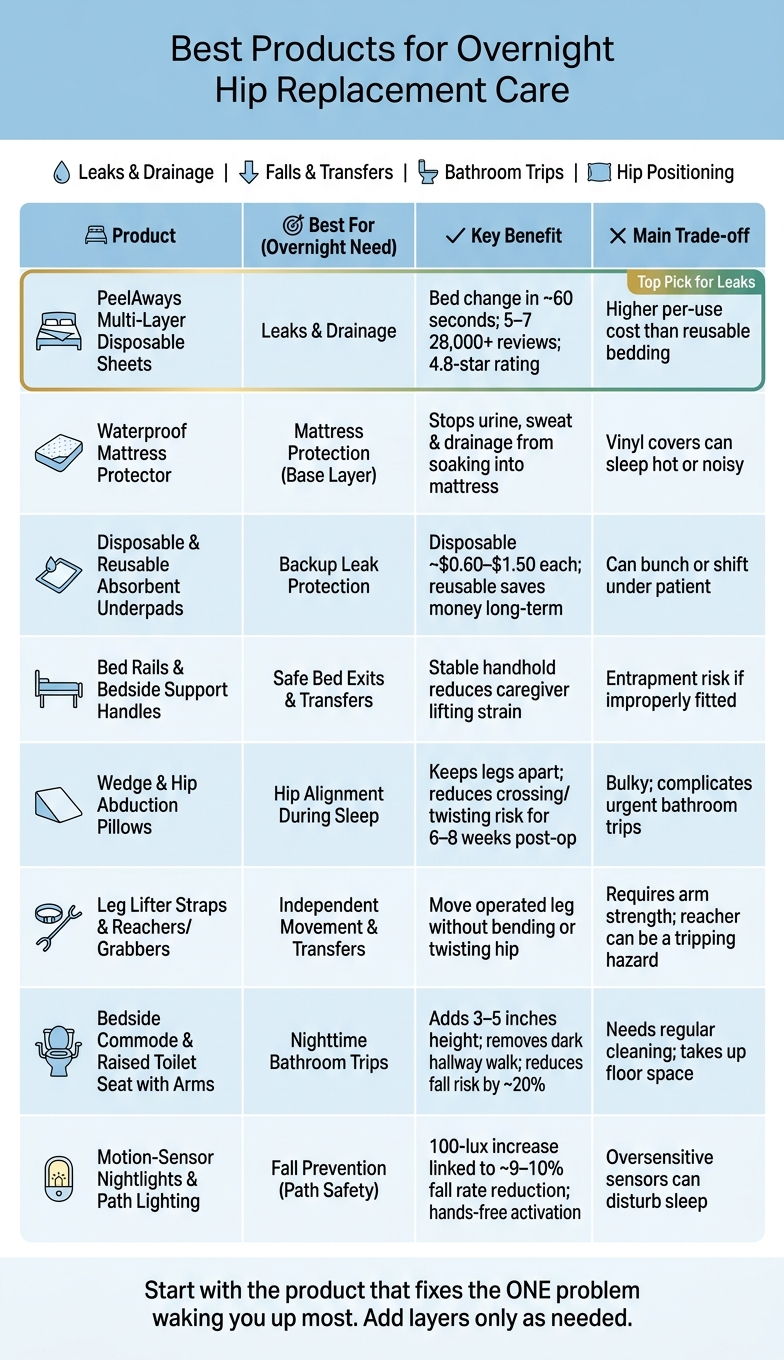
Best Products for Overnight Hip Replacement Care: Quick Comparison Guide
It’s 2am. You hear movement, then the rustle of sheets, then that split-second panic - is it a leak, a fall, or another full bed change? When nights keep going sideways, it helps to match the product to the problem that keeps blowing everything up.
Start with the one issue causing the biggest mess, the most strain, or the most lost sleep. Then build the rest of the setup around that. The chart below groups each option by the overnight problem it helps with most.
| Overnight Need | Products That Fit Best | When They Matter Most | Main Trade-offs |
|---|---|---|---|
| Falls and transfers | Bed rails/support handles, motion-sensor nightlights, leg lifter straps, reachers/grabbers | Early recovery, nighttime transfers | Need proper fit; entrapment risk |
| Leaks and drainage | PeelAways multi-layer disposable sheets, waterproof mattress protector, absorbent underpads | Heavy leakage or drainage | Top sheet can still get wet; can bunch if not secured |
| Bathroom trips | Bedside commode with arms, raised toilet seat with arms, leg lifter straps | When bathroom trips are unavoidable | Needs cleaning and floor space |
| Caregiver burden | PeelAways sheets, waterproof mattress protector, disposable/reusable underpads, bed rails, bedside commode, motion-sensor nightlights | Early recovery | Disposable sheets add ongoing supply costs |
If getting out of bed is the scary part, fall-support items usually come first. If leaks are what turn a rough night into 20 minutes of laundry and sheet changes, layered bedding matters more.
That’s where PeelAways can take a huge load off. I found them while looking for anything that would stop the middle-of-the-night full bed reset. They use 5-7 layers, come in sizes from crib to king, and let you peel away the soiled top layer instead of remaking the whole bed. For anyone dealing with incontinence pads, drainage, or repeat leaks, that 60-second bed change can feel like getting part of your night back. They also have 28,000+ reviews and a 4.8-star rating.
If bathroom trips are still happening no matter what, commode support may matter more than extra bedding. And as recovery gets better, you may find that a simpler setup is enough.
That’s the goal here: tie the first purchase to the biggest overnight problem, not the longest product list.
Pros and Cons of Each Product
It’s 2am.
You hear movement before you’re fully awake.
Now you’re doing that tired mental math: Is this a bathroom trip, a leak, a transfer, or all three at once?
That’s the part people miss. Overnight care usually isn’t one problem. It’s a stack of small problems that hit when you’re half-asleep and your body is already running on fumes.
This table makes the choice easier. Match the product to the problem that wakes you up most often. That’s usually the cleanest place to start.
| Product | Strongest Pro | Strongest Con | Best Fit For |
|---|---|---|---|
| PeelAways Multi-Layer Disposable Sheets | Soiled layers peel away in about 60 seconds without lifting the patient or stripping the bed | Higher per-use cost than reusable bedding | Caregivers handling nighttime leaks who need faster cleanup |
| Waterproof Mattress Protectors | Works as the waterproof base layer under all other bedding | Older vinyl-style covers can be hot or noisy | Most recovery setups that need a durable foundation layer |
| Disposable and Reusable Absorbent Underpads | Easy to place on top of other bedding for quick swaps; reusable options save money over time | Can bunch or shift under the patient; do not cover the mattress as fully as a fitted protector | Patients who need backup protection for leaks |
| Bed Rails and Bedside Support Handles | Give patients a stable handhold for repositioning and transfers, reducing how much lifting the caregiver does | Bed rails carry entrapment and climbing risks and should only be used after individualized assessment | Carefully assessed patients who need help sitting up or transferring in and out of bed |
| Wedge Pillows and Hip Abduction Pillows | Help maintain hip alignment and reduce leg-crossing risk during sleep | Bulky, can interfere with transfers, and may cause back discomfort if placed incorrectly | Early recovery patients who need help staying aligned while sleeping |
| Leg Lifter Straps and Reachers/Grabbers | Let patients move the operated leg and retrieve items without bending or twisting | Require arm strength and coordination; reachers near the bed can become a tripping hazard | Patients who want more independence overnight and can safely use simple assistive tools |
| Bedside Commodes and Raised Toilet Seats with Arms | Remove the dark hallway walk entirely; raised seats limit how far the hip flexes during toileting | Commodes need regular cleaning and take up floor space | Patients who make frequent nighttime bathroom trips when mobility is still limited |
| Motion-Sensor Nightlights and Path Lighting | Hands-free activation; studies link a 100-lux increase in bedroom light to about a 9–10% reduction in fall rate | Oversensitive sensors can disturb sleep; bright cool light can disrupt circadian rhythms | Anyone who gets up at night to use the bathroom |
A simple way to think about it:
- If leaks are the thing wrecking your nights, start with PeelAways Multi-Layer Disposable Sheets or underpads.
- If falls worry you most, look first at path lighting, toilet access, and only then support equipment that fits the person using it.
- If pain, twisting, or poor positioning is the issue, pillows and simple reach tools may help more than extra bedding.
I learned this the hard way: buying three “helpful” products at once can leave you with more clutter, more laundry, and one more thing to trip over in the dark. Start with the biggest overnight risk first. Then add the next layer only if you still need it.
Every product here solves one problem well.
Every product also asks you to live with one trade-off.
That’s the part that matters when you’re the one getting out of bed.
Conclusion
It’s 2am. You hear movement before you’re fully awake, and now you’re trying to figure out what happened first - the unsafe trip out of bed, the rush to the bathroom, or the wet sheets.
That’s why the right setup matters so much.
The best overnight setup usually comes down to three things: safer transfers, easier toileting, and cleaner bedding.
In plain terms, the first problems to solve are bed-exit safety, bathroom urgency, and mattress protection. When those three are handled, nights tend to feel less chaotic. You’re not scrambling as much. Your loved one keeps more dignity. And you’re not stuck doing a full bed change when you should be getting back to sleep.
A good setup often means safer bed exits, faster toileting, clear paths you can see in the dark, and layered leak protection.
Start with the product that fixes the one problem waking you up most often.
Then add the next layer only if you need it.
That’s the part people miss. You do not need to buy everything at once. Fix the biggest pain point first, whether that’s getting out of bed safely, making it to the bathroom in time, or keeping the mattress dry.
And if wet bedding is the issue that keeps knocking your night off the rails, PeelAways is the one I wish I’d found sooner. It turns a full bed change into about 60 seconds, not 15 to 20 minutes. It also helps protect dignity when accidents happen. Making aging and caregiving easier, one bed at a time.
Blog readers save 10% with code BLOGS10 at checkout. Available on peelaways.com/shop and Amazon. Free shipping on orders over $100.
FAQs
How soon after hip replacement should I set up overnight safety products?
It’s late. You’re trying to get the room ready before your loved one comes home, and every little thing suddenly feels urgent. The bed has to be safe. The path has to be clear. And you do not want to be fixing bedding at midnight after a hard day.
Set up all overnight safety products before the patient returns home from the hospital. That gives you a bed that’s safe, comfortable, and ready to use right away.
Prepare the space early. Clear access around the bed. Secure cords. Add nightlights. Put your protective bedding system in place. Taking care of this ahead of time cuts down on last-minute scrambling and helps lower the risk of falls during those first nights at home.
Which overnight care products matter most in the first two weeks?
Those first nights after hip surgery can feel endless. You’re half awake, listening for movement, hoping your loved one doesn’t try to get up too fast. In that stretch, the right bed setup matters more than most people expect.
In the first two weeks after hip replacement, focus on products that support hygiene, safety, and proper alignment.
-
Multi-layer disposable sheets, such as PeelAways
This was the one that changed the routine for me. Instead of stripping the bed and starting over, you peel off one clean layer and you’re done in about 60 seconds. That matters when someone is sore, tired, and embarrassed. PeelAways come in 5-7 layers, fit sizes from crib to king, and they have 28,000+ reviews with a 4.8-star rating. You can also find them on Amazon. -
Waterproof mattress protectors and absorbent underpads
These help with leaks, sweat, and the small messes that seem to happen at the worst time. They also save the mattress, which means one less thing to worry about at 2am. -
Wedge pillows, bed rails, and nightlights
These help keep the hip in a safer position and make nighttime movement less risky. A wedge pillow can help with alignment. Bed rails give extra support getting in and out of bed. Nightlights make those dark hallway trips less dangerous. -
Bedside commodes to reduce urgent bathroom trips
In the early days, even a short walk to the bathroom can feel like a long way. Keeping a commode close to the bed can cut down on rushing, pain, and the chance of a fall.
If you’re setting up the room, it also helps to read through a few practical guides before the first hard night hits. Start with the main shop page at peelaways.com/shop, then take a look at other helpful posts on PeelAways blog and how PeelAways work.
How do I choose the right bedding setup for leaks after hip surgery?
A leak at 2am doesn’t stop at the sheet. It soaks into the bed, the pad shifts, and now you’re stripping everything while your loved one waits. That’s the kind of night that wears you down fast.
Use a layered setup so the bed is better protected and cleanup takes less time. Start with a six-sided zippered waterproof mattress encasement. Then place an absorbent reusable bed pad under the hips and torso.
On top of that, add PeelAways multi-layer disposable sheets. Finish with overnight-rated briefs for extra protection at the source.
That stack matters because each layer does a different job:
- The mattress encasement helps stop moisture from reaching the mattress
- The reusable pad adds absorbency where leaks usually happen
- PeelAways let you remove a soiled top layer in about 60 seconds instead of changing the whole bed
- Overnight briefs help catch more at the source
It’s a simple setup, but when you’re tired and the bed is wet, simple is exactly what you need.
Comments
0



SAVE MONEY & WATER
Professionals & Institutions save a fortune on labor/laundry.

SUPERIOR COMFORT
The first thing our customers notice is how soft our sheets are.

100% WATERPROOF
Each layer is 100% Waterproof, perfect for spills and accidents

SAVE TIME
Change the sheet in under 1 minute without stripping the bed.

Leave a comment