
Best Incontinence Bedding for Alzheimer's Patients at Home

She doesn’t understand why the bed is wet.
You do. And you’re doing this alone at 3 a.m. for the fourth time this week.
If you need the best incontinence bedding for Alzheimer’s patients at home, the best setup is usually a zippered waterproof mattress encasement underneath and PeelAways on top for the fastest full-bed reset. PeelAways stand out when wet nights happen often because you can change the bed in about 60 seconds instead of 15–20 minutes, with 5–7 waterproof layers per set, sizes from crib to king, and 28,000+ reviews with a 4.8-star rating. For lower-cost setups, choosing between waterproof mattress pads vs. disposable sheets depends on your budget and laundry capacity.
- Best for frequent night accidents: PeelAways multi-layer disposable fitted sheets
- Best mattress backup: Zippered waterproof encasement
- Best lower-cost setup: Waterproof fitted protector + washable bed pad
- Best for travel or short-term backup: Disposable underpads
- Best for less laundry: PeelAways, with brands claiming 50%–80% less laundry
| Bedding type | Best for | Main downside |
|---|---|---|
| PeelAways | Fast 2 a.m. bed changes | Higher per-pack cost |
| Waterproof fitted protector | Basic mattress backup | Still needs sheet changes |
| Zippered encasement | Full mattress coverage | Hard to remove |
| Washable bed pad | Lower-cost repeat use | More laundry |
| Disposable underpad | Short-term backup | Can shift at night |
Here’s the short version of what matters when the bed is wet and everyone is exhausted.
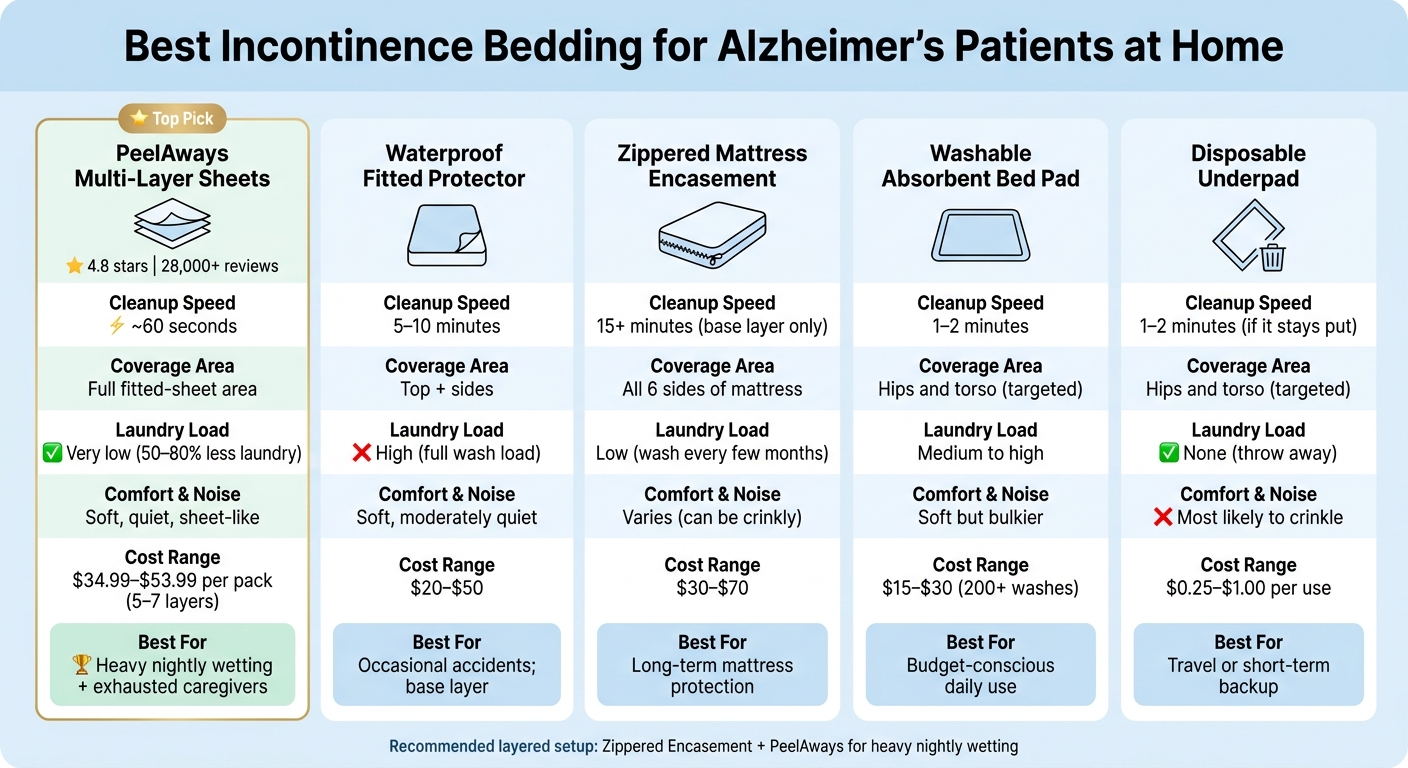
Best Incontinence Bedding for Alzheimer's Patients: Quick Comparison Guide
Why this problem is harder than people realize
Nighttime incontinence is hard on any family.
Add Alzheimer’s, and it gets worse fast.
Your loved one may wake up confused.
They may fight the bed change.
They may not understand what happened.
They may feel ashamed even if they can’t say it.
And you’re standing there trying to do four things at once:
- Keep the mattress dry
- Change the bed fast
- Keep your loved one calm
- Avoid one more load of laundry before sunrise
That’s why the best bedding solutions for incontinence is not just about waterproof fabric.
It’s about time, dignity, and how much work lands on you at 2 a.m.
sbb-itb-45288fe
What to look for before buying
Before you choose bedding for incontinence care, I’d focus on five things:
-
How much of the bed stays protected
A small pad is not the same as full fitted-sheet coverage. -
How fast you can reset the bed
There’s a big difference between 60 seconds and 15–20 minutes. -
Whether it stays in place
Alzheimer’s often comes with restlessness, pulling at bedding, and wandering. -
How it feels and sounds
Crinkly or hot bedding can make sleep worse. -
How much laundry it creates
Some setups save money up front but leave you washing nonstop.
If your loved one uses diapers or incontinence briefs and the bed is still getting wet, you need a bedding layer that can catch what leaks through without turning the whole night into a cleanup job.
PeelAways multi-layer disposable waterproof fitted sheets

This is the one I would keep closest if wet nights happen often.
PeelAways are fitted sheets with 5–7 waterproof layers stacked together.
When the top layer gets wet, you peel it off, and a clean one is already there.
That’s the whole point.
No stripping the mattress.
No digging for fresh sheets.
No middle-of-the-night laundry. It is one of the most effective ways to keep beds dry during incontinence care.
What I like most is the time. The bed can be reset in about 60 seconds. That matters when your loved one is cold, upset, or half awake and you need to get them settled fast.
They also cover the full fitted-sheet area, which helps more than loose pads if your loved one moves around at night.
A few details matter here too:
- Sizes: crib to king
- Layers: 5–7 per set
- Reviews: 28,000+
- Rating: 4.8 stars
- Feel: soft and quiet compared with many waterproof options
If I were dealing with heavy wetting several nights a week, this is where I’d start.
You can check them here:
And if you want more help with nighttime cleanup, these guides are worth reading too:
- PeelAways blog
- More caregiving and bedding articles on PeelAways
The downside is simple: they cost more than washable bed sheets.
But for many of us, the trade is clear. Less laundry. Less lifting. Less chaos.
Waterproof fitted mattress protectors
A waterproof fitted protector is a good base layer.
It goes on like a traditional waterproof sheet and helps stop urine from reaching the mattress. But it does not solve the whole problem by itself.
That’s because it blocks liquid.
It does not absorb much of it.
So if the sheet gets soaked, you still have a wet surface to deal with. You may still need to strip the bed, change the sheet, and wash everything.
I see this as a lower-cost layer under the rest of your bedding, not the thing that saves your night.
[Best for:
- Early or occasional accidents](https://peelaways.com/blogs/peelaways-blog/best-waterproof-hypoallergenic-bedding-for-incontinence)
- A layer under a washable pad
- Extra backup under PeelAways or regular sheets
Main downside:
- It still leaves you doing more work after leaks
Zippered waterproof mattress encasements
If your main fear is the mattress getting ruined, this is the layer that helps most.
A zippered encasement covers all six sides of the mattress.
Once it’s on, it stays put.
That matters when leaks hit the edges, when sheets get pulled around, or when your loved one moves a lot in bed.
I would not count on this for a fast midnight cleanup.
That’s not its job.
Its job is to keep urine, odor, and stains from getting into the mattress over time. This is a key part of maintaining comfort and dignity in incontinence bedding for your loved one.
Best for:
- Heavy or repeated wetting
- Long-term mattress protection
- Restless sleepers who shift bedding around
Main downside:
- It’s bulky and a pain to remove and wash
If you can only buy one mattress-protection layer, this is often the safest pick for the mattress itself. Then put your easier-change layer on top.
Washable absorbent bed pads
Washable bed pads can work well if you need a lower-cost setup and you don’t mind more laundry.
They sit on top of the sheet or protector and catch leaks around the hips and lower torso. Many overnight pads hold a good amount of liquid, and swapping one out is faster than remaking the whole bed.
That said, they do have limits.
They can bunch up.
They can shift.
They can feel damp if not changed fast.
For some families, that trade is worth it because the per-pad cost is low.
For others, the repeat washing becomes its own problem.
Best for:
- Lower-cost repeat use
- Lighter wetting
- Homes where daily laundry is already part of the routine
Main downside:
- More washing and less full-bed coverage
Disposable absorbent underpads
Disposable underpads sound easy.
Sometimes they are.
Sometimes they aren’t.
If the pad stays where it belongs and catches the leak, cleanup is simple. Toss it and put down another one.
But in Alzheimer’s care, pads often shift.
That’s the problem.
Restless movement, pulling at sheets, and side sleeping can leave the wet area outside the pad. Then you still end up changing the bed anyway.
Best for:
- Travel
- Short-term backup
- Nights when you want a throw-away option
Main downside:
- High shift risk and repeat buying
I would treat these as backup supplies, not the main plan for frequent overnight accidents.
Comparison table
| Option | Mattress protection | Change speed | Comfort | Laundry load | Best fit |
|---|---|---|---|---|---|
| PeelAways | Full fitted-sheet area | About 60 seconds | Soft, quiet | Very low | Heavy nightly wetting |
| Waterproof fitted protector | Top and sides | Slower | Usually soft | High | Base layer for light to medium leaks |
| Zippered encasement | Full mattress | Slow to remove | Varies by material | Low day to day | Mattress backup for long-term use |
| Washable bed pad | Targeted area | Fast if swapped | Soft but bulkier | Medium to high | Lower-cost setup |
| Disposable underpad | Targeted area | Fast only if it stays put | Less comfortable | None | Travel or short-term use |
FAQ
What is the best bedding setup for Alzheimer’s patients with frequent bedwetting?
If wetting happens most nights, I’d go with a zippered waterproof encasement under PeelAways. The encasement protects the mattress. PeelAways handle the fast bed reset.
Are washable bed pads enough on their own?
Sometimes, but I would not trust them alone for heavy or repeated wetting. They work better over a waterproof protector or
1. PeelAways Multi-Layer Disposable Waterproof Fitted Sheets
It’s 2am. The top sheet is wet, your loved one is upset, and you’re standing there doing the math in your head: strip the bed, start laundry, find dry bedding, try not to wake them all the way up. If that’s your night, PeelAways can take a brutal job and cut it down to about 60 seconds.
PeelAways are made for fast overnight changes. You peel off the soiled top layer and there’s a clean one right underneath. Each fitted set comes with 5 to 7 waterproof layers. It’s one of those things that sounds almost too simple until you’re the person changing a bed in the dark.
Mattress Protection
Each layer has a breathable waterproof backing to keep liquid off the mattress. That matters more than people think. A pad can shift. A mattress protector can still leave you with a full bed change. PeelAways cover the whole fitted sheet area, which helps keep the mess contained.
They’re also free from vinyl, PVC, phthalates, and fire retardants. If you’re putting this on a bed someone sleeps on every night, that kind of detail matters.
For deeper mattresses, sizing helps too. Twin XL fits up to 9 inches deep, and Queen and King fit up to 12 inches deep. If your loved one tosses, turns, or slides around at night, sheet straps can help keep the corners in place.
Overnight Cleanup Speed
This is the big draw. The brand says you can change a layer in under a minute. No stripping the whole bed. No hauling wet sheets to the washer before sunrise. Just peel, smooth, and help your loved one settle back down.
Compared with the usual 15 to 20 minutes it can take to change bedding the old way, that time gap feels huge when you’re half awake and running on fumes.
Comfort and Noise
Some waterproof bedding feels stiff or sounds crinkly every time a person moves. PeelAways are made to be soft and quiet, so the bed still feels like a bed. That can make a big difference for someone who’s already self-conscious or struggling to sleep.
Ongoing Cost and Laundry
PeelAways start at $34.99 for a Twin, $47.99 for a Queen, and $53.99 for a King. Yes, the upfront price is more than a plain sheet set. But if you’re doing constant linen changes, the tradeoff is easy to see.
The brand says they can cut laundry by 4 to 6 loads per week. That’s less washing, less drying, less remaking the bed, and less wear on your back. HSA/FSA eligibility may also cut what you pay out of pocket.
If you want to look at sizes or buy directly, you can check the PeelAways shop. They’re also available on Amazon. For more nighttime incontinence care tips and bedding choices, see other articles on peelaways.com, like the blog’s published guides on caregiving and incontinence bedding.
If you need less coverage, the next section covers mattress-only protection.
2. Waterproof Fitted Mattress Protectors
It’s 2am. The top sheet is wet, the pad has shifted, and you’re standing there hoping the mattress somehow made it through the night. That little moment of dread is exactly why a waterproof fitted mattress protector matters.
A waterproof fitted mattress protector goes on like a regular fitted sheet. It stops liquid before it reaches the mattress. In most homes, it works best as a base layer under your sheets and an absorbent pad when you want something you can wash and use again.
Mattress Protection
Newer protectors are a lot easier to live with than the old plastic-feeling covers many of us remember. Most use a thin waterproof backing with a soft fabric top, so they stay flexible and much quieter than older vinyl styles.
For light to moderate nighttime leaks, this kind of protector does a good job keeping the mattress dry. But here’s the part that matters at 2am: it’s waterproof, not absorbent. It blocks liquid from soaking down into the mattress, but it does not soak up the mess on its own. You still need an absorbent layer on top.
If leaks happen often or are heavy, use the fitted protector with a zippered encasement and an absorbent pad. That gives you more coverage and less chance of the mattress getting hit.
Overnight Cleanup Speed
On its own, a fitted protector won’t make cleanup much faster. The time-saver comes from how you layer the bed.
When it sits under a pad and sheet, you can often pull off only the wet top layers and leave the protector in place. That means less work, less mattress checking, and one less step when you’re already tired.
Comfort and Noise
This is one area where newer TPU-backed protectors help. They’re softer and quieter than old vinyl covers, so there’s less crinkling, less irritation, and less chance of sleep getting broken by noise.
That may sound like a small thing. It isn’t. When someone is already restless at night, even a little extra noise or stiffness can make the whole night harder.
Ongoing Cost and Laundry
A washable protector can save money over time because you reuse it instead of tossing it out after one accident. It also helps cut down on the kind of laundry nobody wants to deal with.
When accidents happen night after night, the pads and sheets on top usually take most of the mess. That keeps the laundry focused on smaller items instead of forcing you to wash bulky bedding over and over.
If you want the mattress covered from every side, the next option goes a step further and seals the whole bed.
3. Zippered Waterproof Mattress Encasements
It’s 2am. The top sheet is twisted, the blanket’s half on the floor, and somehow the wet spot reached the side of the mattress again. You clean what you can, but that sinking feeling hits fast when you realize the mattress itself may not be safe.
When a fitted protector is not enough, a zippered encasement gives you full-mattress coverage.
A zippered waterproof mattress encasement covers all six sides of the mattress and zips closed, making a full barrier. That matters when wandering, side-sleeping, or pulled bedding leaves the mattress edges exposed.
Mattress Protection
This is the layer that stays put.
A zippered encasement helps keep urine, sweat, and other fluids from getting into the foam or coils. That can cut down on odor, stains, and mold risk. Proper incontinence bedding disposal is also key to managing these hygiene concerns. It’s especially helpful when your loved one moves a lot at night or keeps pulling the bedding around, because the encasement stays anchored to the mattress even when everything above it shifts. It also helps protect specialty mattresses and may help prevent the kind of damage that can affect warranty coverage.
Overnight Cleanup Speed
Here’s the hard truth: a zippered encasement is not your fast-change layer.
Pulling a full encasement off a queen or king mattress takes time. It’s awkward. And when you’re tired, it can feel like wrestling a wet tent. That’s why most people use it as a permanent base layer under an absorbent pad. When an accident happens, you change the top layers and leave the encasement in place.
If you’ve ever spent 15 to 20 minutes remaking a bed in the dark, you already know why this matters.
Comfort and Noise
Older vinyl encasements can feel stiff, sound crinkly, and trap heat. That can be a problem at night, especially when someone is already restless or upset.
Newer fabric-backed encasements with a soft knit or terry top and a thin waterproof backing are quieter, more breathable, and feel closer to regular bedding. For someone with Alzheimer's who is easily startled or agitated at night, that softer and quieter surface is less likely to set things off.
Ongoing Cost and Laundry
A good encasement usually costs more up front than a basic fitted protector, but it’s made to last for years. Since the top layers handle most nightly accidents, many caregivers only wash the encasement every few months, or after a major spill that gets through everything above it. Most fabric-backed polyurethane models are machine washable and can go in the dryer on low heat.
That up-front cost can sting a little. Still, it often costs less than replacing a urine-damaged mattress.
For nightly accidents, the absorbent layer on top does the day-to-day work.
4. Washable Absorbent Bed Pads
It’s 2am. You’ve already changed the bed once, and now there’s that cold damp spot spreading under the hips again. You don’t need a big cleanup. You need something that catches the leak fast and lets everyone get back to sleep.
Once the mattress is protected, the next job is catching the leak before it spreads.
Washable absorbent bed pads sit on top of the fitted sheet and help keep urine off the mattress. They’re reusable, and most are built with three parts: a soft top layer, an absorbent middle, and a waterproof bottom. Many pads made for overnight accidents hold about 6–8 cups (48–64 fl oz) of liquid, which is about what a full adult bladder may release overnight.
Mattress Protection
A large washable pad - around 34 in x 52–54 in - placed under the hips and lower torso covers the area where most leaks happen. Used over a waterproof mattress protector, it gives you one more layer between the accident and the bed.
If the person you care for moves a lot in sleep, size matters. A longer pad covers more of the bed and helps cut down on leaks that run off the edge.
Overnight Cleanup Speed
This is where washable pads help the most in real life.
Cleanup is often just one quick swap: pull the wet pad, put down a clean one, and leave the rest of the bedding alone. That means less disruption in the middle of the night. And if accidents happen more than once, that saved time adds up fast.
Keeping 2–4 clean pads at the bedside helps a lot. No digging through a closet. No standing there half-awake trying to find backup linens.
Comfort
Modern washable pads with a quilted cotton or brushed polyester top are made to feel soft under the body while pulling moisture away from the surface. That part matters more than people think. If someone is lying on the pad for hours, rough or plastic-feeling fabric can make a long night feel even longer.
The biggest comfort issue is dampness. If the pad isn’t changed soon after an accident, it can feel wet against the skin. That’s a bigger concern when the person in bed can’t easily say they’re uncomfortable.
Ongoing Cost and Laundry
Washable underpads in 4-packs often cost about $20–$55 total, or around $5–$14 per pad. Many consumer-grade pads are rated for 200–300 wash cycles, and some higher-end options say they can last up to 500 washes with proper care.
Over time, that can mean potential annual savings of $200–$500 for a senior using 2–3 pads each night. Most families keep 3–4 pads in rotation as a starting point, and 4–6 pads if wetting is heavier or laundry isn’t done every day.
The tradeoff is simple: more laundry, less panic cleanup.
5. Disposable Absorbent Underpads
It’s 2am. You strip off the top layer, hoping this will be the fast fix, and then you see the pad has bunched up again. Now the mattress is wet, your loved one is upset, and a “quick change” just turned into the whole bed.
When washing is the problem, disposable underpads can help. But during overnight Alzheimer’s care, they’re more of a short-term backup than a bed setup you want to rely on every night.
Mattress Protection
Disposable absorbent underpads are single-use pads placed under the body to catch urine. The hard part is that they’re laid on top of the bed, not fitted to it.
That means they move. A lot.
If your loved one wanders, turns often, or pulls at the bedding, the pad can slide out of place. That’s common with Alzheimer’s, and once the pad shifts, less of the mattress stays covered. Underpads move more than fitted layers, so they’re best used as a disposable top layer, not your only line of defense.
Overnight Cleanup Speed
This is where the promise of a fast cleanup can fall apart.
If the underpad stays put and catches everything, you can toss it and reset the bed with less work. But if it shifts or leaks over the edge, you’re back to doing a full bed change anyway.
That’s the catch. The speed only helps when the pad works exactly the way you need it to.
Comfort and Dignity
Disposable underpads also tend to feel bulkier and more obvious under the sheets. That may not sound like a big deal at first, but at night, it can matter.
If someone is already confused, restless, or bothered by changes in how the bed feels, that extra bulk can make settling down harder. It can also chip away at dignity in incontinence care, which matters more than most people realize.
Ongoing Cost and Laundry
Yes, they cut out washing. On a rough week, that can feel like a gift.
But the cost shows up somewhere else. Disposable underpads cost more per use than reusable choices, and if accidents happen often overnight, that spending adds up fast.
So the trade-off is pretty simple:
- Less laundry
- More repeat buying
- Less security if the pad shifts
For many exhausted families, disposable underpads make the most sense as backup supplies, travel stock, or for those nights when a throw-away change matters more than long-term savings.
How These Bedding Types Compare for Alzheimer's Care at Home
It’s 2 a.m. again. The bed is wet, your loved one is upset, and you’re standing there half-awake trying to change everything without turning the whole house upside down. In moments like this, the bedding that sounds fine on paper can fall apart fast in real life.
Now that each bedding type has been introduced, the comparison below shows which one fits the hardest nighttime situations. No single bedding type works for every night. The right pick depends on how often accidents happen, how much your loved one moves, and how fast you need that bed clean and ready again.
Mattress Protection
Zippered encasements offer the most complete coverage, since they cover all six sides of the mattress. That matters if wetting is heavy or keeps happening over time. PeelAways sit in a different spot: they give you full fitted-sheet coverage, but they also let you change the bed fast when the night goes sideways.
| Item Type | Coverage Area | Leak Severity Fit | Best Use Case |
|---|---|---|---|
| PeelAways Multi-Layer | Full fitted-sheet coverage | Moderate to heavy | Nightly use; fast layer changes |
| Waterproof Fitted Protector | Top and sides (fitted) | Light to moderate | Permanent base layer under a pad or fitted sheet |
| Zippered Encasement | All 6 sides | Heavy / chronic wetting | Long-term mattress protection |
| Washable Absorbent Pad | Under the hips and torso | Light to moderate | Targeted coverage; layered setup |
| Disposable Underpad | Under the hips and torso | Light to moderate | Backup or travel use |
Coverage matters, but in Alzheimer’s care, the next thing that matters is simple: how fast can you reset the bed and get your loved one settled again?
Overnight Cleanup Speed
PeelAways are the fastest option - peel the soiled layer from the corners and a clean one is already underneath, usually in under a minute. That difference hits hard when your loved one is confused, cold, or fighting sleep.
A fitted protector can do the job, but you still have to strip the bed and pull corners loose. A zippered encasement helps guard the mattress, but it’s not the thing you want to mess with in the middle of the night. Pads and underpads can be fast too, though only if they stay put.
| Item Type | Typical Change Process | Mattress Lifting Needed | Cleanup Time |
|---|---|---|---|
| PeelAways | Peel top layer from corners; toss | No | Under 1 minute |
| Waterproof Fitted Protector | Strip bed; remove and replace protector | Yes (corners) | 5–10 minutes |
| Zippered Encasement | Not changed at night; base layer only | Yes (during installation/removal) | 15 minutes or more if removed |
| Washable Absorbent Pad | Slide out soiled pad; slide in clean one | No | 1–2 minutes |
| Disposable Underpad | Lift and toss; place new pad | No | 1–2 minutes if it stayed in place |
If you’ve ever changed a bed while someone is restless or embarrassed, you already know this: a 60-second reset feels very different from a 15- to 20-minute ordeal.
Comfort and Noise
Soft, quiet bedding can help lower agitation. Crinkly or stiff materials can do the opposite. When someone is already confused at night, even a small sound or odd texture can set things off.
PeelAways have more of a sheet-like feel, which can help with sleepers who startle easily. Waterproof layers can feel a bit warmer, mainly when the backing is thicker. Disposable underpads are often the toughest sell for sensitive sleepers because they can crinkle, shift, and feel less like regular bedding.
| Item Type | Surface Feel | Noise Level | Breathability | Dementia Comfort Notes |
|---|---|---|---|---|
| PeelAways | Soft, sheet-like fabric | Quiet | More breathable | Sheet-like feel; good for easily startled sleepers |
| Waterproof Fitted Protector | Terry or jersey | Moderately quiet | Moderate | Can trap heat with thicker backing |
| Zippered Encasement | Smooth or quilted | Moderately quiet (varies by material) | Less breathable | Vinyl versions may feel hot or stiff |
| Washable Absorbent Pad | Quilted fabric | Quiet | Moderate | Soft but bulkier under hips; test for tolerability |
| Disposable Underpad | Paper or plastic | Most likely to crinkle | Less breathable | Most likely to shift and agitate sensitive sleepers |
Once comfort is dialed in, the day-after part starts to matter too. Not just money. Laundry. Time. Energy you may not have.
Ongoing Cost and Laundry
Reusable layers can cost less over time. Disposables cut down on laundry, but the per-use cost keeps adding up. That tradeoff feels different when you’re dealing with nightly accidents instead of the occasional bad night.
PeelAways cost more up front than a single pad, but they remove the laundry burden and save time when wetting is frequent. They’re sold in packs with 5 or 7 layers, depending on size, and come in sizes from crib to king. Many families find that time savings matters just as much as sticker price. PeelAways are also backed by 28,000+ reviews and a 4.8-star rating, which is one reason so many people land there after trying other setups.
If you want to look at them directly, you can check PeelAways on peelaways.com and the PeelAways Amazon listing. You may also want to read more on the brand’s blog, like how PeelAways work and other published articles on peelaways.com.
| Item Type | Typical Price Range (USD) | Laundry Impact | Replacement Frequency | Best Fit for Budget |
|---|---|---|---|---|
| PeelAways | $41.99–$53.99 per pack | None | 5 or 7 uses per pack, depending on size | Nightly heavy wetting; limited caregiver time |
| Waterproof Fitted Protector | $20–$50 | High (full wash load) | Every 1–2 years | Occasional accidents; foundational layer |
| Zippered Encasement | $30–$70 | Very high (large item) | Every 2–5 years | Long-term mattress protection |
| Washable Absorbent Pad | $15–$30 | Moderate | 200+ washes | Daily use; budget-conscious households |
| Disposable Underpad | $0.25–$1.00 each | No laundry; more waste | Per use | Backup, travel, or short-term use |
Pros, Cons, and Best Picks by Nighttime Scenario
It’s 2 a.m. again. The bed is wet, your loved one is upset, and you’re standing there half-awake trying to figure out the FASTEST way to get everyone back to sleep.
That’s the part people don’t see. Not every bedding product works the same when you’re tired, rushed, and changing a bed in the dark.
No single bedding product handles every Alzheimer's caregiving situation well. The right setup depends on how often accidents happen, how much your loved one moves at night, and how much energy you have left at 2 a.m. The table below sums up the tradeoffs for each bedding type.
| Item Type | Main Pros | Main Cons | Best For |
|---|---|---|---|
| PeelAways Multi-Layer Sheets | Fast changes; no laundry; soft, breathable | Ongoing cost; disposable waste | Heavy nightly wetting; exhausted caregivers |
| Waterproof Fitted Protector | Protects mattress top; feels like a standard sheet | Requires full bed stripping and laundering after leaks | Early-stage or occasional accidents; base layer |
| Zippered Waterproof Mattress Encasement | 360-degree mattress protection | Hard to remove and wash; can feel crinkly or warm | Permanent base layer for all stages |
| Washable Absorbent Bed Pad | Reusable; targeted protection | Shifts and bunches easily; adds to laundry load | Targeted protection; budget-conscious households |
| Disposable Absorbent Underpad | No laundry; low upfront cost | High shifting risk; plastic feel; more waste | Short-term use or travel backup |
Those tradeoffs matter most when the night gets interrupted. Here’s the setup that tends to make the most sense in each common situation.
| Nighttime Scenario | Recommended Layered Setup | Why It Works |
|---|---|---|
| Heavy nightly wetting | Zippered encasement + PeelAways multi-layer sheets | The encasement protects the mattress over time, while PeelAways make the 2 a.m. change fast and laundry-free |
| Wandering or restless sleep | Zippered encasement + PeelAways with sheet straps | The fitted design stays in place better than loose pads, and sheet straps help keep the corners secure during movement |
| Occasional early-stage accidents | Waterproof fitted protector + washable absorbent pad | Lower-cost for infrequent use; the pad swaps fast while the protector guards the mattress underneath |
| Late-stage care and fragile skin | Zippered encasement + PeelAways multi-layer sheets | Soft, breathable layers help keep the bed cool and dry, and the materials are free from vinyl, PVC, and phthalates |
If your loved one is in the early stages of Alzheimer's, you may want a setup that doesn’t make the bed look medical. A discreet multi-layer disposable sheet under a cotton fitted sheet can help keep the bed looking normal while still putting a waterproof layer underneath.
If you want to see the PeelAways options mentioned here, you can check the PeelAways shop and the Amazon listing for PeelAways. For more help with bedding and night care, see other articles on peelaways.com, including posts like how to handle overnight incontinence and ways to make bed changes easier.
Conclusion
It’s 2am. The bed is wet again. You’re tired, your loved one is embarrassed, and the thought of stripping the whole bed feels like too much.
The best setup is a layered one: protect the mattress first, then pick the top layer based on how often accidents happen and how fast you need cleanup. That starts with the mattress.
Use a waterproof mattress protector or zippered encasement as your base layer. Then choose the top layer based on what your nights look like.
When accidents happen most nights, speed matters. That’s where PeelAways make sense. If frequent wetting has turned every overnight change into a 15- to 20-minute ordeal, PeelAways can cut that down fast. A soiled layer peels away in under 60 seconds, leaving a clean, dry surface underneath without stripping the bed and with far less disruption in the middle of the night. The soft, quiet fabric helps the bed feel normal, which can protect comfort and dignity.
I found PeelAways the same way a lot of people do: in the middle of burnout, looking for anything that would make nights easier. If you already use diapers or incontinence pads, adding PeelAways on top can take a brutal job and make it much more doable. They come in 5-7 layers, sizes from crib to king, and they have 28,000+ reviews with a 4.8-star rating. You can find them on peelaways.com/shop and on Amazon. For more help, see other guides on PeelAways like this blog article and this one.
Choose the setup you can live with night after night: mattress protection first, washable pads for lower-cost routine use, or disposable fitted layers when speed and less labor matter most. PeelAways is the one I’d keep close when the nights are hard and every minute counts - Making aging and caregiving easier, one bed at a time.
Blog readers save 10% with code BLOGS10 at checkout. Available on peelaways.com and Amazon. Free shipping on orders over $100.
Comments
0



SAVE MONEY & WATER
Professionals & Institutions save a fortune on labor/laundry.

SUPERIOR COMFORT
The first thing our customers notice is how soft our sheets are.

100% WATERPROOF
Each layer is 100% Waterproof, perfect for spills and accidents

SAVE TIME
Change the sheet in under 1 minute without stripping the bed.

Leave a comment