
Best Incontinence Bedding for Adults: Tested by Real Caregivers

It’s 2 a.m. The sheets are soaked again. Your loved one is embarrassed, your back hurts, and you have to be up in four hours. If that’s your night, you do not need hype. You need bedding that cuts the work.
The best incontinence bedding for adults depends on what you need most: the fastest bed change, the strongest mattress backup, the lowest laundry load, or the lowest long-term cost. From what I’ve seen, PeelAways stands out for overnight changes because it can cut a full bed reset from 15–20 minutes to about 60 seconds, with 5–7 waterproof layers in one set.
Here’s the short version:
- Peel-away sheets: best when you need the bed clean fast
- Waterproof mattress protectors: best for protecting the mattress itself
- Disposable sheets: best for short-term, no-laundry use
- Washable underpads: best when you want to spend less over time
- PeelAways details: 28,000+ reviews, 4.8 stars, sizes crib to king
| Option | Best for | Main tradeoff |
|---|---|---|
| Peel-away sheets | 2 a.m. bed changes | Higher upfront spend |
| Mattress protectors | Mattress backup | Full sheet change if soaked |
| Disposable sheets | Short-term use | High repeat cost |
| Washable underpads | Lower long-term spend | More laundry |
If you’re tired of doing sheet changes in the dark, this is the setup I’d look at first.
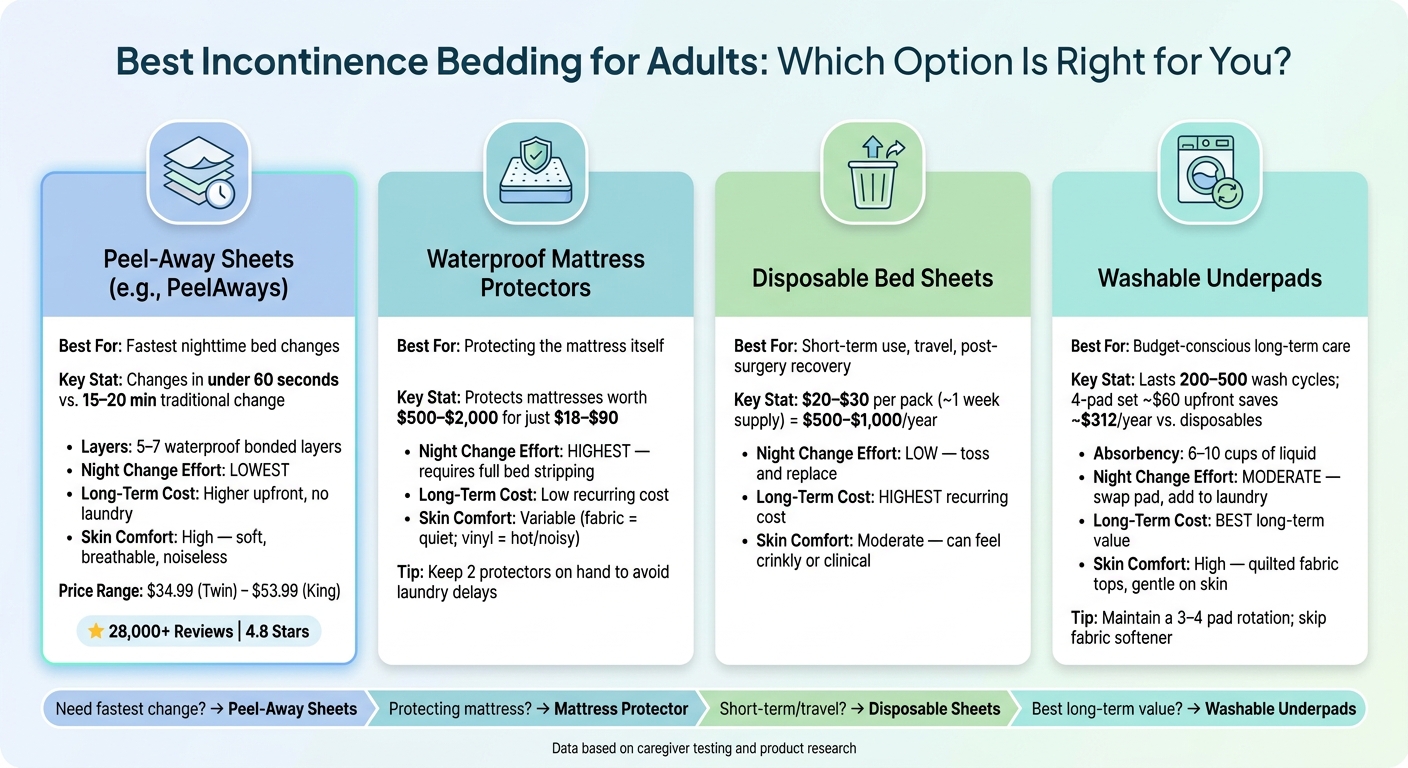
Best Incontinence Bedding for Adults: Side-by-Side Comparison
Reusable Bed Pads with Transfer Handles - Close Look at AGOOLIIU
1. Multi-Layer Peel-Away Sheet Systems
It’s 2am. The bed is wet again, your loved one is upset, and the idea of stripping the whole bed feels like too much. In that moment, shaving 15 or 20 minutes down to under a minute can feel like getting part of your night back.
Multi-layer peel-away sheet systems let you remove one soiled layer fast, without pulling off the whole bed or lifting the mattress. That matters when you’re tired, your back already hurts, and you just need the change done with as little fuss as possible.
PeelAways is the one I keep coming back to because it was built for this exact problem. It uses a patented design with 5 to 7 fitted, waterproof layers. Each layer helps stop fluid and odor from reaching the mattress. And this part matters more than people think: the bamboo/rayon top doesn’t feel like stiff plastic. It feels much closer to normal bedding.
The sheets are breathable and hypoallergenic. They’re made to pull moisture away from the skin and don’t contain vinyl, PVC, or fire retardants. That’s a big deal when someone is already uncomfortable and the last thing they need is a sweaty, crinkly bed.
Carol Suchman, Creator of PeelAways, captures why the independence factor matters so much:
"My parents can change their sheet in the middle of the night on their own without any aid and go back to bed."
That one line says a lot. This isn’t just about cleanup. It’s about dignity. It’s about letting someone handle a hard moment without turning it into a full production.
PeelAways comes in sizes from Twin to King, including Twin XL for standard hospital beds. Pricing starts at $34.99 for Twin and goes up to $53.99 for King, with Twin XL at $41.99.
If you want to look at the product itself, you can find it on peelaways.com/shop and on Amazon. You can also read more on the PeelAways blog, including posts like How to Change a Bedridden Patient’s Sheets and Incontinence Bed Pads vs. Layered Bedding Options.
For caregivers who want a base layer instead of a change-out system, the next option is a waterproof mattress protector.
2. Waterproof Mattress Protectors
It’s 2am. The sheet is wet, the mattress is the one thing you can’t afford to ruin, and you’re standing there half-awake trying to keep this from turning into a full bed disaster. In that moment, a waterproof mattress protector isn’t fancy. It’s the layer that keeps one bad leak from becoming a much bigger mess.
If you want mattress protection without changing the whole bed every time, a waterproof mattress protector is the simplest base layer. It goes between the mattress and the sheets and acts as backup protection for a mattress that may cost $500–$2,000, while the protector itself usually runs about $18–$90. For light to moderate leaks, a protector alone may be enough. For heavier overnight accidents, it works better with absorbent layers on top.
The big choice comes down to style. Fitted-sheet protectors are easier to pull off, wash, and put back on. But they only cover the top and sides, so the bottom of the mattress is still exposed. Six-sided zippered encasements cover the whole mattress and give the strongest shield against heavy leaks. The tradeoff? They’re slow and awkward to remove at 2 a.m., which matters a lot when bed changes happen often.
Material matters more than people think, especially when sleep is already hard to come by. Polyurethane (PU) backing blocks liquid while staying more breathable and much quieter than older vinyl covers. Vinyl gives the strongest waterproof barrier and can be wiped clean instead of washed, which sounds good on paper. But it also traps heat and makes noise, and that can make a rough night feel even longer for someone who’s already uncomfortable.
A few care basics help these last longer:
- Dry on low heat
- Skip fabric softener
- Replace the protector when liquid stops beading on the surface
It also helps to keep two protectors in the house. That way, you’re not waiting on laundry before you can get the bed set up again.
If you want even less cleanup in the middle of the night, the next option is disposable bed sheets.
3. Disposable Bed Sheets
It’s 2am. There’s that wet, sinking feeling again. You’re stripping the bed in the dark, trying not to wake your loved one all the way, and all you want is the fastest cleanup possible.
Disposable bed sheets are often the simplest no-laundry option when you need to move fast. They tend to work best for light to moderate overnight leaks. They can also make sense for travel, short-term recovery, or those nights when the laundry just isn’t happening.
When a leak happens, you remove the soiled sheet and place it in a sealed bag or bin. That absorbent top layer helps hold moisture and odor, which can help the person in bed feel drier and spare them the stress of waking up in wet bedding.
Fit matters more than people think. If you’re using a hospital bed for post-surgery care or elder care at home, Twin XL sizing often gives a better fit. A loose disposable sheet can bunch up or slide during sleep. For someone with limited mobility, that can lead to more skin irritation.
Then there’s the cost. This is where disposable sheets can get tough to stick with day after day. A single pack of premium disposable sheets usually costs $20 to $30 and may last about a week. If you’re dealing with frequent overnight changes, that can add up to $500 to $1,000 per year on disposable sheets alone. That’s not a small line item when you’re already paying for so much else.
Skin comfort and noise can vary too. Some disposable sheets feel crinkly or rough, while others are softer and quieter. If your loved one spends long stretches in bed, that texture can affect sleep and skin comfort more than you’d guess.
If you want something that cuts down on laundry without going fully disposable, the next section looks at washable underpads.
sbb-itb-45288fe
4. Washable Underpads
It’s 2am. The bed is wet again. You’re stripping sheets with one hand, steadying your loved one with the other, and all you can think is: there has to be an easier way than this.
If you want bedding that feels softer and costs less over time, washable underpads are usually the next thing people try.
They’re best for repeated use and can hold about 6 to 10 cups of liquid overnight. That makes them a solid pick for heavy leaks and long, hard nights. The catch is simple: laundry. They only help if you’ve got enough clean pads ready to go.
Most washable pads are made with quilted cotton, bamboo, or polyester blends. They tend to feel better against the skin than plastic-backed options, and they pull moisture down into the center of the pad. If the person in bed has fragile or sensitive skin, that softer feel can make a tough night a little less miserable.
Fit matters more than people think. Washable pads tend to stay in place better when the backing is non-slip and the size matches the sleeper. If your loved one sleeps on their side or moves around a lot, going up to 34" × 52" or 44" × 52" gives you more room for movement than a standard 34" × 36" pad.
You’ll also want enough pads in rotation. A 3- to 4-pad rotation helps you avoid that awful moment when it’s late, everything is wet, and the last clean pad is already in the wash. A four-pad set costs about $60 up front. If you’re replacing nightly disposables, that switch can save about $312 per year.
Good washable pads can last 200 to 500 wash cycles. One small thing that matters: skip fabric softener. It coats the fibers and cuts down absorbency.
That trade-off comes into focus in the overnight comparison below.
How the Four Options Hold Up in Overnight Care
It’s 2 a.m. again. The bed is wet, your loved one is half-awake and upset, and you’re standing there doing tired math in your head: What keeps the mattress safe? What keeps the room calm? What gets me back to bed fastest?
That’s where these four options start to feel very different.
No single bedding option wins across the board. Waterproof mattress protectors do the most to shield the mattress itself, but they’re also the biggest job when they get wet. Disposable bed sheets cost the most over time. Washable underpads save the most money in the long run, but only if you can stay on top of the laundry. Peel-away sheets make night changes much easier and cut down on disruption, but the upfront price is higher.
At 2 a.m., the biggest difference usually isn’t absorbency by itself. It’s how much work the mess creates.
| Criteria | Peel-Away Sheets | Waterproof Mattress Protectors | Disposable Bed Sheets | Washable Underpads |
|---|---|---|---|---|
| Leak Containment | High - 5 to 7 bonded waterproof layers | High - protects the mattress; use absorbent layers above the protector for heavier leaks | Very high - polymer cores lock in fluid, but pads can shift | Moderate to high - non-slip backing helps keep them in place |
| Night Change Effort | Lowest - soiled layer peels off in under 60 seconds | Highest - requires full bed stripping and remaking the bed | Low - toss and replace, though a shifted pad can still soil sheets | Moderate - swap the pad and add it to the laundry pile |
| Skin Comfort & Dignity | High - soft, breathable, and noiseless | Variable - fabric versions are quieter, while vinyl can run hot and crinkly | Moderate - highly absorbent, but the surface can feel clinical | High - quilted fabric tops feel closer to regular bedding |
| Long-term Cost | Higher upfront cost; no laundry required | Low recurring cost; high laundry volume when soiled | Highest recurring cost; no laundry | Best long-term value; moderate laundry |
If you’re exhausted and just need the short version, here it is:
- Choose Peel-Away Sheets if your main goal is the fastest night change with the least disruption.
- Choose a waterproof mattress protector if mattress protection comes first and you can handle full sheet changes.
- Choose disposable bed sheets if you want easy cleanup and don’t mind the repeat cost.
- Choose washable underpads if saving money matters most and laundry is doable.
The pros and cons below make those trade-offs easier to sort through.
Pros and Cons of Each Bedding Option
It’s the middle of the night. The bed is wet again. You’re trying to change everything without fully waking the person you love, and every extra minute feels like an hour.
That’s why this comparison matters.
Not in theory. In real overnight care.
Here’s the quickest caregiver-focused look at what each bedding option does well, where it gets frustrating, and when it makes sense to use it.
Use this side-by-side view to match the bedding type to the care problem you're trying to solve.
| Solution | Main Benefit | Main Drawback | Best Fit |
|---|---|---|---|
| Multi-Layer Peel-Away Sheets | Changes in under 60 seconds; no laundry; 5–7 waterproof layers | Higher cost per use; more waste | Caregivers who need fast, quiet nighttime changes with minimal disruption |
| Waterproof Mattress Protectors | Strong mattress protection; quiet waterproof-backed styles are breathable and don't shift | Requires full bed stripping and immediate laundry if soiled | Base protection for expensive mattresses |
| Disposable Bed Sheets | No laundry; high absorbency; fast cleanup | Can shift and bunch; highest recurring cost; more waste | Post-surgery recovery, travel, or unpredictable heavy overnight leaks |
| Washable Underpads | Most cost-effective long-term; can last 500+ wash cycles; soft quilted tops are gentle on skin | Requires a steady laundry rotation of 3–4 pads; can leak under extreme saturation | Long-term care in budget-conscious households |
The table shows the trade-offs, but overnight care always comes down to one thing: how much work lands on you at 2am.
If you need the fastest possible change with the least disruption, multi-layer peel-away sheets are hard to ignore. That’s the reason so many families end up looking at PeelAways after trying pads, protectors, and stacks of laundry first. They’re built for those moments when a 15- to 20-minute bed change just isn’t doable anymore.
If your main goal is guarding the mattress, a waterproof protector belongs underneath everything else. It’s your backup layer. It won’t save you from laundry, but it can save an expensive mattress.
Disposable bed sheets make sense when life is messy and temporary. Think recovery after surgery, travel, or nights when leaks are heavy and hard to predict. The trade-off is cost and waste, and some can bunch up when you least need that.
Washable underpads are usually the budget pick for long-term use. They can work well, but only if you can stay on top of laundry. And that’s the part people don’t talk about enough. A lower price tag doesn’t feel low when you’re washing pad after pad all week.
For many families, the setup that works best is simple:
- Use a protector as the mattress base
- Add an absorbent layer above it for heavier leaks
That gives you both mattress protection and easier cleanup. And if you’re dealing with repeated overnight accidents, pairing that base setup with a peel-away system can take a lot off your plate.
If you want to see PeelAways options directly, you can check them on peelaways.com/shop or on Amazon. You may also want to read more on the PeelAways blog and another published article on peelaways.com.
The next section turns these trade-offs into a simple final choice.
Conclusion
It’s 2am. The bed is wet again. You’re half-awake, your loved one is upset, and the last thing you have in you is a full sheet change.
After looking at absorbency, cleanup, comfort, and cost, the choice usually comes down to one thing: how much work does this create in the middle of the night?
The right bedding depends on the problem you’re trying to fix.
- Peel-away sheets are for fast nighttime changes.
- Waterproof protectors help guard the mattress.
- Disposable sheets can make sense for short-term use.
- Washable underpads usually cost less over time.
If you’ve done the late-night routine enough times, you know speed matters. So does dignity. So does keeping the room calm instead of turning one accident into 15 to 20 minutes of stripping, wiping, remaking, and starting over.
The setup that makes the most sense for most families is a waterproof protector under a PeelAways system. That gives you mattress coverage underneath and a clean sleep surface on top that’s ready in about 60 seconds. Quiet. Simple. One peel, and you’re done.
That’s why I keep coming back to PeelAways. It’s not just bedding. It’s less laundry, less stress, and one small thing that makes caregiving feel a little more bearable. Making aging and caregiving easier, one bed at a time.
You can find PeelAways at peelaways.com/shop and on Amazon. They come in 5-7 layers, sizes crib to king, with 28,000+ reviews and a 4.8-star rating. For more help, you can also read other guides on PeelAways like this one and this article.
Blog readers save 10% with code BLOGS10 at checkout. Available on peelaways.com and Amazon. Free shipping on orders over $100.
FAQs
What bedding is best for heavy overnight leaks?
It’s 2am. The bed is wet again. You’re half asleep, your loved one is upset, and the last thing you have in you is stripping the mattress in the dark.
For heavy overnight leaks, a layered system often works best. It gives you a clean, dry surface right away, without middle-of-the-night laundry or lifting the mattress.
PeelAways is one of those things I wish I’d found sooner. It uses 5 to 7 bonded waterproof, absorbent layers. When an accident happens, you peel away the soiled top layer in under 60 seconds and there’s a fresh, dry surface underneath.
How many PeelAways sets do I need at home?
One PeelAways set comes with 5 to 7 stacked waterproof layers. That means you can get through several nighttime accidents before you need to put on a new set.
In plain terms: fewer full bed changes, less laundry, and one less thing on your plate at 2am.
Depending on your setup, a 5-layer set can last about 1 to 2 weeks. One pack gives you roughly 35 to 50 days of use, based on how often you peel off a layer.
Can PeelAways fit a hospital bed mattress?
Yes. PeelAways are made to fit hospital beds, and the Twin XL size with seven absorbent layers is sized for hospital bed mattresses.
If you’ve ever had to change a wet bed in the middle of the night, you know how hard that job can be. PeelAways are often used in care facilities and at home because they make bed changes much easier, cut down the need to lift heavy mattresses, and help keep the sleeping surface clean and dry.
Comments
0



SAVE MONEY & WATER
Professionals & Institutions save a fortune on labor/laundry.

SUPERIOR COMFORT
The first thing our customers notice is how soft our sheets are.

100% WATERPROOF
Each layer is 100% Waterproof, perfect for spills and accidents

SAVE TIME
Change the sheet in under 1 minute without stripping the bed.

Leave a comment