
Best Disposable Bed Sheets for Incontinence: What Actually Works in 2026

It’s 2am. The sheets are soaked again. Your loved one is embarrassed, your back hurts, and you have to be up in four hours. If this is your life right now, you do not need hype. You need the option that gets the bed dry fast and cuts down the mess.
For full-bed nighttime incontinence, multi-layer disposable fitted sheets like PeelAways work best when leaks are frequent, heavy, or hard to predict. They cut bed changes to about 60 seconds instead of 15–20 minutes, can cut laundry by 50% to 80%, and come with 5–7 waterproof layers in each set. PeelAways also comes in sizes crib to king and has 28,000+ reviews with a 4.8-star rating.
What matters most before you buy:
- Change time: full reset in 60 seconds vs. a full strip and remake
- Coverage: full mattress vs. one small target area
- Absorbency: light leaks vs. heavy overnight accidents
- Laundry load: disposable layers vs. repeat washing
- Fit: sizes from crib to king, plus Twin XL for hospital beds
| Option | Best for | Main tradeoff |
|---|---|---|
| PeelAways multi-layer fitted sheets | Heavy leaks, frequent accidents, restless sleepers | Higher per-change cost |
| Disposable underpads | Spot protection, chairs, post-surgery drainage | Can slide or miss side leaks |
| Waterproof mattress protectors | Mattress backup under other layers | No absorbency on their own |
| Disposable vs. washable bed sheets | Light, predictable leaks | More laundry and slower cleanup |
Here’s the short version: if you’re tired of doing full sheet changes in the dark, the best fit is usually the one that lets you peel off the mess and keep going.
What stood out to me most was not just absorbency. It was what happens at 2am.
That is where the gap gets clear.
PeelAways is built for the hardest nights. One soiled layer comes off, and a clean layer is already underneath. No full remake. No digging for corners. No extra load of laundry before sunrise. If you already use diapers or incontinence pads, this is the add-on that can make the bed setup much easier.
By contrast, disposable underpads help with one section of the bed. They can work well for mild to moderate leaks, or as a top layer over other protection. But if the sleeper moves a lot, the pad can shift. Then you are back to wet sheets.
A waterproof mattress protector still matters. I would not skip it.
It is the backup layer that protects the mattress itself.
But on its own, it does not solve the cleanup problem.
Washable pads with regular sheets cost less up front.
That sounds good until you are washing them over and over.
If leaks are rare and laundry is easy, fine.
If not, the work piles up fast.
If I had to sum up the article in one line, it would be this:
Use a waterproof protector under everything, but for the fastest full-bed change, PeelAways is the one that does what most other options do not.
A few details from the article matter:
- Twin XL sets start at $41.99
- Each set has 5–7 layers
- Bed changes take under 60 seconds
- The article also points to Amazon and PeelAways shop for buying direct
If you want to compare options yourself, I’d still keep the same order in mind:
- How often is the bed getting soaked?
- Are you protecting one spot or the whole mattress?
- Can you keep up with the laundry?
- How much does speed matter at night?
For heavy overnight leaks, dementia care, or post-surgery cleanup, the answer is usually simple: full-bed layered protection beats spot pads alone.
If you want to look closer, the article points to:
- PeelAways shop
- PeelAways on Amazon
- Other guides on peelaways.com
- Blog content on overnight care and bedding
- More reading on the PeelAways blog
What I took from it is simple.
When the bed is wet at 2am, you are not looking for a perfect system.
You are looking for the one that gives you the least work, the least lifting, and the least stress.
That is why PeelAways comes out on top here: 60-second bed changes, less laundry, and less disruption for the person in the bed.
Making aging and caregiving easier, one bed at a time.
Blog readers save 10% with code BLOGS10 at checkout. Available on peelaways.com and Amazon. Free shipping on orders over $100.
1. PeelAways Multi-Layer Disposable Fitted Sheets
It’s 2am. The bed is wet, your loved one is half-awake, and you’re trying to change everything without turning it into a whole ordeal. Your hands are tired, your back is barking, and the last thing you need is a full sheet wrestle in the dark.
PeelAways is built for the fastest full-bed change in nighttime incontinence care. Each set comes with 5 to 7 waterproof, absorbent layers fitted right onto the mattress. When one layer gets soiled, you peel it off in under 60 seconds and there’s already a clean, dry sheet underneath - no need to lift the patient or fight with mattress corners. If speed, mattress protection, and dignity are at the top of your list, this is why so many people keep coming back to it.
The absorbency comes from a fiber blend that pulls moisture away fast and holds it there. Each layer also has a waterproof, breathable barrier to protect the mattress. In plain English: fewer leaks hit the bed, less laundry stacks up, and the whole night gets a little less chaotic.
Coverage goes edge to edge, and the fitted design stays put across sizes from Crib to King. There’s also a Twin XL made for standard hospital beds often used at home. If your mattress is deeper, sheet clips or straps can help tighten the fit.
Where PeelAways stands out most is change speed. The peel-off setup cuts cleanup time to under 60 seconds, which can make a hard moment feel a little more manageable. That matters when you’re caring for an older adult, helping someone after surgery, or dealing with dementia care where quick bed changes can calm a situation instead of dragging it out.
Cost depends on the size and the number of layers. Twin XL 7-layer sets start at $41.99, and the product has a 4.61/5 rating from 260+ reviews.
If you want to look at sizes or buy direct, you can check peelaways.com/shop. It’s also available on Amazon. For more tips from people living this every day, see other articles on PeelAways at peelaways.com.
sbb-itb-45288fe
2. Disposable Underpads and Flat Bed Pads
It’s 2am. You hear that small shift in the bed, then the sinking feeling hits - not again. You’re half-awake, reaching for a clean pad in the dark, hoping this one caught enough to spare the sheets.
Disposable underpads and flat bed pads protect one section of the bed, not the full mattress. They sit on top of the bedding, soak up liquid in a polymer core, and then go in the trash after use. So the first thing to figure out is simple: how much of the bed are you trying to protect?
Coverage matters more than people think. A 23" x 36" pad is the bare minimum for overnight use. If the person moves around a lot, 30" x 36" is usually the safer pick. Smaller pads often lead to side leaks when someone shifts even a little. If restlessness is part of the picture, pads with adhesive strips or a non-slip, rubberized backing can help keep them from bunching up or sliding away.
Absorbency is another place where the differences show up fast. Standard pads usually hold about 300–400 mL. Moderate pads hold 400–600 mL. Heavy and highest-absorbency pads can go up to 2,000 mL for overnight flow. Pads made with SAP tend to pull liquid away from the skin better than low-cost fluff-heavy pads.
On paper, changing a pad is faster than stripping the whole bed. And sometimes it is. But that only helps if clean pads are right there when you need them. Otherwise, those middle-of-the-night swaps still drag on.
Cost can sneak up on you too. A low per-pad price looks fine until you’re changing them over and over.
- Mild use runs about $30–$50 per month
- Moderate use runs about $50–$80 per month
- Heavy use can hit $100+ per month
If you’re going through them often, buying bulk cases of 100–150 pads can cut the per-unit cost.
These pads are for spot protection. They help with one area. They do not defend the whole mattress. For that, you need a waterproof layer underneath. And once you start needing more than spot coverage, waterproof mattress protectors are usually the next thing people look at.
3. Waterproof Mattress Protectors
It’s the middle of the night. The top layer gave out, the bed is wet, and your first thought isn’t laundry - it’s the mattress. Because once liquid gets into that core, you’re not just dealing with a mess. You’re dealing with damage that can stick around.
A waterproof mattress protector is a barrier, not something that soaks fluid up. Its job is simple: stop liquid before it reaches the mattress. In a layered setup, it goes under the disposable sheet or pad. That placement matters when the top layer is drenched and the mattress still needs to stay dry.
Think of the protector as the backup layer. If the absorbent layer above it does its job, the protector may stay dry. But if that top layer fails or gets overwhelmed, the protector is what can save a $500–$2,000 mattress from lasting damage. This is the mattress-level backup under disposable sheets and pads. It helps most with overnight accidents, post-surgery recovery, and bedbound care, where mattress damage is a real concern.
The material changes how the bed feels. It also affects noise and heat.
- Polyurethane (TPU/PUL) membrane protectors usually cost $50 to $110. They’re the standard pick for caregiving because they block liquid while staying more breathable and quiet.
- Vinyl protectors usually run $30 to $70. They create a stronger waterproof seal, but they can hold heat and make that crinkly sound every time someone moves.
If the person you’re caring for sleeps lightly or gets hot at night, vinyl can be hard to live with.
The hard part is change speed. Swapping a mattress protector means stripping the whole bed - fitted sheet, pad, all of it. At 2 a.m., that’s a lot.
For someone who is bedridden or turns often, a six-sided zippered encasement - usually $90 to $160 - gives full mattress coverage, including the bottom, which fitted-style protectors leave exposed. It also helps to keep at least two protectors in rotation so the mattress is never bare while one is being washed.
Care is pretty simple:
- Wash in warm water
- Tumble dry on low
- Skip bleach and high heat, since both can wear down the polyurethane membrane over time
Used under absorbent bedding, a waterproof protector helps shield the mattress and cuts down on cleanup. If your bigger goal is fewer wash cycles, not total waterproof coverage, washable pads and regular sheets are the next tradeoff.
4. Washable Bed Pads Plus Regular Sheets
It’s 2am. You’re stripping one wet spot, then finding another one near the edge of the bed. The pad shifted, the sheet is soaked, and now you’re doing more laundry when you barely had the energy for one load.
Washable bed pads with regular sheets can work for mild, predictable leaks in 2026. But once accidents get heavy or happen a lot, they start to fall short. The upside is lower long-term cost. The downside is plain as day: more laundry and less full-bed coverage.
A washable pad only covers one part of the bed. So if the leak runs to the side, it can still hit the sheet. And if your loved one rolls or shifts in the night, the pad can move too. Edges lift. Fabric bunches. Parts of the mattress end up exposed. This setup works best when leaks stay in one area and the sleeper doesn’t move much.
Reusable underpads can handle light leaks. Heavy overnight output is a different story. When the pad gets overwhelmed, moisture can wick back onto the skin. That can increase the risk of skin irritation and pressure sores, especially for someone with limited mobility. To stay ahead of daily accidents, many families need 4–6 washable pads ready to go. If you’re washing every other day, that usually means keeping 6–8 pads on hand. There’s also wear and tear to think about. Repeated hot washing can break down the waterproof backing, even when the pad still looks fine from the outside.
Still, washable pads do have a real place in a layered system. Used in the middle - with a waterproof mattress protector underneath and a disposable pad on top - they add backup absorbency without doing all the work alone. After about 50 washes, the cost per use drops to pennies, which can make sense over time if laundry feels doable and leaks stay predictable.
If not, this setup can turn into one more chore pile you didn’t ask for. And when you’re already tired, that tradeoff hits hard.
Which Option Works Best for Each Care Situation
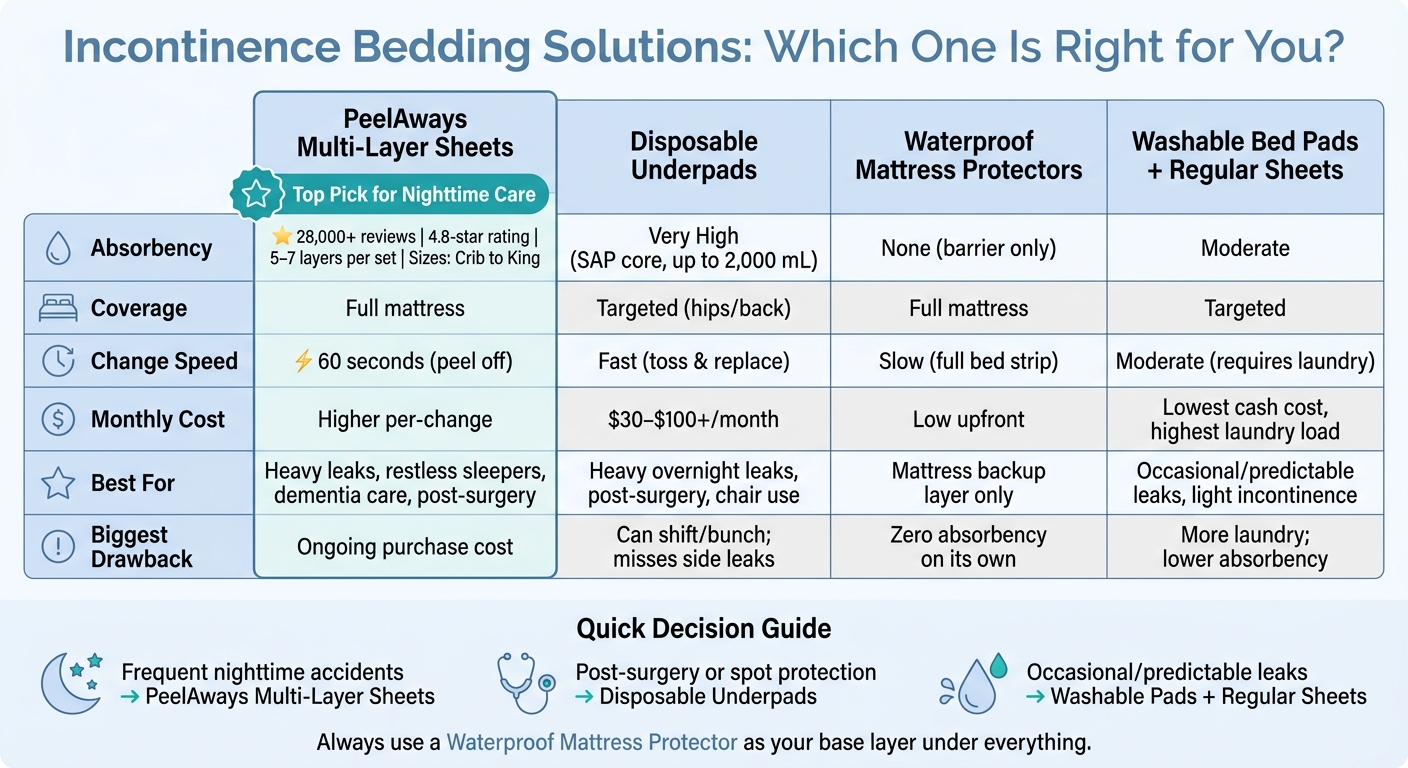
Disposable Bed Sheets for Incontinence: Side-by-Side Comparison Guide
It’s 2am. The bed is wet again. You’re trying to keep your loved one calm while you strip sheets with one hand and hold back your own frustration with the other.
Use this quick guide to match absorbency, coverage, and change speed to the care situation.
After the feature-by-feature comparison, this chart shows where each setup fits in real care situations.
| Solution | Absorbency | Coverage | Change Speed | Cost Profile | Best For |
|---|---|---|---|---|---|
| PeelAways Multi-Layer Sheets | High (multi-layer) | Full mattress | Easiest - peel off in 60 sec | Higher upfront / repeat purchase | Heavy leaks, restless sleepers |
| Disposable Underpads | Very high absorbency | Targeted (hips/back) | Fast - toss and replace | Ongoing pad cost | Heavy overnight leaks, post-surgery |
| Waterproof Mattress Protectors | Low (barrier only) | Full mattress | Hard - full bed strip required | Low upfront cost | Backup protection only |
| Washable Bed Pads + Regular Sheets | Moderate | Targeted | Moderate - requires laundry | Lowest cash cost, highest laundry load | Occasional leaks, kids, light incontinence |
For heavy overnight leaks, use a 900 mL+ SAP pad in 30" x 36" or 36" x 36".
For dementia care, quick-change bedding and adhesive-backed pads help cut down on disruption and bunching. That matters more than people think. When someone is confused or easily upset, even a small bedding change can turn into a long night.
Post-surgery recovery calls for tear-resistant pads with breathable backing, especially when frequent repositioning is part of care. You want something that stays in place and holds up when the person in bed needs help moving.
For occasional adult incontinence, a moderate-absorbency disposable pad or washable pad is usually enough. For child bedwetting, adhesive-backed pads tend to stay put better on cotton or flannel sheets.
If you’ve been stuck doing full bed changes over and over, this is where PeelAways Multi-Layer Sheets stand out. A fellow caregiver finds them and suddenly the whole routine changes: peel off one layer, smooth the bed, and move on. About 60 seconds instead of 15–20 minutes. That’s a big deal when you’re exhausted. PeelAways comes with 5-7 layers, sizes from crib to king, and has 28,000+ reviews with a 4.8-star rating. You can see them on peelaways.com/shop or on Amazon. For more help, it’s also worth reading other guides on peelaways.com, like their blog articles on bedding and overnight care.
Next, weigh the tradeoffs behind each option.
Pros and Cons of Each Option
It’s 2am. The bed is wet again. You’re pulling off sheets in the dark, trying not to wake your loved one all the way, and doing mental math on how much sleep you’re about to lose.
This is where the trade-offs get painfully clear. Speed, absorbency, and laundry load do not usually line up. One option saves time. Another saves money. Another protects the mattress but still leaves you with a full strip-and-remake.
| Solution | Main Pros | Main Cons | Best Use Case | When to Skip |
|---|---|---|---|---|
| PeelAways Multi-Layer Sheets | 60-second changes; no laundry; clean layers stay ready underneath | Ongoing purchase cost; generates more waste than reusable options | Frequent nighttime accidents; dementia care; assisted living; post-surgery recovery | If budget is extremely tight and laundry is easy to manage |
| Disposable Underpads (Chux) | High absorbency; easy disposal; portable | Can shift or bunch during the night; ongoing cost; environmental impact | Heavy overnight voids; post-surgery drainage; chair or wheelchair use | For restless sleepers unless the pad has adhesive strips |
| Waterproof Mattress Protectors | Stops liquid from reaching the mattress | Zero absorbency; requires a full sheet change and laundry if soiled | The mattress barrier under any absorbent layer | As a standalone solution for heavy or frequent leaks |
| Washable Bed Pads + Regular Sheets | Eco-friendly; lowest long-term cost; holds up through 300–500 washes | Adds laundry every time; lower absorbency than premium SAP disposables | Moderate or predictable incontinence; long-term home care on a budget | If laundry is physically exhausting or unavailable |
If you’re looking at this from the edge of burnout, one thing stands out fast: PeelAways wins on change speed. That matters more than people think. A 60-second bed change is not just about saving time. It can mean less lifting, less disruption, less embarrassment, and less of that middle-of-the-night scramble.
The hard trade-off is simple. Time versus money. PeelAways costs more upfront, but it cuts laundry and speeds up nighttime changes.
That’s the part to hold onto as you compare the rest. What sounds cheaper on paper can cost you more in broken sleep, extra washes, and sheer physical effort.
Next, match those trade-offs to the care situation.
Conclusion
It’s 2am. The bed is wet again. You’re tired, your loved one is upset, and the last thing you need is another full sheet change before morning.
After looking at absorbency, fit, comfort, and cleanup speed, the right pick depends on what your nights look like.
Waterproof mattress protectors belong in every setup. When choosing between waterproof mattress pads vs. disposable sheets, washable pads make sense for leaks you can mostly predict, especially if laundry feels doable. Disposable underpads help with spot protection or as one part of a layered setup. The best choice is the one that keeps the mattress dry without giving you more work in the middle of the night.
When overnight accidents happen often or come out of nowhere, speed matters most. That’s where PeelAways stands out. It works best in those harder situations because it speeds up changes, cuts down on lifting, and makes nighttime cleanup much easier. And when you’re running on fumes, that 60-second bed change can feel like a lifeline.
I found PeelAways the way a lot of people do: after one too many miserable nighttime cleanups. It’s made for real caregiving nights, with 5-7 layers, sizes from crib to king, and 28,000+ reviews with a 4.8-star rating. If you already use diapers or incontinence pads, PeelAways is one of those things that just makes the whole setup easier. Making aging and caregiving easier, one bed at a time.
You can get PeelAways at PeelAways.com, the shop page, and on Amazon. You may also want to read more on the PeelAways blog at peelaways.com and peelaways.com/shop.
Blog readers save 10% with code BLOGS10 at checkout. Available on peelaways.com and Amazon. Free shipping on orders over $100.
FAQs
How many nights does one set usually last?
A wet bed in the middle of the night can break you a little. You're tired, your loved one feels awful, and the thought of stripping the whole bed again is almost too much.
Each PeelAways layer is made to last 7 to 10 days, unless it gets soiled sooner. With 5 to 7 layers in each set, one pack can last up to 50 days.
If an accident happens, you just peel away the top layer and there’s a clean sheet right underneath. No full bedding change. No 15- to 20-minute ordeal. Just a clean bed in about 60 seconds.
Will the sheets stay in place for restless sleepers?
Yes. They stay put, even if your loved one moves a lot at night.
That matters more than people think. Small pads can slide, bunch up, or leave part of the bed exposed. Then you're back to fixing sheets in the dark.
PeelAways work differently. These multi-layer fitted sheets wrap around the mattress with elastic corners, so they stay flat and secure instead of shifting around with movement.
What setup works best for heavy overnight leaks?
For heavy overnight leaks, the worst part isn’t just the mess. It’s that moment in the dark when you realize the mattress got hit, the pad shifted, and now you’re doing a full bed change when you can barely keep your eyes open.
A layered setup helps a lot.
Start with a zippered waterproof mattress encasement on the bare mattress. That gives you a backstop if anything gets past the top layers. Then place an absorbent reusable bed pad under the hips and torso, where leaks usually hit hardest. On top, fit a PeelAways multi-layer disposable sheet.
For extra protection, add overnight-rated incontinence briefs or underwear.
If the top sheet is soiled, you can peel it away in about 60 seconds and get back to a clean surface without doing a full bed change. That’s the part that can save your back, your time, and a lot of middle-of-the-night stress.
Comments
0



SAVE MONEY & WATER
Professionals & Institutions save a fortune on labor/laundry.

SUPERIOR COMFORT
The first thing our customers notice is how soft our sheets are.

100% WATERPROOF
Each layer is 100% Waterproof, perfect for spills and accidents

SAVE TIME
Change the sheet in under 1 minute without stripping the bed.

Leave a comment