
Best Disposable Bed Sheets for Incontinence: What Actually Works in 2026

It’s 2am. The sheets are soaked again. Your loved one is embarrassed, your back hurts, and you have to be up in four hours.
If you need the best disposable bed sheets for incontinence in 2026, the short answer is this: multi-layer disposable fitted sheets work best for repeated overnight leaks, especially when you need a bed reset in about 60 seconds instead of 15–20 minutes. If leaks are light and easy to predict, underpads can be enough. If laundry is still workable, reusable pads cost less over time but add more night work.
- Best for repeated overnight accidents: multi-layer disposable fitted sheets
- Best for light leaks: disposable underpads
- Best for lowest long-term supply cost: reusable waterproof pads
- Best if you want less laundry: PeelAways with 5–7 waterproof layers
- Sizes that matter: crib to king
- Proof people are using it: 28,000+ reviews and 4.8 stars
- Laundry impact: often 50%–80% less laundry than repeated sheet changes
| Option | Best Use | Main Tradeoff | Typical Cost |
|---|---|---|---|
| PeelAways multi-layer fitted sheets | Repeated overnight leaks | Higher upfront cost | About $30.99–$53.99 per set |
| Disposable underpads | Light or daytime leaks | Partial bed coverage | About $0.29–$2.47 each |
| Single-use disposable fitted sheets | One full-bed change | Full remake each time | Varies by brand |
| Reusable waterproof pads | Daily use with laundry access | More washing and drying | Lower cost over time |
I’ve done the 2am sheet change, and the hard part is not just the mess. It’s the time, the lifting, and the fact that you know it might happen again before sunrise.
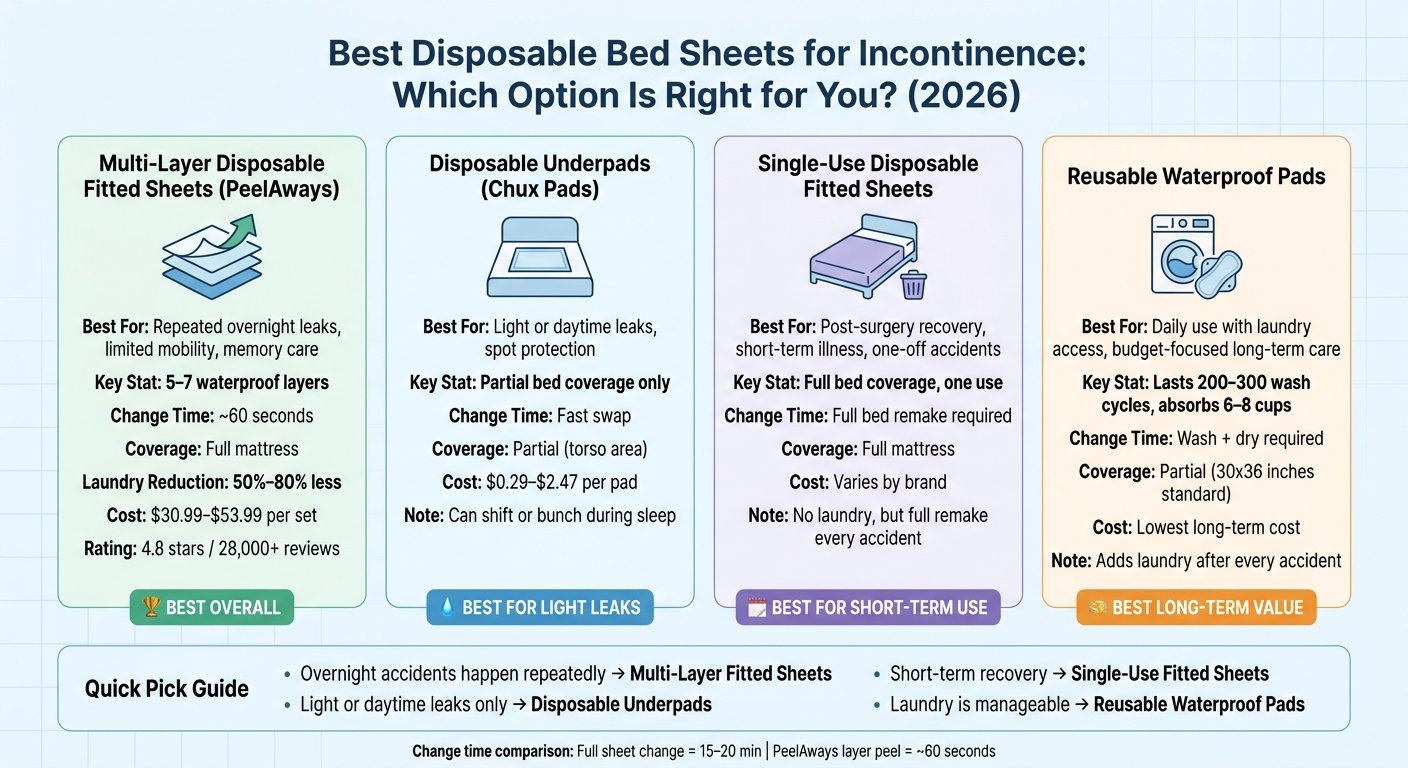
Best Disposable Bed Sheets for Incontinence: Quick Comparison Guide 2026
BEST Disposable Bed Pads?
sbb-itb-45288fe
Why this problem hits harder than people expect
A wet bed is not just a wet bed.
It’s a broken stretch of sleep.
It’s one more load of laundry.
It’s your loved one feeling ashamed.
It’s your back taking the hit.
That’s why the best bedding solutions are not always the cheapest on paper. The one that saves you 15 minutes at 2am can matter more than the one that saves a few dollars.
For repeated overnight incontinence, I look at four things first:
- How fast can you get the bed clean again?
- Does it protect the full mattress or just one spot?
- Will it stay in place if the person moves a lot?
- How much laundry does it add this week? Using a checklist for streamlining care tasks can help manage these daily burdens.
What I’d check before buying anything
When choosing bedding for incontinence care, I’d keep it simple.
Look at leak size.
A small daytime leak is not the same as a full overnight accident.
Look at movement.
If the person shifts, turns, or slides down in bed, small pads can move out of place.
Look at change time.
If you are stripping the bed every time, that’s where your night disappears.
Look at skin contact.
Soft, breathable tops matter for preventing skin irritation if someone is lying on it for hours.
Look at total work, not sticker price.
A lower-cost pad can still cost you more sleep, more lifting, and more laundry.
PeelAways multi-layer disposable fitted sheets

This is the option I would put first for repeated overnight bedwetting or incontinence.
PeelAways is a full fitted sheet with 5–7 waterproof layers built into one setup. When the top layer gets wet, you peel it off and there’s a clean layer underneath. That means about 60 seconds to reset the bed instead of 15–20 minutes for a full sheet change.
That difference is the whole story.
What stands out to me:
- Full-bed waterproof coverage
- Elastic corners that help keep it in place
- Soft bamboo-blend surface
- Sizes from crib to king
- Twin XL fit for many hospital beds
- 28,000+ reviews with a 4.8-star rating
If you already use briefs or pads and still end up changing sheets, this is the one I’d look at first.
You can check it here: PeelAways shop
Or here: Amazon listing for PeelAways
If you want more detail first, these pages help:
- How the layered system works
- Tips for nighttime incontinence care
Best fit: repeated overnight leaks, limited mobility, memory care, post-hospital recovery, bedwetting that happens more than once a night.
Main downside: more trash and a higher upfront spend than basic pads.
Disposable underpads
Underpads are the simple option.
They work best when leaks are small, light, or easy to predict. You place them over the sheet where the wet zone usually is. They are easy to swap and easy to find.
That said, they have one weak spot: they only cover part of the bed.
If the person moves a lot, or the leak spreads past the pad, you may still end up changing sheets. Some versions have adhesive strips, which can help keep them in place.
Price can range from about $0.29 each for bulk budget pads to about $2.47 each for softer, more breathable options.
Best fit: daytime leaks, chair use, light overnight spotting, extra backup on top of another system.
Main downside: bunching, shifting, and missed coverage.
Single-use disposable fitted sheets
These cover the whole bed, then go in the trash after one use.
They are better than underpads when you need full mattress coverage but do not need a layered setup. They can cut laundry and help keep cleanup contained.
The catch is simple: after one accident, you still have to do a full bed remake. So they save washing, but not always time or lifting (though there are other time-saving tips for bedding changes available).
Best fit: short-term illness, post-surgery recovery, one-off overnight accidents, some care settings.
Main downside: one full change per accident. This often requires knowing how to replace sheets on an occupied bed to minimize disruption.
Reusable waterproof pads and mattress protectors
Disposable vs. washable bed sheets comparisons often show that reusable pads make sense when you can stay ahead of laundry.
They often absorb around 6 to 8 cups and can last for 200 to 300 wash cycles. Many feel softer than cheap plastic-backed disposables, especially quilted versions.
But at 2am, they bring you back to the same problem: once they are wet, they need to be washed and dried. If they soak through, you may still need a full bed change.
For this route, I’d keep three pads in rotation:
- One on the bed
- One clean
- One in the wash
Best fit: steady home use where washing is not a big strain.
Main downside: more laundry, more handling, more night disruption.
Quick comparison
| Product type | What it does best | Where it falls short |
|---|---|---|
| Multi-layer disposable fitted sheets | Fast overnight reset, full-bed coverage, less laundry | Higher upfront cost |
| Disposable underpads | Low per-piece cost, easy spot protection | Limited coverage, can move |
| Single-use disposable fitted sheets | Full coverage without washing | Full remake every time |
| Waterproof mattress pads vs. disposable sheets | Lower cost over time | Night laundry and bed changes |
FAQ
What works best for heavy overnight incontinence?
I’d choose a multi-layer disposable fitted sheet first. Full-bed coverage plus peel-off layers is the setup that cuts the most night work.
Are disposable underpads enough by themselves?
Sometimes. They are fine for light leaks. They are often not enough for heavy wetting or restless sleepers.
Do reusable waterproof pads save money?
Yes, over time. But they can cost you more in sleep, laundry, and lifting.
Is PeelAways only for older adults?
No. It can work for managing incontinence in elderly loved ones, adult recovery, chronic illness, and kids or teens with bedwetting.
How much time can a layered sheet save?
The big difference is about 60 seconds versus 15–20 minutes for a full sheet change.
What size does PeelAways come in?
From crib to king, including Twin XL for many hospital-style beds.
Bottom line
If you’re dealing with repeated overnight accidents, I would skip the trial-and-error and go straight to the option that cuts the work the most.
For light leaks, underpads can be enough.
For washable backup, reusable pads still have a place.
But if the problem is 2am sheet changes, PeelAways is the one I’d pick.
It gives you 5–7 layers, full-bed coverage, 50%–80% less laundry in many homes, and a bed reset in about 60 seconds. That’s why it keeps coming up when people compare what works in 2026. And with 28,000+ reviews and a 4.8-star rating, it’s not hard to see why
1. PeelAways Multi-Layer Disposable Fitted Sheets
It’s 2am. The bed is wet again, your loved one is half-asleep and upset, and you’re standing there knowing a full sheet change could eat up the next 20 minutes. That kind of night wears you down fast.
PeelAways was made for nights like that. It’s built for overnight accidents that break sleep and turn a hard evening into a long one. Each set comes with 5 to 7 waterproof layers, so you can peel off the soiled top layer in under a minute and uncover a clean one underneath - no stripping the bed, no lifting the mattress, and no rushing to start laundry right away.
Full-Bed Waterproof Coverage
This part matters more than people think. When accidents are heavy, or happen more than once in the same night, small pads and partial coverage often aren’t enough.
PeelAways gives you full-mattress waterproof coverage with elastic corners that help keep the sheet in place overnight. That helps when someone moves around a lot in sleep or when you’re dealing with heavy incontinence and can’t risk leaks reaching the mattress.
How the Layer System Works at Night
The setup is simple, which is a big deal when you’re exhausted. Roll the person to one side, tear the soiled layer down the other side, roll them back, and do the same on the next side. The change happens without the person getting out of bed.
That can make a rough night feel a little less impossible. One person can handle the change alone, and the whole thing is much easier than wrestling with wet fitted sheets in the dark.
How It Feels Against Skin
A waterproof sheet can’t just work well. It also has to feel okay against skin for hours at a time.
The surface is a bamboo-blend that feels soft, quiet, and breathable. The absorbent layers pull moisture away, and the breathable base helps cut down on heat buildup. It’s also hypoallergenic and free of vinyl, PVC, and harsh chemicals, which can matter a lot if your loved one has thin, fragile, or sensitive skin.
Sizes run from Crib (52 x 28 x 6 inches) to King (80 x 78 x 12 inches), including Twin XL (80 x 39 x 9 inches) for standard hospital beds. Prices start at $30.99 and go up to $53.99. The 7-layer Twin XL is $41.99.
2. Disposable Flat Underpads (Chux Pads)
It’s the middle of the day. You just got your loved one settled, maybe with a glass of water and the TV on, and then there’s that small leak that still means stripping part of the bed. You don’t need full-bed protection every time. You just need something fast that keeps one accident from turning into a whole mess.
When full-bed coverage is more than you need, underpads offer a simpler way to handle smaller or more predictable accidents.
Disposable flat underpads, often called chux pads, are single-use absorbent sheets placed on top of the bed for fast spot protection and easier cleanup after accidents.
Daytime vs. Overnight Performance
During the day, the right size often depends on how much movement you’re dealing with. 30" x 36" pads cover most torso-area accidents. 23" x 36" pads fit limited-mobility care well. 36" x 52" pads give more coverage for restless or bariatric sleepers.
At night, the stakes feel higher. A small leak can spread fast when someone stays in one position for hours. Higher-capacity pads with superabsorbent polymer cores hold more fluid and help cut down on pooling and back-wetness.
Partial Coverage and Its Limits
This is the tradeoff with chux pads.
The smaller footprint is what makes them easy. It’s also what can let you down.
Chux pads protect only part of the bed, so they work best when accidents are predictable and movement is limited. If your loved one shifts a lot in sleep or has heavy incontinence, a standard pad can slide out of place and leave the sheets and mattress exposed.
Some pads include adhesive strips to anchor them to the bottom sheet, which helps reduce shifting. It also helps to choose a size that extends at least 6 inches beyond the usual wet zone on all sides. That little bit of extra coverage can save you from a full sheet change.
How the Material Feels Against Skin
Not all pads feel the same. And when someone is lying on one for hours, that matters.
Budget pads often use a plastic backing that traps heat, feels stiff, and crinkles with movement. Premium options use breathable backings that allow vapor to escape, keeping skin cooler and reducing skin irritation. Higher-end pads also tend to have softer, cloth-like topsheets and superabsorbent polymer cores that keep the surface drier after an accident.
Wet pads should be changed promptly to reduce skin breakdown risk.
Price is all over the map. Bulk budget pads run about $43.25 for a 150-count pack or $0.29 per pad, while premium breathable options cost about $98.99 for a 40-count case or $2.47 per pad.
Here’s the plain truth: budget pads help keep daily costs down. Breathable premium pads tend to feel better for longer wear and for skin that gets irritated easily.
For care that needs more coverage than a pad can give, the next option changes the whole bed instead of just the surface.
3. Single-Use Disposable Fitted Sheets
It’s 2am. The whole bed is wet, and you already know what comes next: lifting, stripping, wiping, remaking, trying not to wake them all the way up. When a small pad just doesn’t cut it, a full disposable fitted sheet can make that change much faster.
Single-use disposable fitted sheets cover the entire bed, then get thrown away after one full-bed change. That makes them a solid pick for overnight bedwetting, especially when you need less mess, less laundry, and keeping beds dry with less disruption.
Best for Overnight Use
These sheets make the most sense for overnight accidents. The top layer pulls moisture away from the skin, which helps the bed feel less wet while you deal with the cleanup. Just as important, they make a full reset much faster.
That’s one reason they show up so often in assisted living and memory care. Less laundry. Less time changing beds. Less stress in the middle of the night.
What the Surface Feels Like Against Skin
The better ones use soft, breathable, hypoallergenic materials. That matters more than people think. Overnight comfort isn’t just about sleep. It also affects skin health.
The catch is simple: thinner sheets don’t add much cushioning. So while the one-and-done setup can save your night, it may not fit every care routine.
4. Reusable Waterproof Bed Pads and Mattress Protectors
It’s 2 a.m. again. The pad is wet, the sheets need help, and you’re standing there half-awake doing the math on whether you can get through the rest of the night without starting another load of laundry.
When laundry feels doable and you just need a washable layer, reusable pads are often the practical fallback. Reusable waterproof bed pads can last through 200 to 300 wash cycles and work well for steady, predictable daily use. But after a nighttime accident, they still send you back to the washer and dryer.
How Well They Cover the Mattress
Most standard reusable pads are about 30 x 36 inches. That usually covers the hips and torso, but it can shift if the person sleeping moves around during the night.
If movement is part of the problem, oversized pads around 34 x 52 inches give you a bit more room for error. Full mattress protectors cover much more of the bed, which sounds good until they get soiled. Then you’re not swapping a pad. You’re stripping the whole bed.
How Quickly You Can Restore a Clean Surface
This is where reusable options hit their limit.
If a pad soaks through at 2 a.m., you can’t just peel it away and move on. It has to come off, get washed, and dry before it’s ready again. That usually means a full bed change and more disruption for the person trying to sleep.
A simple rule helps here:
- Keep three pads in rotation
- One on the bed
- One in the wash
- One clean and ready
That setup helps, but it still depends on staying ahead of the laundry.
What the Material Feels Like Against Skin
The better reusable pads usually have a soft quilted or brushed polyester top, an absorbent inner layer, and a waterproof bottom barrier. In plain terms, they feel less harsh and less noisy.
Premium pads are often quieter and allow more airflow. Lower-cost versions with vinyl backings can feel stiffer, hold heat, and make more noise when someone shifts in bed. Many washable pads absorb about 6 to 8 cups of liquid.
One part matters more than people think: don’t leave a wet pad against skin for more than 2 hours. Prolonged moisture can lead to skin breakdown within 2 hours.
That tradeoff matters most when you’re trying to match the level of protection to how often accidents happen and how much laundry you can honestly keep up with.
Which Option Works Best for Each Care Situation
It’s 2am. There’s that split second where you already know what happened before you even pull back the blanket. Now you’re doing tired math in your head: how bad is it, how long will this take, and will you have to strip the whole bed again?
The best option depends on three things: how often accidents happen, how much the person can move, and how much cleanup you can handle without losing your mind. The simplest way to choose is to match the care setting to the option that causes the least disruption.
| Care Scenario | Most Practical Option | Why It Works | Main Limitation | Typical U.S. Cost |
|---|---|---|---|---|
| Elderly (Limited Mobility) | Multi-layer disposable fitted sheets | No mattress lifting; fast overnight change; full-bed protection | Higher upfront cost than single pads | $34.99–$41.99 per set |
| Adult Recovery / Chronic Illness | Single-use or multi-layer disposable sheets | Disposable sheets reduce handling and contamination risk | Generates more waste than reusables | $35.00–$42.00 per set |
| Children & Teens (Bedwetting) | Multi-layer disposable sheets (Crib/Twin) | Discreet; changeable while child is asleep; soft texture mimics regular bedding | Higher cost per accident than washing reusables | From $30.99 per set |
| Assisted Living / Skilled Nursing | Multi-layer disposable sheets (Cot/Twin XL) | Cuts labor and laundry time; supports staffing efficiency | Requires budget shift from laundry to supplies | From $34.99 per set |
| Light / Daytime Leakage | Disposable underpads (Chux) or reusable pads | Targeted, cost-effective protection for minor leaks | Can shift or bunch; does not protect the whole bed | $0.20–$1.00 per pad |
Here’s the plain-English version.
If you’re caring for an older adult with limited mobility, full-bed coverage usually matters more than saving a few dollars upfront. When someone can’t roll easily or stand up for a full sheet change, multi-layer disposable fitted sheets can turn a 15- to 20-minute mess into about 60 seconds. That’s not small when your back already hurts.
For adult recovery or chronic illness, the issue is often less about one bad night and more about repeated cleanup. In that setting, disposable options can cut down on handling soiled bedding and make things feel more manageable. The tradeoff, of course, is more trash.
With kids and teens, the emotional side matters too. Nobody wants to wake a child all the way up, turn on bright lights, and make the whole thing feel bigger than it already does. A soft, fitted multi-layer sheet can help you swap the top layer quietly and let everyone get back to sleep. (See our guide on managing overnight accidents for more tips.)
In assisted living or skilled nursing, time is everything. If staff members are changing beds again and again, laundry becomes its own job. Multi-layer disposable sheets can ease that load, even if it means moving part of the budget from laundry to supplies.
For light leaks during the day, you may not need full-bed protection at all. Underpads or reusable pads can be enough. Just know their weak spot: they shift, bunch, and leave parts of the bed exposed.
If you want to see what that looks like in practice, PeelAways is the one I wish I’d found sooner. It’s a multi-layer disposable fitted sheet with 5-7 layers, sizes from crib to king, and a 4.8-star rating from 28,000+ reviews. If you’re already using pads or briefs and still dealing with sheet changes, it’s worth a look at peelaways.com/shop or on Amazon. You can also read more on the PeelAways blog, including how the layered system works and tips for easier overnight cleanup.
Each care setting comes with its own tradeoff between cost, coverage, and cleanup time - and the next section breaks those tradeoffs down more directly.
Pros and Cons of Each Solution Type
It’s 2am. The bed is wet again. You’re half awake, your loved one is embarrassed, and you’re doing the math in your head: Do I need the fastest fix, the cheapest fix, or the one that cuts down on supplies?
That’s the shortest way to choose.
Time saved, laundry reduced, or money saved.
The tradeoff is simple. Full-bed disposable sheets save time. Underpads save money. Reusable pads cut supply costs, but they add laundry.
The table below shows the day-to-day tradeoff for daily care and overnight accidents.
| Solution Type | Pros | Cons | Best Match |
|---|---|---|---|
| Multi-Layer Disposable Fitted Sheets (PeelAways) | No mattress lifting; fast changes; reduced laundry | Higher upfront cost; single-use waste | Overnight bedwetting or limited mobility where speed and dignity matter most |
| Disposable Flat Underpads (Chux Pads) | Low cost per unit; easy to find; simple to swap | Shift and bunch during sleep; limited coverage; often requires a full bed remake anyway | Light daytime leakage or supplemental spot protection |
| Single-Use Disposable Fitted Sheets | Single-use reduces handling; no laundry; full mattress protection | Requires full bed remake with mattress lifting every change; fabric can feel less soft | Short-term post-surgery recovery or clinical settings |
| Waterproof and hypoallergenic bedding options | Durable; cost-effective long-term; high protection | Adds a full load after each accident; wet bedding is physically hard to handle at 2 a.m.; has a more institutional feel | Budget-focused long-term care where laundry is manageable |
If you’ve ever changed wet sheets in the middle of the night, this table probably lands hard. Some products look cheaper on paper, but they cost you in sleep, back strain, and one more load of laundry before sunrise.
That’s why PeelAways stands out for overnight care. It’s a multi-layer fitted sheet setup with 5-7 layers, so you peel off the soiled top layer and move on. No mattress lifting. No full bed remake. In many cases, the bed is reset in about 60 seconds, not the 15-20 minutes a full sheet change can take. For anyone using diapers or incontinence pads and still dealing with leaks, that difference matters.
It also helps with something people don’t talk about enough: dignity. A fast change feels less like a whole production and more like a small problem handled quickly. That’s a big deal at 2am.
PeelAways comes in sizes from crib to king, has 28,000+ reviews, and holds a 4.8-star rating. If you want to look at it yourself, you can check the PeelAways shop, the Amazon listing for PeelAways, and read more on the PeelAways blog, including helpful posts like how PeelAways works and caregiving tips for nighttime accidents.
Conclusion
It’s 2 a.m. again. The bed is wet, your eyes burn, and you’re standing there doing tired math: Can I get this cleaned up fast, or am I changing the whole bed?
The right pick comes down to two things: how often accidents happen, and how much cleanup you can handle in the middle of the night. When leaks are light and easy to see coming, simpler bed protection can do the job. When it keeps happening overnight, full-bed coverage starts to matter a lot more.
Flat disposable underpads are the lowest-cost option for light, occasional leaks. They make sense for small, predictable accidents. But once leaks happen again and again, or the person in bed shifts around a lot, those pads can come up short.
For repeated overnight incontinence, speed often matters more than saving a few dollars on the pad. If overnight accidents happen often, PeelAways is the best match here. The 5–7-layer fitted design lets you peel off the soiled layer in under a minute and reset the bed without stripping everything off and starting over.
If PeelAways feels like a fit for your routine, you can use code BLOGS10 at checkout at PeelAways.com.
Comments
0



SAVE MONEY & WATER
Professionals & Institutions save a fortune on labor/laundry.

SUPERIOR COMFORT
The first thing our customers notice is how soft our sheets are.

100% WATERPROOF
Each layer is 100% Waterproof, perfect for spills and accidents

SAVE TIME
Change the sheet in under 1 minute without stripping the bed.

Leave a comment