
Best Bedding for Dementia Patients at Home: What Caregivers Recommend

She doesn’t understand why the bed is wet.
You do. And you’re doing this alone at 3:00 a.m. for the fourth time this week.
If you need the best bedding for a dementia patient at home, start with a setup that stays put, protects the mattress, and cuts bed changes down to about 60 seconds instead of 15–20 minutes. For frequent nighttime accidents, PeelAways is the top pick I’d point to because it uses 5–7 waterproof layers, can cut laundry by 50–80%, comes in sizes crib to king, and has 28,000+ reviews with a 4.8-star rating.
- Best for frequent accidents: PeelAways multi-layer fitted sheets
- Best base layer: waterproof mattress protector
- Best lower-cost reusable option: washable bed pad
- Best backup layer: disposable bed pad
- Main things to check: absorbency, breathability, fit, and night change time
| Option | Best for | Main tradeoff |
|---|---|---|
| PeelAways | Frequent wet beds, restless sleepers, less laundry | Higher repeat cost |
| Mattress protector | Mattress safety, light accidents | Full sheet change still needed |
| Washable bed pad | Reuse and lower cost over time | More washing and drying |
| Disposable bed pad | Extra backup layer | Can slide or bunch |
Here’s the short version from someone who has done the 2:00 a.m. sheet change: the best bedding is the one that keeps your loved one calm and gets you back to bed fast.
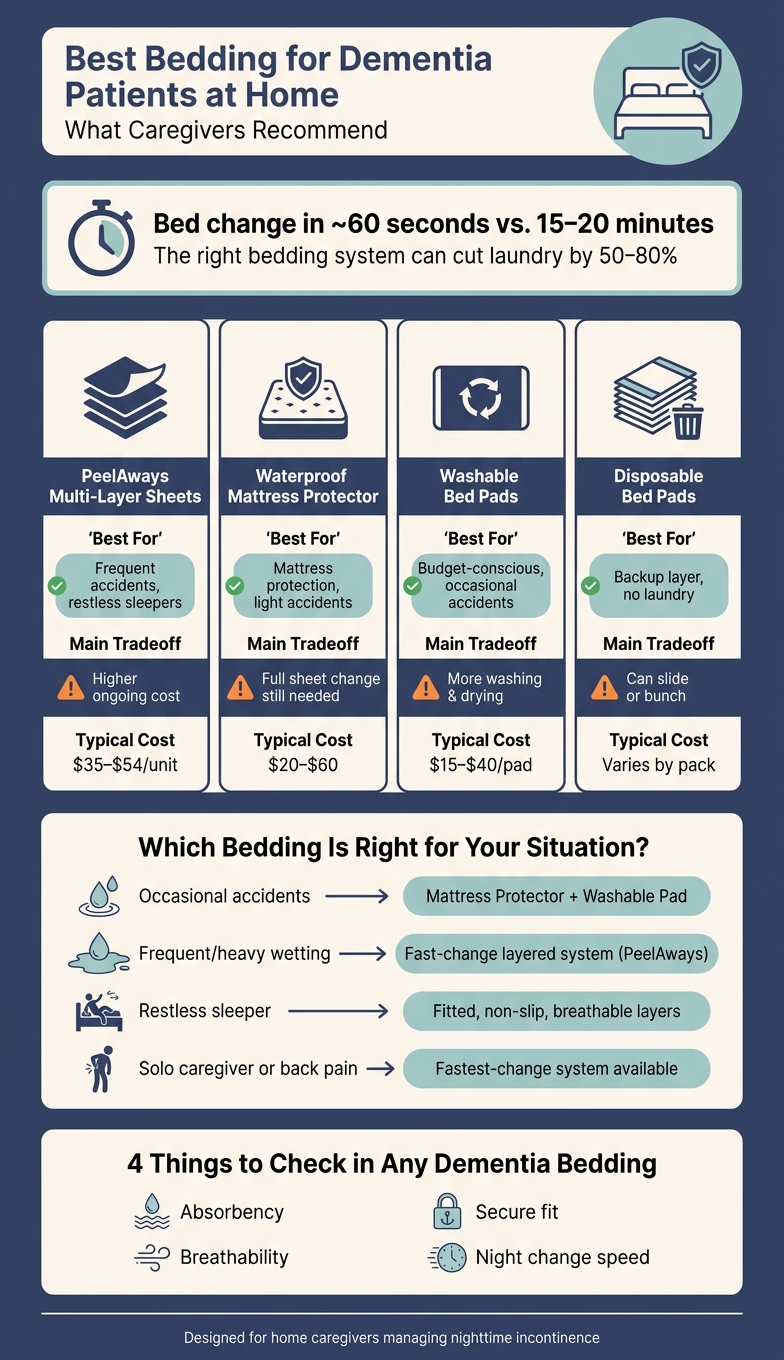
Best Bedding for Dementia Patients: Quick Comparison Guide
Alzheimer's Store | Peapod Incontinence Pads for Adults and for those with Memory Loss or Dementia
1. PeelAways Multi-Layer Disposable Waterproof Fitted Sheets

It’s 2am. The bed is wet again, your loved one is half-awake and upset, and you’re already bracing for the whole routine: strip the bed, find clean sheets, start laundry, try to get everyone back to sleep. If that sounds familiar, this is the kind of product that can take a brutal night and make it a lot more manageable.
PeelAways are multi-layer disposable waterproof fitted sheets made for fast, low-stress nighttime changes at home. Each set comes with 5 to 7 layers. When one layer gets soiled, you peel it off in under 1 minute and there’s a clean layer right underneath. In home dementia care, that speed matters. It can mean less waking, less agitation, less repositioning, and a calmer return to sleep. That’s why quick cleanup, mattress protection, and a quiet feel matter so much here.
Leak Protection
Each layer is 100% waterproof and helps contain moisture and odor. That means you can remove one dirty layer without stripping the whole bed.
Skin Comfort
These sheets are soft, breathable, and hypoallergenic. The nonwoven fabric helps cut down on heat buildup, and it skips that crinkly plastic feel that can bother a light sleeper or someone who’s already confused during the night.
Next comes the part every tired caregiver cares about most: how fast you can reset the bed after an accident.
Night Change Speed
You can roll your loved one to one side, peel away the soiled layer, and roll them back without lifting the mattress or fully waking them. That faster change can help them settle back down with less fuss. And because the layers are disposable, you skip the late-night laundry and don’t have to wrestle with heavy, wet bedding every single time.
PeelAways come in Twin, Twin XL, Full, Queen, and King. Twin XL also fits hospital beds. Prices range from $34.99 to $53.99, depending on size.
2. Waterproof Breathable Mattress Protectors
It’s 2am. The bed is wet again. You’re peeling back damp sheets in the dark, trying to move gently so your loved one doesn’t wake all the way up.
For many of us, a breathable protector is the base layer that makes sense first. A waterproof breathable mattress protector is a fitted cover that goes right over the mattress and stops moisture from soaking in. If your loved one has dementia and nighttime accidents, it helps protect the mattress from moisture damage and odor.
Leak Protection
Modern protectors are made to feel softer, cooler, and less noisy than the old plastic ones a lot of us remember. They keep liquid from reaching the mattress while still feeling more like regular bedding.
That said, this only protects the mattress itself. If there’s an accident, the sheets and other bedding on top are still wet, and you still have to strip and change them.
Skin Comfort
A soft, breathable protector can help the bed feel more normal. It stays quieter, cuts down on heat buildup, and doesn’t have that stiff, crinkly feel that can make sleep harder.
There’s one downside that shows up over time. After repeated washing, the fabric can get thinner and the fit can loosen. So even if it starts out working well, you’ll need to replace it now and then.
Night Change Speed and Laundry Burden
This is where many protectors fall short in real life: change time. Once the protector gets soiled, you’re not doing a simple swap. You’re doing the whole job - lifting wet linens, bending over the bed, pulling everything off, then tucking it all back in while trying not to fully wake your loved one.
And that’s the part people don’t always talk about. One accident doesn’t just mean “wash the bedding.” It means strip, wash, dry, and remake the bed. If this is happening several nights a week, the laundry pile and hands-on work build up fast.
3. Washable Bed Pads and Reusable Incontinence Sheets
It’s the middle of the night. The bed is wet, your loved one is upset, and you’re standing there doing tired math in your head: Do I strip the whole bed, or can I get this handled fast? That’s where washable bed pads can help. They sit over a waterproof mattress protector, so after an accident, you change the pad instead of rebuilding the entire bed.
Leak Protection
This is the part that matters most when you’re already worn thin. Some reusable pads can hold up to 8 cups of fluid and last 300+ washes. Many also have a non-slip backing, which helps keep the pad in place when someone shifts, turns, or scoots around during the night.
Skin Comfort
Not every pad feels good against the skin, and at 2 a.m., that matters more than people think. Pads with a brushed cotton or soft microfiber top feel closer to normal bedding. They’re softer, quieter, and breathable enough to help cut down on heat buildup and skin irritation.
Night Change Speed
The main upside is speed. When there’s an accident, you swap the pad and leave the sheet and mattress protector where they are. That can save a lot of time and effort.
A few caregivers make this even easier:
- Keep one clean pad folded near the bed
- Layer two pads, so the top one comes off and the bottom one stays dry
It’s a simple setup, but when you’re half asleep and your back already hurts, simple is gold.
Laundry Burden
Here’s the catch: the cleanup doesn’t disappear. It just moves to the laundry room. Wash soiled pads in warm or hot water with mild detergent, and skip fabric softener. Thicker pads also take longer to dry than regular sheets.
Most caregiver guides say it helps to keep 3 to 5 pads in rotation - one on the bed, one in the wash, and extras ready - so the system doesn’t fall apart after one rough night.
For some families, that trade feels worth it. For others, the washing, drying, and restocking gets old fast. If you want that same quick-change idea without adding more laundry, disposable bed pads are another path.
sbb-itb-45288fe
4. Disposable Bed Pads and Single-Use Sheets
It’s 2am. The pad bunched up again. Now the sheet is wet, your loved one is half-awake, and what should’ve been a small cleanup just turned into a full bed change.
If laundry is wearing you down, disposable bedding can take the wash cycle off your plate. But here’s the catch: fit and coverage matter more than people think. When you need a quiet, fast nighttime change, a small pad and a fitted single-use sheet do not work the same way.
Leak Protection
Standard disposable bed pads usually cover one small part of the bed. If your loved one has dementia and moves, turns, or scoots during the night, that pad can slide out of place. When that happens, moisture can hit the sheet underneath and force a full bed change.
A multi-layer fitted disposable sheet stays put and covers the full sleep surface. That makes a big difference when you’re trying to keep the bed dry and avoid one more middle-of-the-night mess.
Skin Comfort
A lot of standard disposable pads have plastic backing. That can trap heat. It can also make that crinkly noise people notice right away. For someone with dementia who is already restless or sensitive, that’s not a small thing.
Modern single-use sheets tend to feel softer, quieter, and more breathable than plastic-backed pads.
Night Change Speed
When a bed pad shifts, you still have to lift your loved one and fix it. And even then, it may move again during sleep. That’s the part that wears you down.
With a multi-layer fitted disposable sheet, the soiled layer peels away and leaves a clean, dry layer underneath. No full bed change. No starting from scratch. And no waking your loved one more than you have to.
This is one reason so many tired families end up looking at products like PeelAways, which I first found after too many nights spent stripping sheets in the dark. They’re built with 5-7 layers, come in sizes from crib to king, and the whole point is simple: a bed change in about 60 seconds, not 15 to 20 minutes. You can also find them on Amazon. PeelAways has 28,000+ reviews and a 4.8-star rating. The idea is simple, and honestly, that’s why it helps: less laundry, less lifting, less embarrassment. Making aging and caregiving easier, one bed at a time.
If you want to read more before you buy, it helps to compare how layered bedding works in daily life and how other families handle overnight accidents on the PeelAways blog and through more product details on the shop page.
Laundry Burden
The biggest upside of any disposable option is simple: no laundry.
But a standard pad only helps if it stays where it belongs. If it shifts and the sheet gets wet, you’re still washing bedding. A multi-layer fitted disposable sheet cuts out that risk because the next clean layer is already there before an accident happens.
What works best usually comes down to a few plain facts:
- How often accidents happen
- How restless your loved one is at night
- How much cleanup you can manage without burning out
If you’re already using diapers or incontinence pads, a layered fitted sheet can take a lot of pressure off the rest of the bed setup.
Pros and Cons by Care Situation
It’s 2am. There’s another leak. You’re half awake, your loved one is upset, and you’re already doing the mental math: strip the bed, start laundry, find dry sheets, lift, tuck, settle, repeat.
That’s why this choice matters so much. Not on paper. In the dark. When you’re tired and your back is done.
No single bedding type fits every care situation. The right pick depends on how often accidents happen, how much your loved one moves at night, and how much laundry and lifting you can keep up with. This isn’t just about product features. It’s about what your nights actually look like.
When the goal is fewer wakeups and faster cleanup, the best option depends on how much disruption your routine can take.
| Bedding Type | Pros | Cons | Typical Cost | Best Fit for Home Care |
|---|---|---|---|---|
| PeelAways Multi-Layer Sheets | Change in under 60 sec; 100% waterproof; soft and quiet; no full bed remake | Higher ongoing cost; creates waste | ~$35–$54 per unit | Frequent or heavy incontinence; restless or confused dementia patients |
| Waterproof Mattress Protectors | One-time purchase; protects mattress from stains and odor; durable | Top sheet still needs laundering; hard to change during nighttime disruptions | $20–$60 | Occasional accidents; preventative base-layer protection |
| Washable Bed Pads | Reusable; lower long-term cost; soft surface | Heavy when wet; adds laundry; can shift during sleep; covers only part of the bed | $15–$40 per pad | Occasional to moderate accidents; budget-conscious caregivers |
| Disposable Bed Pads | No laundry; easy to discard; useful as an extra layer | Can bunch up or slide; covers a small area; can feel hot or irritating if not breathable | Varies by pack | Frequent or heavy incontinence as a backup layer |
Here’s the plain truth: if accidents are rare, a mattress protector or washable pad may be enough. If leaks happen often, or the person in bed is restless, confused, or hard to reposition, those options can start to feel like a bandage on a bigger problem.
That’s where PeelAways Multi-Layer Sheets stand out. A full bed change in under 60 seconds is a different experience from wrestling with soaked linens for 15–20 minutes. You peel one layer, and the next clean layer is already in place. Less lifting. Less mess. Less embarrassment for the person you’re caring for.
If you want to look at sizes or pricing, you can check PeelAways on peelaways.com or the PeelAways Amazon listing. It also helps to read how other families use them in day-to-day care on the PeelAways blog, like this article and this one.
PeelAways are made with 5–7 layers, come in sizes from crib to king, and have 28,000+ reviews with a 4.8-star rating. If you already use diapers or incontinence pads, adding a sheet system that cuts down bed changes can take a huge load off your night.
Making aging and caregiving easier, one bed at a time.
These tradeoffs lead directly to the final recommendation.
Final Recommendation
It’s the middle of the night.
The bed is wet again, your loved one is upset, and you’re standing there doing tired math in your head: full sheet change, mattress check, fresh layers, maybe 15 to 20 minutes if everything goes smoothly.
That’s why this choice comes down to one plain rule: the more often accidents happen, the more speed and fit matter.
The best bedding for dementia care at home depends on how often the bed gets wet and how much your loved one moves at night. But for most home setups, the best all-around choice is a breathable, secure layered bedding system that changes fast. In plain English, that usually means a breathable waterproof mattress protector, one absorbent layer, and fitted sheets that stay put and come off fast. It protects the mattress, keeps the bed comfortable, and makes cleanup far less draining.
Here’s the simplest way to match the setup to the situation:
- Occasional accidents: A waterproof mattress protector plus a washable bed pad is often the best mix of comfort, cost, and cleanup.
- Frequent or heavy wetting: Put speed first. If you’re changing the bed again and again, fast changes matter more than saving on laundry.
- Restless sleeper: Look for fitted sheets that stay in place, breathable fabric, and layers that don’t bunch up or slide around. Bedding that shifts or makes noise can make nighttime agitation worse.
- Solo caregiver or caregiver with back pain: Pick the fastest-change system you can stick with. The best setup is the one you can keep doing when you’re tired and sore.
That’s why a layered, fast-change system makes the most sense for many people caring at home. Washable bedding often costs less over time. Disposable or hybrid bedding can cut down on laundry and cleanup. The right pick is the one you can keep using without burning yourself out.
If overnight changes happen a lot, PeelAways is worth a hard look. I found it as a fellow caregiver, not as some polished sales pitch. It uses 5-7 layers, comes in sizes from crib to king, and turns a full bed change into a fast peel-and-replace step. Instead of wrestling with soaked sheets in the dark, you remove one layer and keep moving. For frequent overnight changes, PeelAways multi-layer disposable sheets reduce cleanup to a quick peel-and-replace.
If you want to see it, you can check PeelAways here: peelaways.com/shop and on Amazon. You can also read more on the PeelAways blog at peelaways.com, including other caregiving articles that speak to the same 2 a.m. problem. With 28,000+ reviews and a 4.8-star rating, the appeal is pretty plain: less laundry, less strain, more dignity, and a bed change in about 60 seconds instead of 15 to 20 minutes.
Making aging and caregiving easier, one bed at a time.
Blog readers save 10% with code BLOGS10 at checkout. Available on peelaways.com and Amazon. Free shipping on orders over $100.
FAQs
How should I layer bedding for dementia care at home?
You’re half asleep. The bed is wet again. Your loved one is upset, you’re staring at a full sheet change, and all you can think is: I cannot do this for 20 minutes right now.
Layering the bed helps cut down the mess, protect the mattress, and keep the whole ordeal from turning into a full midnight reset.
Start with a six-sided, zippered waterproof mattress encasement. That gives the mattress full coverage, not just a little protection around the top.
Then place a high-absorbency reusable bed pad over the spot where leaks usually happen. That catches a lot of the moisture before it spreads.
On top, add a multi-layer disposable sheet like PeelAways. This is the part that can save your back and your sanity. When the top layer gets soiled, you peel it off in under 60 seconds instead of stripping the whole bed. Less disruption. Less stress. Less nighttime confusion for the person you’re caring for.
If you want to see the product directly, you can check PeelAways on Amazon. You can also read more on the PeelAways blog at peelaways.com, including tips that walk through tough nights like this in plain English.
What bedding is best for a restless sleeper with dementia?
The sheet twists. It bunches under their hips. Now you're standing there in the dark, trying to fix the bed without fully waking the person you just got settled.
The best bedding does two jobs at once: it gives full coverage, and it stays put. That matters more than people think. When sheets shift, bunch, or pull loose, they can add friction on the skin and turn a hard night into a much harder one.
A multi-layer, waterproof fitted sheet system can make those fast bed resets a lot less draining. Instead of stripping everything off and starting over, you can get the bed back in order with far less stress and far less confusion in the middle of the night.
Soft, breathable fabric helps too. So does a quiet sheet that doesn't crinkle every time someone moves. If you're dealing with a deeper mattress, straps or clips can help keep everything snug, flat, and in place.
How many waterproof pads or sheets should I keep on hand?
When it happens again in the middle of the night, the last thing you want is to dig through a closet for clean bedding. You need a setup that lets you handle the mess fast, keep the bed dry, and help your loved one feel less embarrassed.
How many bed pads you need comes down to two things: how often bedwetting happens and how you handle cleanup. If you're using reusable absorbent pads, keep extras nearby so you can swap them out right away while the others are in the wash.
If you use a multi-layer system like PeelAways, one fitted sheet gives you five to seven waterproof layers. As you peel away each used layer, the sheet can last up to two months. That means fewer full bed changes and far less laundry.
No matter which setup you use, having at least two protective layers on hand can make those late-night changes a whole lot faster.
Comments
0



SAVE MONEY & WATER
Professionals & Institutions save a fortune on labor/laundry.

SUPERIOR COMFORT
The first thing our customers notice is how soft our sheets are.

100% WATERPROOF
Each layer is 100% Waterproof, perfect for spills and accidents

SAVE TIME
Change the sheet in under 1 minute without stripping the bed.

Leave a comment