
Best Bedding for Adults With MS Who Need Overnight Protection

It’s 2am. The sheets are soaked again. Your loved one is embarrassed, your back hurts, and you have to be up in four hours. If this is your life right now, you do not need hype. You need a bed setup that cuts mess, laundry, and the time it takes to get everyone back to sleep.
A 60-second bed reset matters when a full sheet change can take 15 to 20 minutes. For adults with MS, the best bedding usually includes a waterproof mattress barrier, a surface that stays cooler, and - if accidents happen often - a peel-away fitted sheet system like PeelAways, which has 5–7 waterproof layers, fits crib to king, and has 28,000+ reviews with a 4.8-star rating. It can also cut laundry by about 50% to 80% compared with washing standard sheets after each accident.
What matters most:
- PeelAways: best for frequent overnight accidents and the least hands-on cleanup
- Waterproof mattress protectors: best as a base layer to protect the mattress
- Disposable underpads: best as backup for one target area
- Washable bed pads: best if accidents are less frequent and you can keep up with laundry
- Moisture-wicking sheets: best for sweat and heat, not heavy wetting
| Option | Best For | Main Tradeoff |
|---|---|---|
| PeelAways | Fast overnight changes | Repeat purchase cost |
| Mattress protector | Mattress-only protection | Full bed remake if wet |
| Disposable underpads | Small, targeted leaks | Can shift in sleep |
| Washable bed pads | Lower disposable use | More washing and drying |
| Moisture-wicking sheets | Heat and night sweats | Not waterproof by themselves |
If you are tired of doing full bed changes in the dark, this is the short answer: protect the mattress underneath, keep the top cooler, and if pads or diapers are not enough, use a peel-away sheet system.
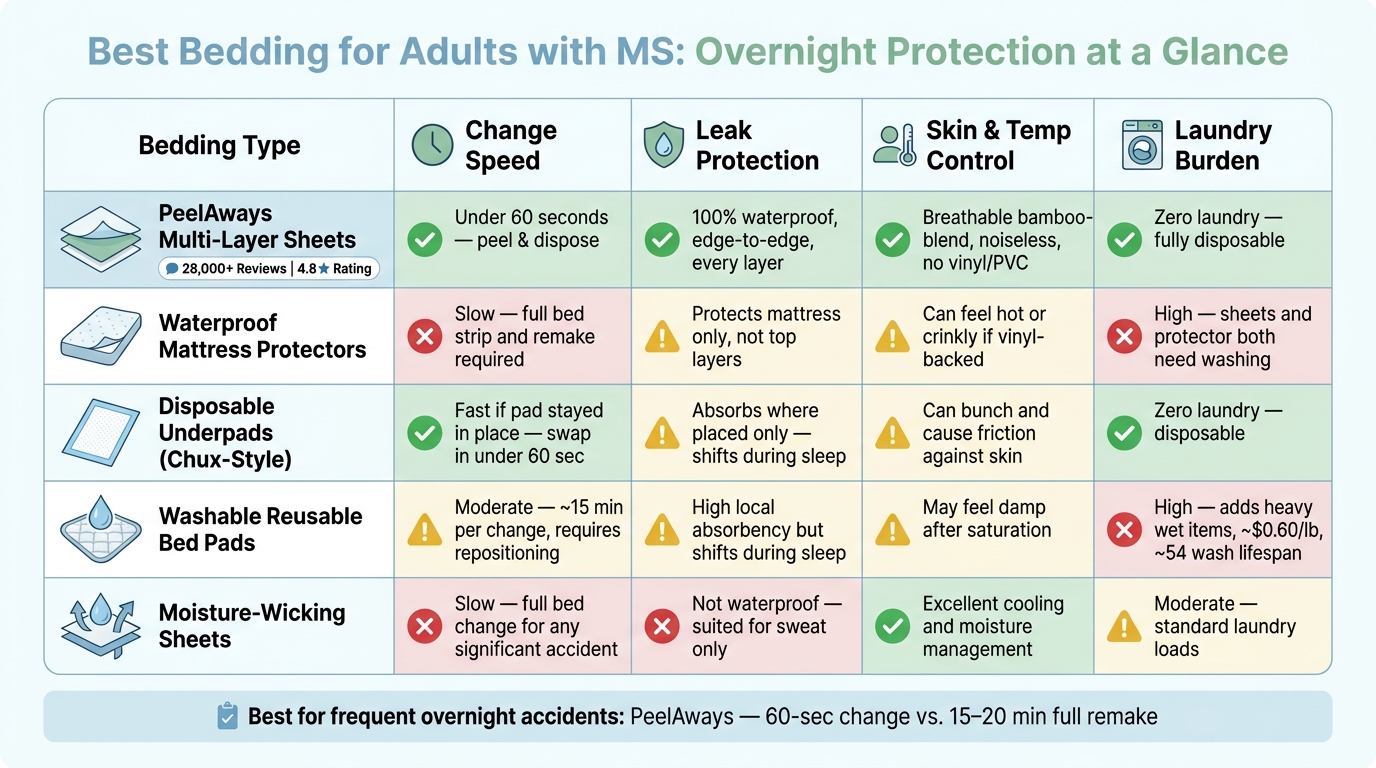
Best Bedding for MS Overnight Protection: Quick Comparison Guide
Why this is harder than people think
MS can turn a wet bed into a whole-body job.
It is not just the mess.
It is the lifting.
The turning.
The heat.
The muscle stiffness.
The fear of waking someone all the way up.
The look on their face when they know you have to change everything again.
That is why standard bedding often falls apart at night. A setup that works for sweat is not the same as one that works for urine leaks. Choosing waterproof mattress pads vs. disposable sheets may save the mattress, but it does not save you from changing the whole bed.
When I look at overnight bedding for MS, I care about four things:
- How fast can I fix the bed?
- Will it stop leaks from reaching the mattress? (See our guide on how to keep beds dry.)
- Will it feel hot, damp, or noisy?
- How much laundry does it add by morning?
Those are the questions that matter at 2am.
sbb-itb-45288fe
What to look for before buying
Before you choose bedding for incontinence care, I would keep it simple.
Look for:
- Full-surface waterproof protection if accidents are more than occasional
- Breathable fabric if heat sensitivity or night sweats are part of the picture
- Low-lift changes if mobility is limited or spasticity is common
- A setup that works with adjustable or split-king beds
- Less laundry, not just better absorbency
If the person in bed uses briefs, pads, or other incontinence products and the bed still gets wet, that is your sign the bedding needs to do more.
PeelAways multi-layer disposable waterproof fitted sheets

This is the one I would point to first for frequent overnight accidents.
PeelAways are fitted sheets with 5 or 7 waterproof layers stacked together. When the top one gets wet, you peel it off and the clean sheet under it is already in place. That cuts a full bed reset down to about 60 seconds, instead of 15 to 20 minutes.
That time difference is not small.
It can mean less lifting.
Less turning.
Less emotional stress.
Less laundry before sunrise.
Each layer is waterproof, so liquid does not pass through to the next one or to the mattress. The fabric is made to feel softer and less plastic-like than old vinyl-backed options, which matters if your loved one is in bed for long stretches or gets hot at night.
What stands out most to me:
- Fastest change of the group
- No middle-of-the-night washing
- Works well when mobility is limited
- Helps protect dignity because the reset is fast and quiet
The downside is simple: you are buying a disposable system, so there is a repeat cost.
Still, if you are already using pads or diapers and still losing sleep over wet sheets, this is the product I wish more people knew about sooner.
You can find it on PeelAways shop and on Amazon.
You can also read more here:
- PeelAways blog
- More PeelAways articles
Tagline: “Making aging and caregiving easier, one bed at a time”
Breathable waterproof mattress protectors
A mattress protector is the layer I would put underneath almost anything else.
Its job is simple: save the mattress.
That matters, but it does not solve the full problem. If the sheet above gets soaked, you still have to strip and remake the bed. This is why many caregivers look for time-saving tips for bedding changes to manage the workload. So I would not count on this as the only overnight layer if accidents are moderate or heavy.
What it does well:
- Covers the whole mattress
- Helps stop deep soak-through
- Often costs less over time than replacing a mattress
What it does not do well:
- Does not absorb much on its own
- Can feel warm if the fabric is not breathable
- Still leaves you with a full bed change when wet, requiring more bedding solutions for incontinence care.
For MS, I see this as a base layer, not the whole answer.
Disposable underpads
Disposable underpads can help, but only if the leak lands where the pad is.
That is the problem.
They protect one section of the bed. If your loved one shifts, has spasms, or moves during sleep, the pad can slide or bunch. Then the sheet still gets wet.
When they work, they are fast. You can toss the soiled pad and put down another one in less than a minute. When they fail, you are back to a full sheet change. This is especially difficult if you have to replace sheets on an occupied bed.
Best use:
- Backup protection
- Targeted placement
- Added help on top of a more secure base setup for caregivers
I would not trust them alone for heavy or frequent overnight accidents.
Washable reusable bed pads
Washable bed pads cut down on disposables, but they move the work to your laundry room.
That is the tradeoff.
If the pad gets wet, you now have one more heavy item to wash, dry, fold, and rotate back in. If accidents happen often, that pile builds fast. The article notes laundry costs around $0.60 per pound, and reusable pads may last about 54 washes before replacement.
They can make sense if:
- Accidents are less frequent
- You want to limit throwaway products and improve dignity
- You can keep up with the washing
They make less sense if you are already overwhelmed by laundry or need the shortest night reset possible.
Moisture-wicking sheets and comfort layers
If heat sensitivity and night sweats are the main problem, this is the layer that can make the bed feel better.
Moisture-wicking sheets help pull sweat away from the skin. They can make the surface feel less clammy. That matters with MS, because a hot bed can make a rough night worse.
But there is a clear limit:
They are not enough for incontinence unless they also have waterproof bedding.
So I would think of these as a comfort layer, not a leak-control layer.
Best use:
- Night sweats
- Heat sensitivity
- Long hours in bed where surface comfort matters
Quick comparison
| Bedding type | What I’d use it for | Main downside |
|---|---|---|
| Disposable vs. washable sheets like PeelAways multi-layer sheets | Frequent accidents, low-lift overnight changes | Higher repeat cost |
| Waterproof mattress protector | Base mattress barrier | Slow cleanup when soiled |
| Disposable underpads | Small-area backup protection | Shifts and leaves edges exposed |
| Washable reusable bed pads | Lower disposable use, less frequent leaks | Adds laundry and wet bulk |
| Moisture-wicking sheets | Sweat and heat control | No true leak protection alone |
FAQ
Are PeelAways worth it for adults with MS?
If overnight accidents happen often, I would say yes. The main reason is the 60-second change. That is a big difference from a 15–20 minute full bed remake, especially when mobility is limited.
Do I still need a mattress protector with PeelAways?
I would still use one. A mattress protector adds backup protection under the fitted system. This is a key part of nighttime incontinence care for maintaining hygiene. It is the layer you hope never has to do much, but you are glad it is there.
Are disposable underpads enough by themselves?
Usually not for frequent adult accidents. They
1. PeelAways Multi-Layer Disposable Waterproof Fitted Sheets
It’s 2:00 a.m. again. The bed is wet, your loved one is half-awake, and you’re staring at fitted corners like they personally offended you. If you’ve ever tried to do a full sheet change in the dark with a tired back and shaky hands, you know how brutal that moment can be.
PeelAways are the first thing I found that made that whole mess feel less impossible. Instead of stripping the bed and fighting the mattress, you peel off one top layer and there’s a clean sheet underneath in under 60 seconds. That’s a huge deal when nighttime changes need to be fast, quiet, and low-effort. And if you’re dealing with spasticity, low mobility, or plain old exhaustion, that kind of time savings can mean the difference between coping and falling apart.
Change Speed
A standard nighttime sheet change takes about 15 minutes and usually means lifting, repositioning, smoothing things out, and tucking corners back in. PeelAways cut that down to under 60 seconds.
Each set comes in 5-layer or 7-layer versions. And this is the part that makes it work: each layer is its own fitted sheet. You peel one back from the corner, remove it, and the next clean layer is already in place, with no lifting and no full bed remake needed.
That speed matters most when the wetness hasn’t soaked through.
Leak Protection
Each layer is 100% waterproof. A breathable polyurethane (PU) laminate forms a barrier that keeps liquid from reaching the layers below or the mattress. The layers stay separate from each other, so fluid doesn’t pass down to the next one.
That matters more than people think. A fast change doesn’t help much if the mattress is still wet underneath.
Skin and Temperature Control
The sheets use a soft blend of bamboo, rayon, and polyester. The breathable membrane lets air move through, which helps release heat and perspiration so the sleep surface stays cool and dry through the night.
They’re also free from vinyl, PVC, and phthalates, which makes them a better pick for long periods of skin contact.
If someone is lying in bed for hours, comfort isn’t a small detail. It’s the whole ballgame.
Laundry and Care Burden
This is where PeelAways can feel like a lifesaver. Because each layer is disposable, there’s no middle-of-the-night laundry. You remove the soiled layer and move on.
Each layer can last about 7 to 10 days between accidents. The sheets are made to fit mattresses from Twin XL for split king beds through King.
PeelAways is one of those products I wish someone had told me about sooner. It cuts out the late-night stripping, washing, drying, and remaking. More than that, it helps protect dignity when someone already feels exposed.
You can find them on peelaways.com/shop and on Amazon. For more help on bedwetting care and easier nighttime cleanup, see the other articles on PeelAways, including their blog.
2. Breathable Waterproof Mattress Protectors
It’s the middle of the night.
The bed is wet, the room feels too warm, and now you’re pulling sheets off while trying not to wake your loved one all the way up.
When MS is part of the picture, even a simple bed change can turn into a long, exhausting job.
A breathable waterproof mattress protector is the bed’s base barrier. It stops leaks from reaching the mattress while still letting some air move through. On its own, it protects the mattress. Paired with an absorbent layer on top, it makes a lot more sense for overnight accidents.
Leak Protection
The big upside here is full-mattress coverage.
Unlike a small pad that protects one area, a fitted protector covers the whole sleep surface.
That said, this layer is not enough on its own for moderate or heavy overnight accidents. It doesn’t hold much liquid. Instead, moisture can sit on top of the waterproof surface. That’s why an absorbent layer on top still matters if you want overnight protection that works in real life.
And once you get to that point, the next issue is comfort. If the person with MS sleeps hot or sweats at night, that top-to-bottom bed setup can feel miserable fast.
Skin and Temperature Control
For adults with MS, heat sensitivity can make sleep a lot harder. A bed that traps warmth can turn a rough night into an even rougher one. Breathable, noiseless fabric can help cut down on heat buildup and nighttime discomfort.
That matters more than people think. If someone is spending long stretches in bed, fabric feel matters. Sound matters too. Nobody wants that stiff, crinkly, plastic feel under them all night.
Modern protectors are also free from vinyl, PVC, and phthalates, which is worth noting for anyone dealing with long hours in bed and skin that’s already under stress.
Change Speed
This is where mattress protectors often fall apart in actual caregiving.
When the protector gets wet, you usually have to strip the whole bed and remake it. That’s slow. It’s tiring. And at 2 a.m., it can feel endless.
If your loved one has limited mobility or spasticity, that bed change isn’t just annoying. It can be physically hard on both of you. Rolling, lifting, smoothing sheets, getting everything back in place - it’s a lot for one accident.
That’s why a breathable protector usually works best as a base layer, not the layer you plan to swap in the middle of the night. The layers above it should be handling most accidents.
Laundry and Care Burden
If the protector is reusable and it gets wet, that’s one more thing to wash.
One more load. One more dry cycle. One more task when you already feel tapped out.
Used the right way, a breathable protector does one job well: it shields the mattress. For overnight MS care, it makes more sense to let an absorbent top layer handle the accident itself. That gives you a mattress barrier underneath, without asking that layer to do more than it can.
3. Disposable Underpads (Chux-Style Bed Pads)
It’s the middle of the night. There’s a wet spot on the bed, the room is dim, and you’re trying to fix it fast without fully waking the person you love. In that moment, disposable underpads can help - but only up to a point.
Disposable underpads are single-use absorbent pads that sit on top of the fitted sheet to catch overnight leaks. If you put them over a waterproof base layer, cleanup gets a lot faster when the accident lands where the pad is placed. That said, they work best as a backup layer, not a full-bed answer. For an adult with MS who shifts, has spasms, or needs help turning, placement matters more than people think.
Leak Coverage
This is the hard part.
Underpads protect one section of the bed, not the full surface. If the person moves during sleep, the pad can slide away from the area that needs protection. That’s where things go wrong. Bunching and shifting happen all the time, and once the pad moves, the sheet under it can still end up wet.
Change Speed
When only the underpad is wet, you can swap it out in under 60 seconds without stripping the bed or lifting the person. That kind of speed matters at 2 a.m.
But there’s a catch. If moisture gets through to the sheet underneath, you’re no longer doing a simple pad change. You’re doing a full bed change.
Skin and Temperature Control
A breathable polyurethane backing helps move heat and moisture through the pad, which can keep the sleep surface cooler and drier.
That may not sound like a big deal on paper. In bed, overnight, it is.
Laundry and Care Burden
Disposable bed sheets and underpads can cut down on laundry because you throw the soiled pad away instead of washing it. That helps. Still, if the leak reaches the sheet below, you’re back to extra cleanup.
They tend to work best when paired with a waterproof base layer. In that setup, the underpad handles the first mess, while the layer below helps protect the mattress.
4. Washable Reusable Bed Pads
It’s 2 a.m. again. The pad is wet, the bed smells off, requiring proper bedding disposal to manage hygiene, and now you’re standing there half-awake trying to figure out whether you can get away with a spot fix or if the whole bed needs to be redone.
Washable reusable bed pads can cut down on disposables. But they usually trade one job for another. Instead of tossing a used pad, you’re washing, drying, folding, and putting it back into rotation. If you want a washable layer, they can work. If you need the fastest overnight change, they usually don’t.
For an adult with MS who has frequent accidents or limited mobility, that extra handling is often the hard part.
Leak Protection
Reusable pads only protect the space they cover. That sounds fine until the pad slides during sleep. Then the sheet and mattress underneath can get wet too.
Change Speed
This is usually the biggest pain point.
A change can mean stripping the bed, helping the person move, and pulling fitted corners back into place at 2 a.m. That takes about 15 minutes per incident. At a $25/hour wage, that comes to about $6.25 per change in labor.
When you’re exhausted, 15 minutes feels a lot longer.
Skin and Temperature Control
Reusable pads can stay damp after an accident, and that can irritate skin and interrupt sleep. Some pads use a breathable polyurethane laminate backing, which may help lower heat buildup and reduce surface dampness.
If your loved one already sleeps hot, that detail matters more than people think.
Laundry and Care Burden
This is the tradeoff you feel the most over time.
Laundering costs run about $0.60 per pound, and reusable bed pads usually last around 54 washes before they need to be replaced. The money adds up. So does the work. Washing and drying soaked pads over and over can wear you down fast.
If the person in bed also runs hot, this kind of layer tends to work better with moisture-wicking comfort materials on top.
5. Moisture-Wicking Sheets and Comfort Layers
It’s 2am. The bed feels clammy, your loved one is restless, and you already know what comes next. Even when the mattress is protected, a damp top layer can still ruin the whole night.
After mattress protection and absorbency, this is the part people feel right away: how the bed feels. Moisture-wicking comfort layers pull sweat off the skin, but they help with comfort, not mattress protection, unless there’s a waterproof backing. For an adult with MS, that top layer can be the difference between sleeping dry and waking up damp. That’s why the top layer often decides whether the night stays manageable.
Skin and Temperature Control
This is where moisture-wicking layers matter most in MS care. If heat sensitivity, night sweats, or long hours in bed are part of your life, the top layer changes how the night feels from one hour to the next. Breathable fabric blends let heat escape instead of holding it in, which can help keep the sleep surface drier between changes.
The material matters too. Some better-made options skip vinyl, PVC, phthalates, and fire retardants. That’s worth paying attention to when skin is already dealing with pressure, sweat, and too much time in bed.
Leak Protection
A moisture-wicking sheet does not protect the mattress unless it also has a waterproof backing.
That’s the catch. A sheet can feel cooler and drier on top, but if moisture passes through, you’re still dealing with a wet mattress layer underneath.
Change Speed
By itself, a moisture-wicking sheet still means a full bed change.
The only time you save real time is when that comfort layer is built into a peel-away system. That’s the difference between stripping the whole bed and getting your loved one back onto a dry surface in about 60 seconds instead of 15 to 20 minutes.
Laundry and Care Burden
washable moisture-wicking sheets can feel like one more thing on an already too-long list. For those looking to simplify bedding management, every accident means another load of laundry.
Disposable moisture-wicking layers take that step off your plate. If you’re dealing with frequent overnight accidents, that time savings isn’t small. It adds up fast, especially when you’re the one changing sheets in the dark.
If that sounds familiar, PeelAways is worth a look. It’s a peel-away bedding system I wish I’d found sooner. You get 5–7 layers, sizes from crib to king, and a dry bed change in about 60 seconds. It’s made for the nights when pads and diapers still aren’t enough. PeelAways has 28,000+ reviews and a 4.8-star rating, which tells you a lot about how many tired families have needed this too.
"Making aging and caregiving easier, one bed at a time"
You can see it here: peelaways.com/shop
Or on Amazon: PeelAways on Amazon
For more help, read PeelAways blog and another article on peelaways.com.
How These Bedding Types Compare Across Four Key Criteria
It’s 2:00 a.m. again. The bed is wet, your loved one is tired and embarrassed, and you’re standing there doing the math: How long will this take, how much laundry is this going to add, and can I get them back to sleep without turning the whole night upside down?
That’s where the differences get very real. Some bedding changes in seconds. Some only protects one spot. Some saves the mattress but still leaves you with a pile of wash.
Use the table for the quick read. The notes below show what those ratings look like when you’re the one changing the bed in the dark.
| Bedding Type | Change Speed | Leak Protection | Skin & Temp Control | Laundry Burden |
|---|---|---|---|---|
| PeelAways Multi-Layer Sheets | Under 60 seconds; peel and dispose | 100% waterproof per layer; edge-to-edge coverage | Breathable bamboo-blend; noiseless; no vinyl | Zero laundry; disposable |
| Waterproof Mattress Protectors | Slow; requires stripping and remaking the full bed | Protects the mattress only | Often hot or noisy if vinyl-backed | High; sheets and protector both need washing |
| Disposable Underpads (Chux-Style Bed Pads) | Fast; swap the pad only | Absorbs where placed, but leaves exposed edges | Can bunch; potential friction against skin | Zero laundry; disposable waste |
| Washable Reusable Bed Pads | Moderate; swap pad, then launder | High local absorbency; risk of shifting during sleep | Soft fabric; may feel damp after saturation | High; adds heavy, wet items to every load |
| Moisture-Wicking Sheets | Slow; full bed change for significant accidents | Low; suited to sweat, not overnight accidents | Excellent cooling and moisture handling | Moderate; standard laundry loads |
Change Speed
Change speed matters most because nighttime MS care often comes down to one thing: how fast you can reset the bed and keep the night moving.
PeelAways are the fastest option by a wide margin. You peel off one soiled layer in under 60 seconds and there’s a clean sheet already underneath. No lifting the mattress. No fighting elastic corners. No full remake.
Disposable underpads can also be quick. But that only holds if the pad stayed where it was supposed to stay. If it shifted and moisture got onto the sheet, you’re no longer doing a simple swap. You’re changing the whole bed.
Leak Protection
This is where some options sound better than they feel at 2:00 a.m.
A waterproof mattress protector helps protect the mattress, which matters. But it doesn’t save you from a wet fitted sheet. If there’s a leak, you still have to strip the bed and make it again.
Underpads absorb well in the area they cover. The problem is the area they don’t cover. If the pad moves, the rest of the bed is exposed.
PeelAways use a 100% waterproof PU laminate barrier on every layer, covering the entire fitted surface so fluid can't reach the mattress or the layer below.
Skin and Temperature Control
If your loved one deals with heat sensitivity or sensory issues, the wrong bedding can make a hard night even worse.
Vinyl-backed protectors can feel hot. They can also crinkle every time someone moves, which is enough to keep light sleepers awake. Disposable underpads may bunch under the body, and that can lead to rubbing and sore spots.
PeelAways are made from a soft bamboo, rayon, and polyester blend - noiseless, breathable, and free from vinyl, PVC, and phthalates.
That matters more than people think. A bed product isn’t helping much if it keeps someone sweaty, uncomfortable, or painfully aware of every wrinkle under them.
Laundry and Caregiver Workload
This part hits when the sun comes up.
Washable options may seem fine in theory, but they add one more wet, heavy item to deal with. Then another. Then another. If you’re already washing clothes, towels, and extra bedding, that load adds up fast.
PeelAways remove that step for the fitted layer.
Next, weigh the tradeoffs: what each option does well, and where it falls short.
Pros and Cons of Each Bedding Type
It’s 2am. The bed is wet, your loved one is half-awake, and you’re standing there doing the math in your head. Full sheet change? Mattress check? Laundry now or later? When nights go like this, the “best” bedding isn’t about theory. It’s about what gets you through the next 10 minutes with the least strain.
Each bedding type fixes a different mess. Using a checklist for streamlining incontinence care can also help manage these daily challenges. Some make bed changes fast. Some protect the mattress. Some help with heat. Some cut down on laundry. The simplest way to choose? Start with the problem that’s making your nights hardest.
The table below lays out the tradeoff between speed, protection, comfort, and cleanup.
| Bedding Type | Advantages | Disadvantages | Best Use in MS Care |
|---|---|---|---|
| PeelAways Multi-Layer Sheets | Change in under 60 seconds; no patient lifting required; 100% waterproof; breathable bamboo-blend fabric; noiseless; free from Vinyl, PVC, and Phthalates | Recurring cost; corners may need sheet straps or clips on deep mattresses | Frequent nighttime accidents; limited mobility; caregiver back strain; anyone who needs the fastest possible reset |
| Waterproof Mattress Protectors | Protects the mattress from deep saturation; one-time purchase | Can feel hot or crinkly; requires stripping and remaking the full bed when soiled | Mattress barrier for occasional leaks |
| Disposable Underpads (Chux-Style Bed Pads) | Low cost per unit; no laundry; easy to use as a secondary layer | Shift and bunch during sleep; limited coverage area; can cause skin irritation if not breathable | Minor leaks or backup protection under a fitted sheet |
| Washable Reusable Bed Pads | Soft surface; reusable; eco-friendly; durable | Adds significantly to laundry loads; heavy when wet; requires moving the person to replace | Low-frequency accidents when laundry is manageable |
| Moisture-Wicking Sheets | Excellent for heat sensitivity and night sweats; breathable and comfortable | Not waterproof; won't protect the mattress from incontinence | Adults with MS whose main issue is heat or night sweats |
Here’s the tradeoff in plain English: the faster the change, the more you’ll usually pay. The more washable the setup, the more work you’ll usually do.
That’s where PeelAways stands apart. I didn’t find it as some shiny product pitch. I found it as a caregiver looking for a way to stop doing full bed changes in the middle of the night. With 5-7 layers, sizes from crib to king, and a 4.8-star rating from 28,000+ reviews, it’s built for the nights when speed matters most. If you use diapers or incontinence pads, PeelAways makes a lot of sense because the whole point is simple: peel one wet layer, and the clean one is already underneath. No full remake. No dragging out the process. Just a reset in about 60 seconds instead of 15-20 minutes.
If your biggest problem is rare leaks, a mattress protector may be enough. If heat is the issue, moisture-wicking sheets may help more. But if the night keeps getting blown up by wet beds, limited mobility, or the toll on your back, fast changes start to matter a lot more than the price tag.
Conclusion
It’s the middle of the night again. The bed is wet, your shoulders are tight, and you’re doing that tired math in your head: full sheet change, partial fix, or just get through till morning.
After looking at speed, protection, comfort, and cleanup, the answer comes down to one thing: how much the bed goes through overnight. The best setup depends on mobility, leak volume, sweating, how much hands-on help you can give, and what fits your budget. Light, moderate, or heavy protection should match what the person in bed deals with at night.
For minor leaks and night sweats, use a protector with moisture-wicking layers. For frequent accidents that still need fast changes, PeelAways makes more sense. And for frequent or high-volume overnight accidents, use PeelAways with disposable underpads placed where wetness happens most often.
That’s the plain answer: match the bedding to the hardest part of the night. The right system protects the mattress, speeds up changes, and takes some of the strain out of those 2 a.m. moments.
Comments
0



SAVE MONEY & WATER
Professionals & Institutions save a fortune on labor/laundry.

SUPERIOR COMFORT
The first thing our customers notice is how soft our sheets are.

100% WATERPROOF
Each layer is 100% Waterproof, perfect for spills and accidents

SAVE TIME
Change the sheet in under 1 minute without stripping the bed.

Leave a comment