
Q&A: Bedding Solutions for Autism at Any Age

Choosing bedding for individuals with autism requires attention to sensory needs, hygiene, and comfort. People on the spectrum often face challenges like texture sensitivities, temperature regulation, and incontinence, making standard bedding unsuitable. Here's a quick breakdown of key solutions:
- Sensory-Friendly Materials: Soft, breathable fabrics like cotton or bamboo reduce irritation. Avoid scratchy or synthetic materials.
- Temperature Control: Bedding should support airflow and avoid overheating. Noiseless waterproof options prevent disruptions.
- Incontinence Solutions: Multi-layer disposable sheets like PeelAways simplify clean-up and reduce stress for caregivers and users.
- Age-Specific Needs: Toddlers need safety-focused bedding, while teens and adults benefit from products promoting independence, like weighted blankets or discreet waterproof layers.
PeelAways, with its noiseless, waterproof multi-layer design, addresses these issues effectively. It's suitable for all ages, easy to use, and reduces laundry demands. Bedding plays a vital role in improving sleep, behavior, and overall well-being for individuals with autism.
A Sensory Bed for children with Autism -
Common Bedding Challenges for Individuals with Autism
Finding bedding solutions for individuals with autism involves addressing a range of unique challenges that go beyond typical sleep concerns. One of the most common issues revolves around texture sensitivities. Scratchy or synthetic fabrics can feel unbearable, disrupting sleep and creating stress. For individuals with autism, the feel of a fabric isn’t just a minor detail - it can be a major sensory trigger. What feels neutral or even comfortable to neurotypical individuals might be overwhelming to someone on the spectrum, making fabric choice a critical consideration.
Another significant hurdle is temperature regulation. Many neurodivergent individuals struggle to communicate whether they are too hot or too cold, leading to discomfort that can disturb sleep [3]. Beyond temperature, other sensory factors - like sound and smell - further complicate bedding choices.
Auditory sensitivities are a prime example. Traditional waterproof mattress protectors, while practical, often emit crinkling sounds that can be highly disruptive for sensitive sleepers. Similarly, chemical and olfactory sensitivities add another layer of complexity. Bedding treated with harsh chemicals, fire retardants, or those with strong odors can cause significant distress. Some individuals are so attuned to smells that they can detect lingering odors even after the bedding has been thoroughly aired out [7].
Bedwetting and incontinence present additional challenges, especially for individuals with autism. These issues are more common due to difficulties with interoceptive awareness - the ability to recognize internal bodily signals like a full bladder. This can lead to frequent accidents, creating a need for waterproof bedding that is not only easy to clean but also avoids adding sensory discomfort through noisy materials, rough textures, or complicated maintenance [6].
Addressing these overlapping needs requires thoughtful, sensory-friendly solutions that prioritize comfort, practicality, and ease of use.
How Bedding Needs Change from Toddlers to Adults
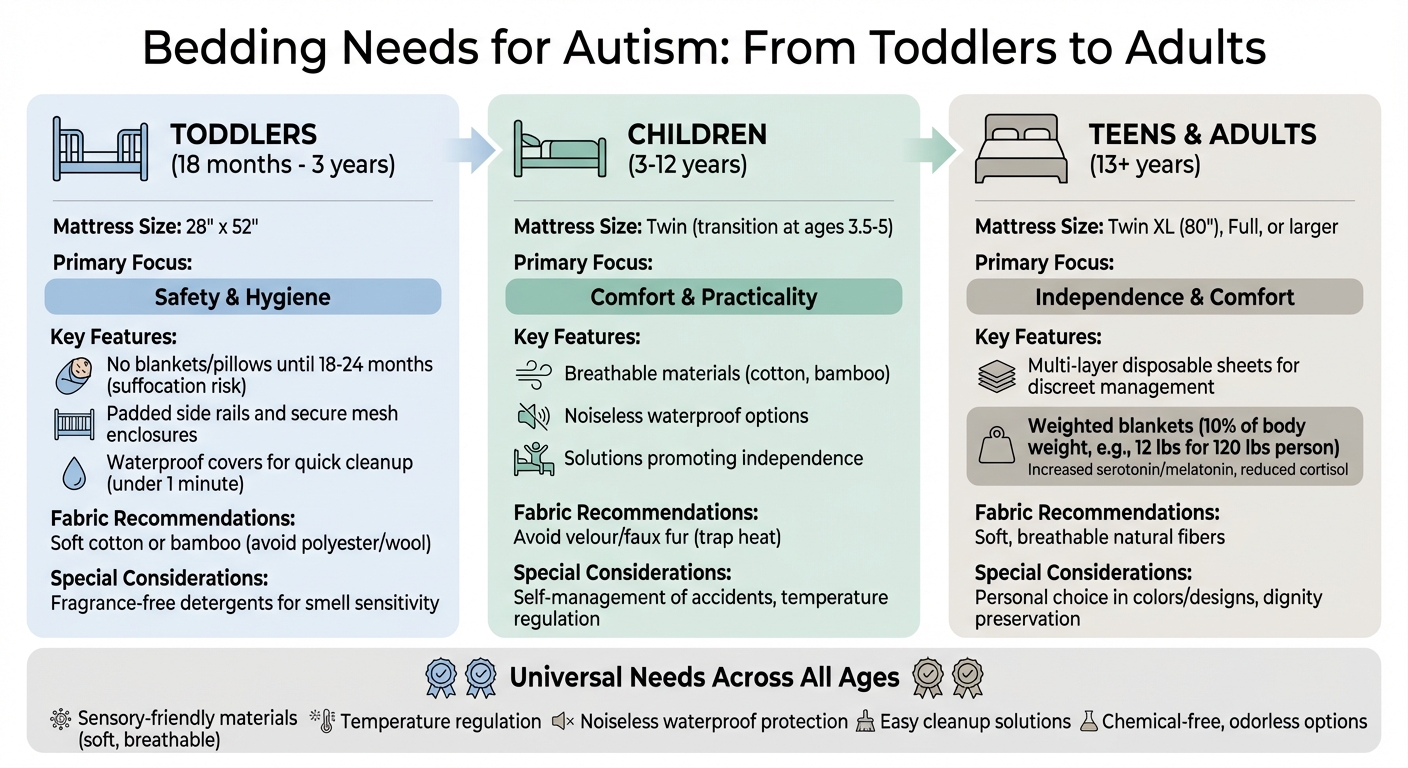
Bedding Needs for Autism: Toddlers to Adults Comparison Guide
As individuals with autism grow, their bedding needs evolve significantly. Bedding that suits a toddler won't necessarily work for a teenager or adult. Understanding these changes can help caregivers prepare for each stage, making transitions smoother and less stressful. Here's a closer look at how bedding requirements shift from toddlerhood to adulthood, focusing on safety, comfort, and independence.
Bedding for Toddlers: Safety and Hygiene First
For toddlers (18 months to 3 years), safety takes center stage. Toddler mattresses, typically 28" x 52", are designed to ease the transition from crib to bed [10]. Until toddlers reach 18–24 months, blankets and pillows are usually not recommended due to suffocation risks [10].
Children with autism may have unique needs, such as a tendency to wander at night. In these cases, safety beds equipped with padded side rails, secure mesh enclosures, and locks can provide peace of mind [9][2]. Additionally, waterproof mattress covers or multi-layer disposable sheets simplify cleanup - some options allow a bed to be changed in under a minute without removing the entire mattress cover [1].
Sensory sensitivity is another key factor at this stage. Soft, breathable fabrics like cotton or bamboo are ideal, while scratchy materials such as polyester or wool should be avoided to prevent overstimulation [2][10]. For toddlers sensitive to smells, using fragrance-free laundry detergents can also make a difference in their sleep environment [8].
Bedding for Children: Comfort Meets Practicality
As children grow (ages 3–12), their bedding needs shift toward balancing comfort with practicality. The move to twin-sized beds often occurs between ages 3.5 and 5 [11]. During this stage, sensory sensitivities may become more pronounced, and practical challenges like bedwetting or restless sleep behaviors (such as head-banging or body-rocking) may emerge.
Fabric choice becomes more nuanced at this stage. Materials like cotton and bamboo remain popular for their breathability and ability to regulate temperature, while fabrics like velour or faux fur may trap heat or allergens [10]. For children who dislike the cold or crinkly feel of traditional waterproof covers, noiseless disposable options provide protection without causing sensory discomfort [1][6].
Parents often appreciate solutions that promote independence. As Ronda, the parent of a 12-year-old, shared:
"When he has an accident, he now can take care of it himself and put a new top sheet on his bed. No more scrubbing, no more smell, and no more embarrassment" [1].
These practical and sensory considerations help prepare children for more independence as they grow.
Bedding for Teens and Adults: Comfort and Independence
By the time individuals reach their teenage years and adulthood, bedding needs to support both personal independence and ongoing sensory challenges. Transitioning to larger beds, such as Twin XL (80 inches long) or Full-size options, provides the extra space and durability needed for this life stage [11].
Disposable, multi-layer waterproof sheets allow teens to discreetly manage accidents by peeling away the soiled layer, eliminating the need for full mattress changes [1]. This not only supports self-care but also reduces the embarrassment that can come with such situations. Jalene Stanger, a caregiver, noted:
"With 2 incontinent special needs teenagers... these have relieved a lot of stress. They hold a LOT of liquid and are easy to use and tear away. No more 15 loads of laundry and wet mattresses!" [1].
Just like in earlier stages, material softness and minimizing sensory triggers remain critical. Weighted blankets are an excellent option for teens and adults, providing deep pressure that can increase serotonin and melatonin levels while reducing cortisol [12][13]. These blankets should typically weigh about 10% of the user's body weight - for instance, a 12-pound blanket for a 120-pound teen [12][13]. Involving teens in selecting colors and designs for their bedding can help them feel more connected to their sleep environment, encouraging better rest [12][10].
Sensory-Friendly Bedding Features to Consider
Choosing bedding that adapts to sensory needs is a key consideration for individuals with autism, regardless of age. Fabrics made from natural fibers like cotton, bamboo, and linen are highly recommended because they’re breathable and help wick away moisture effectively [3]. If tactile sensitivity is a concern, opt for sateen instead of percale, as its smoother texture creates less friction [14]. Bamboo-derived viscose is another excellent choice, known for its softness and cooling properties, which can be especially helpful for those prone to overheating or with sensitive skin [14].
Temperature regulation plays a major role in creating a sensory-friendly sleep environment. A lower core body temperature is essential for initiating sleep, and breathable fabrics improve airflow, helping to dissipate heat and minimize sweating. This is particularly useful for neurodivergent children who may struggle with overheating. Synthetic fibers, on the other hand, should be avoided as they can hinder temperature control and have even been linked to respiratory issues like frequent wheezing [3].
Waterproofing is another important factor, but it’s critical to avoid materials that could trigger sensory discomfort. Traditional protectors made from vinyl or PVC often produce crinkling noises and an unpleasant plastic-like texture. Instead, modern waterproof options use breathable membranes that block liquids without making noise, offering a more comfortable alternative [1].
Compression sheets made from materials like Lycra, nylon, or spandex provide adjustable deep-pressure support, which can be soothing. According to Stanford Medicine, “compared to weighted blankets, compression bed sheets are less constrictive and more breathable” [4]. This makes them a great option for those seeking calming pressure without feeling overly confined.
Layering bedding is another effective strategy. Instead of using a single heavy comforter, multiple layers allow for easier adjustments throughout the night. This is particularly helpful for children who may not be able to express discomfort clearly [3]. By layering and combining sensory-friendly options, you can create a sleep environment tailored to individual needs, ensuring both comfort and hygiene for all ages.
sbb-itb-45288fe
PeelAways: A Solution for Autism Bedding Needs

PeelAways offers a practical solution for families dealing with bedding challenges often associated with autism. With its patented multi-layer design, the product features 5 to 7 disposable, waterproof sheets stacked directly on the mattress. When a layer gets soiled, you can peel it off in under 60 seconds[15], revealing a clean sheet underneath - no need for heavy mattress lifting, endless laundry, or worrying about cross-contamination. This design is tailored to meet the evolving bedding needs of individuals with autism, regardless of age.
What sets PeelAways apart is its sensory-friendly construction. The sheets are made from a soft, non-woven blend of bamboo, rayon, and polyester, which is 32% softer than standard hospital sheets[16]. Unlike vinyl or PVC mattress protectors that can be noisy, PeelAways are completely noiseless[1]. They also feature a breathable membrane that blocks 100% of liquids while allowing airflow, helping to regulate temperature and keep sleepers cool[1].
Product Overview: Features and Benefits
Each PeelAways layer provides complete waterproof protection from urine, spills, and sweat while remaining breathable. The sheets are free from Vinyl, PVC, Phthalates, and fire retardants, making them odorless and safe for sensitive skin[1]. Plus, each layer can last 7–10 days[15], making it a convenient option for caregivers and individuals alike.
The design promotes independence for users of all ages. For example, Ronda, a mother of a 12-year-old, shared:
"When he has an accident he now can take care of it himself and put a new top sheet on his bed. No more scrubbing, no more smell, and no more embarrassment."[1]
Caregivers managing multiple individuals have also noted the stress relief PeelAways provides. Jalene Stanger explained:
"With 2 incontinent special needs teenagers... these have relieved a lot of stress. They hold a LOT of liquid and are easy to use and tear away. No more 15 loads of laundry and wet mattresses!"[1]
PeelAways can be placed directly on the mattress or tucked under a regular fitted sheet for a more familiar sleep environment[1]. Sheet straps or clips help secure the corners for a snug fit[1]. With an impressive 4.8 out of 5 rating from over 12,000 customers, the product has proven to be a reliable choice for special needs care[1].
PeelAways Sizing and Pricing Guide
PeelAways are designed to fit a wide range of mattress sizes, making them suitable for toddlers, teens, and adults. The Crib-A-Peel includes 5 layers and fits mattresses up to 6 inches deep. For older children and teens, the Cot and Twin XL sizes offer 7 layers for longer use. Standard sizes - Twin, Full, Queen, and King - come with 5 layers and fit mattresses up to 12 inches deep.
Prices start at $30.99 for the Crib-A-Peel, with options for subscription savings of 15% and bundle discounts of up to 10%[1]. Orders over $100 qualify for free shipping.
Size and Price Table
| PeelAways Size | Dimensions | Layers | Price | Best For |
|---|---|---|---|---|
| Crib-A-Peel | 52" x 28" | 5 | $30.99 | Toddlers |
| Cot | 75" x 30" | 7 | $34.99 | Children |
| Twin | 75" x 39" | 5 | $34.99 | Children |
| Twin XL | 80" x 39" | 7 | $41.99 | Teens/Adults |
| Full | 75" x 54" | 5 | $43.99 | Teens/Adults |
| Queen | 80" x 60" | 5 | $47.99 | Adults |
| King | 80" x 78" | 5 | $53.99 | Adults |
Adapting Bedding Solutions Over Time
Bedding needs change as children grow and their behaviors shift. According to the American Academy of Pediatrics, it’s time to transition to a new bed when a child reaches 35 inches in height or when the side rail of the crib aligns with their chest level[17]. Behavioral changes, like climbing out of the crib or wandering at night, are also clear indicators that it’s time to reassess their sleeping setup[11][5].
Potty training introduces new challenges, and bedding that supports independence can make a big difference. Products like PeelAways allow older children and teens to handle bed cleanup themselves, encouraging self-reliance and reducing feelings of embarrassment[1].
For caregivers, the demands of endless laundry can become overwhelming. When the workload becomes too much, it’s a clear sign to update the bedding. Multi-layer disposable sheets offer a practical solution, easing the burden significantly. Caregiver Jalene Stanger shared her experience:
"With 2 incontinent special needs teenagers... these have relieved a lot of stress. They hold a LOT of liquid and are easy to use and tear away. No more 15 loads of laundry and wet mattresses!"[1]
Establishing a new bedding routine typically takes about three weeks. Using visual schedules and consistent bedtime steps can help make the transition smoother[18].
Sensory-friendly designs remain essential throughout all stages of development. As sensory needs change, bedding features should adapt too. For individuals seeking greater independence, discreet waterproof layers that fit beneath standard sheets provide protection while maintaining dignity. Keep an eye on sleep patterns and physical growth to know when it’s time to move to different products, whether transitioning from toddler to teen or adult sizes[1].
Conclusion
The importance of bedding in achieving quality sleep and managing behavior cannot be overstated. Bedding choices directly impact sleep quality, emotional well-being, and overall health. For children on the autism spectrum, this connection is especially profound - studies reveal that 50% to 80% of these children face chronic sleep challenges. Poor sleep in children with ASD often correlates with more severe daytime behavioral issues compared to their peers who sleep well[19]. Given the link between restful sleep and emotional balance, learning, and physical health, sensory-friendly bedding becomes an essential factor at every stage of life.
As people grow, their bedding needs change significantly. For teens and adults, solutions like multi-layer disposable sheets offer a discreet way to handle accidents, promoting independence and preserving dignity[1]. These thoughtful designs allow individuals to address challenges privately, without the stress or embarrassment of dealing with traditional bedding.
Conventional bedding often requires constant laundering and cleaning, which can overwhelm caregivers. Multi-layer disposable sheets reduce this burden while still providing soft, breathable, and quiet materials that meet sensory needs. Caregivers often report greater satisfaction when using these specialized bedding options, highlighting their effectiveness across different ages and situations[1].
Related Articles
Dive deeper into the topic of specialized bedding for autism with these helpful resources.
The PeelAways blog is packed with practical advice for caregivers, offering solutions that address everyday challenges. Here are some articles worth checking out:
- How PeelAways Makes Caregiving Easier: This piece tackles common issues like incontinence and nighttime care. It highlights how PeelAways' peel-away design can drastically reduce laundry - cutting it from 15 loads per week to almost none - while easing the physical demands of caregiving. A must-read for families managing care at home.
- The Benefits of Multi-Layer Disposable Sheets: Discover the details behind PeelAways' patented multi-layer sheets. With a 100% waterproof barrier that still allows for breathability, these sheets are ideal for individuals with sensory sensitivities. No wonder 95% of users recommend them!
- Choosing the Right Bedding for Special Needs: This guide helps you navigate the process of selecting bedding tailored to sensory, safety, and hygiene requirements. It's a valuable resource for making thoughtful decisions at every stage of life.
Explore these articles to find solutions that make caregiving simpler and more effective.
FAQs
What are the best bedding options for individuals with autism?
The right bedding for individuals with autism should prioritize comfort, sensory preferences, and practicality. Materials like cotton, bamboo, or Tencel work well because they are soft, breathable, and hypoallergenic. These fabrics feel gentle on the skin, help regulate body temperature, and reduce irritation - perfect for those with sensitivities.
For added relaxation, weighted blankets can be a great choice. Opt for blankets with non-toxic weights and soft, washable fabrics. These blankets provide gentle, evenly distributed pressure that can help promote a sense of calm and improve sleep quality.
If incontinence or frequent accidents are a concern, disposable waterproof bedding such as PeelAways offers a practical solution. These multi-layer sheets let you peel away the top layer after an accident, instantly revealing a clean layer underneath. This eliminates the need for washing and avoids the discomfort of wet or heavy fabrics, making cleanup quick and stress-free.
How can the right bedding help individuals with autism stay comfortable during sleep?
Bedding plays a crucial role in sleep comfort, especially for individuals with autism who may be particularly sensitive to temperature changes. Studies show that most people sleep best when their bedroom temperature stays between 68°F and 77°F. Temperatures outside this range can disrupt sleep, and for those on the autism spectrum, even minor shifts can feel uncomfortable. That’s why bedding designed to regulate temperature can make a big difference.
Opting for breathable materials like lightweight cotton, bamboo, or moisture-wicking fabrics can help prevent overheating by allowing heat and moisture to escape. Another smart approach is layering - start with a soft, breathable fitted sheet, add a lightweight blanket, and, if needed, include a temperature-neutral weighted blanket for calming deep-pressure input. This setup makes it easy for caregivers to adjust warmth as needed without changing the room’s temperature, creating a tailored sleep environment that promotes better rest and a more balanced mood.
What are the advantages of using PeelAways multi-layer disposable sheets for individuals with autism?
PeelAways multi-layer disposable sheets provide a practical and hygienic option for bedding, particularly helpful for individuals with autism who may be more sensitive to odors or germs. Each sheet is designed with 5 to 7 soft, absorbent layers that can be peeled away once soiled, instantly revealing a fresh, clean layer beneath - no need for lifting mattresses, doing laundry, or dealing with extra mess.
This thoughtful design simplifies cleanup for caregivers, saving time and effort while helping to maintain a calm and consistent environment - something that's often crucial for supporting daily routines. Prices range from $30.99 to $53.99, depending on the size, but the benefits are clear: less laundry, reliable protection for frequent wetting, and added peace of mind. Available in sizes from crib to king, PeelAways cater to all age groups and bedding needs.
Comments
0



SAVE MONEY & WATER
Professionals & Institutions save a fortune on labor/laundry.

SUPERIOR COMFORT
The first thing our customers notice is how soft our sheets are.

100% WATERPROOF
Each layer is 100% Waterproof, perfect for spills and accidents

SAVE TIME
Change the sheet in under 1 minute without stripping the bed.

Leave a comment