
Anti-Shear Bedding: How It Prevents Pressure Ulcers

Pressure ulcers, also called bedsores, are a serious issue for people with limited mobility. Anti-shear bedding can help prevent these injuries by reducing harmful forces on the skin and deeper tissues.
Here’s the key takeaway: Pressure ulcers form when blood flow is blocked due to prolonged pressure, friction, and shear forces. Anti-shear bedding uses specialized materials and designs to minimize these risks. Features like multi-layer fabrics, low-friction surfaces, and moisture management protect vulnerable skin areas like the tailbone, heels, and hips.
Quick Facts:
- Pressure ulcers can develop in as little as 2 hours.
- 70% of cases occur in people over 65.
- Anti-shear bedding reduces friction and shear forces, preventing deep tissue damage.
- Products like low-friction sheets, foam mattresses, and gel layers distribute pressure evenly and keep skin dry.
Caregivers can combine anti-shear bedding with proper repositioning and wrinkle-free setups to improve patient care and reduce the risk of skin breakdown.
Bed Sores / Pressure Injuries: Prevention & Treatment - Ask A Nurse | @LevelUpRN
How Anti-Shear Bedding Works
Shear forces play a major role in tissue damage, and anti-shear bedding is specifically designed to counteract these forces. By using carefully engineered layers, this bedding prevents mechanical damage beneath the skin. Unlike standard hospital linens, which can pull and drag against the skin during movement, anti-shear materials are crafted to reduce friction and absorb shear forces before they can harm delicate tissues. Let’s dive into the materials that make this possible.
Materials and Features
The best anti-shear bedding relies on multi-layer designs, allowing movement to occur between the fabric layers rather than directly against the patient’s skin. For example, some overlays feature quadruple layers of polyester fibers that slide smoothly against one another, significantly reducing friction and preventing chafing [6].
Low-friction fabrics, such as GlideWear, are engineered to lower the coefficient of friction. This prevents the skin from sticking during repositioning, reducing the risk of tissue damage [9][10]. Additionally, high-specification foam - like convoluted or cubed designs - molds to the body’s contours, redistributing pressure across a wider area and minimizing shear risk [8]. Medical-grade sheepskins, made from dense Merino wool, create a soft interface that reduces rubbing, particularly at bony points [8]. Each of these materials plays a specific role in protecting vulnerable skin from shear forces.
Another critical feature is moisture management, which helps regulate the skin’s microclimate by controlling temperature and humidity. This prevents the skin from becoming overly moist or dry, both of which can weaken its natural barrier [7][10].
"These dressings also manage microclimate which is the temperature and humidity of the skin and the dressing interface", explains Patricia Turner, BSN, RN, CWOCN, CWS, a Medline Clinician [5].
Finally, layers filled with gel, air, or water adapt to the patient’s body shape, evenly distributing weight and minimizing stress points where shear forces are most damaging [8].
How It Reduces Shear and Friction
The effectiveness of anti-shear bedding lies in its ability to redirect mechanical forces away from the body. Dr. Kevin Woo, PhD, RN, NSWOC, FAPWCA, a Medline Consultant, highlights this point:
"The material can compress and redistribute shear across the dressing and beyond" [5].
Instead of allowing shear forces to distort blood vessels and tissues, these multi-layer systems absorb and spread the forces across the material itself. This design ensures that the body is protected from the harmful effects of shear, offering a crucial layer of defense for patients at risk.
How to Use Anti-Shear Bedding
Getting the most out of anti-shear bedding involves careful selection, proper setup, and consistent upkeep. While these products are designed to minimize shear and protect the skin, how you use them plays a huge role in maximizing their effectiveness.
Choosing the Right Bedding
Start with a pressure-relieving mattress made from foam, gel, or air cushioning materials. These options help evenly distribute body weight, reducing pressure on sensitive areas like the tailbone or heels [1][2]. For sheets, opt for smooth, low-friction fabrics that stay wrinkle-free to avoid unnecessary friction.
For added convenience and protection, consider waterproof, low-friction sheets. A standout option is PeelAways, which offers multi-layer disposable fitted sheets. These come in 5 to 7 layers, depending on the size. When a layer gets soiled, you simply peel it off to expose a clean sheet underneath - no need to lift the patient or completely remake the bed. This not only reduces caregiver effort but also minimizes skin-damaging shear forces. PeelAways sheets are available in all standard sizes, from Crib to King.
Preparing the Bed Correctly
Once you’ve chosen the right bedding, setting up the bed properly is crucial. Always ensure the bedding is smooth and free of wrinkles, as even small creases can create friction that harms delicate skin [1][4]. Before placing the patient on the bed, run your hand across the surface to check for wrinkles or any foreign objects [1].
The angle of the bed matters, too. Keep the head of the bed at 30 degrees or lower. Raising it higher can cause the patient to slide downward, increasing shear forces on the lower back and tailbone. As MedlinePlus explains:
"Do not raise the head of your bed to more than a 30 degree angle. Being flatter keeps your body from sliding down. Sliding may harm your skin." [1]
Positioning aids can also make a big difference. Use soft pillows or foam wedges to support the knees and ankles when the patient is lying on their side. For patients lying on their back, place supports under the tailbone, shoulders, and elbows. One critical tip: place a pillow under the calves to completely "float" the heels off the mattress. Heels are especially vulnerable to pressure injuries [1][4].
Repositioning and Managing Layers
Regular repositioning is non-negotiable. Turn the patient every 2 hours - or every 4 hours if you’re using a pressure-redistributing mattress - to prevent prolonged pressure on any one area [1][4][12]. Use a draw sheet or lifting device to gently lift the patient rather than dragging them, which can cause skin damage [1][4].
To manage moisture and keep the skin dry, use underpads and disposable peel-away sheets. These sheets allow for quick removal of soiled layers without disturbing the patient’s position, providing an easy way to maintain a clean and dry surface [11][1].
Lastly, make daily skin checks a priority. Pay close attention to pressure-prone areas, and clean and dry the skin immediately after any incontinence episodes. Moisture can quickly lead to skin breakdown, so staying vigilant is key [1][13]. Keep in mind that pressure injuries can develop in just a few hours without consistent care [4].
sbb-itb-45288fe
Benefits of Anti-Shear Bedding
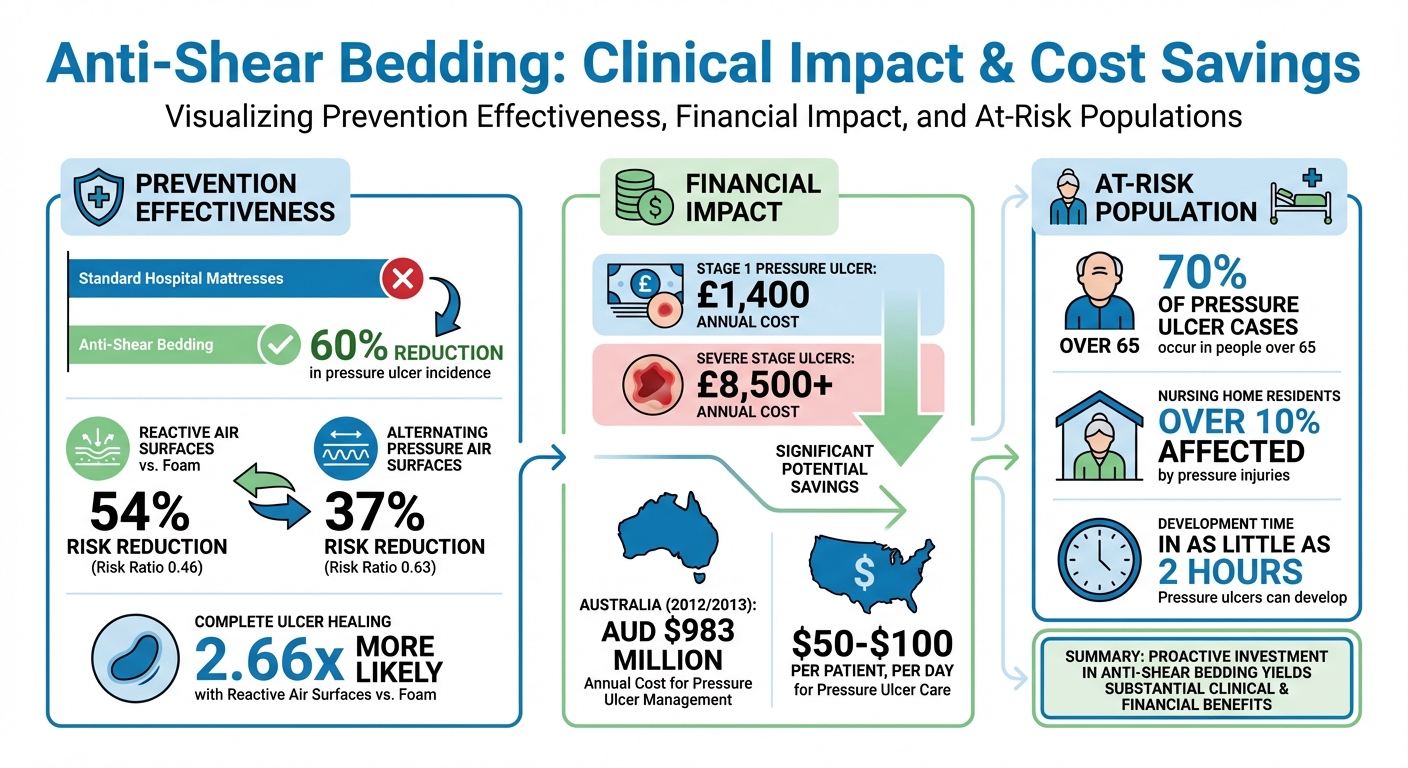
Anti-Shear Bedding Statistics: Pressure Ulcer Prevention and Cost Savings
Clinical Benefits and Research
Studies have consistently shown that anti-shear bedding plays a crucial role in reducing the occurrence of pressure ulcers. For instance, pressure-reducing surfaces can lower the incidence of ulcers by an impressive 60% when compared to standard hospital mattresses [3]. This is a significant improvement for a condition that impacts over 10% of nursing home residents [4].
When comparing different types of bedding, reactive air surfaces have been found to reduce the risk of pressure ulcers by 54% (risk ratio 0.46) compared to foam surfaces [14]. Similarly, alternating pressure air surfaces can decrease the risk by 37% (risk ratio 0.63) [14]. For patients already suffering from pressure ulcers, those using reactive air surfaces are 2.66 times more likely to experience complete ulcer healing compared to those on foam surfaces [15].
The financial impact of pressure ulcers is also substantial. In the UK, treating a single Stage 1 pressure ulcer costs approximately £1,400 annually, with costs exceeding £8,500 for more severe stages [15]. In Australia, the annual cost of managing pressure ulcers was estimated at around AUD 983 million based on 2012/2013 prices [15]. By preventing these ulcers, anti-shear bedding not only safeguards patient health but also significantly reduces healthcare expenses, creating a win-win for patients, caregivers, and healthcare providers alike.
Easier Care for Caregivers
Anti-shear bedding doesn’t just benefit patients - it also makes life easier for caregivers. These specialized surfaces reduce the need for frequent manual repositioning and minimize the time spent on wound care, lessening the physical strain on caregivers. As highlighted by InformedHealth.org:
"Frequent repositioning is physically demanding for caregivers or family members too" [2].
In the U.S., caring for patients with pressure ulcers costs between $50 and $100 per patient, per day [16]. Prevention, therefore, is not only more effective but also far less costly than treatment.
Products like PeelAways multi-layer disposable sheets offer a practical, time-saving solution. When a layer becomes soiled, caregivers can simply peel it away to reveal a clean sheet underneath - no lifting of the patient or laundering required. This eliminates concerns about cross-contamination and drastically reduces caregiver workload. For those managing both incontinence and pressure ulcer prevention, this streamlined approach helps maintain patient dignity while conserving caregiver energy. These features make anti-shear bedding a practical and cost-efficient choice for various care settings.
Conclusion: What Caregivers Need to Know
Anti-shear bedding provides a practical solution for reducing pressure ulcers in patients with limited mobility. By minimizing friction and shear - two major contributors to skin breakdown - this specialized bedding helps protect deep tissues before visible damage occurs[10]. However, these bedding systems work best when paired with proper caregiving techniques.
To prevent shear injuries, always lift patients instead of dragging them, and make sure the bedding stays smooth, dry, and wrinkle-free[1]. Keeping the setup straightforward ensures better support and comfort. Regularly check areas like elbows, heels, and hips for early signs of skin breakdown, as these are common pressure points[1].
For caregivers juggling pressure ulcer prevention and incontinence management, PeelAways offers a patented 5-layer waterproof bedding system. This innovative design allows you to remove a soiled layer in under a minute, leaving a clean, smooth surface. With over 1,100 5-star reviews, it’s a time-saving option that simplifies care while maintaining hygiene and comfort[17].
Related Articles
Check out these guides to simplify caregiving tasks and help prevent pressure ulcers.
The Benefits of Disposable Bedding for Elder Care highlights how multi-layer sheets can ease the burden of traditional bed changes. It focuses on improving hygiene practices and streamlining workflows for caregivers juggling demanding schedules.
How to Choose the Right Bedding for Incontinence Management provides insights into selecting bedding designed to protect skin and extend mattress life. It tackles incontinence-specific concerns like odor control and quick cleanup, which are essential for managing moisture and reducing the risk of pressure ulcers.
5 Caregiving Tips for Bedridden Patients shares practical advice on repositioning, performing skin checks, and minimizing friction. With over 10% of nursing home residents affected by pressure injuries[4], these tips can help caregivers address potential issues before they arise.
FAQs
How does anti-shear bedding help prevent pressure ulcers?
Anti-shear bedding is crafted with special materials that help reduce friction and shear forces on the skin. These materials work to limit the sliding and pulling that often occur when someone changes position, offering protection to the skin and deeper tissues. This can be crucial in preventing damage that might lead to pressure ulcers.
Unlike standard bedding, which doesn’t tackle these challenges, anti-shear bedding is designed to improve pressure distribution and lower the risk of skin breakdown. It’s particularly beneficial for individuals with limited mobility or those more prone to developing pressure ulcers.
How does anti-shear bedding help manage moisture and prevent pressure ulcers?
Anti-shear bedding is crafted to handle moisture effectively by incorporating breathable, moisture-wicking materials. These fabrics pull sweat and other fluids away from the skin, keeping the surface dry. This not only supports the skin's natural barrier but also minimizes the chance of maceration - a condition that can increase the likelihood of pressure ulcers.
Products like PeelAways add another layer of convenience and hygiene with their multi-layer, peel-away design. Instead of lifting the mattress or dealing with laundry, you can simply remove the soiled layer to reveal a fresh, clean sheet beneath. This quick-change feature not only saves time but also helps reduce cross-contamination, promoting better skin health.
What are the advantages of using multi-layer disposable bed sheets like PeelAways?
Multi-layer disposable bed sheets, such as PeelAways, bring a lot of relief to caregivers and individuals at risk of pressure ulcers. These sheets feature multiple soft, absorbent layers designed to pull moisture away from the skin. By keeping the skin dry and reducing friction, they help lower the chances of tissue damage.
What sets these sheets apart is their disposable, waterproof design. Instead of dealing with the hassle of washing soiled linens or lifting heavy mattresses, caregivers can simply peel off the top layer to reveal a fresh, clean sheet beneath. This straightforward process not only streamlines hygiene routines but also cuts down on the risk of cross-contamination and eases the physical effort required during sheet changes. For anyone focused on maintaining skin health and making caregiving tasks more efficient, PeelAways are a smart, practical solution.
Comments
0



SAVE MONEY & WATER
Professionals & Institutions save a fortune on labor/laundry.

SUPERIOR COMFORT
The first thing our customers notice is how soft our sheets are.

100% WATERPROOF
Each layer is 100% Waterproof, perfect for spills and accidents

SAVE TIME
Change the sheet in under 1 minute without stripping the bed.

Leave a comment