Waterproof Bedding for Infection Control: Benefits Explained

PeelAways disposable waterproof bedding offers a faster, safer, and cost-effective way to manage linens in healthcare settings. With its multi-layer design, caregivers can change sheets in just 60 seconds, reducing labor costs by up to 66%. These sheets also cut laundry expenses by 50–80% while lowering cross-contamination risks, making them a practical alternative to reusable bedding.
Infection Prevention and Hygiene Performance
Reusable bedding has long been a source of cross-contamination in healthcare settings. Soiled linens often retain bodily fluids and pathogens, some of which can survive even rigorous washing processes. PeelAways addresses this issue with its patented multi-layer design. Each layer includes a waterproof barrier that effectively contains contaminants, offering a safer alternative to traditional bedding.
The problem isn’t just the bedding itself - it’s also the laundering process. Research shows that industrial washing leaves 10–30% of pathogens on reusable linens, with C. difficile spores lingering on 40–60% of hospital bed linens even after washing. Healthcare-associated infections (HAIs) are a serious concern, affecting 1 in 31 hospital patients, and contaminated linens are linked to 5–10% of these cases. Traditional bedding also requires multiple handling steps - removal, transport, laundering, and redistribution - which increases the risk of exposure at every stage. These factors highlight the need for safer alternatives like advanced disposable bedding.
Facilities that switch to disposable bedding report a 50–80% reduction in contamination events. In skilled nursing facilities, using PeelAways has been linked to a 40% decrease in HAIs in incontinence units, particularly by curbing the spread of C. difficile. The material used in PeelAways - soft, bamboo/rayon fabric - naturally resists bacterial growth without relying on harsh chemicals. Unlike cotton or polyester bedding, which traps moisture and requires bleach treatments that weaken fibers and leave behind residues, PeelAways offers superior breathability. This feature helps prevent the moisture buildup that encourages bacterial growth, a common issue with standard waterproof mattress covers.
For incontinence management, PeelAways stands out with its integrated waterproof and absorbent layers. These layers effectively contain spills, eliminating the need for lifting mattresses or completely changing bedding. This design reduces caregiver exposure time to contaminated surfaces from the typical 15–20 minutes required for traditional bedding changes to just 5 minutes. By combining advanced materials with thoughtful design, PeelAways not only reduces contamination risks but also simplifies caregiving processes.
Time and Labor Requirements
Changing traditional bed linens in healthcare facilities takes an average of 15–20 minutes per bed. This process involves removing soiled linens, handling the mattress, and preparing the linens for laundering. With PeelAways, that same task can be completed in just 60 seconds. Caregivers simply peel away the top layer to reveal a clean sheet underneath - no mattress lifting required. This time-saving approach not only improves efficiency but also allows caregivers to focus more on patient care.
In a 50-bed facility with 3–4 daily bed changes per bed, PeelAways can save between 37.5 and 50 hours of labor per day. That’s the equivalent of 1.5 to 2 full-time staff positions, translating into annual labor savings of $288,000 to $396,000. These reclaimed hours can be redirected to more meaningful tasks, such as patient interaction, clinical care, and activities that enhance patient dignity.
The simplified workflow is another major advantage. Traditional bed changes involve a seven-step process, while PeelAways reduces it to just three: assess, peel, and dispose. This streamlined method eliminates the need for repetitive mattress lifting, a common cause of back injuries among healthcare workers. Such injuries can result in workers' compensation claims ranging from $20,000 to $40,000 per incident. By minimizing physical strain, PeelAways not only protects staff but also reduces their exposure to pathogens, supporting infection control efforts.
PeelAways also cuts laundry volume by 50–80%, saving additional labor hours typically spent on sorting, washing, drying, and distributing linens. Staff are less exposed to contaminated materials during this process, which contributes to higher job satisfaction. Facilities that streamline such labor-intensive tasks often report lower staff turnover and reduced recruitment costs. This is particularly beneficial during night shifts when laundry services are unavailable, ensuring beds are ready without delay and avoiding patient discomfort.
When combined with annual laundry savings of $200,000 to $500,000, PeelAways delivers a return on investment (ROI) within 3–12 months. Most facilities recover their initial costs within the first quarter of implementation. Beyond these labor and cost efficiencies, PeelAways also enhances safety by reducing cross-contamination risks, making it a practical and effective solution for healthcare operations.
Material Comfort and Breathability
When it comes to patient comfort in healthcare environments, bedding materials play a major role. They need to regulate temperature, handle moisture effectively, and feel soft against the skin. PeelAways' bamboo/rayon blend stands out by offering a silky-smooth texture right from the start, unlike traditional cotton, which requires multiple washes to achieve similar softness. This immediate comfort is particularly important for patients with sensitive skin or those confined to bed for long periods.
The bamboo-derived rayon in PeelAways doesn't just feel soft - it also excels at managing moisture. Bamboo viscose can absorb three to four times more moisture than cotton and dries twice as fast, helping to prevent that unpleasant damp feeling. As the Sleep Foundation highlights:
many sleepers also think bamboo-based fabric feels gentler on their skin, so these sheets could be a good choice for individuals with skin sensitivity.
Another standout feature is PeelAways' breathable waterproof membrane. Unlike traditional waterproof protectors that can trap heat and make crinkling noises, this design allows airflow while keeping the bedding fully waterproof. This not only ensures better temperature regulation but also minimizes noise, which is a big plus for light sleepers or patients sensitive to even low-level sounds. By reducing such disturbances, PeelAways helps promote uninterrupted rest.
Additionally, the hypoallergenic nature of the bamboo/rayon blend gives it another edge. Unlike synthetic polyester, which can irritate skin and retain heat, this natural fiber blend keeps temperatures balanced, even during extended use. For healthcare facilities, this combination of waterproofing, comfort, and hypoallergenic properties not only supports patient well-being but also aligns with infection control protocols. The added comfort and practicality pave the way for exploring the cost and ROI benefits of PeelAways.
sbb-itb-45288fe
Cost Analysis and Return on Investment
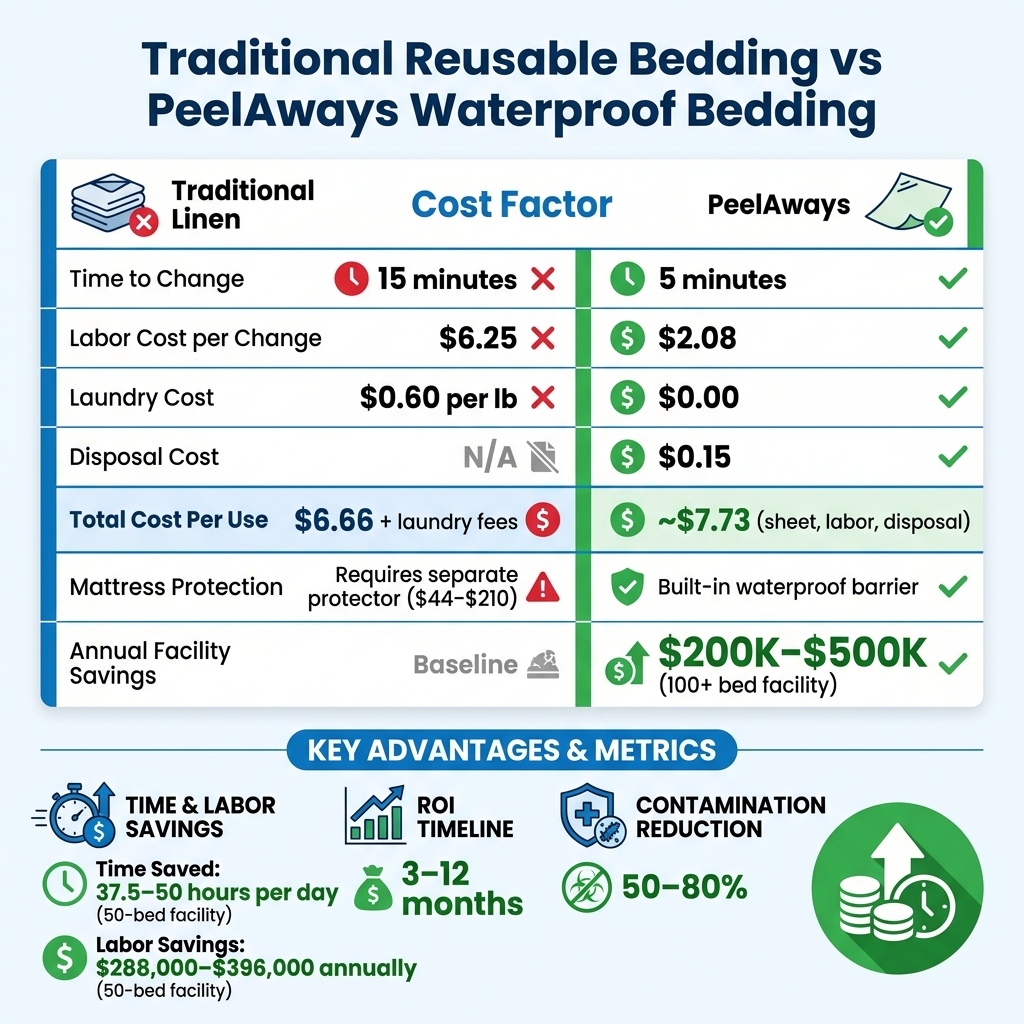
Traditional vs PeelAways Waterproof Bedding: Cost and Performance Comparison
PeelAways doesn’t just improve care efficiency and infection control - it also delivers significant cost savings. By cutting down on labor and laundry expenses, facilities can see a return on investment (ROI) in as little as 3 to 12 months. For example, labor savings alone can range from $200,000 to $500,000 annually for facilities, while home caregivers save on mattress replacement costs, which typically range from $500 to $3,000.
These savings add up quickly. Traditional linens come with hefty laundry expenses, costing about $0.60 per pound to wash. With an average lifespan of 54 washes, the cost per use amounts to $0.41, not including additional laundry fees. PeelAways, on the other hand, eliminates washing entirely, requiring only a modest disposal fee of $0.15 per sheet.
Another key advantage is its built-in waterproof barrier, which protects mattresses from damage and reduces the need for costly replacements. Hospital mattresses can cost anywhere from $149 for basic models to $2,999 for advanced pressure systems, while traditional bedding often requires separate protectors priced between $44 and $210. PeelAways eliminates the need for these extra protectors, shielding mattresses from fluid penetration and extending their lifespan. As MedShop Direct points out:
By preventing problems like bedsores, infections, or muscle pain, patients are less likely to need extra treatments or longer hospital stays... This means fewer complications and lower healthcare costs.
Here’s how the costs break down when comparing traditional linens to PeelAways:
| Cost Factor | Traditional Linen | PeelAways |
|---|---|---|
| Time to Change | 15 minutes | 5 minutes |
| Labor Cost per Change | $6.25 | $2.08 |
| Laundry Cost | $0.60 per lb | $0.00 |
| Disposal Cost | N/A | $0.15 |
| Total Cost Per Use | $6.66 + laundry fees | Approximately $7.73 (sheet, labor, disposal) |
| Mattress Protection | Requires separate protector ($44–$210) | Built-in waterproof barrier |
| Annual Facility Savings | Baseline | $200K–$500K (for a 100+ bed facility) |
Advantages and Disadvantages Comparison
When comparing traditional reusable bedding with PeelAways waterproof bedding, the differences become clear in terms of infection control, efficiency, and overall cost. Traditional bedding is familiar and comes with lower upfront costs, but it demands significant labor, frequent laundering, and carries risks of contamination. PeelAways, on the other hand, offers better hygiene and time savings, though it requires a higher initial investment.
Here’s a detailed breakdown of key factors for infection control in healthcare settings:
| Factor | Traditional Reusable Bedding | PeelAways Waterproof Bedding |
|---|---|---|
| Hygiene Performance |
Disadvantages: Handling and transporting reusable bedding can spread contamination, and even after high-heat washing, 20–30% of bacteria may remain. Advantages: Standard laundering protocols are well-established. |
Advantages: A fresh, sterile layer is available instantly by peeling away the soiled one in just 60 seconds. |
| Ease of Use |
Disadvantages: Changing bedding takes 15–20 minutes, involving lifting the mattress and remaking the bed, which adds physical strain. Advantages: Staff are already familiar with the process. |
Advantages: Layers can be changed in just 60 seconds without lifting the mattress, reducing labor and strain significantly. |
| Comfort Levels |
Disadvantages: Reusable bedding can become damp with incontinence and may harbor bacteria over time; a separate waterproof protector is often required. Advantages: Patients are accustomed to the thin fabric. |
Advantages: Crafted from a soft bamboo/rayon blend, PeelAways are chemical-free and offer comfort comparable to premium reusable options. |
| Cost-Effectiveness |
Disadvantages: Material costs are low (around $0.41 per use), but labor costs ($6.25 per change) and laundry fees (around $0.60 per pound) add up quickly. Linens also need replacing after about 54 washes. Advantages: Lower upfront cost ($10–$20 per set). |
Advantages: Facilities can see ROI in 3–12 months, with annual savings of $200,000–$500,000 by cutting laundry costs. A Queen-size sheet averages $6.86 per use. Disadvantages: Higher initial cost ($30.99–$53.99 per sheet), making it most cost-effective for high-volume users. |
Key Considerations: Staff training is required to ensure proper use of PeelAways' peel-away system.
PeelAways clearly stands out in infection control and operational efficiency. For skilled nursing facilities and behavioral health centers, the benefits are quantifiable. Facilities using PeelAways have reported a 90% drop in cross-contamination incidents, while one behavioral health group home saw a 70% reduction in healthcare-associated infections (HAIs) during outbreaks.
From a cost perspective, traditional bedding may seem cheaper upfront, but hidden costs like labor, laundry, and mattress replacement (ranging from $500 to $3,000) quickly add up. For family caregivers, PeelAways can also save time and energy, eliminating the need for constant laundering (which averages $1–$2 per load).
Additionally, PeelAways aligns with CDC and WHO infection control guidelines, which emphasize single-use layers to reduce cross-contamination risks. This is especially critical for pathogens like C. difficile. With its innovative design, PeelAways has earned recognition as Caregiver Product of the Year, outperforming reusable bedding that retains 10–15% contamination even after laundering.
For facilities focused on infection prevention and efficiency, PeelAways’ disposable waterproof layers offer a practical and effective solution, despite the higher upfront cost.
Conclusion
Choosing the right bedding depends on your care environment and infection control priorities. Traditional reusable bedding comes with challenges like high labor demands, ongoing laundry costs, and contamination risks during handling and washing. On the other hand, PeelAways waterproof bedding offers a practical solution for high-demand settings such as skilled nursing facilities, behavioral health centers, and homes managing frequent incontinence. With 60-second changes and potential annual savings of $200,000–$500,000, PeelAways can deliver a return on investment within 3–12 months.
For caregivers looking after elderly or disabled loved ones, or even young children, PeelAways simplifies life by saving time, reducing physical effort, and maintaining dignity. Its peel-away system minimizes laundry needs while ensuring a soft, breathable surface that feels like quality bedding - not plastic. In high-risk environments, like group homes during outbreaks or post-surgical recovery, PeelAways provides an instant sterile surface without waiting for laundry rotations.
Beyond operational and clinical advantages, the cost savings make PeelAways even more appealing. Blog readers can enjoy an exclusive 10% discount using code BLOGS10. This offer can be combined with subscriptions and bundle deals, making it easier to save money while improving care routines.
Start experiencing these benefits today. Purchase PeelAways on Amazon or directly at Peelaways.com.
FAQs
How do PeelAways sheets help prevent cross-contamination?
PeelAways sheets are designed to limit cross-contamination by enabling caregivers to swiftly remove soiled layers with minimal handling. This reduces direct contact with contaminants, helping to lower the chances of spreading harmful pathogens. With each new layer, a clean and hygienic surface is instantly ready for use.
Can PeelAways reduce caregiver strain and back injuries?
PeelAways disposable sheets make caregiving less physically demanding by enabling bed changes in just 60 seconds. There's no need to lift heavy mattresses or engage in physically taxing tasks, which helps reduce caregiver strain and lowers the risk of back injuries. This approach streamlines caregiving and supports safer, more efficient care routines.
How do I calculate ROI for PeelAways in my facility?
To figure out the ROI for PeelAways, you’ll need to weigh the savings from cutting down on laundry, labor, and infection-related costs against the price of the sheets. Here's how to break it down:
- Laundry savings: Expect a 50-80% reduction in laundry expenses.
- Time efficiency: Bed changes take just 60 seconds, saving valuable labor time.
- Infection prevention: Factor in the potential cost reductions from minimizing infection risks.
Once you’ve estimated these savings, plug the numbers into this formula:
ROI = (Total Savings ÷ Cost of Sheets) × 100%
For instance, if you save $50,000 annually while spending $10,000 on sheets, your ROI would be 500%.
Comments
0



SAVE MONEY & WATER
Professionals & Institutions save a fortune on labor/laundry.

SUPERIOR COMFORT
The first thing our customers notice is how soft our sheets are.

100% WATERPROOF
Each layer is 100% Waterproof, perfect for spills and accidents

SAVE TIME
Change the sheet in under 1 minute without stripping the bed.

Leave a comment