
Ultimate Guide to Autism Bedding Safety by Age

Selecting the right bedding for children and teens with autism is key to improving sleep quality and ensuring safety. Sleep challenges affect up to 80% of autistic children, and sensory sensitivities often make standard bedding uncomfortable or unsafe. This guide breaks down age-specific bedding needs, from toddlers to teens, addressing issues like fall protection, sensory comfort, and incontinence management.
Here’s a quick overview of what you’ll learn:
- Toddlers (1–3 years): Low-profile beds, snug mattresses, and breathable materials to prevent falls and overstimulation.
- Children (4–12 years): Enclosed beds, padded rails, and locking casters for active sleepers or those prone to wandering.
- Teens (13+ years): Adult-sized beds with privacy-focused designs, adjustable frames, and discreet solutions for incontinence.
Key safety tips include ensuring rail gaps are under 4.75 inches, using hypoallergenic fabrics, and managing sensory triggers like light and noise. Products like multi-layer disposable sheets simplify cleanup and reduce caregiver stress. Thoughtful bedding choices can create a calming, secure environment that supports better sleep for the entire household.
How Autism Affects Sleep and Bedding Requirements
Sleep can be a major challenge for individuals with autism. Studies show that between 50% and 80% of autistic children have difficulty falling or staying asleep - almost twice the rate of their neurotypical peers [2][5]. Reduced melatonin levels often disrupt their sleep-wake cycles, sometimes leading to delayed sleep phase syndrome [5][8]. Additionally, about 43% of parents report that their child leaves the bed or room during the night. Behaviors like head banging, rocking, or chewing bedding can also create safety concerns [5].
The right bedding can make a big difference. By creating a predictable and sensory-friendly environment, it helps signal the body to relax and prepares it for sleep [11][12]. Addressing both sensory needs and physical safety can lead to better rest for everyone in the household.
Sensory Processing and Sleep Quality
Sensory sensitivities play a huge role in how autistic individuals experience their sleep environment. For those with heightened auditory sensitivity, even faint background noises - like the hum of a refrigerator or distant traffic - can interrupt sleep [5][9]. Similarly, visual sensitivities can make small light sources, such as smoke detector LEDs or moonlight, feel overwhelmingly bright, making a darkened room essential [5][9].
Touch and temperature also matter. Fabrics that feel soft to most people may seem scratchy to some autistic children, and temperature fluctuations can further disrupt comfort [5][9]. Many autistic individuals also experience proprioceptive challenges, which can create a need for deep-pressure sensations. This explains why some children instinctively burrow into confined spaces, seeking the calming effect of being snugly enclosed [5].
"Contained environments reduce anxiety and promote calm. This isn't about restriction: it's about providing the physical security that anxious brains crave." - Creative Care [5]
These sensory preferences highlight the importance of designing a bedroom that aligns with individual needs.
How Bedroom Design Supports Better Sleep
A well-thought-out bedroom design can significantly improve sleep quality by addressing sensory sensitivities. Pairing smart design choices with appropriate bedding can help reduce sensory overload. For instance, limiting light exposure by turning off electronic devices 1–3 hours before bed can prevent melatonin suppression [9]. Blackout curtains or covering small LED lights are often necessary for visually sensitive individuals who need complete darkness.
Sound control is equally important. White noise machines, fans, or soft music can mask disruptive sounds, while choosing quiet, sturdy bed frames can eliminate creaking noises that might wake a child [7][9]. For children who rock or jump on their beds, using frames with locking casters ensures stability and safety [1][10].
Creating a "safe space" within the bedroom can also help. Enclosed pod beds or tent-style setups provide a cocoon-like environment that blocks out light and noise while offering the deep-pressure comfort many autistic children find soothing [2][5]. For those prone to wandering, these enclosed spaces can also serve as a gentle way to keep them safe during the night without feeling restrictive.
Bedding Safety Guidelines by Age Group
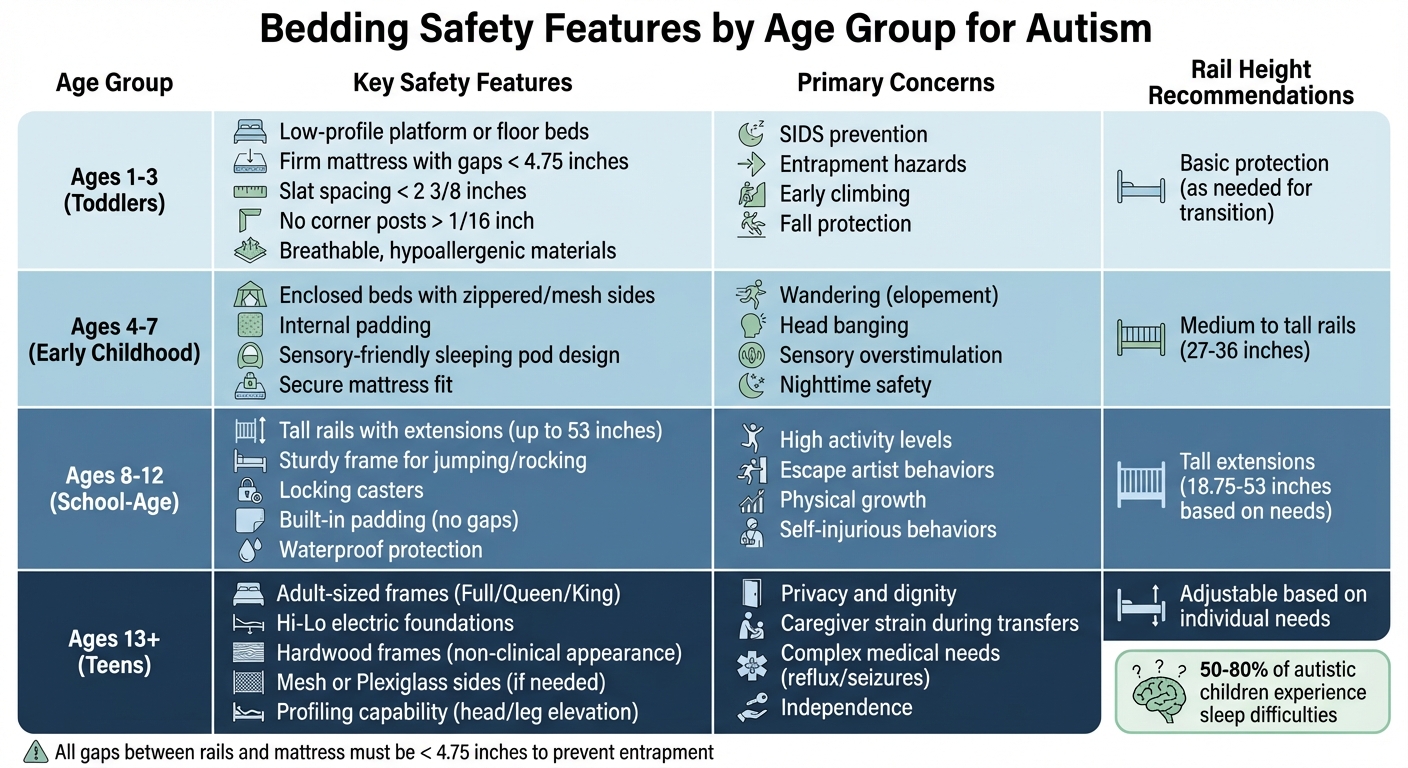
Autism Bedding Safety Features by Age Group Guide
When it comes to choosing bedding for children, safety is a top priority. A toddler moving from a crib needs protection against falls, while a teenager might require features that balance security with privacy. By understanding the specific needs of each age group, caregivers can select bedding that ensures safety while promoting restful sleep. Below, we explore age-specific recommendations to address the unique challenges children face as they grow.
Ages 1-3: Toddler Bedding and Crib-to-Bed Transitions
Transitioning from a crib to a bed is a significant milestone, but it requires careful planning to ensure safety. For toddlers, low-profile platform beds or Montessori-style floor beds are ideal. These options sit close to the ground, reducing the risk of injury if the child rolls out of bed during the night[2].
A snug mattress fit is critical to avoid entrapment hazards. Gaps between the mattress and bed frame should be less than 4.75 inches to prevent a child’s head or limbs from getting stuck[6].
"Entrapment is a huge issue. The child should not be able to flip a mattress and get caught underneath. Kids can get limbs and their whole body caught in the bed rails and spaces between the mattress and rails." - Deborah Humpl, Occupational Therapist at CHOP Adaptive Equipment Clinic[1].
Choosing bedding made from breathable, hypoallergenic materials can also help toddlers stay comfortable and avoid overstimulation. For families managing nighttime accidents during potty training, PeelAways Crib size sheets offer a practical solution. These disposable, waterproof sheets come with multiple peel-away layers, allowing for quick cleanup in less than a minute[4].
Ages 4-7: Early Childhood Bedding for Growing Independence
As children grow, their safety needs evolve. Between ages 4 and 7, the focus shifts to preventing wandering and elopement, especially for children with autism who may wake and leave their beds during the night. Enclosed beds with zippered or mesh sides can create a secure "sleeping pod", reducing the risk of nighttime hazards[2].
These enclosed designs also serve as a sensory-friendly retreat, helping to block out visual and auditory distractions. This calming environment can lower anxiety levels and support better sleep.
Ages 8-12: School-Age Bedding for Complex Safety Needs
For school-age children, bedding safety becomes more complex as behaviors like jumping, rocking, or burrowing emerge. Beds designed for this age group often include tall rails, ranging from 18.75 to 36.25 inches above the mattress, to protect active children who may climb or pull themselves up[6]. For children with a tendency to escape, taller extensions - up to 53 inches - might be necessary[1][6].
If the child rocks or jumps on the bed, locking wheels are essential to keep the bed stable during movement[1][6]. Caregivers should also measure the room's floor-to-ceiling height to ensure the bed fits comfortably into the space[6].
Padding is another critical feature for children prone to self-injurious behaviors. Safety beds with built-in padding should always have it in place to prevent dangerous gaps that could lead to entrapment[6]. For discreet management of nighttime accidents, PeelAways sheets in Twin or Twin XL sizes provide an easy and dignified solution.
"With 2 incontinent special needs teenagers... these have relieved a lot of stress. They hold a LOT of liquid and are easy to use and tear away. No more 15 loads of laundry and wet mattresses!" - Jalene Stanger, Verified User[4].
Ages 13+: Adolescent and Teen Bedding Solutions
Teenagers require bedding that balances safety with their need for privacy and dignity. Full, Queen, or King beds are often the best choice to accommodate their growing bodies and mobility needs[6][4]. Many modern safety beds for teens feature hardwood frames that resemble standard furniture, avoiding the clinical look of medical equipment[6][4].
Hi-Lo electric foundations are a useful addition, allowing caregivers to adjust the mattress height for easier transfers and reduced strain[6]. While fixed foundations may cost less, the ergonomic benefits of adjustable systems often make them worth considering.
For teens who still need enclosed beds to prevent wandering, both mesh and Plexiglass sides offer distinct advantages. Mesh provides ventilation and a soft surface for active sleepers, while Plexiglass allows for clear visual monitoring and better sound transmission[6][13]. Consulting with an Occupational Therapist can help families determine the best option and assist with insurance documentation if a medical-grade safety bed is required[1].
Core Safety Features for Autism Bedding
As children grow, their bedding needs to evolve to meet changing safety requirements, with a consistent focus on preventing entrapment. Autism-specific bedding addresses these needs by ensuring gaps between rails and mattresses are less than 4¾ inches, and gaps at rail ends are under 2 inches[6].
Rail Height. Choose rail heights based on activity levels: basic rails (16–22 inches) for less active children, medium rails (27–36 inches) for climbers, and extensions up to 53 inches for highly active children[6].
Padding and Locking Casters. Beds should be padded to protect children prone to head-banging or seizures. Locking casters are essential to keep the bed stable during movement[1][6].
Material Choices and Waterproof Protection. For ventilation, opt for breathable mesh. Bite-resistant fabrics or wipeable PVC are ideal for children with Pica or sensory smearing behaviors[5]. To handle accidents, consider PeelAways disposable sheets. These innovative, multi-layer sheets let you peel away the soiled top layer in under a minute, offering a soft, noiseless, waterproof surface. Available in sizes from Crib to King, they are priced between $30.99 and $53.99[3].
Below is a checklist summarizing key safety features by age group.
Safety Features Checklist by Age
| Age Group | Key Safety Features | Primary Concern |
|---|---|---|
| Ages 1–3 | Firm mattress, slat spacing < 2 3/8 inches, no corner posts > 1/16 inch, transition to low-rail safety beds if climbing[14][6] | SIDS prevention, entrapment, early climbing[14] |
| Ages 4–7 | Medium to tall rails (27–36 inches), internal padding, enclosed pods for sensory regulation[6] | Wandering (elopement), head banging, overstimulation[1][6] |
| Ages 8–12 | Tall rails with extensions (up to 53 inches), sturdy frame for jumping, locking casters[6] | High activity levels, "escape artist" behaviors, physical growth[6] |
| Ages 13+ | Hi-Lo height adjustment, profiling (head/leg elevation), adult-sized frames (Full/Queen)[5][6] | Caregiver strain during transfers, complex medical needs (reflux/seizures)[5] |
sbb-itb-45288fe
Managing Nighttime Accidents and Incontinence
Nighttime accidents are a common challenge for many children with autism. Factors like sensory processing differences, delayed potty training, sleep disturbances, and co-occurring conditions - such as gastrointestinal issues or medication side effects - can all contribute to incontinence. For toddlers (ages 1–3), early struggles with bladder control are expected. School-age children (ages 4–12) may experience regression due to anxiety or sensory overload, while teens (ages 13+) might face difficulties stemming from hormonal changes or medication effects[15][16]. Let’s explore how bedding solutions can help manage these challenges effectively.
Waterproof protection is a must. It not only shields the mattress from moisture but also prevents long-term damage. However, traditional waterproof protectors often require frequent deep cleaning, adding to the laundry workload[15]. Managing nighttime accidents efficiently supports the broader goal of ensuring safety and uninterrupted sleep.
Bedding that’s easy to clean and stays securely in place can significantly reduce sensory discomfort and sleep disruptions. Hypoallergenic, waterproof sheets with soft textures help minimize irritation, while fitted designs prevent bunching and discomfort. For families dealing with frequent accidents, cutting down the time spent on washing and remaking beds - often 1–2 hours per incident - can ease caregiver fatigue.
Benefits of Multi-Layer Disposable Sheets
Multi-layer disposable sheets are a practical solution to reduce the laundry burden caused by frequent accidents. Products like Peelaways feature 5 to 7 waterproof layers that sit directly on the mattress. When an accident happens, caregivers can peel away the soiled layer in under 60 seconds, revealing a fresh, clean sheet underneath - no need to lift the mattress and minimal risk of cross-contamination[3].
"These have saved my sanity! With 2 incontinent special needs teenagers... these have relieved a lot of stress. They hold a LOT of liquid and are easy to use and tear away. No more 15 loads of laundry and wet mattresses!"
– Jalene Stanger[4]
These sheets are designed with sensory-sensitive children in mind. They’re soft, 100% waterproof, and free from Vinyl, PVC, Phthalates, and fire retardants, making them safe for children with respiratory or skin sensitivities[3]. Available in sizes ranging from Crib to King, they cater to the needs of all age groups[3]. For older children and teens, the peel-and-dispose design encourages independence, allowing them to handle accidents discreetly and with less reliance on caregivers[4].
"When he has an accident he now can take care of it himself and put a new top sheet on his bed."
– Ronda[4]
For optimal use, place Peelaways directly over a firm mattress protector, especially in low-profile or safety beds. Remove the soiled layer immediately after an accident during nighttime checks, and keep extra sheets nearby for quick replacements. If your child is an active sleeper or uses a deep mattress, sheet straps or clips can help keep the corners securely in place[3].
Setting Up the Bedroom for Better Sleep
While age-appropriate bedding safety is crucial, creating a well-optimized bedroom environment is just as important for promoting restful sleep. Bedding is only part of the equation - how the entire space is set up can significantly impact sleep quality, especially for individuals with autism. A calm, sensory-friendly bedroom can mean the difference between restless nights and uninterrupted rest. Together, these adjustments work to enhance the effectiveness of safe, sensory-friendly bedding.
Controlling Light and Sound
Managing light exposure is key. Many autistic individuals are so sensitive to light that they can perceive it even through closed eyelids[5]. Studies show that exposure to moderate or brighter light in the evening can interfere with deep sleep[17]. Blackout curtains are a great solution to block out streetlights or moonlight, while dimmer switches can gradually reduce brightness as bedtime nears. For nighttime visibility without disrupting sleep, red-hued night lights are an excellent choice.
Sound control is just as important. Everyday noises like a refrigerator hum, heating system clicks, or distant traffic can be incredibly disruptive for those who struggle to filter background sounds[5]. To soften the room’s acoustics, consider heavy curtains, thick rugs, or even acoustic tiles[18][19]. Alternatively, a high-quality white noise machine or sound-masking device can help drown out unpredictable noises, reducing sleep interruptions.
Even bedding can contribute to noise. Traditional waterproof protectors often create distracting crinkling sounds. Products like PeelAways disposable sheets are specifically designed to be noiseless, offering a quiet and comfortable alternative that users appreciate[3][4]. Alongside sound management, addressing visual distractions is another critical step.
Minimizing Visual Distractions
Visual clutter can make it hard to relax. Opt for muted colors and simple patterns to avoid overstimulation[18][19]. Interior designer Haley Beckham Shetty explains:
"Layered patterns can present as visual clutter to a person who is easily overstimulated by their environment"[18].
Organizing the bedroom into distinct "play" and "sleep" zones can also help. Keep toys, electronics, and bright colors confined to the play area, while maintaining a neutral and calming sleep space. Jana Sarno, BCBA at HopeBridge Autism Therapy Centers, advises:
"Bedrooms should be calming, whereas playrooms should be fun and exploratory. Save the cartoon characters, bright colors, TVs, sound-making toys... for the playroom rather than the bedroom"[18].
At night, store overstimulating items in closets or drawers to keep them out of sight. For those who need extra sensory deprivation, bed tents or canopies can create a cozy, enclosed space that limits visual input. A streamlined, clutter-free environment not only reduces overstimulation but also enhances the soothing effects of specialized bedding.
Conclusion
Creating a safe and supportive sleep environment for autistic individuals involves bedding and design choices that adapt to their changing needs. Sleep challenges often affect not just autistic children but also their caregivers, making thoughtful solutions essential for improving rest across the household[5].
Age-specific safety features play a crucial role in enhancing sleep quality. From enclosed toddler beds to discreet options for teens, these designs cater to unique developmental stages. Bedding solutions like PeelAways disposable sheets simplify caregiving by allowing quick and hassle-free cleanup. As parent Ronda explained:
"When he has an accident he now can take care of it himself and put a new top sheet on his bed. No more scrubbing, no more smell, and no more embarrassment"[4].
This guide has explored how safety, sensory comfort, and caregiver convenience can address evolving needs. Challenges vary by age, whether it’s preventing entrapment in toddler beds or managing complex behaviors during adolescence. By combining safety beds, sensory-friendly materials, and controlled environments, caregivers can help reduce anxiety and injury while ensuring both child safety and their own peace of mind.
To create a truly supportive sleep setting, it’s essential to integrate safety features with sensory-friendly designs. Consulting an Occupational Therapist can help tailor bedding choices to specific behaviors, such as head-banging, chewing, or elopement. With the right mix of safety, comfort, and practicality, caregivers can build a sleep environment that nurtures well-being at every stage of development.
FAQs
How can I create a safe and calming sleep environment for my autistic child?
Creating a peaceful and secure sleep environment for your autistic child begins with reducing sensory triggers. Choose soft, neutral wall colors, dimmable lighting, and keep the room free of clutter to encourage relaxation. Opt for soft, breathable fabrics for bedding to avoid tactile discomfort, and stick to a consistent bedtime routine with calming activities like playing quiet music or using white noise.
When it comes to the bed, focus on both comfort and safety. A firm mattress with a pressure-relieving surface can help, and PeelAways disposable, waterproof sheets are a convenient option. These sheets come with multiple layers that can be peeled off when dirty, cutting down on laundry and minimizing sensory disruptions. A lightweight weighted blanket (no more than 10 lbs for children under 60 lbs) can provide soothing deep-pressure input, while safety rails or an enclosed bed design can help prevent wandering during the night.
Adjust the setup based on your child’s age and needs. For toddlers, consider crib-size PeelAways sheets and safety rails to prevent falls. As they grow, transition to a twin bed with fitted PeelAways sheets and explore tools like motion sensors for added security. Supporting better sleep also involves maintaining a consistent sleep schedule, limiting screen time before bed, and ensuring the room is quiet and dark, regardless of your child’s age.
What are the safest and most comfortable bedding options for teens with autism?
For teens on the autism spectrum, creating the right bedding setup means finding a balance between safety, comfort, and practicality. Beds with enclosed designs and soft, breathable materials can offer a sense of security, helping to ease nighttime anxiety while also preventing accidental falls. Features like zippered sides or low-profile rails add an extra layer of safety without compromising privacy or independence.
When it comes to keeping things clean and manageable, PeelAways disposable waterproof sheets are an excellent choice. These sheets come with multiple layers that can be easily peeled off after any accidents, instantly revealing a fresh, clean surface. No need for laundry or heavy lifting, making them a convenient and stress-free solution for teens who value their privacy and a smooth bedtime routine.
How do multi-layer disposable bed sheets make managing nighttime accidents easier?
Multi-layer disposable bed sheets are crafted with multiple soft, absorbent layers that rest directly on the mattress. When an accident occurs, the top layer soaks up the mess, and caregivers can simply peel it off to expose a fresh, dry layer underneath - no need to wrestle with the mattress or swap out traditional bedding. This straightforward approach protects the mattress and reduces nighttime disruptions.
These sheets are completely waterproof and disposable, streamlining cleanup while keeping it hygienic. Since they eliminate the need for laundry and help control odors and bacteria, they create a consistent sleep environment. This can be especially comforting for autistic children who may be sensitive to changes in texture or scent, promoting better sleep and offering peace of mind for both the child and their caregiver.
Comments
0



SAVE MONEY & WATER
Professionals & Institutions save a fortune on labor/laundry.

SUPERIOR COMFORT
The first thing our customers notice is how soft our sheets are.

100% WATERPROOF
Each layer is 100% Waterproof, perfect for spills and accidents

SAVE TIME
Change the sheet in under 1 minute without stripping the bed.

Leave a comment