
How to Start a Journaling Routine for Caregivers

Caregiving is emotionally and physically demanding, often leaving little time for self-care. Journaling is a simple yet effective way to manage stress, process emotions, and stay organized. Here’s why it works and how to get started:
- Emotional Relief: Writing helps caregivers process feelings like frustration or guilt and reduces the risk of depression.
- Practical Use: Journaling can track caregiving details like medications, sleep patterns, or mood changes, offering valuable insights for healthcare decisions.
- Health Benefits: Studies show that just 20 minutes of journaling a few times a week can improve sleep, lower blood pressure, and even boost immunity.
Start small by writing a sentence or two daily, use prompts for guidance, and keep separate journals for caregiving details and personal reflections. Even a few minutes a day can make a big difference.
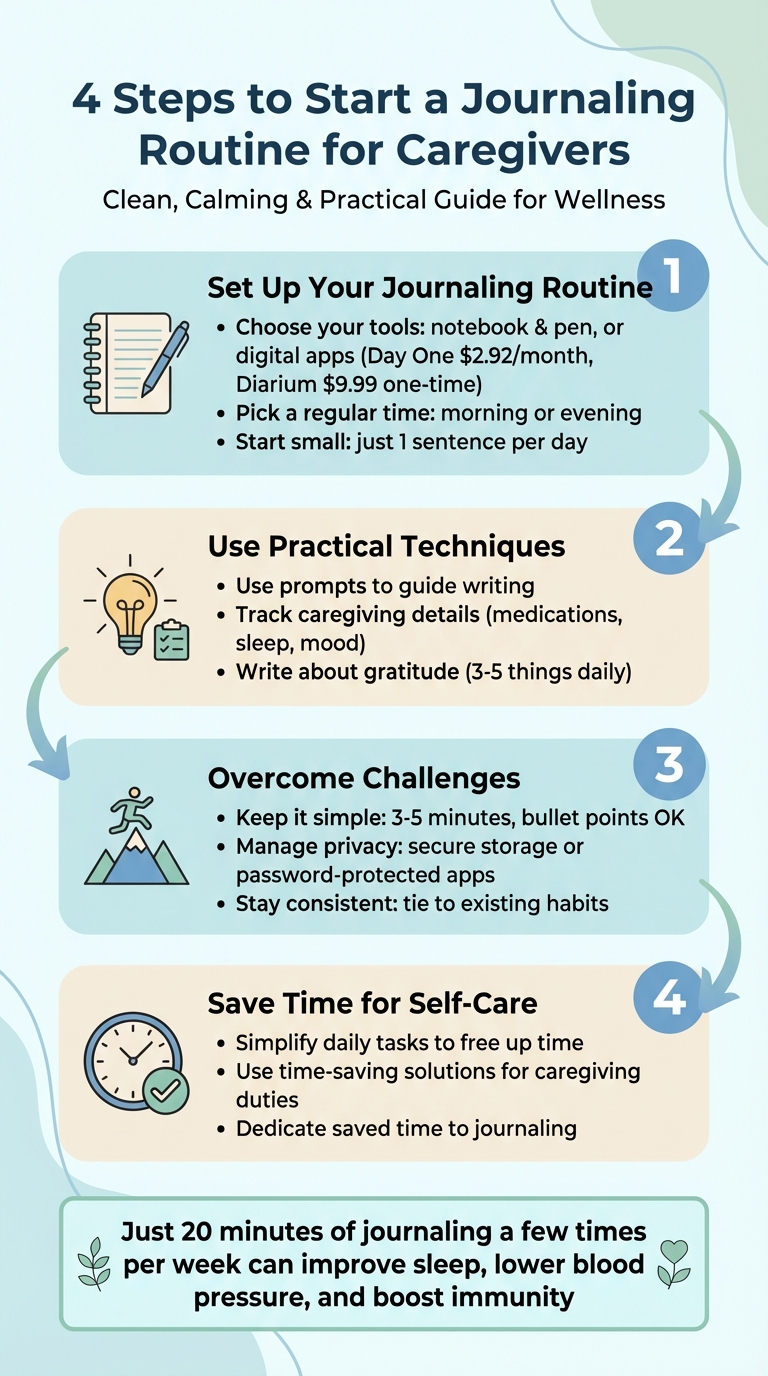
4-Step Guide to Starting a Journaling Routine for Caregivers
Step 1: Set Up Your Journaling Routine
Choose Your Journaling Tools
Select tools that you’ll actually enjoy using. For many, a simple notebook and pen are perfect - no distractions, no batteries, just the essentials. If you lean toward digital solutions, apps like Day One (starting at about $2.92/month) or Diarium (a one-time fee of $9.99) offer features like reminders, photo attachments, and syncing across devices.
You might also want to keep separate journals for different purposes. For instance, one for caregiving details and another for personal reflections. As Crossroads Hospice suggests:
Do not mistake this caregiver journal as a place to note your loved one's current health condition or medical updates. Keep a separate notebook or computer document for this information. [1]
If traditional writing feels like too much, try a photo journal. Snap one photo a day and add a short caption - this can capture emotions and moments without the pressure of long entries. Alternatively, services like Dabble Me let you journal by replying to a daily email (starting at around $4/month). Once you’ve chosen your tools, the next step is to create a consistent habit.
Pick a Regular Time to Journal
The magic lies in consistency, not how much time you spend. Many people find mornings ideal for setting intentions or evenings helpful for reflection and winding down. As a caregiver, you might find natural windows for journaling during a loved one’s nap or while waiting at appointments.
Even just a few minutes daily can help clear your thoughts and ease anxiety. To make journaling stick, tie it to something you already do - like right after your morning coffee or before heading to bed. By anchoring it to an existing routine, it becomes a seamless part of your day.
Start Small and Build Over Time
Once you’ve got your tools and a routine, the key is to start small. One sentence a day is enough in the beginning. Crossroads Hospice emphasizes this approach, noting that even a single sentence can be a meaningful start [1].
Write freely without overthinking or editing - just let your thoughts flow. A timer set for 3 to 5 minutes can help you stay focused without feeling pressured. Over time, you can gradually extend your sessions if it feels right. The goal isn’t perfection - it’s simply showing up and making it a habit.
Journaling for Caregiver Well-Being
Step 2: Use Practical Journaling Techniques
Journaling isn’t just about venting emotions - it can also be a practical tool for caregiving. These techniques provide a structured way to manage stress while staying organized.
Use Prompts to Guide Your Writing
Staring at a blank page when you’re exhausted can feel impossible. That’s where prompts come in. These short, focused questions can help you get started and channel your thoughts effectively. Instead of struggling to decide what to write, you can simply respond to a specific question.
Here are a few prompts to try:
- What emotions am I feeling today?
- What are three caregiving moments I’m grateful for?
- What challenge did I face today, and how did I handle it?
- What advice would I give a friend in my situation?
Research shared by the American Psychological Association shows that expressive writing like this can boost your mood and support mental well-being [5][7].
Track Caregiving Details
Your journal can also double as a caregiving log. Use it to track essential details like medication schedules, sleep patterns, meal habits, or incontinence episodes. Over time, you may notice trends, such as a loved one’s mood dipping after poor sleep or certain foods causing discomfort.
This kind of tracking isn’t just for you - it’s invaluable during doctor visits. Bring your journal along to share precise information about symptoms, side effects, or progress. This level of detail helps healthcare providers make better decisions. By combining practical caregiving notes with reflective entries, your journal becomes both a tool for caregiving and a way to manage stress.
Write About Gratitude and Positive Moments
Caregiving can feel overwhelming, but focusing on positive moments can help balance the tough days. Make it a habit to jot down three to five things you’re grateful for each day. These could be small victories, like successfully managing a difficult care task or enjoying a shared laugh.
You can also create a “spirit-lifter” list - songs, activities, or memories that always brighten your mood. When things get tough, this list can serve as a quick pick-me-up. As Positive Psychology explains:
Journaling helps [people] build a buffer between their negative thoughts and their sense of well-being [3].
sbb-itb-45288fe
Step 3: Overcome Common Journaling Challenges
Even with the best intentions, caregivers often face hurdles when trying to journal. The good news? Most of these obstacles are easy to tackle with a bit of strategy.
Keep It Simple to Avoid Overwhelm
Journaling doesn't have to feel like a daunting task - it’s all about keeping it straightforward. Forget about perfect grammar or flawless handwriting. This isn’t a graded essay; it’s your personal space to unload your thoughts however they come to you. Use bullet points, scribbles, or even a few scattered words if that’s all you can manage. If time feels tight, set a timer for just 3 to 5 minutes. Research suggests that even writing about emotions for just 20 minutes over a few days can support your immune system [6].
The simpler your process, the easier it becomes to stick with it. And remember, your journal is for your eyes only.
Manage Privacy Concerns
It’s natural to worry about someone stumbling across your raw, unfiltered thoughts - especially when those thoughts include feelings like frustration or resentment. If you’re using a physical notebook, find a secure spot to store it. For digital journaling, password-protected apps or encrypted notes can provide peace of mind [6]. Lisa Hutchison from Caregiver.com puts it well:
Most caregivers keep their journal private to ensure they have a safe place to vent about the specific difficulties they face [4].
Knowing your journal is safe can make it easier to be honest and open.
Stay Motivated and Consistent
Caregiving often comes with an unpredictable schedule, making consistency a challenge. One helpful trick is to tie journaling to something you already do - like sipping your morning coffee, winding down before bed, or those quiet moments when your loved one naps [8]. If you miss a day or even a week, don’t stress. Just pick it back up. As former caregiver B. Lynn Goodwin wisely says:
It's always morning somewhere [9].
You can also set reminders on your phone or keep a small notebook handy for those unexpected pockets of time, like waiting at a doctor’s office. Every few months, take a moment to look back at your old entries. Seeing how far you’ve come can be a powerful motivator to keep going [8]. With these tips, journaling can become a natural part of your caregiving routine.
Step 4: Save Time with PeelAways Disposable Bed Sheets

Caregiving takes up so much of your day that finding time for activities like journaling can feel impossible. One of the biggest culprits? Changing bedding, especially when dealing with incontinence or frequent accidents. That’s where PeelAways disposable bed sheets come in. These sheets simplify your routine, giving you back the time you need to focus on yourself.
What Are PeelAways Disposable Bed Sheets?
PeelAways are multi-layer, waterproof disposable sheets designed to make frequent bedding changes easier. Each sheet comes with 5–7 layers that are soft, absorbent, and include waterproof barriers. When one layer gets soiled, you just peel it away to reveal a fresh, clean sheet underneath - no need to lift the mattress, do laundry, or worry about cross-contamination. The whole process takes less than a minute, and you don’t even have to move your loved one from the bed.
These sheets are made from a soft blend of polyester, rayon, and bamboo fibers, offering comfort without sacrificing practicality. They come in all standard sizes, from Crib ($30.99) to King ($53.99), with Cot and Twin XL options featuring 7 layers for extended use. PeelAways are a simple yet effective solution to help caregivers manage their time and energy better.
How PeelAways Supports Your Journaling Routine
For caregivers, journaling often gets pushed aside because of time constraints. Bedding changes can eat up hours, leaving little space for self-care. PeelAways help by drastically cutting down the time spent on this task. As Sustainable Caregiving explains:
Journaling is also hard because it asks us to pause in a fast-moving, high-demand caregiving day. Taking the time to journal can feel like one more to-do on a long list [8].
By eliminating the need to strip beds, haul laundry, and wait for wash cycles, PeelAways free up those valuable minutes. You can use this time to clear your mind, jot down reflections, or track important caregiving details.
Beyond saving time, PeelAways reduce physical exhaustion from constant cleanup. This restored energy gives you the mental space to focus on yourself. Whether it’s during your loved one’s nap or right after a bedding change, those extra minutes can be just what you need to grab a notebook, write down your thoughts, and breathe a little easier.
Conclusion
Journaling - even for just three to five minutes a day - can help release tough emotions, keep track of caregiving details, and strengthen your emotional endurance [3][2]. As the Zen Caregiving Project explains:
Just five minutes of writing can reduce anxiety and restore clarity [2].
Start small and stay consistent. Use your journal as a private space to express anger, worry, or exhaustion, and to celebrate the small wins that might otherwise go unnoticed.
Simplifying daily tasks can make it easier to carve out time for journaling. For example, PeelAways disposable bed sheets can turn a time-consuming bedding change into a task that takes less than a minute, freeing up time and energy for self-care. That extra time can be used to reflect, gain insights, and find clarity.
Journaling isn’t about adding another chore to your day - it’s about giving yourself a moment to process your experiences and acknowledge your growth. It helps you recognize emotional patterns, build resilience, and develop self-compassion. Even starting with a single sentence can set the foundation for a meaningful self-care habit.
FAQs
What should I write about when I’m too tired to journal?
When you're feeling too drained to dive into journaling, consider using low-effort prompts or keeping it simple with brief reflections. You could write just a single word, a quick thought, or even pose a question to yourself. This small act helps you acknowledge your feelings and keeps the habit alive.
Another idea? Imagine you're writing to an audience or pen a few short sentences about your day or emotions. By keeping it easy and manageable, you can stay connected to self-reflection without overexerting yourself. Plus, it gives you the space to rest while still nurturing this meaningful practice.
How can I journal without worrying about privacy?
When journaling, keeping your privacy intact is key. Opt for a plain-cover journal that doesn’t draw attention and store it somewhere discreet - like a labeled file box that blends in with other items. Avoid writing your full name or contact details, and for particularly sensitive entries, you might use a personal shorthand or code.
If you prefer digital journaling, safeguard your entries with features like Face ID, Touch ID, or a strong passcode. For an added layer of security, consider using a locked safe to store physical journals. These small steps can help ensure your thoughts remain yours alone.
What’s the easiest way to track caregiving details in a journal?
The simplest way to keep track of caregiving details is by jotting down quick notes about any observations, concerns, or needs as they come up. Choose whatever method works best for you - whether that's a trusty notebook or a digital app. To stay organized, divide your notes into categories using tabs or sections, and leave room for short daily updates. This keeps things manageable and helps you stay consistent without adding extra stress.
Comments
0



SAVE MONEY & WATER
Professionals & Institutions save a fortune on labor/laundry.

SUPERIOR COMFORT
The first thing our customers notice is how soft our sheets are.

100% WATERPROOF
Each layer is 100% Waterproof, perfect for spills and accidents

SAVE TIME
Change the sheet in under 1 minute without stripping the bed.

Leave a comment