OEKO-TEX vs GOTS: Bedding Certification Comparison

OEKO-TEX Standard 100 and GOTS (Global Organic Textile Standard) are two key certifications for safer and more responsibly produced bedding. Here's what you need to know:
- OEKO-TEX Standard 100 ensures the final product is free from harmful chemicals, testing every component (fabric, threads, zippers, etc.). It works with all fiber types - natural, synthetic, or blends - and focuses on chemical safety.
- GOTS prioritizes organic materials and ethical production. It requires at least 70% organic fibers (95% for full certification), bans harmful substances, and enforces fair labor practices across the entire supply chain.
Key Takeaways:
- OEKO-TEX is ideal if chemical safety is your primary concern, offering broad material compatibility.
- GOTS is the go-to for organic and ethically produced bedding, ensuring sustainability and fair labor standards.
- Some products carry both certifications, combining the benefits of both.
Quick Comparison Table:
| Feature | OEKO-TEX Standard 100 | GOTS (Global Organic Textile Standard) |
|---|---|---|
| Focus | Chemical safety of final product | Organic materials & ethical production |
| Material Requirements | Any fiber type (natural/synthetic) | 70–95% organic fibers |
| Chemical Testing | Tests finished product | Reviews processing materials |
| Labor Standards | Optional via STeP add-on | Mandatory fair labor practices |
| Supply Chain Oversight | End product only | Full supply chain |
Choose OEKO-TEX for versatile, safe bedding or GOTS for organic and responsibly sourced options. Both certifications provide assurance for healthier, cleaner sleep environments.
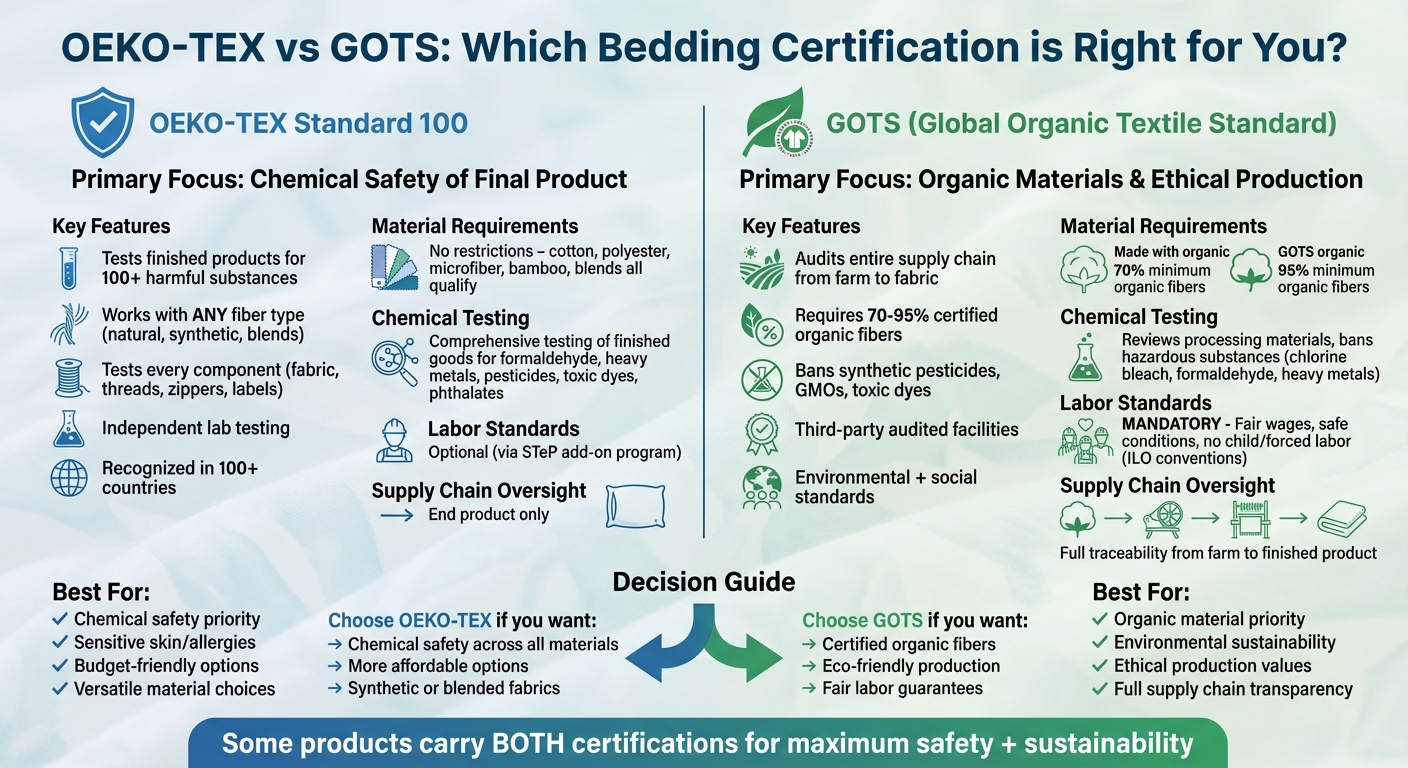
OEKO-TEX vs GOTS Bedding Certification Comparison Chart
Find the Best Organic Sheets: Oeko-Tex vs GOTS Textile Certifications
What is OEKO-TEX Standard 100?
OEKO-TEX Standard 100 is a certification system designed to ensure that textiles are free from harmful chemicals that could affect human health. Unlike organic certifications, which focus on how materials like cotton or wool are grown, OEKO-TEX zeroes in on the safety of the finished product. This means it tests the actual materials in your bedding to make sure they're free from substances that could be harmful.
Every single component of a product is tested - fabric, thread, filling, buttons, zippers, prints, coatings, and even labels - before it can carry the OEKO-TEX mark. For U.S. consumers, this certification answers an important question: "Is this safe to use every night, right next to my skin?"
The testing doesn’t just meet basic safety standards; it often goes beyond what U.S. or international regulations require. OEKO-TEX applies to all types of fibers, whether natural like cotton or synthetic like polyester, making it relevant for everything from sheets to comforters to pillowcases. Below, we’ll break down the key features that make OEKO-TEX certification a trusted safety standard.
Key Features of OEKO-TEX
OEKO-TEX Standard 100 provides a thorough approach to chemical safety. Independent labs test products against a list of over 100 harmful substances, including heavy metals, pesticides, formaldehyde, and toxic dyes. Products are divided into four classes based on how much skin contact they have, with Class I reserved for baby textiles and Class II covering items like bedding.
The certification applies to both natural materials (like cotton, wool, and linen) and synthetic ones (such as polyester and microfiber) and is recognized in over 100 countries. If you have sensitive skin, allergies, or asthma, this certification can help reduce the risk of reactions caused by residue from dyes, finishes, or chemical treatments. By ensuring that products are free from irritants like formaldehyde and azo dyes, OEKO-TEX provides peace of mind for those prone to skin irritation or respiratory issues.
Why It Matters for Bedding
Considering we spend about seven to eight hours a night in close contact with bedding, chemical safety isn’t something to overlook. OEKO-TEX Standard 100 ensures that sheets, pillowcases, and duvet covers are free from substances that could release harmful chemicals during sleep. This reduces potential health risks like hormone disruption, allergic reactions, or breathing problems.
For bedding with extra components - like zippers, elastics, waterproof layers, or synthetic fillings - this certification is especially reassuring. It confirms that every part of the product has been tested for safety. To verify a product’s certification, check the label and use the certification number on the official OEKO-TEX website.
What is GOTS (Global Organic Textile Standard)?
The Global Organic Textile Standard (GOTS) is recognized worldwide as the leading standard for processing organic fibers. It ensures every step of production is tracked and verified, starting from the cotton fields all the way to the final product in your home. While certifications like OEKO-TEX focus on testing finished products for chemical safety, GOTS takes a broader approach. It covers everything - harvesting certified organic materials, environmentally responsible manufacturing, packaging, labeling, and distribution - all under one unified standard.[3][7]
The certification process is managed by an international organization, with independent, third-party, GOTS-accredited bodies carrying out the audits.[3] For bedding items like sheets, pillowcases, and duvet covers, every stage - ginning, spinning, weaving, dyeing, sewing, and packing - is monitored. This ensures that GOTS-certified bedding is not only made from organic fibers but also processed in ways that are environmentally responsible and ethically produced.
Key Features of GOTS
For a textile product to carry the GOTS label, it must meet strict requirements:
- To qualify as "made with organic," the product must contain at least 70% certified organic fibers.[1][3][4]
- For the "GOTS organic" label, the requirement jumps to 95% organic fiber content.[1][4][7]
These thresholds guarantee that the fibers - whether cotton, linen, or wool - are grown without synthetic pesticides, herbicides, or genetically modified organisms (GMOs). This not only protects the environment but also safeguards the health of farm workers.[2][3][6]
GOTS goes beyond fiber content by setting stringent environmental standards at every stage of production, including spinning, weaving, dyeing, and finishing.[1][3][4] Harmful substances like toxic dyes, heavy metals, formaldehyde, chlorine bleach, and certain volatile organic compounds are either restricted or outright banned. Additionally, textile mills are required to treat wastewater properly before discharging it, and only biodegradable, low-impact chemicals are allowed.[1][3][6]
On the social side, GOTS incorporates rules based on international standards like the International Labour Organization (ILO) conventions and the UN Guiding Principles on Business and Human Rights.[3][4][6] These rules address key issues such as banning child labor and forced labor, ensuring safe working conditions, and protecting workers' rights to unionize and bargain collectively.[3][6] This comprehensive approach ensures that products meet both environmental and ethical benchmarks.
Why It Matters for Bedding
GOTS-certified bedding stands out because it combines organic integrity with ethical production. For health-conscious U.S. consumers, this means reduced exposure to synthetic pesticides, herbicides, and harmful chemicals often used in conventional cotton farming and fabric treatments.[2][3][6] For those concerned about the environment, GOTS supports organic farming practices, reduces chemical pollution, and promotes better soil and water conservation, aligning with broader goals of sustainability and biodiversity.[1][3][7]
Ethically minded shoppers also appreciate the labor and social standards built into the certification. These ensure that the workers involved in growing and producing their bedding are treated fairly, which can be a deciding factor when comparing products with similar prices or thread counts.[3][6] The GOTS label on a bedding item guarantees that everything - from the cotton to the threads, trims, and even the dyes - meets stringent environmental and ethical standards.[3][5] For U.S. consumers, this label provides a straightforward assurance that the entire product is produced responsibly, offering peace of mind with every purchase.[1][3]
Key Differences Between OEKO-TEX and GOTS
While both certifications aim to protect consumers, they take noticeably different routes to achieve their goals. OEKO-TEX Standard 100 zeroes in on product safety by rigorously testing finished items like sheets, pillowcases, and duvet covers for harmful chemicals. This includes screening for substances such as formaldehyde, heavy metals, and pesticides to ensure they are safe for skin contact [1]. Notably, OEKO-TEX applies to any fiber type - whether it’s conventional cotton, eucalyptus, bamboo, or synthetic blends - without requiring the use of organic materials.
GOTS (Global Organic Textile Standard), on the other hand, prioritizes sustainability across the entire supply chain. It evaluates every stage of production, from how raw materials are grown to the processes of dyeing, sewing, and packaging. Unlike OEKO-TEX, GOTS mandates a minimum organic content, ensuring that certified products meet strict environmental and ethical standards. It also enforces fair labor practices, prohibiting child labor and requiring safe working conditions [3]. This broader approach makes GOTS a comprehensive standard for sustainability.
The way each certification tests products also sets them apart. OEKO-TEX conducts detailed chemical testing on finished goods, examining everything from threads to buttons and prints for harmful residues. Their testing often exceeds national safety standards across more than 100 countries. GOTS, by contrast, does not focus on testing the end product. Instead, it audits the entire production process, reviewing raw materials, dyes, and chemicals while banning hazardous substances like toxic dyes and chlorine bleach.
When it comes to labor and environmental oversight, the differences become even clearer. OEKO-TEX emphasizes end-product safety, offering optional sustainability measures through its STeP certification. This means that labor and environmental criteria are not inherently part of the OEKO-TEX Standard 100. GOTS, however, integrates these standards directly into its certification, requiring full traceability from farm to finished product. While OEKO-TEX ensures that the final product is safe, GOTS guarantees that sustainability and ethical practices are upheld throughout the entire production process [1][3]. These distinctions are crucial for buyers deciding between safer materials or a more sustainable production journey.
Comparison Table
Here’s a quick breakdown of the key differences:
| Feature | OEKO-TEX Standard 100 | GOTS (Global Organic Textile Standard) |
|---|---|---|
| Primary Focus | Product safety through chemical testing | Full supply chain sustainability |
| Material Requirements | Suitable for any fiber type (natural or synthetic) | Minimum 70% organic fibers (95% for "organic" label) |
| Chemical Testing | Comprehensive testing of finished products for residues | Reviews processing materials and bans hazardous substances |
| Labor Standards | Optional via STeP add-on | Mandatory fair labor practices, including no child labor |
| Supply Chain Oversight | Focuses on the end product | Ensures traceability from farm to finished product |
| Environmental Criteria | Prioritizes end-product safety | Enforces strict environmental standards throughout production |
Benefits of OEKO-TEX Certified Bedding
OEKO-TEX Standard 100 takes safety seriously, testing every single component of bedding - fabric, threads, buttons, zippers, prints, and even labels - for over 100 harmful substances. These include formaldehyde, heavy metals, pesticides, toxic dyes, and phthalates, often going beyond legal safety requirements to ensure added protection while you sleep[3].
What sets OEKO-TEX apart is its flexibility when it comes to materials. Unlike GOTS, which requires textiles to contain at least 70% organic fibers, OEKO-TEX certification applies to a wide variety of fibers. Whether it's cotton, polyester, microfiber, bamboo viscose, recycled materials, or technical blends, there's an option for almost every preference and budget. This means you can find certified bedding ranging from affordable synthetic options to high-end choices like eucalyptus bedding[1].
For people with sensitive skin, allergies, or asthma, OEKO-TEX certification provides peace of mind. By reducing exposure to irritants such as toxic dyes, bleaches, and heavy metals, it helps prevent skin reactions and respiratory issues. The certification even categorizes products based on skin contact: Product Class I is designed for babies and toddlers, while Product Class II covers items like sheets and pillowcases - offering tailored protection for families and individuals with specific sensitivities[1].
Another advantage is the streamlined certification process, which benefits both manufacturers and consumers. Instead of auditing the entire supply chain, OEKO-TEX focuses on testing the finished product. This faster process allows bedding manufacturers to bring certified products to market more quickly, resulting in a wider variety of options with verified chemical safety[1].
sbb-itb-45288fe
Benefits of GOTS Certified Bedding
When it comes to organic and ethical textiles, GOTS certification sets the gold standard. For bedding to achieve full "organic" certification, it must contain at least 95% certified organic fibers. Products labeled as "made with organic" require a minimum of 70% organic content [1][3][5]. These fibers are grown without harmful chemicals, ensuring your bedding contributes to a healthier, more sustainable sleep environment.
GOTS-certified bedding offers cleaner textiles with fewer irritants. The certification bans harmful substances like heavy metals, formaldehyde, chlorine bleach, and azo dyes, mandating the use of eco-friendly alternatives at every stage of production. Wastewater from mills must be treated responsibly to minimize pollution, resulting in bedding that's gentler on sensitive skin and ideal for individuals with allergies, asthma, or eczema.
The certification also emphasizes responsible farming practices and enforces strict labor standards. GOTS prohibits harmful chemicals in agriculture and ensures ethical working conditions through regular third-party audits. Aligned with International Labour Organization conventions and UN guidelines, the certification guarantees fair wages, safe workplaces, and bans on child and forced labor. This means your bedding purchase supports both environmental care and human rights.
GOTS doesn’t just focus on ethics - it also ensures quality and durability. Certified products undergo rigorous testing for factors like colorfastness and shrinkage control, meaning your bedding will hold up well to repeated washing. Additionally, GOTS provides full traceability, allowing consumers to verify the certification from the raw materials to the finished product. For U.S. households aiming for healthier indoor air quality, GOTS-certified bedding fits seamlessly into a lifestyle centered on well-being and sustainability.
OEKO-TEX vs GOTS: Quick Comparison for Bedding Buyers
Here’s a quick breakdown to help you decide between OEKO-TEX and GOTS certifications when shopping for bedding.
OEKO-TEX applies to all fiber types - natural, synthetic, or blends - making it a versatile option if organic content isn’t a priority. It focuses on testing the finished product for over 100 harmful substances, ensuring it’s safe for your skin. However, it doesn’t require the use of organic fibers or conduct full supply chain audits.
GOTS, on the other hand, demands at least 70% certified organic fibers (95% for full certification) and audits every step of the production process, from farming to fabric. It bans synthetic pesticides, GMOs, and toxic dyes while enforcing strict labor standards aligned with International Labour Organization guidelines. This makes GOTS ideal for organic cotton bedding, but it doesn’t cover non-organic materials like eucalyptus or blended fibers.
| Category | OEKO-TEX | GOTS |
|---|---|---|
| Material Type | Works with any fiber - natural or synthetic | Requires 70–95% certified organic fibers |
| Environmental Focus | Tests the finished product for chemical safety | Audits the supply chain for eco-friendly practices |
| Ethical Standards | Optional ethical programs; no mandatory audits | Requires fair wages, safe conditions, no child labor |
Some brands take a dual certification approach to meet diverse customer needs. For example, Ethical Bedding uses OEKO-TEX for eucalyptus sheets, which aren’t organic, and GOTS for organic cotton products. This strategy offers buyers flexibility without sacrificing safety or sustainability.
In short, OEKO-TEX ensures chemical safety, while GOTS guarantees organic materials and ethical production. Choose OEKO-TEX for versatility and safety, or GOTS for organic and responsible sourcing.
Which Certification Should You Choose?
The best certification for you depends on what matters most when it comes to your bedding. If you're focused on chemical safety - especially for sensitive skin or young children - OEKO-TEX Standard 100 is a great choice. This certification ensures that the bedding is free from harmful chemicals and works with a variety of fabrics, including cotton, microfiber, and performance blends. With OEKO-TEX, you can rest easy knowing your bedding is safe for direct contact with your skin.
On the other hand, if you're more concerned about environmental impact and ethical production, GOTS-certified bedding is the way to go. GOTS (Global Organic Textile Standard) requires at least 70% certified organic fibers (and 95% for products labeled fully organic), prohibits synthetic pesticides and GMOs, and audits every stage of production - from farming to finished fabric. It also enforces fair labor practices that align with International Labour Organization standards. GOTS is widely regarded as the benchmark for organic and ethically produced bedding.
For those shopping on a budget, OEKO-TEX bedding is often more affordable and widely available. If you’re looking for both safety and sustainability, consider products that carry both OEKO-TEX and GOTS certifications for the best of both worlds.
With these certifications in mind, let’s take a look at how PeelAways offers a unique solution for hygiene challenges in caregiving settings.
How PeelAways Fits with Bedding Certifications
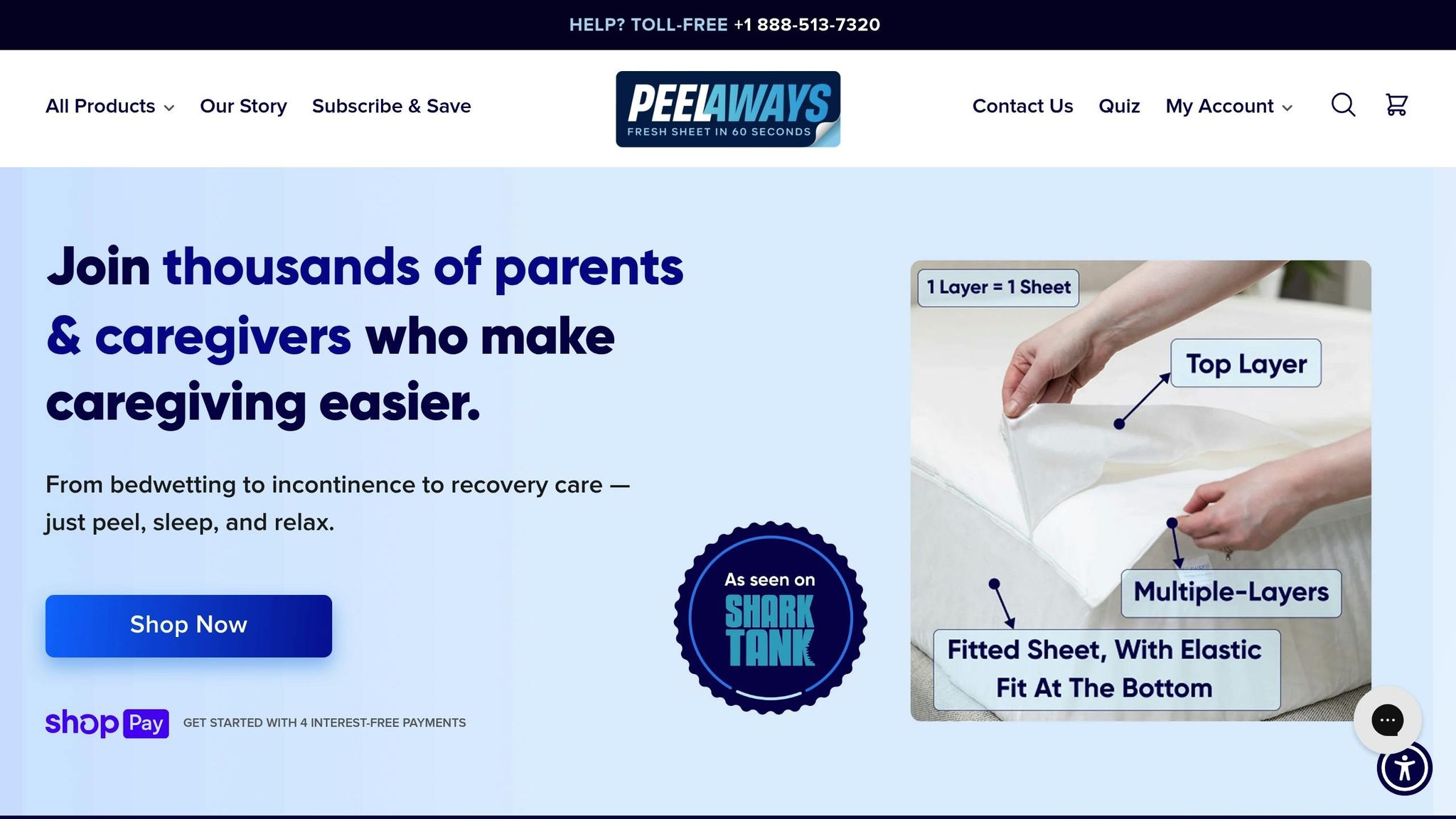
Sometimes, traditional certified bedding can't meet the specific hygiene and convenience needs of caregiving. That's where PeelAways steps in with an innovative disposable solution. Designed for practicality, PeelAways are waterproof fitted sheets featuring a patented multi-layer system with 5 to 7 absorbent layers, depending on the bed size. When a layer gets soiled, you simply peel it away to reveal a fresh new sheet - no need to lift the mattress or do laundry.
PeelAways are free from vinyl, PVC, phthalates, and fire retardants, making them safe for skin contact while still being breathable and odorless. Their advanced breathable membrane blocks liquids while allowing airflow, keeping the bed cool and dry without the crinkly noise or discomfort often associated with traditional waterproof protectors.
For families dealing with incontinence, frequent accidents, or medical conditions, PeelAways can be a game-changer. They save time, cut down on laundry, and eliminate the hassle of daily sheet changes. With over 12,000 satisfied customers and an impressive 4.8-star average rating, users consistently highlight their convenience and reliable leak protection.
"These sheets are the perfect solution. They protect his mattress and they are discreet under his regular bed sheets... When he has an accident, he now can take care of it himself and put a new top sheet on his bed. No more scrubbing, no more smell, and no more embarrassment."
PeelAways are available in various sizes to suit different needs, from Crib-A-Peel at $30.99 to King at $53.99. For caregivers seeking a practical, chemical-free alternative, PeelAways provide an excellent option when traditional certified bedding falls short.
Conclusion
Deciding between OEKO-TEX and GOTS certification becomes much easier when you understand their focus. OEKO-TEX ensures the safety of the final product by testing every component for harmful substances, while GOTS emphasizes sustainable production practices - from organic farming to ethical fabric processing.
These certifications aren't competitors; they complement each other. OEKO-TEX prioritizes the safety of the sleeper, guaranteeing that the bedding is free from harmful chemicals. On the other hand, GOTS focuses on responsible production, supporting organic agriculture, cleaner manufacturing, and fair working conditions. When a product holds both certifications - like GOTS-certified organic cotton that also passes OEKO-TEX testing - you get the best of both worlds: bedding that's safe for your skin and gentler on the planet.
The right certification for you depends on your priorities. If chemical safety is your main concern, OEKO-TEX-certified products are a great fit. For those who value eco-friendly and ethical practices, GOTS-certified bedding is the way to go. Budget is another factor to consider - OEKO-TEX-certified options are often more affordable, while fully GOTS-certified organic bedding tends to be priced higher.
While certifications are an important piece of the puzzle, they’re part of a broader conversation about sleep health and hygiene. Regularly changing and washing your sheets, as well as using protective layers like waterproof or disposable options in caregiving situations, can further promote cleanliness and comfort.
Ultimately, choose bedding that aligns with your values, health needs, and budget. Certified products offer clear advantages over uncertified ones, giving you peace of mind for a healthier, more sustainable sleep environment.
Related Articles
When it comes to selecting bedding that aligns with OEKO-TEX's chemical safety standards or GOTS's organic certifications, understanding practical applications can make all the difference. PeelAways offers a range of articles that tackle real-life bedding challenges, whether your focus is hygiene, sensitive skin, or environmental impact.
Concerned about germs or incontinence? Check out The Importance of Hygiene in Bedding: Why Disposable Sheets Are a Game-Changer. While certifications highlight what's in your bedding, this article dives into how often sheets should be changed and why maintaining good hygiene is just as crucial as the materials themselves. It also explains how PeelAways' multi-layer, peel-away sheets can simplify cleanliness without constant laundering - especially helpful in elder care, post-surgery recovery, potty training, or caregiving settings where preventing cross-contamination is essential.
Dealing with sensitive skin or allergies? Read How to Choose the Best Bedding for Sensitive Skin. Building on OEKO-TEX and GOTS standards, this guide offers practical advice on selecting fabrics, finishes, and care routines that are gentle on your skin. It also explores how hypoallergenic and low-friction bedding - or even disposable options - can minimize irritation caused by frequent washing or detergent sensitivities.
Worried about environmental impact? Dive into Eco-Friendly Bedding Solutions: A Guide to Sustainable Choices. This article examines how GOTS-certified materials fit into a more sustainable lifestyle and compares eco-friendly bedding options available in the U.S. It also highlights how PeelAways can reduce the need for hot-water washes, detergents, and energy-intensive laundry cycles - helping you strike a balance between cleanliness, convenience, and environmental responsibility.
FAQs
What’s the difference between OEKO-TEX and GOTS certifications for bedding?
OEKO-TEX is all about making sure textiles are safe for people to use by testing for harmful chemicals. It focuses on identifying substances that could affect health, making it a great choice for anyone worried about chemical exposure in fabrics.
GOTS takes a different approach. It certifies organic textiles while also promoting eco-friendly production methods and fair labor practices. From sourcing raw materials to creating the final product, GOTS ensures that every step meets strict organic and sustainability guidelines.
To put it simply: OEKO-TEX focuses on chemical safety, while GOTS emphasizes organic and sustainable production.
What does OEKO-TEX certification mean for the safety of your bedding?
OEKO-TEX certification guarantees that your bedding has undergone thorough testing to ensure it’s free from harmful substances, including toxic chemicals, dyes, and finishes. Bedding with this certification meets stringent safety guidelines, offering reassurance that it’s safe for you and your loved ones.
Opting for OEKO-TEX certified bedding not only minimizes potential health concerns but also promotes stricter safety standards and responsible manufacturing practices.
What makes GOTS certification important for eco-conscious shoppers?
GOTS certification matters for shoppers who care about the environment. It ensures textiles are made with organic fibers and meet strict environmental and social standards. This means no harmful chemicals, sustainable production methods, and ethical labor practices are involved.
Opting for GOTS-certified products means you're making a choice that benefits the planet while providing safer, eco-friendly options for your home and loved ones.
Related Blog Posts
Comments
0



SAVE MONEY & WATER
Professionals & Institutions save a fortune on labor/laundry.

SUPERIOR COMFORT
The first thing our customers notice is how soft our sheets are.

100% WATERPROOF
Each layer is 100% Waterproof, perfect for spills and accidents

SAVE TIME
Change the sheet in under 1 minute without stripping the bed.

Leave a comment