
How Nursing Homes Can Reduce Laundry Costs With Disposable Sheets

It’s 2 a.m. The sheets are soaked again. Your resident is embarrassed, making it vital to balance dignity and care, your back hurts, and the night is already falling apart. If this is what your staff keeps dealing with, I get it.
A 60-second sheet change can cut laundry costs in nursing homes by reducing labor, wash loads, linen wear, and bed downtime. For high-incident beds, disposable layered sheets like PeelAways can cut laundry volume by 50% to 80%, while turning a 15- to 20-minute bed reset into a fast peel-away change.
- Best fit: streamlining incontinence care, post-surgery beds, high-turnover rooms
- What matters most: labor time, laundry pounds, linen replacement, mattress protection
- Key difference: 5–7 waterproof layers in one set vs. one full sheet change each incident
- Proof points: 28,000+ reviews, 4.8 stars, sizes from crib to king
- Where to check it: PeelAways shop, Amazon listing, plus tips on the PeelAways blog and this post on how to change a bedridden patient’s bed
Here’s the short version: if you keep washing full sheet sets after every leak, you’re paying for the same problem over and over.
Why this problem costs more than it looks
Laundry costs in a nursing home are not just about detergent and water.
They show up in staff time.
They show up in late-night bed changes.
They show up in linen replacement.
They show up when a room sits empty because turnover takes too long.
A standard bed change can take about 15 minutes. At $25 an hour, that is about $6.25 in labor before laundry even starts.
Then add:
- hot wash cycles
- detergent
- dryer time
- machine wear
- linen wear
- mattress cleanup if fluid gets through
That is why one wet bed never stays “just one wet bed.”
And in nursing homes, this is not rare. One CMS data point in the source article says 75.8% of long-term nursing home residents lacked full bladder or bowel control over a 14-day period. That means repeat bed changes are part of the day-to-day workload, not an edge case.
sbb-itb-45288fe
What to look for before you buy
If you’re trying to cut laundry costs, don’t just look at the price per sheet.
Look at what happens after the bed gets wet.
I’d focus on five things:
- Change time: Can one person handle it fast?
- Full-surface protection: Does it cover the whole sleeping area?
- Laundry reduction: Does the used layer go straight to trash, or back to laundry?
- Resident comfort: Is it soft and quiet, or stiff and noisy?
- Mattress safety: Does it stop leaks from reaching the mattress?
That last part matters more than people think. If moisture gets through, your costs spread past laundry and into cleanup, odor control, and mattress replacement.
PeelAways
This is the option that stands out if your biggest problem is repeat wet-bed changes.
PeelAways is a fitted sheet system with 5–7 waterproof layers built into one set. When the top layer is soiled, you peel it off and there is a clean layer underneath.
That means no full strip.
No laundry bag.
No waiting on a wash cycle.
The brand says the change takes under 60 seconds. Against a 15- to 20-minute full reset, that time gap is the whole point.
What I like here is how direct it is. The mess happens. You remove one layer. The bed is clean again fast. That can mean less discomfort for the resident and less stress for the person doing the change.
PeelAways is sold in sizes from crib to king, has 28,000+ reviews, and holds a 4.8-star rating. If you already use diapers or incontinence pads, this fits right into that setup.
You can look at it here:
- PeelAways shop
- Amazon listing for PeelAways
- time-saving tips for bedding changes
- How to change a bedridden patient’s bed
Standard fitted sheets
Standard sheets are fine until the bed gets wet again. Then the whole system works against you.
One leak often means:
- strip the bed
- bag the linens
- clean the surface
- remake the bed
- send laundry out , which significantly increases caregiver stress
That is a lot of work for something that may happen more than once in one shift.
The upfront cost of washable vs. disposable sheets may look lower, but the repeat labor and wash costs keep stacking up. If your rooms deal with incontinence, wound drainage, or fast turnover, standard sheets usually push more work into the hardest part of the day.
Chux pads
Chux pads can help with small, local messes. But they do not solve the full bed-change problem.
The issue is simple: fluids do not always stay where you want them.
If the leak spreads, the fitted sheet underneath still needs to be changed. So now you have the pad and the laundry problem.
They can still have a place in care routines, especially when you choose bedding for incontinence care that balances protection with efficiency, but they are not a full substitute for a multi-layer sheets when the goal is reducing laundry.
Washable underpads
Washable underpads protect better than many disposable pads, but they still go right back into the wash.
That means you trade one laundry item for another.
You also need enough stock on hand to rotate through:
- soiled pads (which require proper disposal methods)
- clean backup pads
- storage space
- wash-and-return timing
If your main pain point is laundry volume, washable underpads help less than people hope.
Comparison table
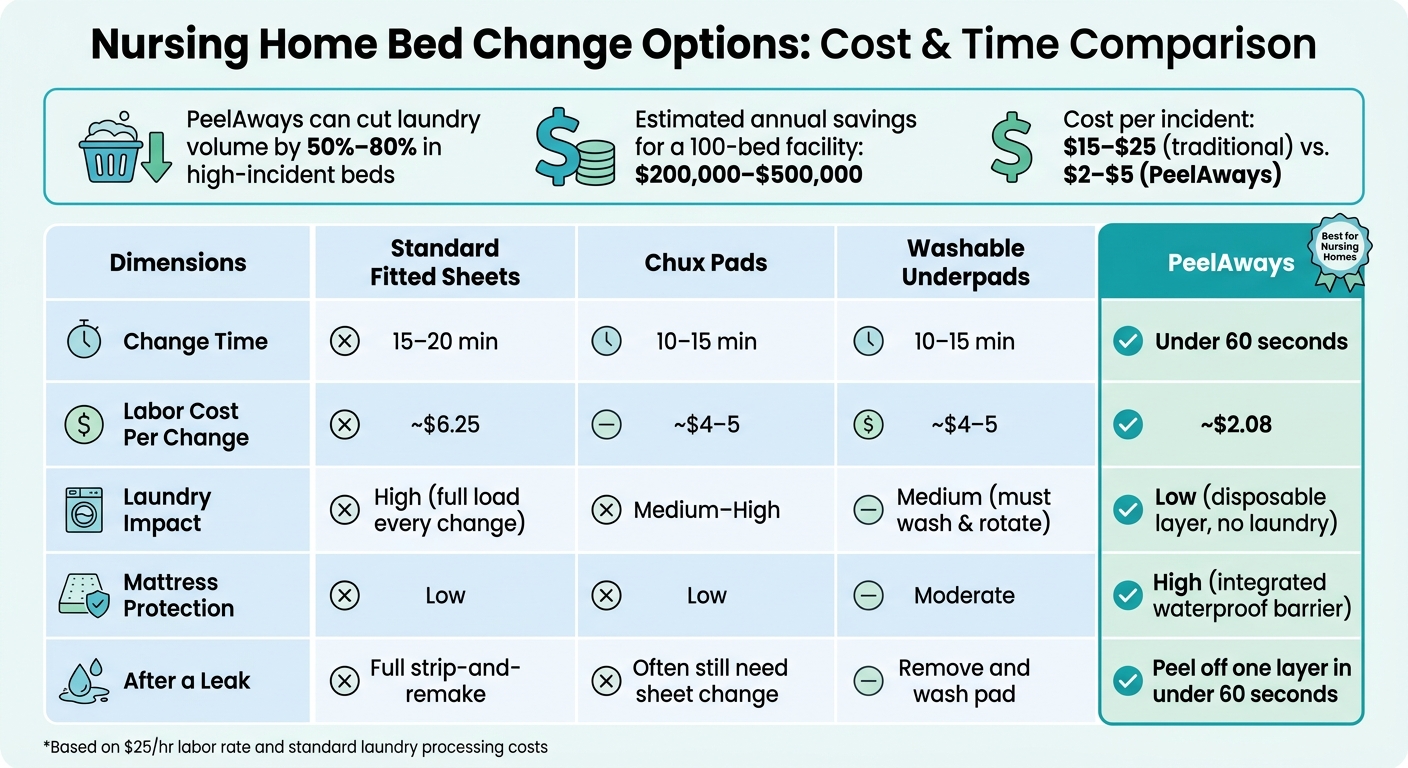
Nursing Home Bed Change Options: Cost & Time Comparison
| Option | After a leak | Laundry impact | Mattress protection | Time burden |
|---|---|---|---|---|
| Standard fitted sheets | Full bed reset | High | Low | High |
| Chux pads | Often still need sheet change | Medium to high | Low | Medium |
| Washable underpads | Remove and wash pad | Medium | Medium | Medium |
| PeelAways | Peel off one layer | Low | High | Low |
FAQ
Do reusable vs. disposable bedding costs differ for nursing homes?
Yes, they can. The savings come from less labor, fewer wash loads, less linen wear, and less room downtime.
Where do they help most?
They help most in rooms with repeat soiling, such as incontinence care, post-surgery recovery, wound care, and high-turnover admissions.
How much time can one change save?
The source article compares under 60 seconds for PeelAways with 15 to 20 minutes for a full bed reset.
Can one person change the bed alone?
That is one reason layered sheets are used. The process is much lighter than stripping and remaking the whole bed.
Do they replace diapers or incontinence pads?
No. They work with them. If you already use diapers or pads, layered disposable sheets add a full-surface backup.
Are they only for nursing homes?
No. They are also sold for home care and come in sizes from crib to king.
Bottom line
If you’re trying to cut laundry costs in a nursing home, the biggest savings usually come from stopping full bed resets after every accident with bedding solutions for incontinence care.
That is where PeelAways makes sense.
You get 5–7 layers, a 60-second change, full-surface mattress protection, and a setup that can cut laundry by 50% to 80% in the right rooms. And it comes with 28,000+ reviews and a 4.8-star rating, which helps if you want something other people have already tried before bringing it into care.
I’d start with your hardest rooms first.
The beds with the most overnight changes.
The rooms your staff dreads at 2 a.m.
Check PeelAways on peelaways.com/shop, see the Amazon listing, and read more on the PeelAways blog, including how to change a bedridden patient’s bed.
Making aging and caregiving easier, one bed at a time.
Blog readers save 10% with code BLOGS10 at checkout. Available on peelaways.com and Amazon. Free shipping on orders over $100.
Where standard sheet changes create the biggest hidden costs
It’s 2am. The bed is wet again. You’re pulling off sheets in the dark, trying not to wake your loved one all the way, and all you can think is: how many more times can I do this tonight?
This is where the hidden costs start piling up. Fast.
These costs climb the quickest when beds are soiled over and over, or when a room has to be turned over with almost no delay. They hit hardest in three places: incontinence care, nighttime accidents, and high-turnover rooms.
How incontinence and nighttime accidents increase laundry volume
Incontinence turns a normal sheet change into an emergency. And emergencies cost more in time, labor, and laundry.
In one long-term care study, 24 incontinent residents had 859 urinary leakage episodes in a single week, which led to 45 hours of nursing time spent on clothing and linen changes. That number says a lot. A leak isn’t just a quick wipe-up. In most cases, it means stripping the bed and starting over because partial removal just doesn’t work.
Medline’s incontinence care guidance puts the average time per episode at 22–23 minutes, with harder cases taking up to 45 minutes. If you’ve done this in the middle of the night, that tracks. By the time you lift, clean, strip, remake, and settle someone back down, the clock has moved a lot more than you expected.
At night, the strain gets worse. Staffing is thinner. Every bed change pulls someone away from rounds, fall checks, and medication oversight. Even the laundry side gets more expensive, since night shifts often run smaller loads. That means more water, more detergent, and more energy used per item.
Why post-surgery recovery beds and high-turnover rooms cost more to maintain
The same labor drag shows up in short-stay rooms too.
Post-surgery recovery beds and short-stay rehab rooms get soiled in more than one way. It’s not just urine. Wound drainage, sweat, and IV line leaks all end up on the linen. That can mean multiple full bed resets in a single day.
And every extra strip-and-remake slows the next step. Bed availability gets pushed back. Admission timing gets tighter. Staff workload gets heavier. In busy units, that ripple effect adds up fast.
There’s another cost people don’t always think about: inventory. Facilities in these units often keep more linens on hand just to avoid running out. That ties up money that could go somewhere else. This is where a peel-away system starts to make a lot of sense. Less laundry. Less bed-down time. Less chaos.
Comparison table: Standard fitted sheets vs. chux pads vs. washable underpads vs. PeelAways
The clearest way to compare these options is to look at waterproof mattress pads vs. disposable sheets to see what happens after a leak and how much work each system creates.
| Feature | Standard Fitted Sheets | Chux Pads | Washable Underpads | PeelAways |
|---|---|---|---|---|
| Coverage | Full surface | Localized | Reusable absorbent layer | Full sleeping surface |
| After a small leak | Full strip-and-remake required | Sheet underneath often still needs changing | Must be collected and laundered | Peel off one layer in under 60 seconds |
| Laundry impact | Every change adds a load | Often adds laundry | Must be washed and returned to stock | No laundry required |
| Mattress protection | Low | Low | Moderate | High - integrated waterproof barrier |
| Bed-change workflow | Full bed reset each time | Partial protection; leaks can spread | Requires inventory rotation | No need to strip the bed |
PeelAways cover the full sleeping surface and let staff peel away one soiled layer in under 1 minute without removing the fitted base from the mattress. If you’ve ever spent 15 to 20 minutes changing a wet bed while someone waits in discomfort, that difference is hard to ignore.
Leaks can also shorten mattress life and add replacement cost. That part often gets missed because it doesn’t show up in the laundry budget. But it still lands on the bill, and over time, it adds up.
How PeelAways cut laundry labor, loads, and downtime
It’s 2am. The bed is wet again, the room smells like detergent and stress, and you’re staring at one more full strip-and-remake when you barely have time to breathe. In a nursing home, those minutes add up fast - and so do the laundry piles.
Those hidden costs start to drop when staff can change the bed without sending a full set of linens to laundry. PeelAways replace full strip-and-remake changes with a layered sheet system. Staff peel off one soiled sheet in under a minute, which cuts room downtime.
How the 60-second PeelAways bed change works
PeelAways go on the mattress just like a standard fitted sheet, with elastic around the bottom and a pull tab at the head or foot of the bed. When one layer gets soiled, the caregiver gently turns the resident to one side, then peels that layer down and off the bed from the corner. There’s already a clean layer underneath, ready to go. The whole thing takes under a minute.
That time gap matters more than people think. At a labor rate of $25 per hour, a standard sheet change costs about $6.25 in labor alone. A PeelAways layer change costs about $2.08 in labor. And that’s before you count fewer wash cycles, less water, less detergent, less energy use, and less wear on linens. Across multiple residents and repeated incidents in one shift, the savings stack up fast.
Which nursing home situations benefit most from PeelAways
Some situations burn through time faster than others. PeelAways help most with managing incontinence, nighttime accidents, post-surgery recovery, wound care, and high-turnover admissions.
If a resident has frequent incontinence, staff don’t have to do a full strip-and-remake after every episode. They peel one layer and keep moving.
Nighttime accidents are another big one. The change is quiet and fast, and it doesn’t call for heavy lifting. When staffing is thin, that can make a hard night a little less brutal.
Post-surgery and wound care beds can get soiled quickly from wound leakage and exudate, which can mean multiple full bed resets in a single day. And in high-turnover rooms, fewer full resets mean the room can be ready for the next admission sooner.
How PeelAways support cleaner beds and more dignified resident care
The soiled layer goes straight out, so it never enters the laundry queue. That means the resident is back on a clean, dry surface within seconds. Health-journal coverage notes that one person can change a soiled fitted sheet in less than 60 seconds without stripping the bed.
That speed helps, but the feel matters too. PeelAways use a soft, breathable fabric with a quiet feel, so the bed still looks and feels normal to the resident. No crinkly, obvious setup. No harsh reminder that something happened.
And if you’ve ever helped someone through a wet bed change, you know this part matters. Faster changes mean less time sitting in moisture, fewer interruptions, and less embarrassment for the resident and the caregiver.
Those saved minutes are what the next section turns into facility-wide dollars.
How to calculate nursing home laundry savings with disposable sheets
It’s 2:17 a.m. A resident’s bed is soaked, the mattress needs to be checked, and one aide is already behind on the rest of the hall. By the time the sheets are stripped, bagged, replaced, and sent through laundry, that “small” incident has turned into time, money, and one more thing your staff didn’t have room for.
Those faster bed changes add up in a way you can measure. Over a full year, the cost isn’t just laundry by the pound. It’s labor. It’s linen wear. It’s water and energy. It’s mattress cleanup or replacement when fluid gets through. This math matters most in the rooms that get changed again and again: frequent incontinence, nighttime accidents, post-surgery recovery beds, and high-turnover rooms.
If you’re pricing this out for a 100-bed facility, include the full picture. Otherwise, the savings estimate will be too low.
What a 100-bed facility should include in its savings calculation
A 100-bed nursing home should account for labor, laundry processing, linen replacement, and water and energy use - not just the cost per pound. And when fluids reach the mattress, there’s another hit: mattress remediation or full replacement. That cost belongs in any honest ROI model too.
PeelAways estimates that a typical bed change costs $15 to $25 once labor, laundry, linen wear, water, and energy are counted.
What savings facilities can realistically expect from PeelAways
With PeelAways, the cost per layer change drops to an estimated $2 to $5 per incident. Put side by side, that works out to $13 to $20 saved per change compared with the old method.
That’s where the difference starts to feel real. Not theory. Not spreadsheet fluff.
Facilities using PeelAways report 50% to 80% cuts in total laundry volume, and the return on investment usually shows up within 3 to 12 months. For a 100-bed facility dealing with repeated wet-bed events and room turnover - not every bed changed every day - PeelAways reports possible annual laundry savings of $200,000 to $500,000, based on resident acuity and how often those changes happen.
This is one of those products people tend to find after they’ve had enough of the same mess night after night. PeelAways has 28,000+ reviews, a 4.8-star rating, comes in 5-7 layers, and is sold in sizes from crib to king. The appeal is simple: a bed change in about 60 seconds, not 15-20 minutes. Making aging and caregiving easier, one bed at a time.
You can see the product at peelaways.com/shop, check the Amazon listing for PeelAways, and read more on the PeelAways blog, including how PeelAways works and caregiving product tips.
Sample annual savings model for a 100-bed nursing home
Use this framework for the rooms with the highest change frequency.
| Cost Category | Traditional Linens | With PeelAways | Net Impact |
|---|---|---|---|
| Labor per change (at $25/hr) | $6.25 (15 min) | $2.08 (5 min) | -$4.17 per change |
| Laundry processing cost | $0.60/lb | $0.00 | Eliminated |
| Linen cost per wash cycle | $0.41 per use | Included in product | Eliminated |
| PeelAways sheet + disposal | N/A | ~$5.65/sheet | New line item |
| Net savings per incident | $15-$25 | $2-$5 | $13-$20 saved |
| Estimated annual facility savings | - | - | $200,000-$500,000 |
To turn per-change savings into an annual number, multiply the savings by the number of incidents your facility handles each day, then project that across the year. Once you’ve got a clean estimate, it makes sense to test it in one unit first and see what the numbers look like in your own building.
Blog readers save 10% with code BLOGS10 at checkout. Available on peelaways.com and Amazon. Free shipping on orders over $100.
Next steps for nursing homes ready to test PeelAways
It’s 2am. Someone needs a full bed change, the laundry pile is already out of hand, and the night shift is stretched thin. You’re not just changing sheets. You’re trying to keep a resident comfortable without turning one accident into 20 more minutes of work.
Start with the beds that create the most laundry and the most overnight interruptions. That’s usually where the waste, time drain, and staff stress show up first. Use those highest-savings rooms as your pilot beds, run them for 30 days, and track what changes.
How to run a focused pilot program
Keep it simple. Pick a small group of high-laundry beds and test PeelAways for 30 days.
Good pilot candidates usually include:
- Residents with frequent incontinence
- Nighttime accident cases
- Post-surgery recovery rooms
- High-turnover rooms
Track three things:
- Bed-change time
- Laundry pounds per week
- Staff feedback
The biggest shift is often plain as day once you write it down. A standard bed change can take 15 to 20 minutes, while a PeelAways change takes under 60 seconds. Over 30 days, that gap starts showing up in labor logs, laundry totals, and staff scheduling.
If you want to compare results across rooms, it helps to log the same data each week. Keep the notes short. How long did changes take? How much laundry left the room? What did staff say after using it on a rough overnight shift?
For more product details, you can check PeelAways.com/shop or view the Amazon listing for PeelAways. You can also read more on the PeelAways blog, including articles like How PeelAways Works and Caregiving Tips from PeelAways.
PeelAways sizes and pricing for nursing homes
For most nursing home and hospital-style beds, Twin XL is the usual place to start. The 7-layer Twin XL sheet is priced at $41.99.
That number makes more sense when you put it next to the cost of the old way. A standard bed change can cost $15 to $25 per incident when you factor in labor, laundry, and utilities. For many facilities, that means ROI can show up within 3 to 12 months.
And this isn’t some hard-to-find item with no track record. PeelAways comes in sizes from crib to king, with 5 to 7 layers, and it has 28,000+ reviews with a 4.8-star rating. If you already use diapers or incontinence pads, PeelAways fits right into that care routine and helps cut the sheet-changing burden.
Conclusion: Cut laundry costs and simplify care with PeelAways
PeelAways cuts bed changes to under 60 seconds, which can reduce laundry, downtime, and disruption in high-use rooms. I found it the same way a lot of people do: after hitting the point where one more soaked bed at the wrong hour felt like too much. It helps protect dignity, and it turns a drawn-out bed change into something you can handle fast.
Buy PeelAways on PeelAways.com or on Amazon. Making aging and caregiving easier, one bed at a time.
Blog readers save 10% with code BLOGS10 at checkout. Available on peelaways.com and Amazon. Free shipping on orders over $100.
Comments
0



SAVE MONEY & WATER
Professionals & Institutions save a fortune on labor/laundry.

SUPERIOR COMFORT
The first thing our customers notice is how soft our sheets are.

100% WATERPROOF
Each layer is 100% Waterproof, perfect for spills and accidents

SAVE TIME
Change the sheet in under 1 minute without stripping the bed.

Leave a comment