
How to Modify a Bedroom for Senior Safety

About 33% of at-home falls happen in bedrooms, making this space a common risk for seniors. Falls can lead to injuries, emergency visits, or worse, but simple changes can significantly reduce these risks while preserving independence. Here’s how you can make a senior’s bedroom safer:
- Clear clutter and trip hazards: Remove loose rugs, secure cords, and create open pathways.
- Adjust bed height: Ensure the bed allows feet to rest flat on the floor when seated.
- Add support tools: Install bed rails, grab bars, or transfer poles for stability.
- Improve lighting: Use motion-sensor nightlights and ensure switches are easy to reach.
- Reorganize storage: Place everyday items within arm’s reach and adjust closet shelves.
These updates help create a safer, more accessible environment, reducing fall risks while maintaining comfort and functionality.
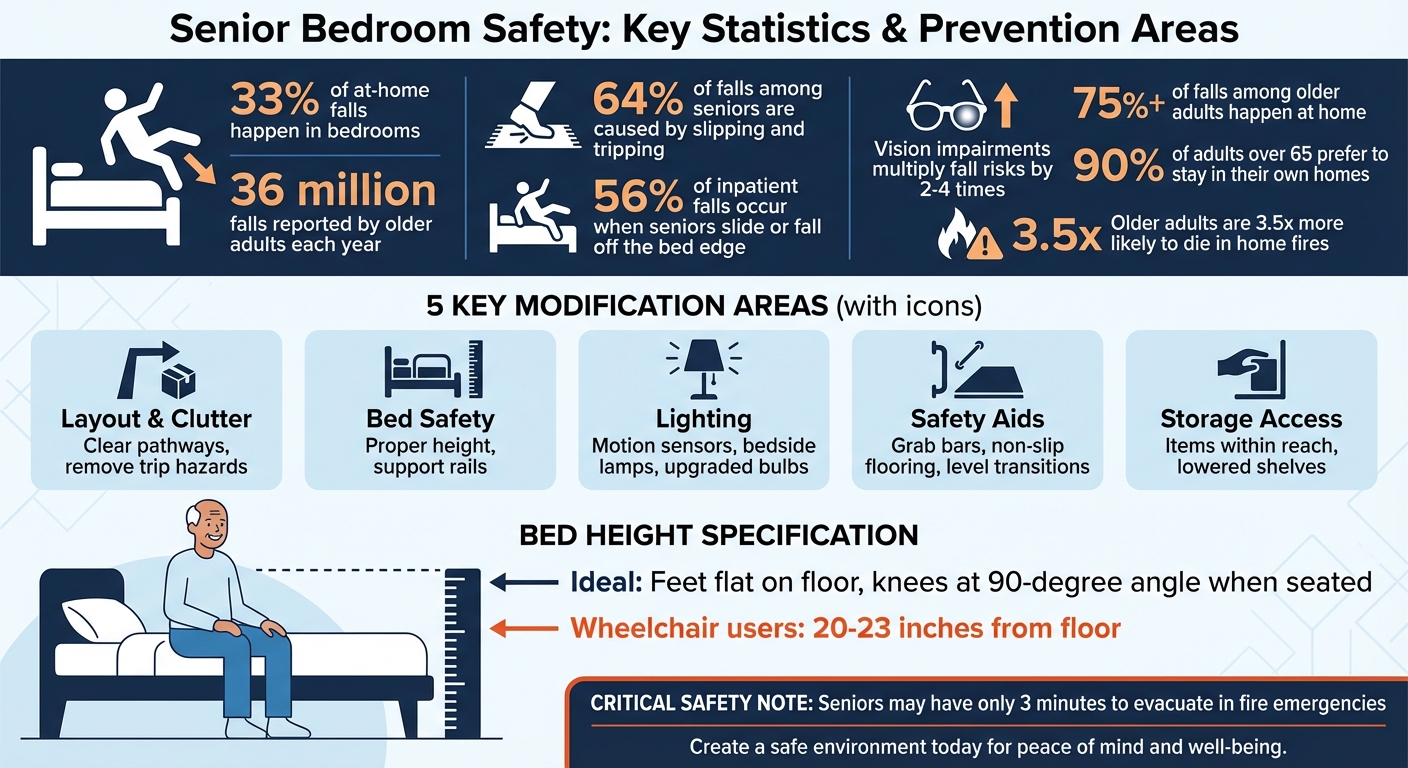
Senior Bedroom Safety Statistics and Fall Prevention Guide
Transform Your Bedroom Safety with These Expert Tips
Clear and Organize the Bedroom Layout
Safety starts with addressing common hazards in the bedroom. Everyday items like throw rugs, tangled cords, scattered shoes, or oversized comforters may seem harmless but can significantly increase the risk of falls. Alarmingly, older adults report about 36 million falls each year [3].
Remove Clutter and Trip Hazards
First, focus on clearing the floor entirely. Get rid of throw rugs, or if they’re necessary, secure them with non-slip backing or double-sided tape to prevent edges from curling. Torn carpeting should be repaired with glue or staples, and avoid using bed skirts or excess decorative pillows that could fall and create obstacles.
Electrical cords are another common hazard. Keep them off the floor by securing them behind furniture with zip-ties or using a cable management box. Daily clutter - like shoes, clothing, magazines, or pet items - should be stored in hampers, racks, or other designated areas away from walking paths.
"Clutter can cause falls. So try to remove clutter, and keep the house and the walkways as free as possible." - Stephen Merrill, Health Promotion Nurse Supervisor, Philadelphia Corporation for Aging
Once the clutter is gone, focus on creating clear, open pathways for safer movement.
Create Wide, Open Pathways
Minimize furniture to ensure walking paths are wide enough for a walker or wheelchair. Stick to essential pieces like a sturdy nightstand or dresser that can double as a support if needed. Avoid using long drapes that touch the floor, as they can easily snag on feet or mobility aids.
With open pathways established, it’s important to arrange the layout to improve access to critical areas.
Provide Direct Access to the Bathroom and Exit
Position the bed to allow a straight, unobstructed path to both the bathroom and the exit. This is especially important since frequent nighttime trips can increase fall risks, and in emergencies like a fire, seniors may only have a three-minute window to evacuate safely [1]. Some caregivers place one side of the bed against the wall to prevent rolling out, provided it doesn’t block the main path. Also, remove low tables or ottomans from travel routes, and ensure door thresholds are low or beveled to avoid tripping or snagging wheelchair wheels.
These layout adjustments lay the groundwork for additional safety measures, which will be explored further in the next sections.
Modify the Bed for Safety and Comfort
Once the bedroom layout is set, it’s time to focus on the bed itself. A few thoughtful adjustments can make a big difference in reducing fall risks and improving comfort for seniors. From setting the right bed height to adding support aids and protective bedding, these changes can help create a safer and more comfortable sleeping environment.
Adjust Bed Height
Getting the bed height right is essential for safe and easy transfers. Ideally, a senior should be able to sit on the edge of the bed with their feet flat on the floor and knees bent at a 90-degree angle. A bed that’s too high increases the risk of sliding or falling, while one that’s too low can make standing up more difficult. In inpatient settings, studies show that 56% of falls occur when seniors slide or fall off the edge of the bed [11].
For seniors who use wheelchairs, the mattress height should typically measure 20 to 23 inches from the floor [12][6]. To check, have the senior sit on the bed’s edge. If their feet dangle or their knees rise above a 90-degree angle, adjustments are needed.
- Lowering the bed: Replace a standard 12-inch box spring with a low-profile 4-inch version (reducing height by about 8 inches), or remove the box spring entirely in favor of a bunkie board or wooden slats [11]. Removing wheels or casters from the frame can also lower the bed by 1 to 2 inches [12].
- Raising the bed: Use heavy-duty bed risers under the frame legs, switch to a taller box spring, or opt for a platform bed frame that adds 10 to 18 inches in height [11][13].
Once the bed height is adjusted, consider adding support features to improve safety even further.
Add Bed Rails or Support Poles
Bed rails and support poles provide stability for seniors as they get in and out of bed. They’re especially helpful for those with balance issues or limited lower body strength.
There are two main types of bed rails:
- Full-length rails: Prevent rolling out of bed during sleep.
- Quarter-length assist rails: Specifically designed to assist with transfers.
Make sure the rails are compatible with the mattress and frame, and check that they meet ASTM F3186-17 standards [14]. Regularly inspect the space between the mattress and rail to ensure it’s not wide enough to pose an entrapment risk [14].
"If there is nothing to grab onto when an older person is getting out of bed, a slight loss of balance could cause them to instinctively grab anything nearby. That could result in broken items or even a dangerous fall." – Daniel Westhead, SureSafe [16]
For added support, consider floor-to-ceiling transfer poles. These provide a sturdy handhold and are an excellent alternative to traditional bed rails [15][2].
Use Waterproof, Disposable Bedding
Protective bedding can also play a key role in preventing falls. Waterproof, disposable sheets help manage incontinence, reducing the need for rushed nighttime bathroom trips - a common cause of falls [7][2].
PeelAways offers an innovative solution with multi-layer disposable fitted sheets. Each sheet has 5 to 7 waterproof, absorbent layers, depending on the size. When one layer is soiled, you simply peel it off to reveal a fresh, clean sheet underneath - no lifting mattresses or doing extra laundry. This design not only saves time but also reduces cross-contamination risks.
PeelAways sheets are available in all major sizes (Crib, Cot, Twin, Twin XL, Full, Queen, and King) and range from $30.99 to $53.99. Orders over $100 qualify for free shipping, and subscriptions come with a 15% discount. The breathable fabric keeps seniors dry and comfortable, helping to prevent skin irritation and pressure sores [6]. Just ensure the added bedding doesn’t raise the total bed height above the safe range of 20 to 23 inches [6].
Improve Lighting Throughout the Bedroom
When it comes to creating a safe bedroom environment for seniors, lighting plays a crucial role. Poor lighting can significantly increase the risk of falls, especially for those with vision impairments. In fact, vision impairments can multiply fall risks by two to four times [17], and over 75% of falls among older adults happen at home [17]. A thoughtful mix of automatic, accessible, and ambient lighting can make nighttime navigation much safer.
Install Motion-Sensor Nightlights
Motion-sensor lights are a game-changer for seniors. They eliminate the need to fumble for light switches, reducing disorientation and potential imbalance [19][22]. Strategically place these lights along the path from the bed to the bathroom to create a well-lit route that minimizes tripping hazards [18][20]. For added safety, consider under-bed motion sensors, like LED strips, that activate the moment a senior's feet touch the floor. This provides immediate illumination for stable bed-to-floor transitions [21]. Since many seniors get up to use the bathroom at least twice a night [21], these lights address a common fall risk. Opt for amber-toned bulbs instead of bright white or blue ones, as amber lighting provides enough visibility without disrupting sleep. Adjustable timers on these fixtures ensure the lights stay on long enough to complete the trip.
"Lighting and clear walking paths top the list - seeing clearly and moving safely go hand in hand." – Oakley Home Access [18]
Keep Bedside Lamps Within Easy Reach
Having bedside lamps within arm’s reach is crucial to avoid navigating in the dark. Touch-activated lamps are especially helpful for those with limited dexterity, while smart bulbs that work with voice commands through devices like Amazon Echo or Google Home add extra convenience. Another option is remote-controlled outlets, allowing seniors to turn lamps on and off without leaving the bed.
"Sudden position changes from lying to standing can temporarily decrease your blood pressure, making you lightheaded and dizzy... Take the time to put your glasses on before leaving your bedside and turn on the lights." – Jennifer Footit-Tank, RN BSN, Quality Care Coordinator, Network Health [2]
These bedside lighting solutions not only enhance safety but also set the foundation for better overall room lighting.
Upgrade Room Lighting
For daytime activities, high-illumination LED or fluorescent bulbs are ideal, as they improve contrast and color perception - important for seniors dealing with conditions like cataracts or glaucoma [7]. Replace traditional switches with rocker-style models positioned 36 to 40 inches above the floor for easier access. To minimize shadows and glare, use light-colored walls and downward-facing fixtures with frosted covers. Additionally, secure all light cords along walls and away from walkways to prevent tripping or fire hazards. This is especially important, as older adults are 3.5 times more likely to die in home fires than the general population [8]. Upgraded room lighting not only reduces fall risks but also improves overall mobility and safety.
sbb-itb-45288fe
Install Safety Aids and Mobility Supports
Creating a safer bedroom environment for seniors often starts with physical support systems. These tools can help reduce fall risks and improve mobility.
Place Grab Bars Near the Bed
Grab bars at key points can make a world of difference for seniors, providing the stability they need during transfers. For example, attaching grab bars or assist rails directly to the bed frame ensures secure support when getting in and out of bed. Floor-to-ceiling security poles placed near the bed or dressing areas offer additional assistance, allowing seniors to safely push themselves into a standing position. To further enhance safety, consider installing support bars or handrails along the path from the bed to the bathroom, making nighttime trips less risky[6].
Even bedside tables can contribute to safety. Secure them to the wall so they can bear weight if a senior uses them for balance. Products like the Stander EZ Adjust Bed Rail, priced at $109.99, are a practical option for added support[1].
Once grab bars are in place, turning attention to the floor is the next step in creating a safer space.
Use Non-Slip Flooring and Secure Rugs
Slipping and tripping are responsible for about 64% of falls among seniors[1], which makes addressing floor safety essential. Start by removing loose throw rugs, or secure them with non-slip backing, double-sided carpet tape, or rug pads designed to prevent slipping.
"Remove your loose rugs in the house... they can be dangerous." – Stephen Merrill, Health Promotion Nurse Supervisor, Philadelphia Corporation for Aging[10]
For hard surfaces like wood or tile, non-slip strips or floor wax can improve traction. Keep an eye out for hazards like torn carpeting, loose floorboards, or curling linoleum edges, and repair them promptly. Adding a floor mat with beveled edges beside the bed can also cushion falls during transfers. To prevent trip risks, secure any electrical or phone cords along walls or beneath floor coverings, but never under rugs where they could become hidden dangers.
Finally, make sure transitions between different floor types are smooth and easy to navigate.
Level Flooring Transitions
Door thresholds and changes in flooring can be tricky for seniors - especially those using walkers or wheelchairs. Low-profile thresholds are ideal, as they allow mobility aids to move smoothly between rooms. Damaged or raised thresholds should be replaced with options that ensure seamless transitions[6][23].
"Place bright tape on any places where the floor surface changes, usually around a doorway or threshold, as a warning to step carefully." – Monique Caruth, Physical Therapist[23]
When different flooring materials meet, like hardwood and carpet, ensure the edges are secure and level. Use double-sided tape or glue to hold carpet edges in place, eliminating bumps that could cause trips[9]. Bright-colored tape can also be applied to highlight transitions, offering a visual cue for seniors with vision impairments. If using low-pile carpets, keep the height under 1/2 inch to reduce resistance and minimize tripping hazards[9].
Taking these steps can make the bedroom a much safer and more comfortable space for seniors.
Reorganize Storage for Easy Access
Making everyday items easier to reach can help prevent strain and reduce the risk of falls. With nearly 90% of adults over 65 preferring to stay in their own homes[3], simple storage adjustments can make aging in place safer and more comfortable.
Keep Bedside Items Within Reach
Items like medications, glasses, and a flashlight should always be within arm's reach on the bedside table, eliminating the need to get up or stretch unnecessarily[4][2][5]. Bed rails with built-in pouches are a great way to store remotes and cell phones, keeping them close at hand[4]. Overbed tables offer an adjustable surface for eating, reading, or storing items, which can be more convenient than leaning over a traditional nightstand[3].
Voice-controlled assistants can further simplify daily tasks by managing lights and window treatments without requiring physical effort[24][3]. Additionally, keeping a corded phone nearby ensures communication during power outages[25]. To avoid tripping hazards, secure any cords away from walking paths.
Beyond bedside setups, reorganizing closet storage can also reduce risks associated with bending or overreaching.
Lower Closet Shelves and Rods
Closet storage should be adjusted to minimize the need for climbing, bending, or stretching. David Slater, a Certified Aging in Place Specialist at Ability Beyond, advises:
"Declutter closets and consider installing universal design closet concepts with shelving and hanger systems put at a height that you can easily access without reaching or using a step stool."[24]
Focus on keeping frequently used items between waist and shoulder height - what's often called the "strike zone" - to reduce strain[24][25]. Heavy items should always be placed on lower shelves to discourage climbing. For added convenience, replace standard drawer knobs with "D" style handles and swap traditional door knobs for lever-style handles, which are easier to grip[24][5]. Use shoe racks and hampers to keep the closet floor clear, reducing tripping risks[4]. A sturdy chair with arms in the dressing area can also provide a safe spot for sitting while getting dressed[4][5].
Improved lighting and pull-out storage solutions can make closets even safer and more functional.
Add Lighting and Pull-Out Storage
Poor lighting in closets can be a serious safety issue, particularly for seniors with vision challenges. Motion-sensor LED strips installed along closet rods or inside shelving units can brighten the space automatically, eliminating the need to fumble for switches[4][3][6]. Pull-out bins and drawers make it easier to access items without bending or reaching into dark corners[1]. For higher storage, pull-down shelving systems offer a safer alternative to step stools, which are a common cause of falls[1].
Battery-operated motion lights are another simple and practical option - they're easy to install and don't require any wiring, making them ideal for quick upgrades.
These storage adjustments, combined with earlier bedroom modifications, create a safer and more accessible environment where everything is within easy reach and every movement feels secure.
Conclusion
Making targeted changes in the bedroom - like tweaking the layout, adjusting lighting, modifying the bed, and improving storage - can go a long way in minimizing fall risks and ensuring a safer environment for aging individuals.
Once the updates are in place, it’s essential to test the setup with the senior. Have them navigate the room using their mobility aid, whether it’s a walker, cane, or wheelchair. This step ensures the space works for their specific needs, as what seems functional in theory might not translate perfectly in practice, especially as mobility and vision evolve over time.
Regular upkeep is just as important as the initial setup. Check that grab bars stay securely mounted, smoke and carbon monoxide alarms are tested monthly, and carpets remain smooth without loose edges that could cause trips. Medical devices, such as CPAP machines, should also be cleaned routinely, with cords kept safely out of walkways to prevent accidents.
For easier hygiene management, consider PeelAways disposable bed sheets. These sheets simplify care with 5 to 7 waterproof, absorbent layers, depending on the size. Caregivers can simply peel off a soiled layer to reveal a fresh one underneath - no need for lifting mattresses, doing laundry, or worrying about cross-contamination. Starting at $30.99 and available in sizes from Crib to King, they’re especially helpful for managing incontinence while preserving dignity and comfort.
FAQs
What’s the safest bed height for a senior?
The ideal bed height for seniors is generally between 20 to 23 inches from the floor. This range helps minimize the risk of falls while making it easier to climb in and out of bed. Adjustments can be made using options like lower-profile box springs, bed risers, or adjustable beds. For individuals with mobility issues, adjustable beds provide added safety by allowing users to modify both the height and sleeping position to suit their needs.
Where should motion-sensor nightlights go?
Motion-sensor nightlights are a smart addition to any bedroom for safe nighttime navigation. Place them strategically along the path from the bed to the bathroom, near doorways, and in other commonly used or dimly lit spots. This setup helps illuminate key areas, reducing the risk of trips or falls during the night.
How do I choose safe bed rails or a transfer pole?
When choosing bed rails or a transfer pole for a senior, it's essential to focus on their specific mobility needs and overall safety.
Bed rails can be helpful for preventing falls and assisting with repositioning in bed. However, they may not be suitable for everyone, especially individuals with conditions like dementia, as they could pose certain risks. Always ensure the rails fit properly and are used safely to avoid accidents.
On the other hand, transfer poles are designed to provide sturdy support for sitting, standing, or transferring between positions. Proper installation is key to ensuring they remain secure and effective.
To make the best choice for maintaining safety and independence, it's a good idea to consult a healthcare professional who can guide you based on the individual's unique needs.
Comments
0



SAVE MONEY & WATER
Professionals & Institutions save a fortune on labor/laundry.

SUPERIOR COMFORT
The first thing our customers notice is how soft our sheets are.

100% WATERPROOF
Each layer is 100% Waterproof, perfect for spills and accidents

SAVE TIME
Change the sheet in under 1 minute without stripping the bed.

Leave a comment