Incontinence Bedding: Affordable Solutions for Care Homes

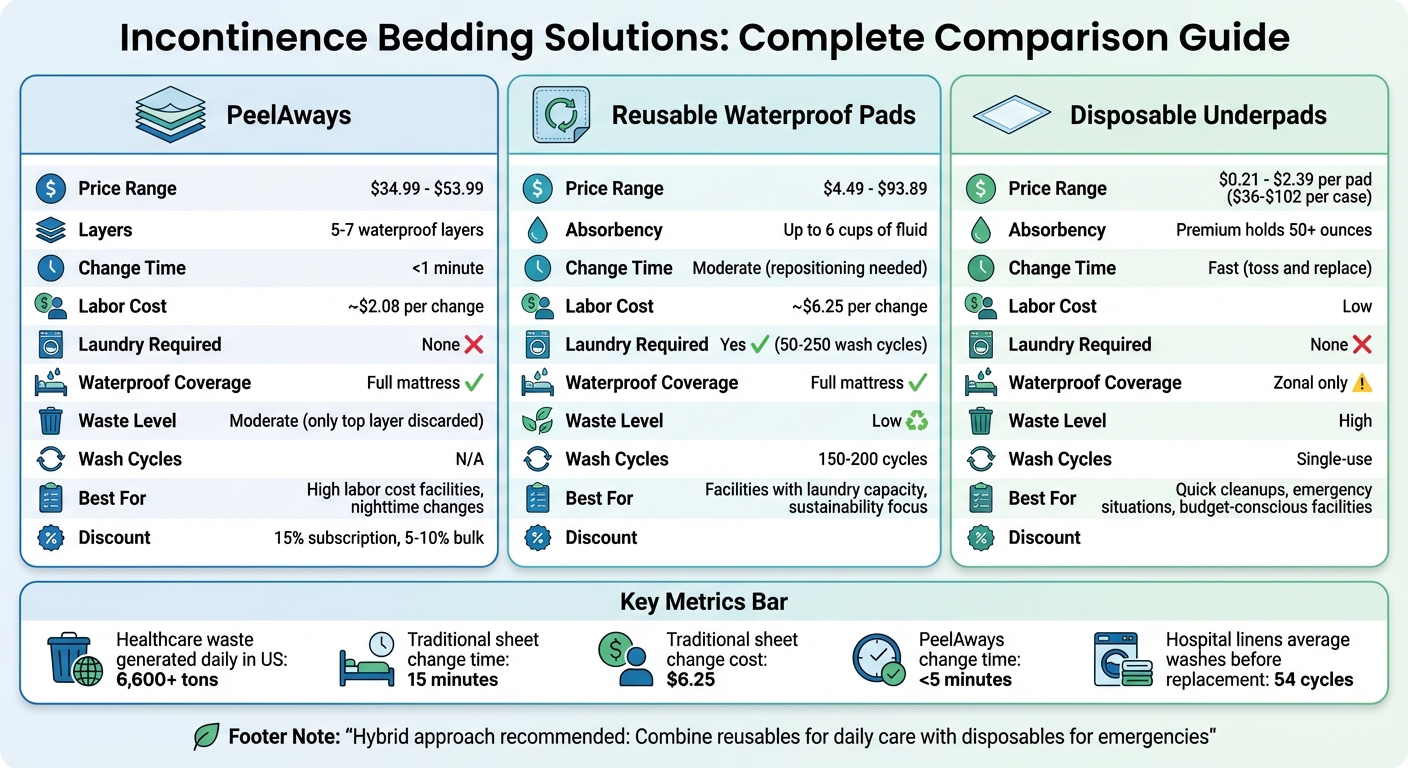
Care homes face challenges managing incontinence while balancing costs and efficiency. Bedding solutions can significantly reduce labor, laundry, and improve resident care. Here’s a breakdown of three options:
- PeelAways: Multi-layer disposable fitted sheets with 5–7 waterproof layers. Quick changes (<1 minute) reduce labor costs and eliminate laundry. Prices range from $34.99 to $53.99.
- Reusable Waterproof Bed Pads: Washable pads lasting 50–250 cycles. Lower waste but require laundry resources. Prices start at $4.49.
- Disposable Underpads: Single-use pads with high absorbency. Convenient but generate more waste. Cost per pad starts at $0.21.
Quick Comparison:
| Feature | PeelAways | Reusable Pads | Disposable Underpads |
|---|---|---|---|
| Change Time | < 1 minute | Moderate | Fast |
| Laundry | None | Required | None |
| Cost Efficiency | High (no laundry) | Long-term savings | Low upfront cost |
| Waste | Moderate | Low | High |
Each option offers distinct benefits. Combining disposables for emergencies and reusables for daily care can optimize efficiency and costs.
Incontinence Bedding Solutions Comparison: Cost, Labor Time, and Environmental Impact
1. PeelAways
Cost-effectiveness
PeelAways fitted sheets are priced between $34.99 and $53.99, depending on the size. For example, Twin and Twin XL sheets with 5 layers start at $34.99, while the King size (also 5 layers) is priced at $53.99. For residents requiring extra protection, the Twin XL 7-layer option is available for $41.99, offering a longer-lasting solution for higher incontinence needs.
When it comes to labor costs, PeelAways offer notable savings. Changing traditional sheets costs around $6.25 in labor per 15-minute change, but PeelAways reduce this to approximately $2.08 in less than five minutes. Plus, bulk purchasing provides additional savings - subscriptions come with a 15% discount, while buying three units offers 5% off, and six or more units qualify for a 10% discount.
In addition to the product price, care facilities can eliminate industrial laundering expenses entirely. Each layer is fully waterproof, protecting mattresses from spills and accidents, which helps avoid costly replacements. Beyond the financial benefits, PeelAways also simplify bed changes, making life easier for caregivers.
Practicality for care homes
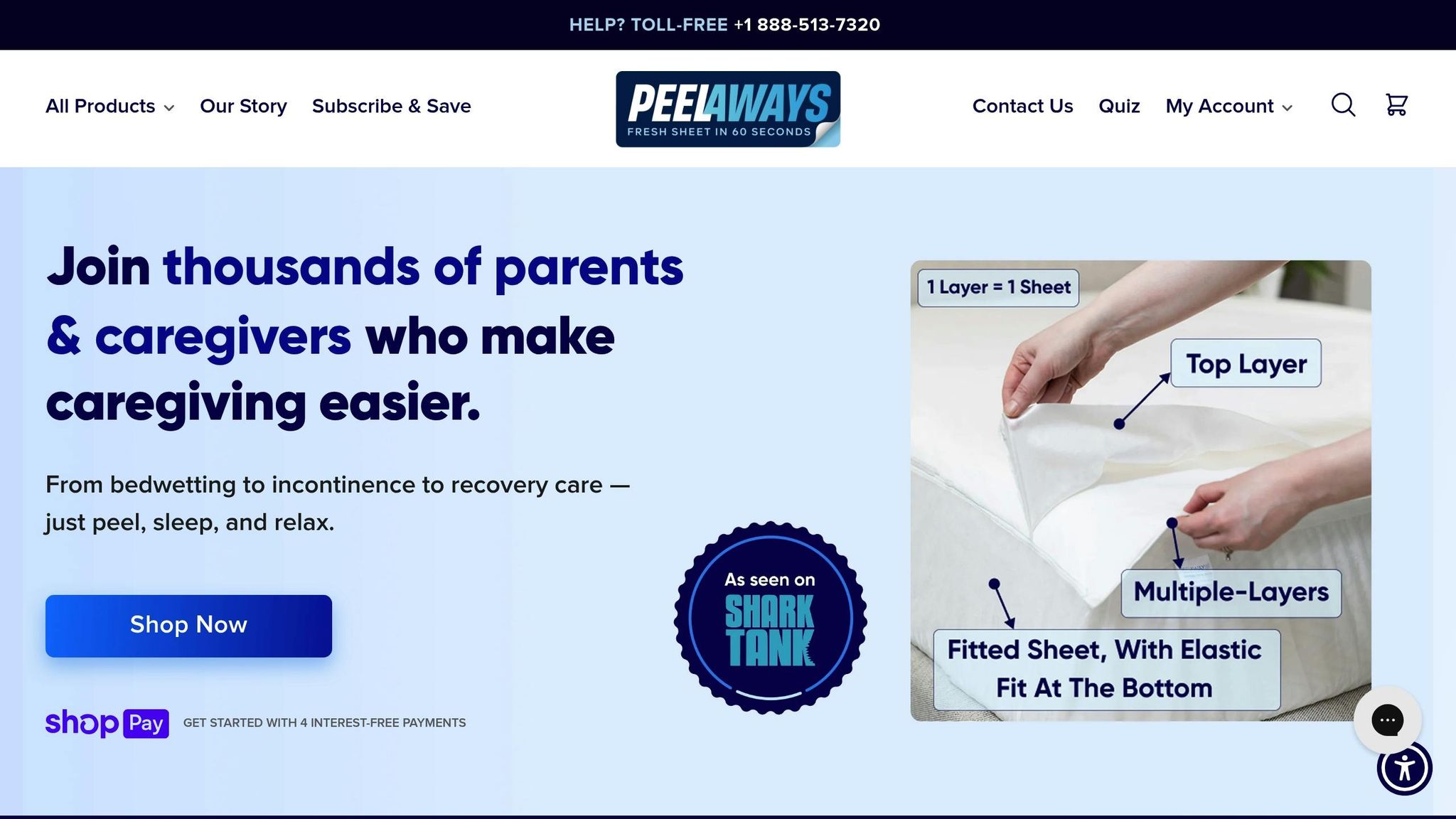
PeelAways are designed to make bed changes as effortless as possible. Instead of lifting mattresses or transferring residents, caregivers simply peel away the soiled top layer to reveal a clean sheet beneath. This feature reduces physical strain on staff and lowers the risk of injuries during bed changes.
"As a mom and a caregiver, these sheets have been a great addition to make my day easier. Quicker bed changes and less laundry. WIN." - Brooklyn Shields, Verified Customer [1]
Available in all standard care home sizes - Crib, Cot, Twin, Twin XL, Full, Queen, and King - PeelAways allow facilities to standardize their bedding across various bed types. This not only simplifies inventory management but also streamlines staff training. The Twin XL 7-layer sheets are particularly useful for residents dealing with severe overnight incontinence, while smaller sizes cater to pediatric or special needs populations. Additionally, the sheets are free of Vinyl, PVC, Phthalates, and fire retardants, ensuring they’re safe for sensitive skin.
On top of these operational benefits, PeelAways also provide an environmentally conscious solution.
Environmental impact
Although disposable, PeelAways are designed to minimize waste compared to single-use underpads. Thanks to their multi-layer design, only the top soiled layer is discarded, while the remaining layers stay in use. This approach can reduce overall waste compared to products that require full replacement after every incident.
The biggest environmental advantage, however, lies in the elimination of industrial laundering. Traditional hospital linens can endure about 54 washes before needing replacement, with each cycle consuming significant amounts of water and energy. By removing the need for laundering entirely, PeelAways help facilities cut down on water and energy use.
"While disposable products may raise concerns about waste, the reduced need for frequent washing and the associated water and energy savings can offset the environmental impact." - PeelAways [4]
Each layer is designed to last 7–10 days if it remains unsoiled, and responsible disposal practices can help manage waste effectively. For care homes looking to balance sustainability with operational efficiency, PeelAways offer a practical alternative to both fully disposable products and resource-heavy reusable linens.
2. Reusable Waterproof Bed Pads
Cost-effectiveness
Reusable waterproof bed pads are priced between $4.49 and $93.89, with premium options ranging from $14.19 to $14.79 each [7]. While the initial cost may seem higher, their durability - lasting through 150 to 200 wash cycles [9] - and compatibility with bulk washing can lead to considerable savings over time.
Vinyl mattress covers are the most economical choice, but if you're looking for better breathability and cooling features, polyurethane barriers are a slightly more expensive but worthwhile upgrade, especially for residents prone to overheating [5]. High-absorbency reusable pads, capable of holding up to 6 cups of fluid, help minimize the need for frequent full sheet changes, which can also cut down on labor costs [5]. These pads easily integrate into standard laundry routines, allowing them to be washed alongside regular bed linens, which simplifies operations for staff [5]. Bulk washing further reduces the cost per use [9].
These financial advantages make reusable bed pads a practical choice for long-term care facilities.
Practicality for Care Homes
Cost savings aside, proper use and maintenance are critical for getting the most out of reusable pads.
These pads are available in saddle-style designs for twin or full beds, complete with side flaps that tuck under the mattress to prevent shifting during use [5]. For optimal performance, the pads need to lie flat - folding or cutting them can damage the absorbent core and waterproof barrier [6]. To keep them in good condition, avoid using fabric softeners, as these can reduce absorbency. A vinegar rinse is a better alternative for removing residues and odors [8].
Unlike PeelAways, reusable pads rely heavily on a facility's laundry operations, which makes maintenance a key consideration for care homes. Over time, frequent washing can cause some pads, especially cheaper vinyl options, to deteriorate or split [8]. To maintain hygiene and functionality, care facilities need sufficient laundry capacity and should avoid overloading machines - keeping loads under 85% capacity ensures thorough cleaning [10]. Facilities with limited laundry resources or staff availability for frequent heavy-duty cycles may find reusable pads challenging to manage [10].
Environmental Impact
Reusable pads offer an eco-friendly alternative by significantly reducing landfill waste compared to single-use options [9]. A clinical trial involving 107 patients across hospitals and nursing centers showed that reusable pads outperformed disposables in keeping both skin and bedding dry [9]. However, because they typically lack super-absorbent polymers found in high-end disposable pads, their absorbency may not match that of premium disposables [10].
The environmental benefits lie in their durability and waste reduction. By switching to reusable pads, care homes can lower their carbon footprint while cutting down on plastic and packaging waste [9]. For facilities with efficient laundry systems and a commitment to sustainability, reusable pads provide a practical way to align environmental goals with quality resident care.
3. Disposable Underpads
Cost-effectiveness
Disposable underpads come in a wide price range, typically $36 to $102 per case, depending on their absorbency and durability levels [11]. For those on a budget, options like McKesson Lite start at around $2.09 for a bag of 10, which breaks down to approximately $0.21 per pad [7]. On the other hand, premium-quality underpads are priced between $1.79 and $2.39 per pad when on sale [7]. Facilities can save even more by purchasing in bulk or subscribing to regular deliveries, which often include discounts of up to 15%, along with other bundle offers [1][7].
One of the biggest financial advantages of these pads is their 100% waterproof barrier, which prevents moisture from damaging mattresses. This feature helps care facilities avoid the expense of frequent mattress replacements, saving money in the long run [1][12].
These cost savings make disposable underpads an efficient choice for fast-paced care environments.
Practicality for Care Homes
Disposable underpads aren’t just budget-friendly - they’re also incredibly practical for everyday use in care settings. Heavy-duty versions can support individuals weighing up to 350 pounds, making them helpful during repositioning tasks [12]. They come in a variety of sizes, from compact 17" x 24" pads for targeted protection to larger 36" x 70" designs that fit different bed types [11].
"These are good for bed ridden patients... Just toss the whole soiled pad away and voila! No washing reusable ones over and over." – Fuji, Customer Review [12]
When choosing underpads, focus on absorbency capacity rather than thickness. The amount of fluid a pad can hold depends on its polymer content, not its size or bulk. Some premium models can absorb over 50 ounces of liquid, offering superior protection [12][2]. Additionally, breathable backsheets are a great feature, as they help prevent skin irritation and infections, which is especially important for residents with limited mobility [11][12].
"Most [underpads] are so thin that the plastic backing causes her to sweat and leads to infections. NOT these! These are thin but substantial, structured and absorbent." – Charlotte, Customer Review [12]
For odor control, seal soiled pads in plastic bags before disposing of them outdoors [12].
Environmental Impact
While disposable underpads are convenient, it’s important to consider their environmental impact. The healthcare industry in the United States generates over 6,600 tons of solid waste daily, adding up to more than four billion pounds annually [3]. Disposable underpads contribute to this waste, with life cycle analyses showing higher resource use and emissions compared to reusable options [3].
To minimize waste, care homes can opt for high-capacity pads that hold 50 to 96 ounces of liquid. Using one premium pad instead of several standard ones can significantly cut down on waste volume [2]. Many facilities find that a hybrid approach works best: disposable pads for situations requiring maximum hygiene and reusable pads (which can withstand 50 to 250 washings) for routine care [3][2]. This balance allows care homes to maintain efficiency while reducing their environmental footprint.
sbb-itb-45288fe
Part 3 of 4 Continence products - Bed and chair protectors
Advantages and Disadvantages
Looking at the detailed evaluations above, it's clear that each bedding solution comes with its own set of pros and cons.
The PeelAways system stands out for its speed and ease of use. Staff can change a bed in less than 60 seconds without needing to lift the mattress or the patient, reducing labor costs from $6.25 to just $2.08 per change[4]. Plus, its built-in waterproof barrier eliminates the need for additional protectors and laundering[1]. However, since each layer is thrown away after use, it does have a higher environmental footprint.
Reusable waterproof bed pads, on the other hand, can be washed and reused between 50 and 250 times, which significantly reduces waste compared to disposable options[3]. When made with breathable polyurethane barriers instead of vinyl, they also help prevent skin irritation and overheating. But they require ongoing laundry efforts, including washing, drying, and storage, and they involve moderate physical effort to reposition patients for proper placement[5].
Disposable underpads are often more affordable upfront and make quick cleanups simple. Their easy disposal design is convenient, though they may shift out of place unless they feature a secure saddle-style design. Like PeelAways, they contribute to the large amount of solid waste generated daily by U.S. healthcare facilities[3][5].
Here's a quick comparison of the key features for each option:
| Feature | PeelAways | Reusable Waterproof Pads | Disposable Underpads |
|---|---|---|---|
| Labor Time per Change | < 1 minute[1] | Moderate (repositioning required)[5] | Fast (toss and replace) |
| Labor Cost | ~$2.08[4] | ~$6.25[4] | Low |
| Laundry Required | No[1] | Yes (50–250 washes)[3] | No |
| Environmental Impact | Higher waste, saves water[4] | Lower waste; higher water and energy usage[4] | High waste volume |
| Waterproof Coverage | Full mattress protection[1] | Full mattress protection[5] | Zonal protection only |
| Stability | High (fitted design)[1] | High (if saddle style)[5] | Low (prone to shifting) |
For the best results, a mixed approach might work well - using disposables for frequent accidents and reusables for regular care. Care homes should take a holistic view of costs, factoring in labor, laundry, water, energy, and disposal expenses, rather than just focusing on the initial purchase price[4].
Conclusion
Finding the right incontinence bedding solution is all about striking a balance between efficiency, cost, and sustainability. There’s no universal answer - what works best depends entirely on the unique needs of your care home.
For facilities grappling with high labor costs or residents who are challenging to move, PeelAways can be a game-changer. These disposable layers drastically reduce labor time and eliminate laundry costs altogether. They’re especially helpful during nighttime accidents when quick, quiet changes are essential to avoid disturbing residents. Plus, with subscription discounts of up to 15% and bundle savings of up to 10%, they offer an opportunity to cut costs even further while easing the physical demands of mattress handling[1].
On the other hand, if your care home has reliable laundry facilities and prioritizes long-term cost savings with less waste, reusable waterproof bed pads are a solid choice. These pads can endure between 50 to 250 washes, making them a durable and environmentally conscious option. However, they do require regular laundering and some effort to reposition residents. For facilities with limited laundry capabilities, disposable underpads provide a convenient alternative for quick cleanups. While they’re easy to use, they can shift out of place and generate more waste over time[12]. Many care homes find that a hybrid strategy - combining reusables for daily use with disposables for emergencies - offers the best of both worlds.
When making your decision, don’t just focus on the upfront cost. Consider the bigger picture: labor hours, laundry expenses, water and energy usage, and waste disposal costs[4]. By aligning your choice with your facility’s specific needs, you can strike the perfect balance between affordability and quality care.
FAQs
What are cost-effective and eco-friendly incontinence bedding options for care homes?
Care homes can manage costs and reduce their environmental footprint by taking a closer look at the true expenses tied to bedding maintenance. While traditional linens might appear budget-friendly at first, the ongoing costs of frequent washing - like labor, water, detergent, and energy - can quickly add up. For instance, a single sheet priced at $22 typically requires about 54 washes before it needs replacement. Each use adds more expenses for laundry and labor.
An alternative worth considering is disposable, multi-layer sheets such as PeelAways. These sheets eliminate the need for washing entirely, saving on water and energy. Their peel-away design allows caregivers to remove soiled layers quickly and easily - no need to lift the mattress - saving time and reducing the chances of cross-contamination. Plus, buying these in bulk can help lower costs even more, making them a smart and practical solution for care homes dealing with incontinence challenges.
Why are PeelAways a better option for care homes than traditional bedding?
PeelAways disposable, waterproof bed sheets provide care homes with a practical and affordable solution to replace traditional bedding. Thanks to their innovative multi-layer peel-away design, caregivers can easily remove the used top layer to reveal a fresh, clean sheet below - no need to lift mattresses, do laundry, or allocate extra labor. This approach saves both time and money while simplifying daily routines.
By removing the need to wash and handle soiled linens, PeelAways also minimize the risk of cross-contamination, making infection control more manageable. Their sturdy, multi-layer construction allows for quick, hygienic bedding changes, making them an excellent option for group homes prioritizing efficiency, cleanliness, and resident comfort.
How can reusable bed pads help care homes save money over time?
Reusable bed pads offer a budget-friendly option for care homes, thanks to their durability - each pad can endure 150–200 washes. This longevity cuts down the need for constant replacements. Plus, laundering them in bulk helps reduce the cost per use, making these pads a practical and efficient choice for long-term care.
Comments
0



SAVE MONEY & WATER
Professionals & Institutions save a fortune on labor/laundry.

SUPERIOR COMFORT
The first thing our customers notice is how soft our sheets are.

100% WATERPROOF
Each layer is 100% Waterproof, perfect for spills and accidents

SAVE TIME
Change the sheet in under 1 minute without stripping the bed.

Leave a comment