
Holiday Travel Checklist for Caregivers Managing Incontinence

It’s 2 a.m. The sheets are soaked again. Your loved one is embarrassed, your back hurts, and you have to be up in four hours. If you’re heading out for the holidays with incontinence in the mix, you need a plan before the trip starts.
A holiday travel checklist for caregivers managing incontinence should cover four things: what to pack, how to protect seats and beds, how to plan bathroom access, and how to handle nighttime accidents fast. For many families, the hardest part is the bed. A bed reset can take about 60 seconds instead of 15 to 20 minutes when you already have the right setup in place.
- Pack extra briefs, wipes, barrier cream, disposal bags, and a full change of clothes
- Protect car seats and beds before the first leak happens
- Plan restroom stops every 2 to 3 hours on the road
- Keep nighttime cleanup items within arm’s reach
- If bedwetting or overnight leaks are part of your trip, look for bedding with 5 to 7 waterproof layers
This is the stuff I wish someone had handed me before the first holiday trip went sideways.
Traveling with a Loved One Who Has Incontinence: Tips & Support
Why this gets harder once you leave home
Incontinence at home is hard enough.
On the road, it gets worse.
You lose your usual bathroom routine.
You don’t know the bed.
You don’t know the distance to the bathroom.
And if you’re staying with family, one wet bed at night can feel like it wakes up the whole house.
That’s why holiday prep matters so much.
Not because you want a perfect trip.
Because you want fewer bad surprises.
A few small setup choices can cut stress fast:
- An aisle seat on the plane
- A hotel room near the elevator
- A change kit you can grab with one hand
- A protected mattress before bedtime
If you skip those steps, you often pay for it later, in the dark, when everyone is tired.
What I’d look for before buying any travel or bed protection
I don’t care how nice the packaging looks.
I care about what happens at 2 a.m.
Before I buy anything for travel, I want answers to a few plain questions:
- Will it stop leaks from reaching the seat or mattress?
- Can I change it fast without lifting a heavy mattress?
- Can I pack it without taking over the whole car?
- Will it spare my loved one some shame?
- Will it cut laundry after a long travel day?
That last one matters more than people say.
If you’re washing sheets every morning in someone else’s house, the trip starts to revolve around accidents. Bedding that cuts laundry by 50% to 80% can take a lot of pressure off your day.
I also look at sizing.
Travel bedding that comes in crib to king sizes gives you more options for hotel rooms, guest rooms, and hospital-style beds.
And yes, reviews matter.
If a product has been used by a lot of tired families already, I pay attention.
PeelAways for overnight bed protection
This is the one I wish I’d found sooner.
PeelAways is a multi-layer disposable fitted sheet. You put it on the bed before the night starts. When there’s an accident, you peel off the top soiled layer and there’s a dry one already underneath.
That’s the whole idea.
No dragging off wet sheets.
No full remake in the middle of the night.
No pile of laundry before sunrise.
What stood out to me:
- 5 to 7 waterproof layers in each set
- Bed change in about 60 seconds
- Standard sheet changes often take 15 to 20 minutes
- 28,000+ reviews
- 4.8-star rating
- Sizes from crib to king
If you use diapers or incontinence pads and still deal with overnight leaks, this kind of backup can save your back.
And just as much, it can help protect dignity.
You can check PeelAways here: peelaways.com/shop
Or on Amazon: Amazon
If you want more help with travel nights and wet-bed cleanup, these are worth reading too:
- PeelAways blog
- How to change a wet bed fast
The brand line says it well: Making aging and caregiving easier, one bed at a time.
Waterproof seat pads for car rides and flights
Beds get most of the attention.
Seats should too.
A leak in the car can leave you with hours left in the drive and nowhere to stop. On a flight, it can turn into panic fast.
A waterproof seat pad helps protect:
- Car seats
- Wheelchair seats
- Airplane seats
What I want from a seat pad is simple:
- It stays in place
- It doesn’t feel bulky
- It handles small to medium leaks
- It’s easy to swap out
This is less about comfort and more about damage control.
Put it down before the trip starts. Not after.
Grab-and-go travel change kit
Your travel kit should not be buried under snacks and phone chargers.
It should be the first thing you can reach.
I’d pack:
- Absorbent briefs or pads
- Wipes
- Barrier cream
- Disposal bags
- Hand sanitizer
- Odor spray
- One full change of clothes
If the trip is long, pack more than you think you’ll need.
Then add a little more.
Because running out on December 24 is its own kind of misery.
Quick comparison
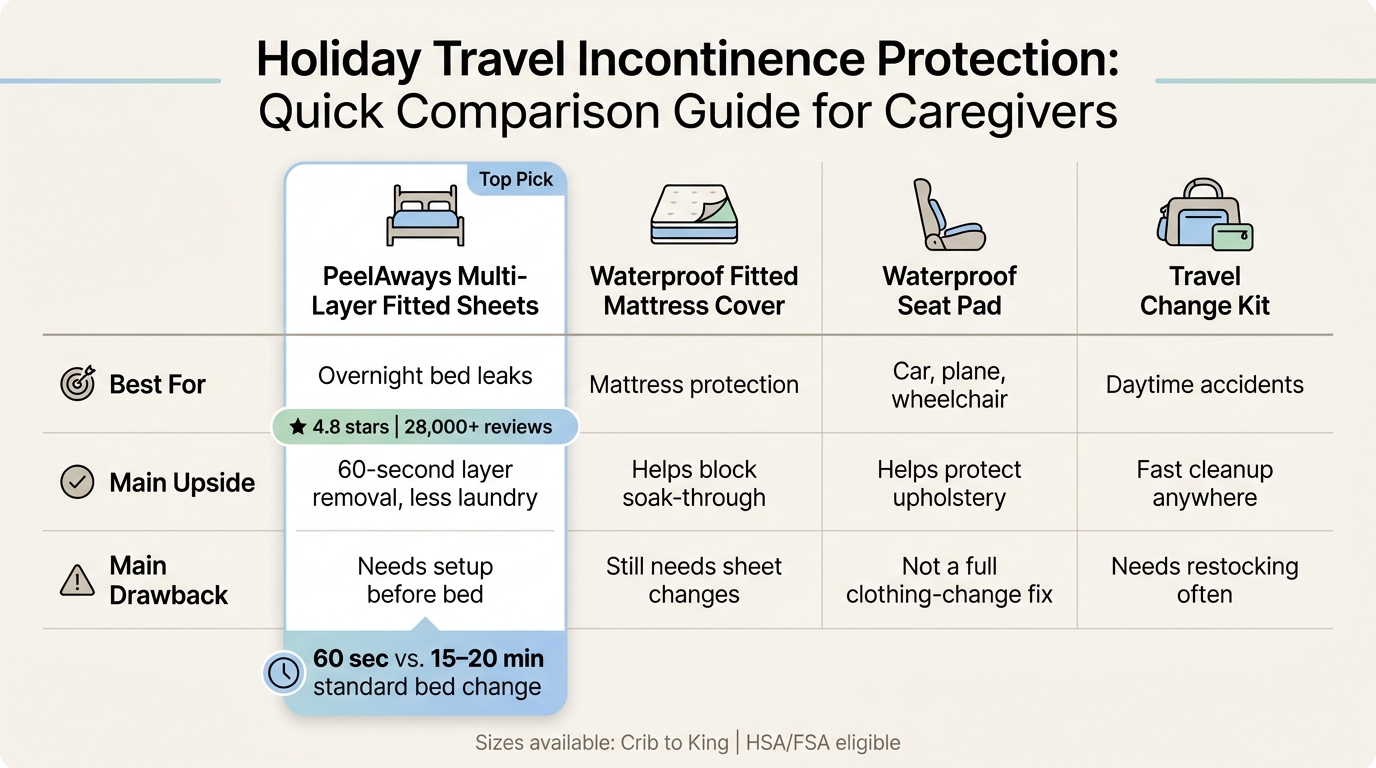
Holiday Travel Incontinence Protection: Quick Comparison Guide for Caregivers
| Option | Best for | Main upside | Main drawback |
|---|---|---|---|
| PeelAways multi-layer fitted sheets | Overnight bed leaks | 60-second layer removal, less laundry | Needs setup before bed |
| Waterproof fitted mattress cover | Mattress protection | Helps block soak-through | Still needs sheet changes |
| Waterproof seat pad | Car, plane, wheelchair | Helps protect upholstery | Not a full clothing-change fix |
| Travel change kit | Daytime accidents | Fast cleanup anywhere | Needs restocking often |
FAQ
How many extra supplies should I pack for holiday travel with incontinence?
I’d pack at least enough for the full trip plus extra for 2 to 3 days. Delays happen. Leaks stack up fast. You don’t want to hunt for supplies in an unfamiliar town.
sbb-itb-45288fe
How often should I stop on a road trip?
A good rule is every 2 to 3 hours. Even if your loved one says they’re fine, regular stops can help lower the chance of a rushed accident later.
What’s the best way to protect a guest-room mattress?
Put protection on the bed as soon as you arrive. Don’t wait until bedtime. A waterproof fitted layer is a good start. If nighttime leaks are common, a multi-layer sheet setup gives you a dry backup already in place.
Are PeelAways only for kids?
No. They come in sizes from crib to king, so they work for children, adults, and older family members. They’re made for anyone dealing with bedwetting, incontinence, or post-care leaks.
Do PeelAways replace diapers or pads?
No. I see them as backup. If you already use diapers or incontinence pads, PeelAways adds bed protection on top of that. That can mean less mattress cleanup and less laundry.
How much do PeelAways cost?
Pricing starts at $30.99. They can also be paid for with HSA/FSA funds, which may help if you’re already buying a lot of care supplies.
Bottom line
Holiday travel with incontinence is not just a packing problem.
It’s a sleep problem.
A dignity problem.
A laundry problem.
A “how fast can I fix this without waking everybody up” problem.
That’s why I’d keep the trip plan simple:
Pack extra.
Protect the seat.
Stage the room early.
Keep cleanup items close.
And for the bed, I’d go with PeelAways.
It’s the first thing I’ve found that speaks to the part nobody sees: the wet-sheet change in the middle of the night, when you’re tired, sore, and trying not to make a hard moment worse. With 5 to 7 waterproof layers, 28,000+ reviews, a 4.8-star rating, and a 60-second bed reset, it solves the part that can wreck the whole trip.
Blog readers save 10% with code BLOGS10 at checkout. Available on peelaways.com and Amazon. Free shipping on orders over $100.
What Caregivers Should Do Before a Holiday Trip
It’s early, you’re already behind, and your loved one is tired before the trip even starts. You’re not just packing clothes. You’re trying to stop one accident from turning the whole day upside down.
Start with medical planning, route planning, and extra supplies before you leave. Check medications, map out restroom stops, and pack more than you think you’ll need. Then put together a kit that works for daytime travel and overnight protection.
Medical and Travel Planning Checklist Before You Leave
Before any holiday trip, fill prescriptions early and bring extra days of medication. Keep a printed medication list, insurance card, and emergency contacts in your travel bag. When you’re tired and something goes wrong, paper copies matter.
If you’re booking a flight, ask for an aisle seat so bathroom trips are less of a struggle. If you’re staying at a hotel, ask for a ground-floor room or one near an elevator. Small choices like that can save your back and make the whole trip feel less hard.
What to Pack in an Incontinence Travel Kit
Pack a travel kit for routine care and fast changes. A good kit should include:
- Absorbent briefs or pads
- Moisture-wicking wipes
- Barrier cream
- Disposable bags for soiled items
- Hand sanitizer
- Odor-control spray
- One full change of clothes in a grab-and-go pouch
Keep it where you can reach it fast. Not buried under snacks, coats, and charger cords.
Bed and Seat Protection to Bring on a Holiday Trip
Once personal supplies are packed, think about the places where accidents create the most work: the car seat and the bed. Bring a waterproof seat pad for the car, wheelchair, or airplane seat to help protect upholstery during long travel days. For the bed at your destination, use fitted waterproof bedding.
Set up the bed before you settle in. That way, if an accident happens in the middle of the night, you’re not stripping sheets while half asleep.
PeelAways multi-layer disposable fitted sheets can make overnight protection easier by giving you a clean bed surface in under 60 seconds, with no laundry or heavy lifting. It’s one of those things you find after too many rough nights and wonder why nobody told you sooner. You can see them at peelaways.com/shop or on Amazon. For more help before you travel, take a look at other guides on peelaways.com, including tips for overnight care and travel prep.
Once the room is protected, the next step is managing rides and flights.
How to Manage Incontinence During Car Rides and Flights
You’re halfway out the door. The bag is packed, the sheets at home are handled, and now there’s that knot in your stomach about the ride itself. Not the destination. The part where you’re stuck in a car seat or airplane seat, hoping you can get to a bathroom in time.
With the kit packed and the bed protected, the next job is timing and access during the trip. Plan restroom stops, keep supplies close, and put on higher-absorbency briefs before you leave.
Car Travel Checklist: Restroom Stops, Seat Protection, and Quick Changes
Car trips can go sideways fast when there’s nowhere to pull over.
Map your route before you leave and identify rest stops along the way. Schedule restroom stops every 2 to 3 hours.
Put a waterproof seat pad down before anyone gets in the car. If a leak happens, the seat stays clean and a quick change stays private. Keep your change kit - briefs, wipes, and disposal bags - in the back seat or in a bag you can reach without climbing over luggage.
Flight Checklist: What to Keep in Your Carry-On
Flights follow the same rule as car travel: keep supplies close and plan every bathroom break ahead of time.
Request an aisle seat when you book so bathroom trips are easier. Use pre-boarding to settle in before boarding slows. Getting settled early means you can arrange your bag, set up any seat protection, and use the restroom once more before the doors close.
Keep briefs, wipes, and disposal bags in your under-seat bag. Use higher-absorbency briefs for longer travel windows.
How to Handle Overnight Accidents Away From Home
It’s late. You’re in someone else’s house or a hotel room, and the bed is wet. You’re trying to move fast without turning on every light, making noise, or making your loved one feel worse than they already do.
Protect the bed before lights out and keep change supplies within reach.
Hotel and Guest-Room Setup Checklist for Leak Prevention
Once the room is booked, get the bed ready before bedtime. Set waterproof bedding in place as soon as you arrive. Do it before anyone lies down.
Use a fitted waterproof sheet and make sure it stays flat across the mattress. If the mattress is deeper or thinner than the one you use at home, add sheet clips or straps so the fitted layer stays snug. If that sheet shifts, the mattress is exposed.
Put a small waste bag, wipes, and a clean pair of briefs on the nightstand before lights out. Keep everything close, so you’re not digging through luggage in the dark. The goal is simple: a quick, discreet, quiet change.
If you’re staying in a shared guest room during a holiday visit, that kind of low-light change matters even more. Extra noise or light can wake other people and turn a hard moment into a long one.
With the room staged, the next thing that matters is being able to change the bed fast and with as little fuss as possible.
How PeelAways Makes a 60-Second Bed Change Possible
A standard overnight bed change usually means lifting the mattress, fighting with fitted sheet corners, and dealing with wet bedding. That can take 15 to 20 minutes.
PeelAways works in a much simpler way. It’s a multi-layer disposable fitted sheet made for moments like this. Each sheet has 5 to 7 stacked waterproof layers already placed on the mattress before the first night. When there’s an accident, you peel off the soiled top layer from one corner, toss it into the waste bag, and there’s already a clean, dry layer underneath.
That’s how a bed change can take about 60 seconds instead of 15 to 20 minutes.
The fabric is a soft, breathable bamboo-rayon-polyester blend, and each layer can stay in place for 7 to 10 days if it isn’t soiled. If you use diapers or incontinence pads, this is the kind of backup that can save your back and spare your loved one some embarrassment.
I found PeelAways the same way a lot of worn-out family members do: in the middle of trying to make nights less brutal. It comes in sizes from crib to king, has a 4.8-star rating, and more than 28,000+ reviews. You can find it on peelaways.com/shop or on Amazon. For more help with bed protection and cleanup, you can also read other articles on PeelAways like https://peelaways.com/blogs/news and https://peelaways.com/blogs/news/how-to-change-wet-bed-fast.
After the bed is reset, move to cleanup and skin care.
What Caregivers Should Do After an Accident or After the Trip
The leak is handled. The bed is dry again. But you're not done yet - because the part that gets missed most often is what happens right after.
Post-Accident Cleanup and Skin Protection Checklist
After a leak, skin care comes first.
Clean the area. Dry the skin all the way. Then apply barrier cream before putting on a fresh brief.
That order matters. Clean skin promptly to help lower the risk of irritation and infection.
Then deal with the mess. Seal soiled items in a disposal bag. Check how many PeelAways layers are left, and restock before the next trip out. If you've ever opened your kit and found it half-empty at the worst time, you already know why this step matters.
Once cleanup is done, move straight to restocking so the next trip starts ready.
After-Trip Reset: Restock Your Travel Kit and Update Your Checklist
When you get home, do a quick inventory.
Look at what ran out first. Notice what slowed you down. Was it briefs? Wipes? Disposal bags? PeelAways layers?
That tells you what to pack more of next time, instead of guessing and hoping for the best.
If you're low on layers or any other supply, add them to your kit before the next holiday. A few minutes now can save you that awful last-minute rush later, when you're already trying to get out the door.
Comments
0



SAVE MONEY & WATER
Professionals & Institutions save a fortune on labor/laundry.

SUPERIOR COMFORT
The first thing our customers notice is how soft our sheets are.

100% WATERPROOF
Each layer is 100% Waterproof, perfect for spills and accidents

SAVE TIME
Change the sheet in under 1 minute without stripping the bed.

Leave a comment