
How Hand Hygiene Reduces Infections in Nursing Homes

Hand hygiene is one of the most effective ways to prevent infections in nursing homes. With residents often having weakened immune systems and living in close quarters, proper handwashing by staff can significantly reduce the spread of harmful germs. The CDC and WHO recommend specific hand hygiene protocols, including washing hands at key moments during care, using alcohol-based sanitizers, and ensuring access to hygiene stations. These practices protect residents, lower healthcare costs, and improve safety for everyone involved.
Key points include:
- 5 Key Moments for Hand Hygiene: Before touching a resident, before clean procedures, after fluid exposure, after resident contact, and after touching surroundings.
- Handwashing Methods: Soap and water for visibly dirty hands; alcohol-based sanitizers for quick disinfection.
- Facility Support: Strategically placed hygiene stations, touch-free dispensers, and visual reminders.
- Training and Compliance: Ongoing education, leadership modeling, and feedback systems to ensure adherence.
Proper hand hygiene, combined with tools like disposable bedding and consistent monitoring, helps create safer care environments. Simple adjustments can lead to significant reductions in infection rates.
Introduction to Just Clean Your Hands (Long Term Care)
When to Practice Hand Hygiene in Nursing Homes
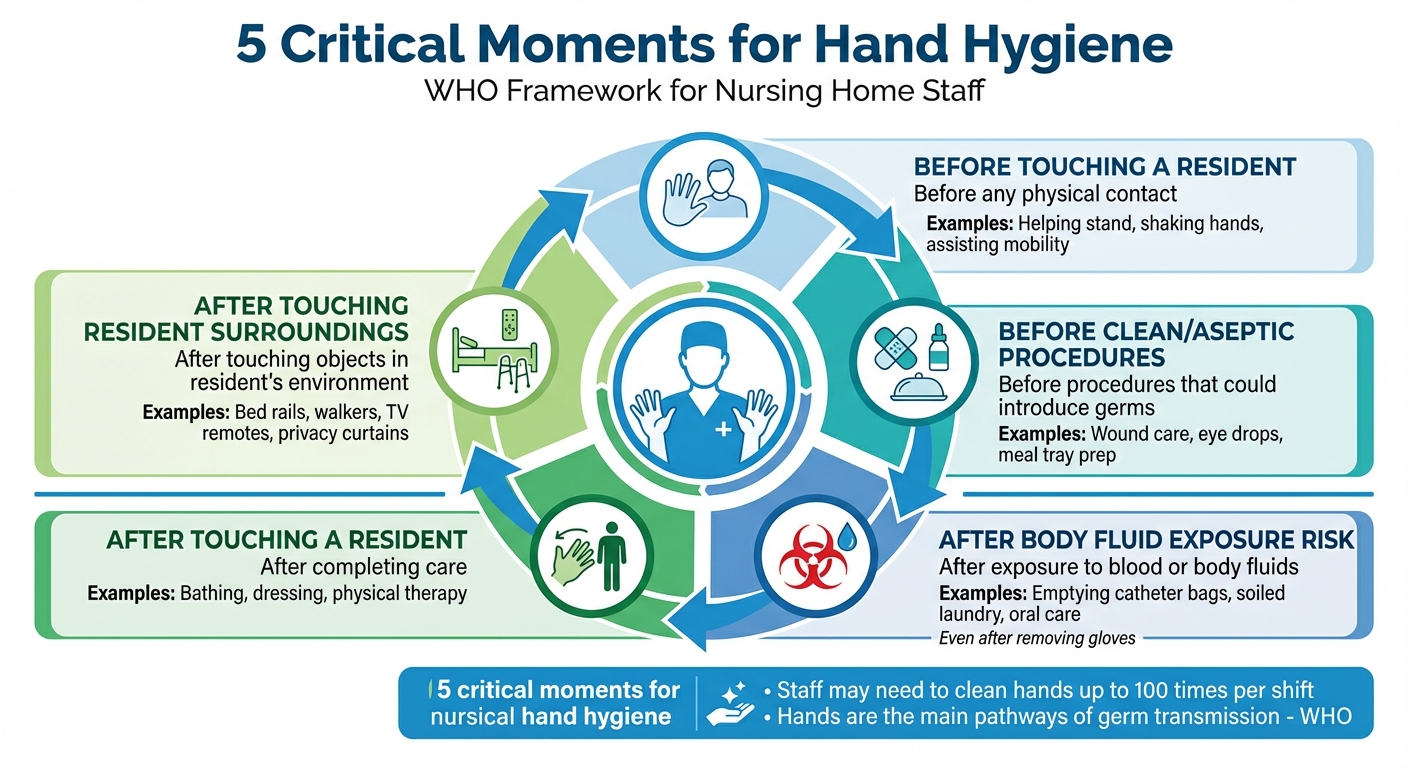
WHO's 5 Critical Moments for Hand Hygiene in Nursing Homes
Knowing when to clean your hands is a key step in stopping the spread of infections. The World Health Organization (WHO) created the "Five Moments for Hand Hygiene" as a global guide for healthcare workers. These moments highlight critical times during care when hand hygiene is necessary to prevent germs from spreading. As WHO explains, "Hands are the main pathways of germ transmission during health care" [2]. By following this framework, nursing home staff can significantly reduce infection rates. Considering that staff may need to clean their hands up to 100 times during a single shift [3], maintaining this routine is vital for the safety of residents.
The 5 Critical Moments
Moment 1: Before touching a resident
Clean your hands before any physical contact with a resident. Whether you're helping them stand, shaking hands, or assisting with mobility, washing your hands first helps protect them from harmful germs.
Moment 2: Before clean/aseptic procedures
Always clean your hands before performing tasks that could introduce germs into a resident's body. This includes wound care, administering eye drops, or preparing a meal tray. These actions bypass the body’s natural defenses, making clean hands essential.
Moment 3: After body fluid exposure risk
Wash your hands immediately after any task involving possible exposure to blood or body fluids. This includes actions like emptying catheter bags, handling soiled laundry, or providing oral care. Even after removing gloves, germs can linger due to tiny glove perforations or improper removal.
Moment 4: After touching a resident
After completing care, such as bathing, dressing, or assisting with physical therapy, clean your hands. This step helps protect you and others from spreading germs.
Moment 5: After touching resident surroundings
Clean your hands after touching objects or furniture in a resident’s environment, like bed rails, walkers, or TV remotes. In shared rooms, the resident’s environment includes everything within the privacy curtain, so even adjusting the curtain requires hand hygiene.
These five moments form a solid foundation for infection prevention, but additional care scenarios highlight the importance of staying vigilant.
Common Care Situations That Require Hand Hygiene
Beyond the five moments, many daily care activities also demand strict hand hygiene. For example, when assisting with meals, wash your hands before preparing, handling, or serving food - and again before feeding a resident. This helps reduce the risk of foodborne illnesses.
When handling soiled laundry, clean your hands thoroughly with soap and water if they are visibly dirty. For tasks like wound care or moving from a soiled to a clean body site on the same resident - such as during perineal care before repositioning - clean your hands both before and after the procedure to avoid cross-contamination.
If using an alcohol-based hand rub, make sure your hands stay wet for at least 15 seconds. If they dry too quickly, apply more product to ensure proper disinfection. These consistent practices make a significant difference in maintaining a safe and healthy environment for everyone.
Building a Hand Hygiene-Friendly Environment
Even the best training can fall short if staff don’t have easy access to the tools they need. The physical setup of your facility plays a crucial role in making hand hygiene both simple and consistent, allowing staff to clean their hands quickly without interrupting care.
Placing Hygiene Stations Where Staff Need Them
Hand hygiene stations should be strategically located at every care touchpoint - this includes facility entrances and exits, inside and outside resident rooms, and throughout common areas. Conducting walk-through assessments can help identify areas where sinks or sanitizers are missing [4].
Fire safety regulations influence how alcohol-based hand sanitizer (ABHS) dispensers are installed. For example, dispensers in corridors are limited to 1.2 liters and must be spaced 48 inches apart horizontally. In suites, dispensers can hold up to 2.0 liters. All dispensers must be placed at least 1 inch away from ignition sources [3].
In memory care or dementia units, wall-mounted dispensers should be located outside resident rooms instead of bedside. Caryn Arnold, Medline Medical Science Liaison, explains:
It's not always appropriate or safe to place bottled products next to resident beds. Residents who are confused or have dementia may not understand its purpose and misuse it or, unfortunately, ingest it [4].
For staff who frequently move between care areas, portable, pocket-sized hand sanitizer containers are a convenient way to ensure hygiene products are always on hand.
Touch-free dispensers further reduce cross-contamination by activating only when an object is within 4 inches. Meanwhile, visual reminders like "Wash Your Hands" signs or "Clean Hands Save Lives" posters reinforce the importance of hygiene [3]. Providing facility-approved lotions or non-drying hygiene products can also help prevent skin irritation, which might otherwise discourage regular handwashing [3] [4].
Optimizing station placement is just one step. Taking additional measures can further lower infection risks.
Additional Infection Control Measures
Hand hygiene works best when paired with other infection control practices. One commonly overlooked source of cross-contamination is the handling of soiled bedding during linen changes. Traditional bed changes require staff to strip the bed, bundle contaminated sheets, transport them to the laundry, and then remake the bed - providing multiple opportunities for germ transmission.
Disposable, waterproof bedding like PeelAways offers a practical solution. These sheets feature a patented multi-layer design with 5 to 7 absorbent layers (depending on the size). When a layer becomes soiled, staff can simply peel it away to reveal a clean sheet underneath - eliminating the need for mattress lifting or laundry. This method takes less than a minute [5], reducing the time spent handling contaminated materials and minimizing the risk of germ spread. Staff can immediately perform hand hygiene after disposing of a soiled layer.
PeelAways also feature a 100% waterproof barrier that prevents bodily fluids from seeping through to the next layer or the mattress. They are free from harsh chemicals like Vinyl, PVC, Phthalates, and fire retardants [5], making them safe for sensitive or elderly residents. By reducing laundry-related labor and costs, these disposable sheets complement hand hygiene protocols while streamlining care processes.
sbb-itb-45288fe
Training Staff and Maintaining Compliance
For infection control to work effectively, staff need to grasp both the how and the why of hand hygiene. This understanding directly impacts infection rates in nursing homes. In late 2022, assessments of over 100 long-term care providers across the U.S. uncovered major gaps in hand hygiene compliance [4]. Bridging these gaps requires a mix of education and ongoing encouragement.
How to Train Staff on Hand Hygiene
Training works best when it combines different methods - like hands-on demonstrations, workshops, videos, printed guides, and online courses [4][6]. This variety ensures that all learning styles are addressed, making it easier for staff to retain the information.
The CDC's "4 E's" framework offers a structured training model: Engage (lay the groundwork), Educate (teach the skills), Execute (ensure accountability), and Evaluate (use data to improve) [6]. This ensures training goes beyond theory and leads to practical, real-world application.
Interactive tools like gamification have proven especially effective. For instance, scenario cards that challenge caregivers to choose the right hygiene product for specific tasks - like feeding a resident versus wound care - boost retention [4]. These activities replace passive learning with active problem-solving.
Training also needs to focus on behaviors after hand hygiene. Caryn Arnold, Medline Medical Science Liaison, highlights this issue:
We also need to change people's behavior after they've cleaned their hands. For example, if a caregiver performs hand hygiene, starts helping a resident dress and then touches their phone or another item, their hands are no longer clean [4].
Understanding the "why" behind hand hygiene is equally crucial. Arnold adds:
What can get in the way of someone performing a task? Not understanding the 'why' [4].
By emphasizing the serious risks of healthcare-associated infections, training can make the importance of compliance hit home. But motivation is just as important as education to ensure these practices stick.
Keeping Staff Motivated to Follow Protocols
Training alone isn’t enough - it needs reinforcement. An 18-month study found that multimodal interventions increased hand hygiene adherence to 60.9%, while control groups dropped to 51.3% [7]. This shows that ongoing attention to hygiene practices is key to lasting change.
Leadership also plays a big role. Research reveals that staff are more likely to follow hygiene protocols when senior team members consistently model proper practices [8]. Nursing managers and senior staff set the tone for the rest of the team.
Recognition programs can keep motivation high. Simple gestures like appreciation lunches, certificates, or posting high-performing staff names in breakrooms show that compliance is valued [4]. These efforts foster a positive culture where good practices are celebrated.
Constructive feedback is another powerful motivator. Tools like monitoring apps, checklists, or electronic systems can provide immediate, non-punitive feedback. This approach shifts the focus from blame to learning, encouraging staff to see hand hygiene as a shared responsibility [4][6].
Environmental cues like visual reminders are also effective. Posters with messages like "Clean Hands Save Lives" near hygiene stations or technique instructions by sinks keep hand hygiene top-of-mind throughout the day [4].
Finally, involving residents and family members in the process creates a culture of accountability. When everyone - staff, residents, and families - takes part in infection prevention, it becomes a shared mission rather than just a staff obligation [4].
Tracking Results and Lowering Infection Rates
Once training is in place and staff are motivated, the next step is measuring the results. To do this effectively, it's important to distinguish between active monitoring and long-term surveillance. Both methods provide valuable insights into a facility's performance, helping identify where improvements are needed and where progress is being made [10].
Setting Baselines and Tracking Metrics
Before implementing any changes, start by establishing a baseline. The CDC's National Healthcare Safety Network (NHSN) offers protocols tailored for long-term care facilities, enabling monthly reporting and trend analysis [12]. Tools like the AHRQ Hand Hygiene Tracking Tool can also help document these baselines in a standardized way [9].
Each facility should set its own compliance targets based on internal risk assessments, which should be outlined in the facility’s performance improvement plan [10]. These goals might include measurable targets - like achieving a specific percentage of successful hand hygiene moments - or narrative descriptions of planned activities.
One of the most critical metrics to monitor is the hand hygiene compliance rate. This is calculated by observing "The 5 Moments" of hand hygiene and comparing successful actions to total opportunities [11]. The impact of proper hand hygiene is immense, with the potential to cut infections by up to 50% [11]. Considering that preventable healthcare-associated infections (HAIs) claim nearly 90,000 lives annually and add approximately $4.5 billion to medical costs, the importance of this metric cannot be overstated [11].
Tracking should also include role-specific adherence (e.g., nurses, medical assistants, physicians) and location-based metrics for areas like patient rooms or hallways [11]. This granularity can reveal whether certain staff groups need additional training or if specific environments present challenges. Additionally, monitoring supply levels is crucial - shortages can directly impact compliance rates [11].
These metrics provide the foundation for identifying where targeted improvements are needed.
Using Data to Improve Performance
Once metrics are in place, the next step is analyzing the data to uncover areas that require immediate attention. Standardized audit tools from organizations like the CDC and WHO ensure consistency in observations and help identify specific compliance gaps [11][12]. For example, staff might excel at hand hygiene after resident contact but struggle before performing aseptic procedures. Pinpointing such trends allows for targeted interventions rather than broad, less effective reminders.
One study involving 14 facilities demonstrated how multifaceted interventions improved hand hygiene compliance by 13% [13]. These efforts included sharing audit results with multidisciplinary teams - spanning clinical staff, administrators, and janitorial workers. This collaborative approach facilitated root cause analyses and launched quality-improvement initiatives [11].
Danielle Roques, BSN, RN, CCRN at IntelyCare, highlights the purpose of such efforts:
Hand hygiene auditing should not be seen as punitive. Its main purpose is to help develop significant change efforts for improved infection prevention practices across organizations and facilities [11].
Sharing compliance data with supply managers and other key stakeholders can also drive targeted improvements [13]. These insights, combined with ongoing training and environmental adjustments, ensure that facilities can address gaps effectively. Regular feedback loops - through team meetings or observation sessions - are essential for maintaining behavior changes and sustaining long-term compliance [13].
Conclusion
Hand hygiene goes beyond being just a routine task - it's the frontline defense against dangerous pathogens like MRSA, C. diff, and Norovirus, which pose significant risks to vulnerable individuals [1].
Building a true culture of cleanliness involves more than just providing hygiene stations. It requires ongoing education, easy access to resources, and active involvement from both residents and their families. As Caryn Arnold emphasizes, maintaining proper behavior even after hand hygiene is key to achieving genuine cleanliness [4]. This approach forms the backbone of a broader infection-control strategy.
Meaningful progress happens when hand hygiene is combined with other measures, such as vaccinations, responsible antibiotic use, and environmental safeguards. Tools like PeelAways' multi-layer disposable sheets can further reduce cross-contamination risks. Pairing environmental upgrades with regular staff training strengthens these safety efforts. Success in this area depends on strong leadership, timely feedback, and consistent recognition of efforts [4].
FAQs
What’s the easiest way to improve hand hygiene compliance on busy shifts?
The simplest way to improve hand hygiene compliance during hectic shifts is by blending education, monitoring, and feedback. Ongoing training helps reinforce proper habits, while tracking adherence and offering real-time feedback keeps staff motivated. Tackling workflow obstacles through system adjustments and behavioral strategies, backed by strong leadership, ensures that compliance remains consistent - even during the busiest times.
When should staff use soap and water instead of hand sanitizer?
Staff should wash their hands with soap and water whenever their hands are visibly dirty or greasy. This is especially important after using the bathroom, changing diapers, or handling food - whether before, during, or after its preparation. These habits are crucial for maintaining hygiene and minimizing the spread of infections in nursing homes.
How can families help support hand hygiene in a nursing home?
Families play an important role in encouraging proper hand hygiene in nursing homes. A gentle reminder to staff to use soap and water or alcohol-based hand rubs before interacting with residents - especially after touching contaminated surfaces - can make a big difference.
By supporting strict infection prevention protocols and helping residents understand the importance of hand hygiene, families contribute to reducing healthcare-associated infections and creating a safer space for everyone.
Comments
0



SAVE MONEY & WATER
Professionals & Institutions save a fortune on labor/laundry.

SUPERIOR COMFORT
The first thing our customers notice is how soft our sheets are.

100% WATERPROOF
Each layer is 100% Waterproof, perfect for spills and accidents

SAVE TIME
Change the sheet in under 1 minute without stripping the bed.

Leave a comment