
Do Bedwetting Alarms Really Work?

Bedwetting alarms are a proven solution for children struggling with nighttime wetting. Research shows that alarms help 76.6% of children achieve 14 consecutive dry nights, with 40% staying dry for over two years after stopping use. Unlike medications, they are safer and train the brain to respond to bladder signals during sleep.
Here’s what you need to know:
- How they work: Detect moisture and alert the child to wake up or stop urination. Over time, this builds bladder control.
- Types: Wearable alarms (clip-on sensors), bedside alarms (sensor pads), and vibrating alarms for deep sleepers.
- Success factors: Best for children over 7 who are motivated and supported by caregivers. Consistent use for up to 15 weeks is key.
- Challenges: Initial disruptions, false alarms, and caregiver involvement are common but manageable.
Bedwetting alarms are effective for long-term results, especially with caregiver support and tools like disposable bed sheets for easier cleanup.
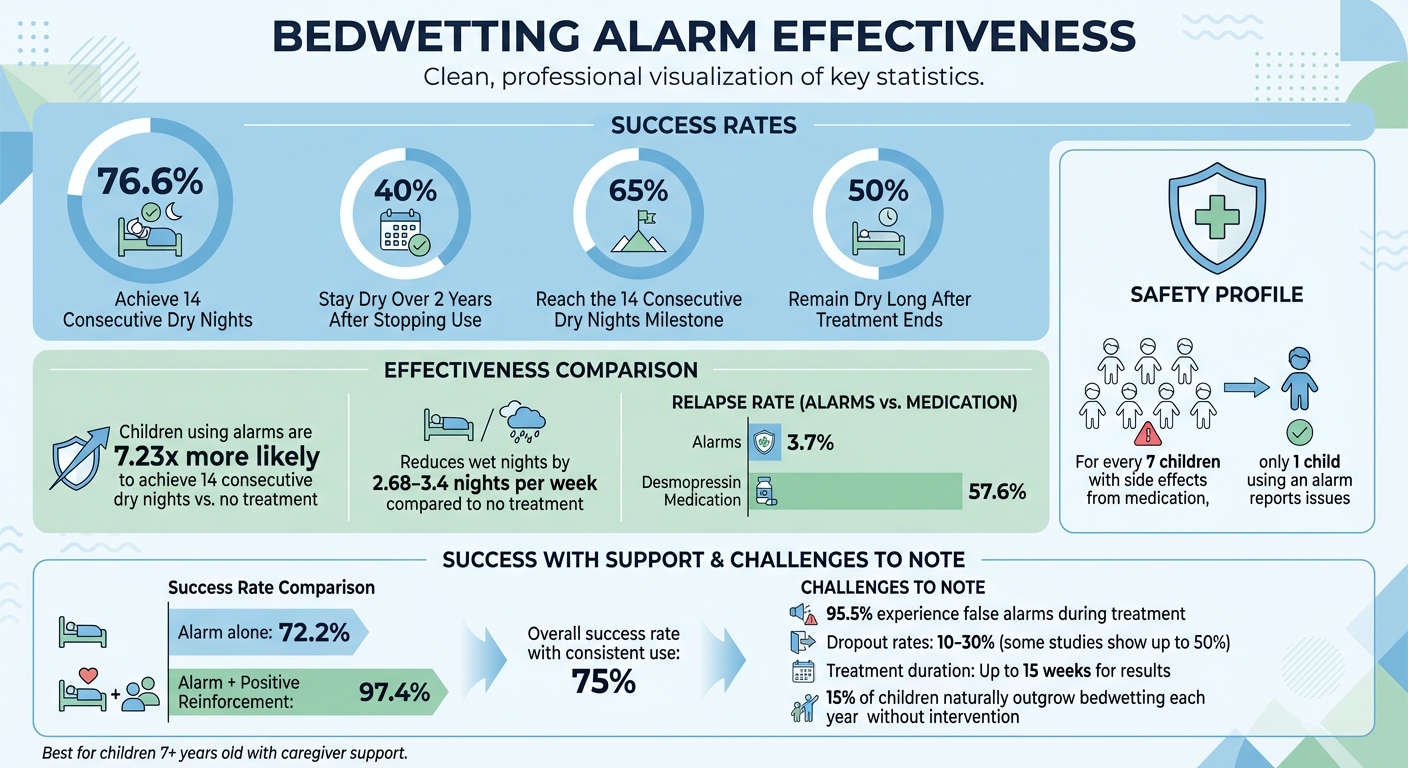
Bedwetting Alarm Effectiveness Statistics and Success Rates
How Bedwetting Alarms Work
The Conditioning Process
Bedwetting alarms help train the brain to respond to bladder signals during sleep. When the alarm goes off, it prompts the child to contract their pelvic floor muscles, stopping urination. Over time, the brain learns to link the sensation of a full bladder with waking up. Eventually, this connection becomes strong enough that the child wakes up before any urine is released. As noted by the National Clinical Guideline Centre (UK):
Alarms achieve dryness over time by training the child to recognise the need to pass urine and to wake to go to the toilet or hold on [1].
The alarm’s unpleasant stimulus acts as a wake-up call, encouraging the child to respond to their bladder signals. This method is especially effective for children who experience arousal dysfunction - a condition where they have difficulty waking up to internal cues during sleep [1].
This conditioning process relies on two key components found in all bedwetting alarms.
Main Parts of a Bedwetting Alarm
Bedwetting alarms typically include two main parts: a moisture sensor and an alarm mechanism. The sensor works through an electrical circuit that activates when it detects urine, which contains electrolytes. Once triggered, the alarm unit produces a response such as a sound, vibration, or light [1][6].
- Body-worn alarms: These have a small sensor that clips onto the child’s underwear. The alarm unit is attached to the pajama top, usually near the shoulder or collar for easy access [1].
- Pad-and-bell alarms: These use a sensor pad placed under a draw sheet on the bed. When urine reaches the pad, it sets off an alarm unit that’s typically located on the bedside table [1].
Each type of alarm provides immediate feedback, helping children develop the habit of waking up in response to bladder signals.
Do Bedwetting Alarms Really Work? What Research and Experience Show
What Clinical Studies Show
Research confirms that bedwetting alarms are more effective than no treatment at all. Studies show that children using alarms are 7.23 times more likely to achieve 14 consecutive dry nights. Around 65% of children reach this milestone, with relapse rates as low as 3.7%, compared to 57.6% for those treated with desmopressin [2][8][1].
On average, alarms reduce the number of wet nights by 2.68 to 3.4 nights per week compared to no treatment [2][3]. A Cochrane Review highlights this:
Alarm interventions reduce night-time bed wetting in children during treatment, and are better in the long term than treatment with desmopressin or tricyclic drugs. [4]
Beyond effectiveness, alarms are safer than medications. For every seven children experiencing side effects from desmopressin, only one child using an alarm reports issues like discomfort or fear [3]. Furthermore, approximately 50% of children who stick with alarm therapy remain dry long after treatment ends [4][3].
These findings showcase how alarms work by conditioning both the body and behavior to respond to nighttime wetting.
While research provides the numbers, understanding caregiver experiences brings a fuller picture of how these interventions play out in daily life.
Parent and Caregiver Experiences
Real-life feedback from parents and caregivers highlights both the positives and the challenges of using bedwetting alarms. For instance, many families report that alarms don’t always wake deep-sleeping children [2][3]. In such cases, parents often need to step in and physically wake the child during the initial weeks of treatment.
Other common issues include false alarms, disruptions to other family members’ sleep, and fear triggered by the alarm sound [2][3]. In fact, one study found that 95.5% of participants experienced false alarms during treatment [1]. These challenges can lead to frustration, contributing to dropout rates that sometimes reach 50% in clinical trials [1].
Caregivers also need to invest significant time and effort, especially at the beginning of the process [5][4]. Interestingly, treatment often fails not because the child doesn’t respond, but because parents grow weary of the nightly disruptions [8]. Additionally, families who try punitive measures, like penalties for wet beds, often find this approach counterproductive [4].
Despite the hurdles, families who stick with the process often see meaningful improvements. Success requires patience, realistic expectations, and a willingness to navigate the initial learning curve of conditioning therapy. With persistence, the results can be well worth the effort.
What Affects Bedwetting Alarm Success
Age and User Readiness
Bedwetting alarms are typically recommended for children aged seven and older [5]. Younger children often lack the motivation and focus needed to stick with the process. For kids under seven, a more patient approach might be better, as about 15% of children outgrow bedwetting naturally each year without intervention [5].
These alarms are most effective for children who have trouble waking up when their bladder is full - a condition called arousal dysfunction - rather than those who produce excessive urine during the night [1][5]. Success also depends on the child’s willingness to actively participate. Both the child and their caregiver need to be ready for a commitment that could take up to 15 weeks to see results [10]. Caregiver involvement is crucial to ensure the process stays on track.
Consistent Use and Caregiver Involvement
Caregivers play an essential role, especially in the early weeks. For children who are deep sleepers, parents might need to stay nearby during this period to help them respond to the alarm until they can do so on their own [10][4].
When families stay motivated and consistent, bedwetting alarms can lead to success rates of around 75% [10]. However, the process is demanding, and dropout rates can range from 10% to 30% [10]. Regular use is key, with progress often taking at least 15 weeks. If there’s no noticeable improvement after six weeks, it may be time to reassess the approach [10].
Setup Guidelines
A proper setup can make a big difference in how effective the alarm is. For body-worn alarms, securing the sensor with two pairs of snug-fitting underwear can help [1]. Instead of only celebrating dry nights, it’s better to reward the child for waking up and participating in tasks like changing the sheets [1].
The process can disrupt sleep for everyone in the household. Alarms might wake siblings or parents, adding stress to the situation [9][3]. False alarms are another common issue that families may face [1].
To make nighttime cleanup easier during the training period, many families turn to PeelAways disposable bed sheets. These sheets feature a peel-away design that eliminates the need to lift the mattress, making cleanup quicker and reducing cross-contamination. This practical solution can ease the burden on both caregivers and children during the process.
sbb-itb-45288fe
Bedwetting Alarms: The Most Effective Solution for Nighttime Accidents You've Likely Never Heard Of
Other Tools and Approaches to Manage Bedwetting
In addition to alarm training, there are practical tools and daily habits that can make managing bedwetting easier and less stressful for families. These strategies not only support the conditioning process but also help maintain a smoother nighttime routine.
Using PeelAways for Easy Cleanup

PeelAways disposable bed sheets are a game-changer for handling bedwetting accidents. These waterproof, multi-layer sheets allow caregivers to quickly peel away a soiled layer, revealing a clean, dry one underneath - all in about 60 seconds [11]. This eliminates the hassle of lifting mattresses or doing emergency laundry in the middle of the night, while also reducing the risk of cross-contamination.
Available in sizes ranging from Crib to King, PeelAways provide a reliable solution for families dealing with nighttime accidents [11]. Having fresh bedding ready to go means less disruption to everyone’s sleep. During alarm training, for instance, simply peeling off the top layer lets everyone get back to bed quickly without added stress [12].
Behavior Changes and Daily Habits
While tools like PeelAways simplify cleanup, adjusting daily habits can help reinforce bladder training. For example, encouraging your child to drink about six 8-ounce glasses of water throughout the day can help expand bladder capacity [16]. However, it’s best to avoid diuretic, caffeinated, or sugary drinks - like sodas - in the evening [12].
Establishing a consistent bedtime routine is equally important. Make sure your child uses the bathroom right before bed. In the first week of alarm use, practice the alarm response by having your child lie in bed and rehearse waking up to go to the bathroom [16]. A nightlight or a flashlight nearby can make nighttime trips to the bathroom easier and safer [13][15].
Using reward charts for small achievements, such as responding to the alarm or helping with cleanup, can motivate your child without putting pressure on them to achieve dry nights immediately [16]. Studies show that punishing a child for wetting the bed is counterproductive. Instead, maintaining a supportive and patient approach fosters better progress [4]. Once your child reaches 14 consecutive dry nights, some experts recommend an "overlearning" phase - offering a small drink at bedtime to further strengthen bladder control and reduce the risk of relapse [4].
Conclusion: Should You Try a Bedwetting Alarm?
Bedwetting alarms stand out as an effective long-term solution for nighttime wetting, supported by both clinical studies and real-world experiences. Research shows that about 1 in 2 children succeed by the end of treatment, and 2 in 5 remain dry for up to 31 months after stopping the alarm [3]. Dr. Linda M. French highlights this unique advantage:
use of an alarm is the only treatment that has demonstrated any decrease in bedwetting after treatment is stopped [6].
Consistency and family support play a critical role in achieving success. The first few weeks - typically 3 to 4 - are key to determining how well the routine can be maintained [7]. Pairing the alarm with positive reinforcement strategies, such as reward charts, can significantly improve outcomes, with success rates jumping from 72.2% to 97.4% [1].
While alarms are particularly effective for heavy sleepers, they may not be as suitable for children who experience high nighttime urine production [1][2]. That said, they are a much safer option compared to medication, with fewer risks of side effects [3].
To make the process smoother, practical tools like PeelAways disposable bed sheets can be a game changer. These sheets allow you to remove a soiled layer in about 60 seconds, revealing a clean one underneath, eliminating the need for late-night laundry. Starting at $30.99 for Crib size and $34.99 for Twin and Twin XL sizes, they simplify the nightly routine and help maintain the consistency needed for alarm training success [14].
For families ready to commit, bedwetting alarms provide the best chance for lasting results. When combined with supportive tools like PeelAways, the effort becomes more manageable, and the long-term benefits are well worth it.
FAQs
How long does a bedwetting alarm take to work?
Bedwetting alarms typically require 6 to 12 weeks of consistent use to start delivering noticeable results. Many caregivers observe progress within roughly three months. The key to success lies in regular use and maintaining patience throughout the process.
What if my child sleeps through the alarm?
If your child isn’t waking up to the alarm, you might need to step in and wake them manually at first. This can help them start associating the sound with the need to respond. With consistent use over time, many children begin to recognize their bladder signals and wake up on their own.
To improve effectiveness, make sure the alarm is being used properly, stick to a regular bedtime routine, and keep an eye on their fluid intake. If the issue persists and your child still doesn’t respond to the alarm, it’s a good idea to reach out to a healthcare professional for further advice.
When should we talk to a doctor instead of using an alarm?
If bedwetting continues even after trying an alarm, or if there are any medical concerns, it’s a good idea to consult a doctor. Persistent bedwetting, significant distress about the issue, or symptoms of potential underlying conditions - such as infections, diabetes, or sleep apnea - might need further evaluation. A healthcare provider can help pinpoint the cause and suggest appropriate treatments through exams and tests. While alarm therapy works well for many, professional medical advice ensures the right approach for each individual.
Comments
0



SAVE MONEY & WATER
Professionals & Institutions save a fortune on labor/laundry.

SUPERIOR COMFORT
The first thing our customers notice is how soft our sheets are.

100% WATERPROOF
Each layer is 100% Waterproof, perfect for spills and accidents

SAVE TIME
Change the sheet in under 1 minute without stripping the bed.

Leave a comment