
How to Remove Someone From a Bed Without Hurting Your Back [Caregiver Lifting Guide]

Did you know that nearly 80% of caregiver injuries stem from lifting, pulling, or turning tasks? Improper techniques can cause chronic back pain, muscle strain, or even spinal injuries. To protect yourself and the person you're caring for, focus on proper body mechanics and simple tools like slide sheets or gait belts.
Key Takeaways:
- Always lift with your legs, not your back, and avoid twisting or overstretching.
- Tools like slide sheets, PeelAways disposable sheets, and gait belts reduce strain and make transfers safer.
- Clear communication and maintaining dignity are crucial for a smooth and respectful process.
UCI Health | How to Safely Transfer a Patient from Their Bed

sbb-itb-45288fe
How Improper Lifting Causes Back Injuries
To grasp the importance of safe lifting techniques, it's crucial to understand how improper methods can harm your back. When you bend at the waist to lift, you shift the entire load onto your lower back muscles. This puts excessive strain on your spine, overworking the muscles and ligaments in the area. Such stress can lead to injuries that might have been avoided with proper technique.
Movements like overstretching or twisting while lifting can strain muscles, ligaments, and even spinal disks. These actions not only increase the risk of acute injuries but can also result in long-term pain. For example, holding a person or object far from your body amplifies the force placed on your lower back. The farther the weight is from your center of gravity, the harder your spine must work to stabilize and compensate.
Improper lifting techniques can also lead to more severe issues, such as displaced spinal disks. This displacement can cause conditions like herniation or sciatica, which become more likely as the spine's natural elasticity decreases with age - typically after 30 years old.
Repeated poor lifting habits can result in chronic back pain that lingers long after the initial injury. Additionally, common mistakes like pulling patients up by their arms can strain not only your shoulders but also the patient’s joints. While these injuries may not be immediately noticeable, the cumulative damage can add up over time.
The next sections will explore effective techniques and tools to minimize these risks during bed transfers.
Preparing for the Bed Transfer
Before starting a bed transfer, it’s crucial to set up a safe environment and gather the right tools. This helps prevent falls and minimizes strain on your back. Clearing the area, adjusting the bed, and having transfer aids ready can make the process smoother and safer.
Clear the Area and Adjust the Bed
Make sure the space around the bed is free of obstacles. Look out for throw rugs, pets, wet spots, or slippery areas that could cause you to lose your footing during the transfer.
Lock the bed’s wheels or brakes to keep it steady. Lower the side rails and adjust the bed height according to the type of transfer you’ll perform. For example, if you’re pulling someone up in bed, raise the bed to waist level to reduce strain on your back. If you’re helping them stand or pivot to a wheelchair, lower the bed so their feet can rest flat on the floor when they’re seated on the edge.
Position the wheelchair or chair at a 30- to 45-degree angle to the bed, ensuring its brakes are locked, and swing the footrests out of the way. Keep transfer aids, like gait belts or slide sheets, within easy reach so you won’t need to search for them during the transfer.
Wear Supportive Footwear and Use a Gait Belt
Both you and the person being transferred should wear non-slip shoes. As Arkansas Hospice warns, “wearing only socks could cause both of you to end up on the floor”. Non-slip footwear provides the traction needed to pivot safely and maintain balance throughout the transfer.
Place a gait belt snugly around the person’s waist, over their clothing. It should be tight enough that only two hands can fit underneath. This gives you a secure grip without needing to hold their arms or clothing, which could cause skin tears or shoulder injuries.
It’s worth noting that nearly 80% of caregiver injuries stem from tasks like lifting, pulling, or turning. Using a gait belt properly helps prevent these injuries by keeping the person close to your center of gravity. This allows you to rely on your stronger leg and hip muscles instead of straining your back.
Up next, we’ll walk through the step-by-step techniques for executing these transfers safely.
Step-by-Step Guide to Safe Bed Transfers
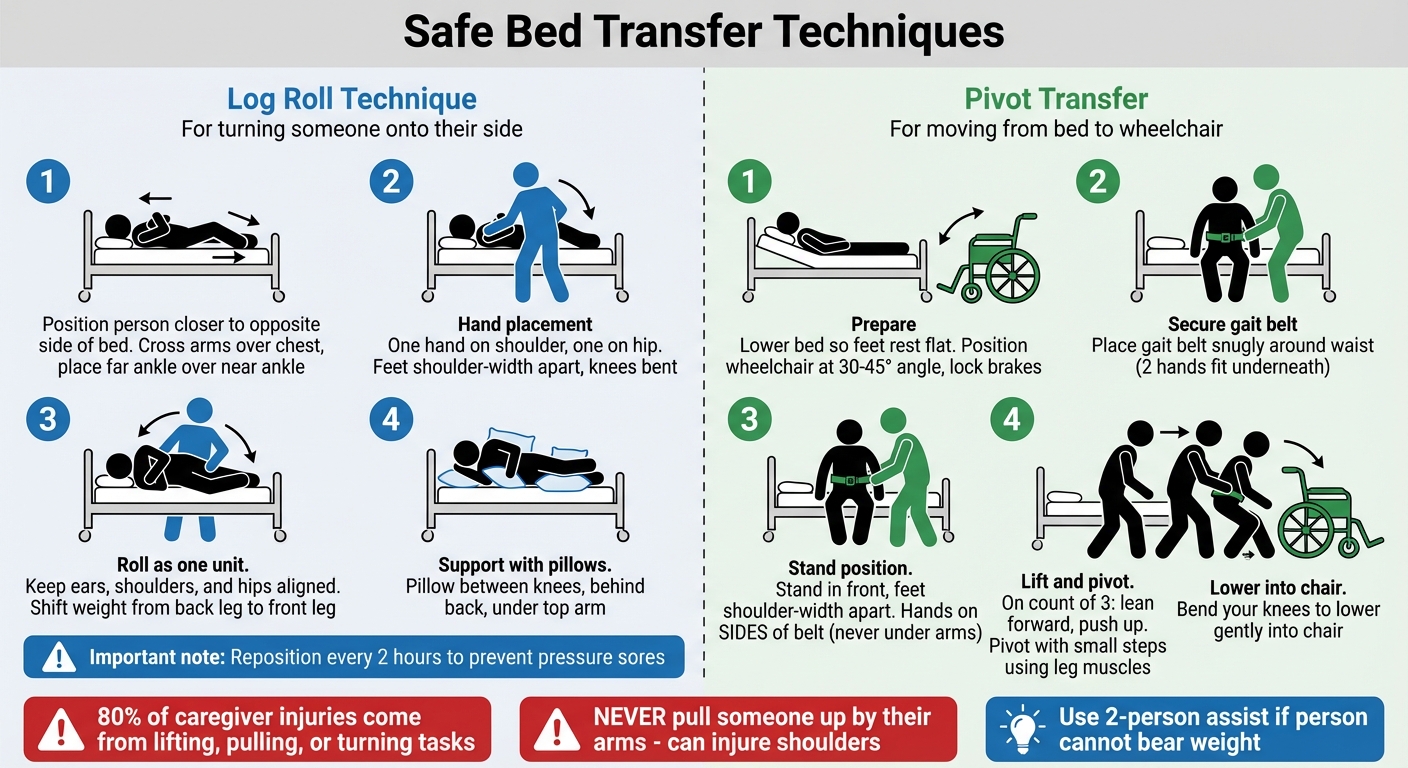
Safe Bed Transfer Techniques for Caregivers: Step-by-Step Guide
When it comes to bed transfers, using the right techniques can make all the difference in protecting your back and ensuring the safety of the person you're assisting. Two common approaches, log rolling and pivot transfers are designed for different needs and require careful positioning to prevent injuries.
How to Use the Log Roll Technique
The log roll technique is all about maintaining spinal alignment by moving the shoulders, hips, and knees together as a single unit. This method is especially useful when turning someone onto their side, particularly if they can't help with the movement.
Start by positioning the person closer to the side of the bed opposite the direction they’ll be rolling. Ask them to cross their arms over their chest and place the far ankle over the near ankle, this helps prevent their limbs from getting caught during the roll.
Place one hand on their shoulder and the other on their hip. Roll the edges of the drawsheet tightly to create secure handles for better grip. Make sure your feet are shoulder-width apart and your knees are slightly bent. As Elle Carlson, PT, DPT at Hinge Health explains, "The log roll technique can temporarily limit twisting by moving your shoulders, hips, and knees together as one unit".
Roll the person gently, keeping their ears, shoulders, and hips aligned. Instead of pulling with your back, shift your weight from your back leg to your front leg. Once they’re on their side, use pillows for support - place one between their knees (with the top leg slightly forward), another behind their back, and one under their top arm.
To prevent pressure sores, reposition bedridden individuals every two hours, focusing on bony areas like the hips, heels, and shoulders.
If the goal is to transfer someone to a wheelchair, the pivot transfer technique may be a better option.
Performing a Pivot Transfer with a Gait Belt
The pivot transfer is designed to move someone from the bed to a wheelchair or chair using a controlled standing and turning motion. However, this technique requires the person to bear at least some weight on their legs, even if they need significant assistance.
Start by lowering the bed so the person’s feet rest flat on the floor when seated at the edge. Position the wheelchair at a 30- to 45-degree angle to the bed, ensuring the brakes are locked and the footrests are out of the way. Secure the gait belt snugly around their waist.
Stand directly in front of the person with your feet shoulder-width apart for stability. Place your hands on the sides of the gait belt, never under their arms. As MedlinePlus emphasizes, "Never move a person up by grabbing them under their arms and pulling. This can injure their shoulders".
On the count of three, instruct them to lean forward and push up while you provide a controlled pull on the gait belt. Once they’re standing, pivot together by taking small, deliberate steps in a circle until they’re aligned with the wheelchair. Use your leg muscles to guide the movement, shifting your weight from one foot to the other instead of twisting your back. Finally, lower them into the chair gently by bending your knees.
If the person isn’t able to bear weight or assist with the transfer, a two-person assist is recommended to distribute the load and avoid injury. Both the log roll and pivot transfer techniques rely on controlled movements and proper weight distribution to protect your back. It’s worth noting that nearly 80% of caregiver injuries result from lifting, pulling, or turning tasks, and once you injure your back, there’s an 80% chance of re-injury.
Using PeelAways Sheets to Reduce Lifting Effort

PeelAways' multi-layer disposable sheets are a game-changer for simplifying bed changes and reducing physical strain. Their patented peel-away design eliminates the need to lift mattresses, making daily care tasks much easier. When a layer gets soiled, you simply peel it off to reveal a fresh sheet underneath, all in under 60 seconds. No wrestling with fitted corners or dealing with unexpected laundry loads.
These sheets are designed for one-handed use, which is a huge help if you're caring for someone alone or have limited strength. Instead of the usual routine of stripping, washing, drying, and folding linens, you can change the bedding directly on the mattress with minimal bending. This not only reduces physical effort but also minimizes disruption to the person you're caring for.
Each sheet features 5–7 waterproof layers made from a soft, breathable bamboo-rayon blend that feels just like regular bedding. If a layer isn’t soiled, it can last 7 to 10 days, and because the layers are disposable, you can cut down your laundry by up to 80%. Plus, you’ll avoid the hassle of handling heavy, wet linens.
"PeelAway sheets make life so much easier for patient care and caregivers. Absolutely a must-have item", says Sharon A., a verified buyer.
LaVora B. shares:
"The five-layer sheets allow sheets to be changed on the bed without taking the sheets off the mattress".
With a 4.7 out of 5-star rating from 265 caregiver reviews and 95% of users recommending them, PeelAways has even been named "Caregiver Product of the Year".
They’re available in sizes ranging from Crib ($30.99) to King ($53.99), with Twin XL priced at $34.99. For caregivers dealing with incontinence, post-surgery recovery, or elderly care, these sheets are a practical solution for incontinence care. They save time and energy, helping to ease the physical demands that often lead to caregiver burnout.
Other Tools That Help Reduce Physical Strain
PeelAways sheets simplify bedding changes, but other tools like slide sheets and absorbent bed pads can also make repositioning and incontinence care easier. Together, these tools help lighten the physical demands on caregivers. Addressing the emotional challenges of caregiving is equally important for long-term wellbeing.
Slide Sheets for Friction Reduction
Slide sheets are designed to minimize friction, allowing you to pull instead of lift someone when repositioning them. By reducing resistance between the person and the bed surface, they make tasks like moving someone up in bed, transferring them across the mattress, or rolling them onto their side much easier.
"Slide sheets are low friction devices when used correctly can minimise the risk of injury to the caregiver and the person you are moving".
For best results, use two slide sheets together so they glide against each other rather than the patient’s skin. The sheets should be long enough to support the person from head to heels. Adjust the bed to a comfortable height and use your legs to shift your weight while moving the person. Always remove the sheets immediately after the transfer to prevent accidental sliding.
Absorbent Bed Pads for Incontinence Management
Absorbent bed pads are another helpful tool, especially for managing incontinence. These pads save time and effort by reducing the need to change entire bedding after accidents.
Simply place a disposable pad on top of the bedding, and when it becomes soiled, remove and replace it without disturbing the rest of the bed. This approach eliminates the need to lift heavy mattresses or frequently retuck sheets.
For added convenience, select pads with anti-slip backings or adhesive strips to keep them in place. Quilted underpads can also help reduce friction during minor repositioning while protecting the mattress from leaks. Keep clean pads, gloves, and wipes within easy reach to make the process smoother.
For a more efficient setup, consider layering a waterproof mattress protector, a fitted sheet (or PeelAways multi-layer sheet), and a disposable bed pad. The peel-away design of PeelAways sheets, combined with this method, simplifies bedding changes and reduces repetitive strain from frequent adjustments.
Maintaining Dignity During Transfers
Ensuring dignity during transfers goes hand in hand with using proper techniques. It's not just about the physical act, it's about treating the person as an individual, not just a task. Clear communication, maintaining privacy, and using appropriate tools can make the process more comfortable and respectful. Explaining each step and seeking the person's input fosters a sense of control and respect during what can be a vulnerable moment.
Start with clear communication. Before making any adjustments or physical contact, explain what you're about to do. This helps avoid startling the individual and encourages relaxation, which is key to a safer transfer. Simple phrases like, "I'm going to help you move up in bed now", or "We're going to roll you onto your left side", followed by, "Are you ready?" can make a big difference. It gives them the chance to prepare and feel in control of the process.
Ensure privacy at all times. Small actions, like closing a door or drawing curtains, can significantly reduce discomfort. Keeping the person covered with a sheet or blanket during the transfer also helps maintain their privacy and dignity, showing respect for their feelings in what might be an uncomfortable situation.
Use calm, coordinated instructions. If the person is able to assist, provide clear and simple cues, such as "push with your heels" or "bend your knees." Rhythmic phrases like "ready, rock, and stand" or counting to three can help synchronize movements, creating a sense of teamwork and preserving their independence.
Respectful language pairs well with tools that prioritize comfort. Choose tools designed for gentleness and quietness. For example, PeelAways sheets, made from soft bamboo/rayon fabric, feel like regular bedding and are completely noiseless. This avoids the crinkling sounds often associated with incontinence care, maintaining a calm and normal bedroom atmosphere. When combined with slide sheets for repositioning, these tools allow for smooth, controlled movements instead of abrupt or jerky actions.
As one caregiver resource puts it:
"Maintaining dignity when lifting a bedridden patient is an ongoing effort. It's choosing calm words when you're tired. It's pausing when they look uncomfortable. It's treating them as a person first, not a task." - San Pablo Commercial Medical Supply
Conclusion
Taking care of your back while ensuring quality patient care boils down to using proper techniques and tools. Always rely on assistance when transferring patients. Adjust the bed to a comfortable height - waist or hip level - shift your weight from your back to your front leg, and use friction-reducing tools like slide sheets to pull rather than lift. As UMass Memorial Health wisely points out, "It's better to wait for help than to risk injury to the patient or yourself".
PeelAways sheets offer a simple way to reduce physical strain by eliminating the need to lift heavy, soiled bedding during nighttime accidents or incontinence care. Their peel-away layers and soft, quiet fabric ensure a clean and comfortable surface without the hassle of heavy lifting. These practices, paired with the right tools, protect your back and preserve your patient’s comfort and dignity.
To make daily care even easier, PeelAways is offering blog readers an exclusive 10% discount. Use code BLOGS10 at checkout to save on PeelAways sheets. You can also combine this discount with subscriptions or bundles for even greater savings while streamlining your care routine.
PeelAways sheets are available for purchase on Amazon or directly from PeelAways.com.
FAQs
When should I use a two-person assist instead of doing the transfer alone?
When someone is too heavy, uncooperative, or positioned awkwardly, it's crucial to use a two-person assist for lifting or repositioning. This method not only reduces the risk of injury to the caregiver but also ensures the safety and comfort of the individual being moved.
How do I know if someone can safely do a pivot transfer?
To figure out if someone can safely perform a pivot transfer, start by evaluating their ability to contribute to the movement. Can they use their arms and legs effectively? Are they able to sit or stand up and stay stable during the process? It's also important to take their overall health and mobility into account, as well as any equipment they rely on or wounds that might interfere. If they’re unable to assist or face major mobility challenges, you may need to explore other methods or get extra help.
What bed height is safest for different types of transfers?
The safest bed height for transfers like moving laterally from a wheelchair to a bed - is when the mattress height aligns with the wheelchair seat height, ideally within a 0.8 to 2-inch range. This alignment allows for a smooth, horizontal movement and lowers the risk of injury. For tasks like repositioning someone in bed, raising the bed to about waist level can help reduce strain on the caregiver's back. Using a firm mattress is also important, as it helps maintain a consistent height during these transfers.
Related Blog Posts
Comments
0



SAVE MONEY & WATER
Professionals & Institutions save a fortune on labor/laundry.

SUPERIOR COMFORT
The first thing our customers notice is how soft our sheets are.

100% WATERPROOF
Each layer is 100% Waterproof, perfect for spills and accidents

SAVE TIME
Change the sheet in under 1 minute without stripping the bed.

Leave a comment