
Best Waterproof Sheets for Bedwetting: A Parent's Guide

Your child is mortified. You’re exhausted. And you’re both pretending this isn’t happening three times a week. It’s 2 a.m., the bed is wet again, and all you want is to get your kid dry and back to sleep without turning on every light in the house.
If you want the best waterproof sheets for bedwetting, start with the setup that cuts the midnight change down the most. For many parents, that means PeelAways, because you can remove one wet layer in about 60 seconds instead of doing a full 15–20 minute sheet change. Each set has 5–7 waterproof layers, comes in sizes crib to king, and has 28,000+ reviews with a 4.8-star rating.
- Best for the fastest cleanup: PeelAways multi-layer sheets
- Best reusable base layer: waterproof fitted sheet or mattress protector
- Best low-cost add-on: washable absorbent bed pad
- Best reusable setup for repeated accidents: layered protector + pad + fitted sheet
| Option | Change Time | Laundry | Best Fit |
|---|---|---|---|
| PeelAways | About 60 seconds | Very low | Frequent bedwetting, heavy accidents, tired parents |
| Waterproof protector | 15–20 minutes for full reset | High | Mattress protection every night |
| Washable bed pad | Fast if the leak stays on the pad | Medium | Lighter accidents, backup layer |
| Layered setup | Fast if pre-made | Medium | Reusable setup with less nighttime work |
Here’s the short version: if wet nights happen a lot, the setup on the bed matters almost as much as the accident itself.
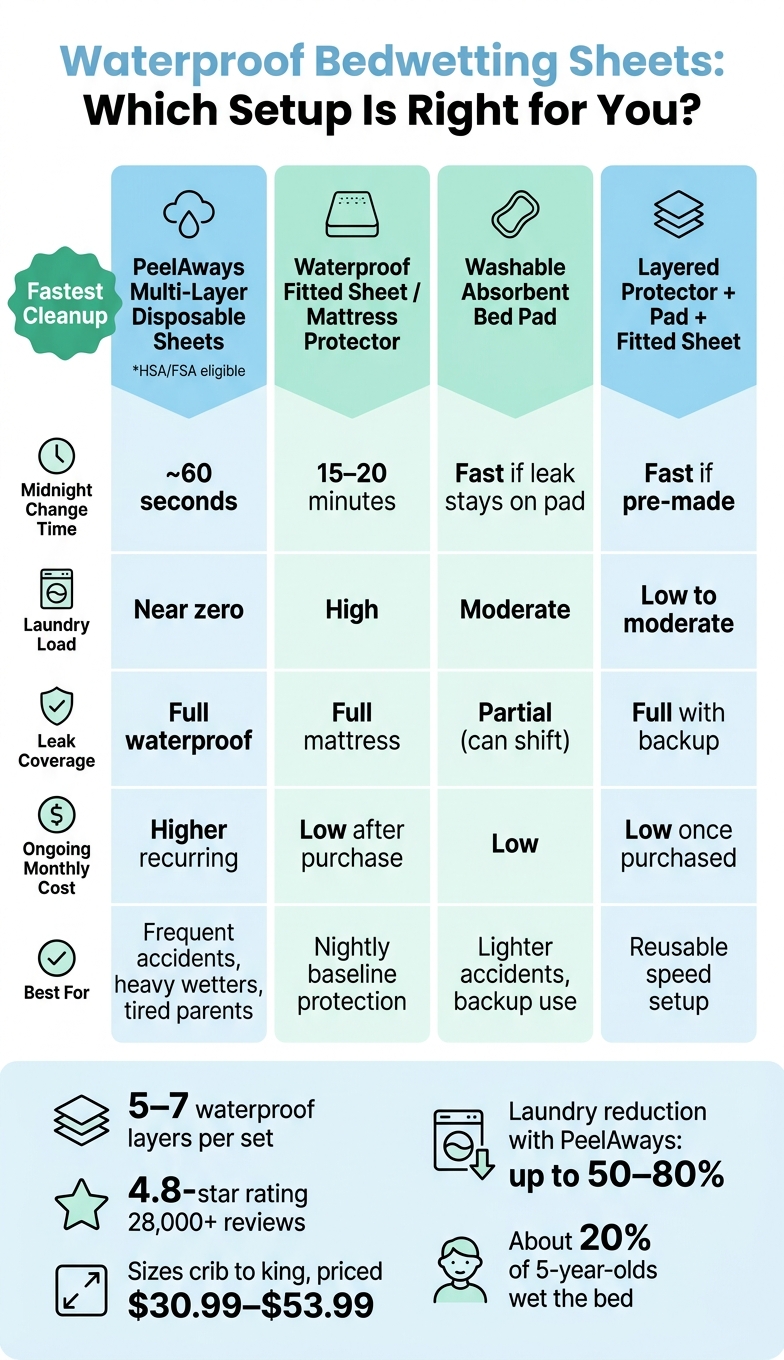
Waterproof Bedwetting Sheets Compared: Speed, Laundry & Cost
Quiet & Soft Bed Protection for Bedwetters
Why this problem is harder than people realize
Bedwetting is common, but that does not make it easy.
About 20% of 5-year-olds wet the bed, and millions of children in the U.S. deal with it. What people miss is the part after the accident. The wet pajamas. The cold sheets. The child trying not to cry. The parent trying not to snap because it’s the third load of laundry this week.
That’s why the “best” waterproof sheet is not just about stopping leaks.
It needs to do three things:
- Protect the mattress
- Feel soft enough to sleep on
- Make cleanup less of a full production
If one of those parts fails, your night falls apart with it.
What to look for before buying
Before I buy anything for bedwetting, I look at four things first.
1. Change time
This is the big one. If you’re stripping the whole bed at 2 a.m., you lose time, sleep, and patience.
2. Leak coverage
A small pad may work for one child and fail for another. Kids move. Wetness spreads. Edges matter.
3. Noise and heat
Some waterproof layers feel fine in the package and awful in bed. If it crinkles or sleeps hot, your child will notice.
4. Laundry load
A low sticker price can still cost you in detergent, water, drying time, and lost sleep.
If you already use diapers or nighttime pull-ups, you may still want sheet protection. Leaks happen. And when they do, the cleanup setup matters.
PeelAways multi-layer disposable waterproof sheets

This is the one I wish I had known about sooner.
PeelAways are stacked fitted sheets with 5–7 waterproof layers built into one set. When the top layer gets wet, you peel it off and the next dry layer is already there. That is why people talk about the 60-second bed change.
At 2 a.m., that time gap is huge.
Instead of pulling off wet sheets, fighting mattress corners, and remaking the whole bed, you remove one layer and move on. That can cut laundry by about 50–80%, which is not small when accidents happen often.
A few details that matter:
- Soft bamboo/rayon blend
- Quiet surface
- Waterproof but breathable feel
- Sizes from crib to king
- Can sit under a regular fitted sheet for older kids who want more privacy
- HSA/FSA eligible
- 28,000+ reviews and 4.8 stars
You can check PeelAways on the official shop or the Amazon listing.
I’d also point you to a couple of articles on the PeelAways site if you want more help with nighttime cleanup and bed protection: the PeelAways blog and more guides there on sleep and incontinence care.
Making aging and caregiving easier, one bed at a time.
Waterproof fitted sheets and mattress protectors
A waterproof protector is the layer I see as the baseline.
It protects the mattress from getting soaked, which matters because once urine gets into a mattress, the smell can stick around for a long time.
Most newer protectors are better than the old plastic kind. You can find soft knit or terry tops with a waterproof backing that feels less loud and less sweaty.
Still, here’s the hard part:
After an accident, you often have to change everything on top of it.
That means:
- Fitted sheet off
- Protector off if it got wet
- Clean layers back on
- Wet laundry started
If accidents are only once in a while, that may be fine.
If accidents happen most nights, this setup gets old fast.
Washable absorbent bed pads
Washable pads are the in-between option.
They sit on top of the sheet and catch a lot of the wetness before it reaches the mattress protector. If the accident stays on the pad, the swap can be fast.
That’s the upside.
The downside is movement. Some kids twist, kick, and slide all over the bed. A flat pad can shift out of place, and then you’re back to wet sheets anyway.
You also need extras.
Not one pad. Usually several.
That means:
- More washing
- More drying
- More storage
- More resets between nights
For some homes, pads work fine as part of a bigger setup. On their own, they can be hit or miss.
Layered protector + pad + fitted sheet
If you want a reusable setup but still need less nighttime work, this is often the setup people land on.
The pattern is simple:
- Mattress protector
- Absorbent pad
- Regular fitted sheet
Some parents even repeat the stack so there is another dry layer under the first one.
When the top layer gets wet, you remove that part and keep going.
This can work well, but it has trade-offs:
- More bulk on the bed
- More pieces to wash
- More heat for some sleepers
- More setup work before bedtime
It can be a solid reusable system.
It is just not as simple as peeling off one layer and being done.
Comparison table
| Product type | What it does best | Main downside | Best for |
|---|---|---|---|
| PeelAways | Fastest bed reset, very little laundry | Higher monthly spend, disposable | Frequent accidents, heavy wetters, deep sleepers |
| Waterproof protector | Full mattress coverage | Full bed remake after leaks | Backup protection under every setup |
| Washable pad | Simple top-layer protection | Can slide or bunch up | Lighter wetting, backup use |
| Layered setup | Reusable faster-change system | More bulk and more pieces | Parents who want reusable layers |
sbb-itb-45288fe
FAQ
Are waterproof sheets enough for bedwetting?
Sometimes. If accidents are small and not very often, a waterproof fitted sheet or protector may be enough. If leaks happen a lot, you may want a setup that also cuts change time.
What is the fastest bedding option for bedwetting?
From the options here, PeelAways is the fastest because you remove one wet layer instead of changing the full bed. That is the difference between about 60 seconds and 15–20 minutes.
Do washable bed pads stay in place?
Not always. Some do fine. Some slide, bunch, or get kicked loose. It depends a lot on how much your child moves at night.
Can older kids use PeelAways without it being obvious?
Yes. One detail I like is that it can go under a regular fitted sheet, which helps it look and feel less obvious.
Are PeelAways sold in twin and larger sizes?
Yes. They come in sizes crib to king, including sizes that work for older kids and teens.
Bottom line
If you are up changing wet sheets once in a while, a waterproof protector may do the job.
If this is happening over and over, I would not just shop by price. I would shop by how fast you can fix the bed when you’re half-asleep.
That’s why PeelAways stands out to me.
You get 5–7 waterproof layers, sizes crib to king, and a bed change that can take about 60 seconds. That means less laundry, less disruption, and a little more dignity for your child when the night goes sideways.
You can find PeelAways at
1. PeelAways Multi-Layer Disposable Waterproof Sheets
It’s the middle of the night. The bed is wet, your child is upset, and you’re standing there half-awake knowing a full sheet change could turn into a 20-minute mess. That’s the kind of moment PeelAways was made for.
Each PeelAways sheet has 5 to 7 waterproof layers. You peel off the wet top layer, and a dry one is already there underneath. The whole bed change takes under 60 seconds.
That speed matters more than people think. Less scrambling. Less laundry. Less stress for you, and less embarrassment for your child.
The fabric uses a soft bamboo/rayon blend with a breathable membrane that blocks liquid while still letting air move through. So it doesn’t feel stiff or crinkly. It’s quiet, soft on skin, and made without PVC, vinyl, phthalates, or fire retardants. The materials are also hypoallergenic.
For older kids, this part stands out: the sheet can sit under a regular fitted sheet. So when there’s an accident, cleanup is simpler and a lot less obvious. Sometimes that small bit of privacy makes a hard night feel a little easier.
PeelAways comes in sizes from Crib-A-Peel through King, so it works whether you’re dealing with a toddler bed, a Twin, or a Twin XL for an older child. Current U.S. prices range from $30.99 to $53.99. Twin and Twin XL are common picks for kids’ beds. You can also buy them with HSA or FSA funds, and there’s a 30-day money-back guarantee.
PeelAways is one of those products I wish more tired families knew about sooner. It’s built for the exact moment when you do not have time, energy, or spare patience. And if you already use pads or nighttime protection, it fits right into that routine.
Making aging and caregiving easier, one bed at a time.
You can find PeelAways here:
- Shop on PeelAways
- Buy PeelAways on Amazon
- Read more on the PeelAways blog: peelaways.com
| Size | Layers | Price |
|---|---|---|
| Crib-A-Peel | 5 | $30.99 |
| Travel crib | 7 | $34.99 |
| Twin | 5 | $34.99 |
| Twin XL | 5 or 7 | $34.99–$41.99 |
| Full | 5 | $43.99 |
| Queen | 5 | $47.99 |
| King | 5 | $53.99 |
PeelAways also has 28,000+ reviews and a 4.8-star rating, which says a lot when you’re buying something for the hardest part of the day.
If you want a reusable option, the next section covers fitted sheets and mattress protectors.
2. Waterproof Fitted Sheets and Mattress Protectors
It’s 2 a.m. again. The bed is wet, your loved one is upset, and you’re standing there knowing this isn’t a one-minute fix.
If you want a reusable setup, waterproof fitted sheets and mattress protectors are usually the next thing people try. They have a moisture-blocking layer - most often polyurethane - that keeps urine from soaking into the mattress.
You’ll usually see two common styles. A 5-sided fitted protector covers the top and sides, which makes day-to-day use a little simpler. A full encasement zips around all six sides, which can help if you’re also dealing with allergies, dust mites, or bed bugs.
The good news? Newer protectors are a lot better than those old crinkly plastic ones. Most use a soft fabric top with a thin polyurethane membrane, so they tend to feel quieter and less sweaty. When you shop, pay attention to terms like “breathable,” “quiet,” and “soft knit surface.” It also helps to check that the protector is free from vinyl, PVC, and phthalates.
But here’s where the hard part hits. After an accident, you still have to strip the bed and make it all over again. That means pulling off the wet top sheet, wrestling the fitted protector off the mattress corners, and putting fresh bedding back on. On a bigger bed, or when more than one layer is wet, that can take 10–15 minutes or more.
And at 2 a.m., that feels like forever.
That’s why the time gap matters so much. A lot of families end up pairing a mattress protector with an absorbent pad on top. The protector stays put, and only the top layer gets changed after an accident.
3. Washable Absorbent Bed Pads and Underpads
It’s 2 a.m. again. The top layer is wet, the fitted sheet may be damp too, and you’re standing there half-awake hoping the mattress didn’t get hit this time.
When you use a mattress protector with a top layer, washable absorbent bed pads are often the part you change first. They sit on top of the fitted sheet and give you a faster swap than changing the whole bed. But there’s a catch: bulkier washable pads aren’t the easiest thing to pack for travel, and they’re not always easy to keep hidden under regular bedding.
Common U.S. sizes include 34 x 36 in. and 34 x 52 in. The larger size gives you more coverage on a twin or queen bed.
The hard part is the laundry. You don’t buy one and call it a day. You buy a few, wash them, dry them, and keep rotating them. If nighttime accidents happen often, families can end up running as many as 15 loads of laundry just to keep up. And after each accident, you still have to strip the bed and wash soiled items right away to help stop odors from setting in.
The other big issue is placement. A flat pad can slide during the night and leave part of the bed exposed. That’s the kind of problem that turns a small accident into a wet mattress and a much longer cleanup. Sheet straps can help keep the pad in place, but now you’ve added one more thing to deal with when you’re already tired.
On paper, washable pads can look like the lower-cost option at first. In real life, the water, energy, and time spent washing and drying start to pile up. That’s why a lot of families use them as just one part of a layered setup.
4. Layered Protector + Pad + Top Sheet Setups
It’s 2 a.m. again. The bed is wet, your child is half-awake, and you’re trying to fix everything fast without turning the whole house upside down.
If pads keep bunching up or cleanup still drags on, layered bedding can make the night a lot easier. The setup is simple: a waterproof protector on the mattress, an absorbent pad on top, and a regular fitted sheet over everything. When there’s an accident, the mattress stays covered, and you only need to pull off the wet top layer. That’s the part that saves your energy when you do not have time to remake the whole bed.
The big win here is speed. For older kids, it can also help with embarrassment because they may be able to change that top layer on their own. This setup fits best if you want a reusable system but still need bed changes to happen fast and quietly.
Sheet straps can help keep layered bedding from sliding during the night. And if your child likes the feel of normal bedding, put a standard cotton fitted sheet over the waterproof layers. That way, the protection stays out of sight instead of feeling obvious. The breathable layer can also make the bed feel less noisy and less hot than plastic protectors.
Next, we’ll look at how each option holds up when the alarm goes off at 2 a.m.
How Each Option Holds Up at 2 a.m.
It's 2am. Your child is wet, half-awake, and fighting sleep while you're pulling back damp sheets with one hand and trying not to lose your patience with the other. In that moment, the setup on the bed decides how long you're up, how much laundry waits for you in the morning, and how comfortable your child feels getting back to sleep.
When an accident happens at 2 a.m., the right setup affects cleanup time, laundry, and your child's comfort. So let's look at what matters most: leak control, change speed, comfort, and cleanup.
Leak Protection
Layered setups usually protect the mattress best. The pad takes the first hit, and the waterproof base catches what gets through. That extra backup matters when the accident is more than a small spot.
PeelAways stay fully waterproof when fitted correctly. That's a big deal when you need the bed to stay dry the first time, not after trial and error.
Waterproof fitted sheets do block leaks that go straight down. But if urine spreads, it can pool or run toward the edges. Washable pads help too, though they only protect the area they actually cover. If your child moves a lot in sleep, that's the catch.
Midnight Change Speed
This is where the differences get very real.
PeelAways is the fastest option here. You peel off the wet layer and move on. No full bed remake. No digging for clean bedding while everyone is tired.
A washable pad swap is often fast too, if the wetness stays contained. A pre-layered setup can be close behind when you've built it the right way ahead of time. You remove the wet top layer and still have a clean surface underneath.
Waterproof fitted sheets on their own are the slowest option. At 2 a.m., stripping and remaking the whole bed feels like a cruel joke.
Comfort and Noise
At night, little things feel big. A crinkly sheet can keep a tired child awake. A hot fabric can make sleep harder than it already is.
Quiet, breathable fabric matters most here. PeelAways use a soft bamboo/rayon blend. High-quality terry- or jersey-topped protectors are usually low-noise too. Vinyl-backed options, on the other hand, can feel hot or stiff.
If your child is sensory-sensitive, this part isn't minor. Fabric-backed, noiseless options can make a huge difference in how well they settle back down.
Laundry and Cost
If you're choosing based on budget and how much washing you can handle, this table gives the short version.
| Option | Laundry Load | Ongoing Monthly Cost | Best For |
|---|---|---|---|
| PeelAways Multi-Layer Disposable | Near zero - just peel and discard | Higher recurring cost | Frequent accidents, heavy wetters, kids who move a lot at night |
| Waterproof Fitted Sheet/Protector | High - full bed strip each accident | Low after the initial purchase | Baseline mattress protection for all setups |
| Washable Absorbent Pad | Moderate - pad washes with regular laundry | Low | Contained accidents, shared bedrooms |
| Layered Protector + Pad + Sheet | Low to moderate - usually just the pad and top sheet | Low once purchased | Families wanting a reusable speed setup |
Reusable setups cost less over time, but they also mean more wash cycles. Disposable layers cost more month to month, but they cut down on water, detergent, electricity, and something that doesn't get talked about enough: your time.
And at 2 a.m., time feels pretty expensive.
Pros, Cons, and the Right Setup for Your Family
It’s 2am. You’re pulling off wet pajamas in the dark, trying not to wake your child all the way up. You want the bed dry, the room calm, and this whole mess over FAST.
No bedding setup fits every family. The right choice comes down to three things: how fast you need a change, how your child sleeps, and how much laundry you can live with.
Quick Pros and Cons
| Bedding Type | Pros | Cons |
|---|---|---|
| PeelAways Multi-Layer Disposable Sheets | 60-second changes; no laundry; designed to block leaks; noiseless; soft bamboo/rayon blend; HSA/FSA eligible | Ongoing cost; disposable waste; needs a secure fit for active sleepers |
| Waterproof Fitted Sheet/Protector | Protects the whole mattress; feels like a normal sheet; breathable | Requires stripping the bed and washing after every accident |
| Washable Absorbent Pad | Reusable; easy to swap in the middle of the night | Can shift during sleep; only covers part of the bed; frequent washing required |
| Layered Protector + Pad + Sheet | Best for full-bed coverage | Bulkier setup; multiple items to wash; can sleep hot |
Matching the Setup to Your Situation
The hard part isn’t just stopping leaks. It’s finding a setup you can deal with when you’re tired, your child is upset, and the bed has to be fixed right now.
If accidents happen only once in a while, a waterproof fitted sheet is often enough. You get full mattress protection without much fuss most nights.
If wetting happens most nights, a multi-layer disposable setup usually saves the most time and cuts down on laundry. When this is part of your nightly routine, speed matters more than people think. A 60-second change is very different from a 15- to 20-minute bed reset.
If you are potty training, fast changes matter most. You don’t want a long cleanup turning one accident into a full wake-up.
If your child is older and embarrassed, a setup that stays hidden under a standard fitted sheet can help. Keeping the protection out of sight can make a rough night feel a little easier to handle.
If your child is sensory-sensitive, pay close attention to texture and sound. A soft, quiet fabric may matter just as much as leak protection. If the material feels rough or makes noise every time they move, sleep can fall apart fast.
If you’re paying with HSA or FSA funds, cost may be less of a hurdle. HSA/FSA eligibility can lower upfront cost.
If you want to look at PeelAways directly, you can check the PeelAways shop or the Amazon listing for PeelAways. For more help sorting out overnight changes and bed protection, see other guides on peelaways.com, like their blog articles on sleep, incontinence, and easier nighttime cleanup.
Conclusion
It’s 2 a.m. again. The bed is wet, everyone is tired, and the last thing you want is a full sheet change when all you need is to get your loved one dry and back to sleep.
Bedwetting wears on sleep, patience, and the laundry pile. In that moment, the best setup is the one that protects the mattress and helps you reset the bed fast.
The right choice depends on how often accidents happen, how much laundry you can handle, and how fast you need the bed ready again. Try to match the bedding to the pattern, not just the accident itself.
When wet nights happen often, change time matters just as much as leak protection. That’s where PeelAways stood out for me. It uses peel-off layers, cuts down on laundry, and makes those middle-of-the-night bed changes much easier.
If frequent accidents are part of your routine, PeelAways is built to make cleanup faster and take some of the stress out of overnight care.
If you want to take a look, you can find PeelAways at peelaways.com/shop and on Amazon. You can also read more on the PeelAways blog for tips on bedwetting, incontinence care, and easier nighttime cleanup.
Blog readers save 10% with code BLOGS10 at checkout. Available on peelaways.com and Amazon. Free shipping on orders over $100.
Comments
0



SAVE MONEY & WATER
Professionals & Institutions save a fortune on labor/laundry.

SUPERIOR COMFORT
The first thing our customers notice is how soft our sheets are.

100% WATERPROOF
Each layer is 100% Waterproof, perfect for spills and accidents

SAVE TIME
Change the sheet in under 1 minute without stripping the bed.

Leave a comment