
Best Overnight Bed Protection for Kids Who Wet the Bed

Your child is mortified. You're exhausted. And you're both pretending this isn't happening three times a week. It's 2 a.m., the bed is wet again, and you're trying to fix it without turning a hard moment into a full wake-up.
The best overnight bed protection for kids who wet the bed is a setup that keeps the mattress dry, cuts cleanup time, and lowers laundry. For many parents, that means a waterproof base layer plus a top layer you can swap fast. If you want the fastest bed change, PeelAways stands out with 5–7 waterproof layers, a 60-second change instead of 15–20 minutes, 50–80% less laundry, 28,000+ reviews, a 4.8-star rating, and sizes from crib to king.
- PeelAways layered sheets: best for fast overnight changes
- Waterproof mattress protectors: best as the base layer
- Washable absorbent pads: best if you want a reusable top layer
- Disposable absorbent pads: best for throw-away cleanup
- Nighttime pull-ups with snug pajamas: best as the first layer on your child
| Option | Best for | Main tradeoff |
|---|---|---|
| PeelAways | Fast bed changes and less laundry | Higher upfront spend |
| Mattress protector | Mattress safety | Doesn't solve sheet changes |
| Washable pad | Reuse | More wash loads |
| Disposable pad | Easy toss-away cleanup | More trash and repeat spend |
| Pull-ups + pajamas | Source control | Can still leak |
If you've been doing sheet changes in the dark, this is the part that matters: the best setup is the one that gets you back to sleep with the least mess and the least stress.
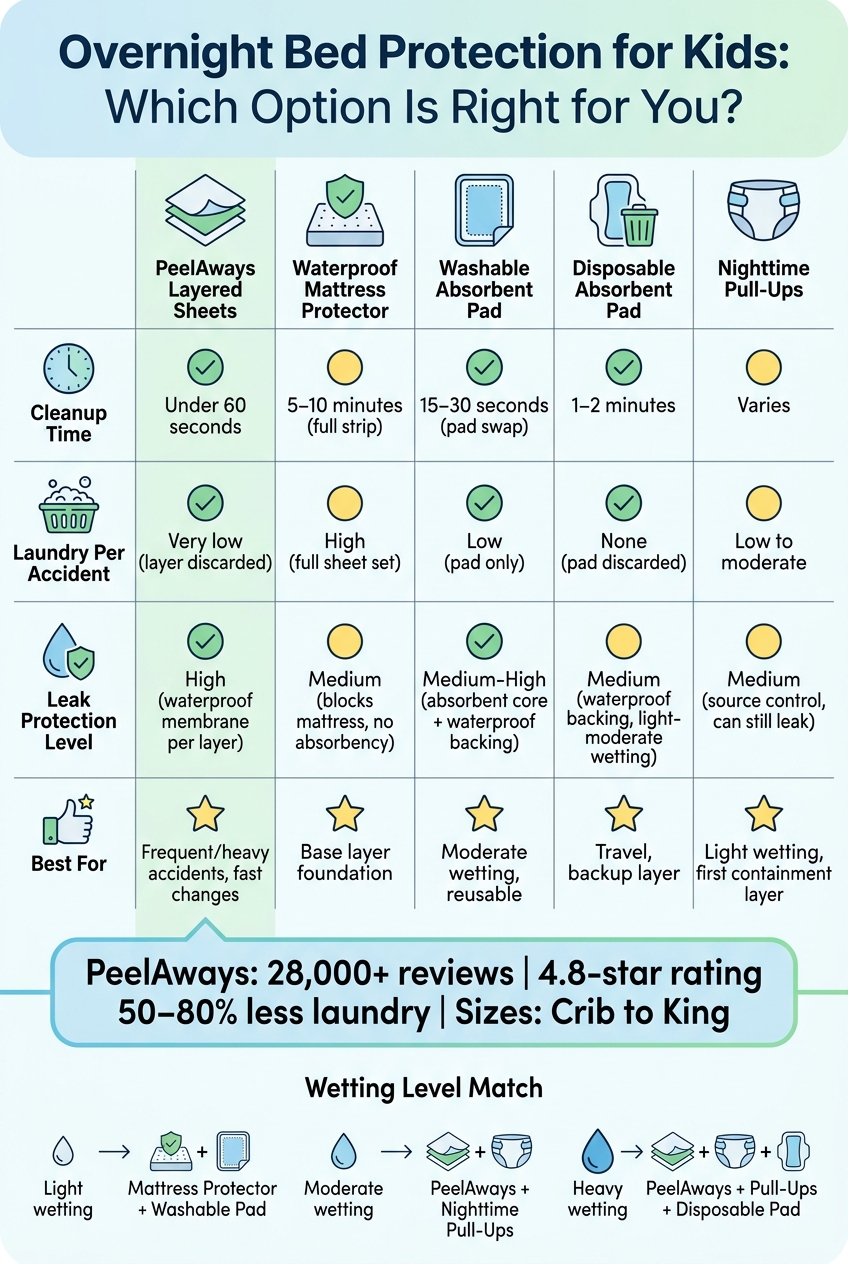
Overnight Bed Protection for Kids: Comparison Guide
Bed Wetting Solutions: 5 Steps Every Parent Should Know
sbb-itb-45288fe
1. PeelAways Layered Disposable Waterproof Bed Sheets

It’s the middle of the night. The bed is wet again, your child is upset, and you’re standing there half-awake knowing this could turn into a full sheet change. That’s the moment PeelAways can change everything.
PeelAways are disposable waterproof fitted sheets with built-in layers of protection. When one layer gets wet, you peel it away and there’s already a clean, dry sheet underneath. The whole change takes under 60 seconds. No lifting the mattress. No stripping the bed.
Leak Protection
Each layer has a breathable waterproof membrane that stops liquid from soaking through to the next layer. That means the mess - and the odor - stay locked into the soiled layer. If you’re dealing with heavy wetting, that kind of backup matters.
They’re also made without vinyl, PVC, phthalates, or fire retardants.
Overnight Change Speed
This is where PeelAways stands out. A wet layer peels off in under 60 seconds, which makes those awful overnight accidents a lot less disruptive.
And honestly, that speed does more than save time. It can help your child feel less exposed in a hard moment.
Laundry Reduction
Because the next clean sheet is already in place, you don’t have to strip the bed and wash sheets after every accident. PeelAways can cut laundry by 50% to 80%.
For hygiene, peel the top layer only after an accident or every 7 to 10 days, whichever comes first.
Sleep Comfort
Nobody wants a crinkly bed. PeelAways use a soft, breathable fabric that stays quiet through the night. If your child likes the feel of a regular bed, you can also put a standard fitted sheet on top for a more familiar setup.
Sizes run from crib to king, and they’re HSA/FSA eligible.
If you want a more lasting barrier that stays on the bed itself, the next option is a waterproof mattress pads vs. disposable sheets.
2. Waterproof Mattress Protectors
It’s 2am. The sheets are damp again. You’re trying to keep your loved one calm while silently begging the mattress not to be ruined too.
A waterproof mattress protector is the layer that keeps urine off the mattress and helps stop stains and odors. For most families, it works best as the base layer under an absorbent top layer.
Leak Protection
A good protector should block about 400–500 mL (13.5–17 oz) without leaking for at least two hours. That’s about one full bladder emptying.
If wetting is heavy, a zippered encasement gives more complete mattress coverage. It wraps all six sides and protects the edges and seams too. That matters most at night, when one leak can turn into a full bed-strip job.
Overnight Change Speed
Here’s the hard truth: changing a mattress protector in the middle of the night is slow, awkward, and exhausting. It pulls at the bed. It wakes everyone up.
That’s why it makes more sense to leave the protector on as a permanent base layer and only change the absorbent layer on top.
Laundry Reduction
A mattress protector protects the bed. It does not cut down laundry on its own.
Once it gets soiled, you’re dealing with a bulky item that can eat up most of a washer load. A simpler setup is to keep 2–3 washable pads on top of the protector and rotate those instead of washing the protector after every accident. On most wet nights, you’ll only need to wash the pad, not the protector.
Also, skip fabric softener and bleach. Both can wear down the waterproof membrane.
Sleep Comfort
Older vinyl protectors had a bad reputation for a reason. They crinkled. They trapped heat. They made an already rough night feel even longer.
Polyurethane-backed protectors with cotton terry or bamboo-viscose tops are quieter and let more air through. If the person in bed is a light sleeper or tends to sleep hot, check for labels like “breathable” or “cooling.”
Price-wise, budget picks start around $9.99 for a twin size. Mid-range protectors usually land between $25 and $45.
If you’ve ever tried to peel off a wet fitted sheet while half asleep, you already know the next issue isn’t just protection. It’s speed. For faster middle-of-the-night cleanup, the next option is an absorbent pad placed on top.
3. Washable Absorbent Bed Pads
It’s the middle of the night. The bed is wet, your child is half-awake, and you’re trying to fix it without turning on every light in the house. You don’t want to strip the whole bed again. You just want something that makes this part easier.
For families who want faster cleanup without changing the whole bed, disposable vs. washable bed sheets comparisons often show that washable pads are a practical next step. They add a reusable top layer that absorbs urine before it reaches the mattress. Many child-focused pads hold enough for a typical overnight accident, depending on output.
Leak Protection
Most good washable pads use three simple layers: a soft quilted top, an absorbent inner core, and a waterproof backing. That setup helps stop moisture before it sinks down into the mattress.
If your child moves a lot in sleep, this part matters more than people think. Pads with tuck-in sides can wrap around the mattress edge and stay in place through the night, instead of sliding around or bunching up.
Overnight Change Speed
This is where washable pads help most. Since the pad sits on top of the bed, you can pull it off and swap in a clean one in 15–30 seconds without touching the sheets underneath.
That kind of time gap adds up fast when you’re tired. Fifteen to thirty seconds feels very different from a full sheet change at 2 a.m.
Laundry Reduction
Washable pads can cut down the laundry to one smaller item instead of a whole bed’s worth of bedding. On most wet nights, only the pad needs to be washed, not the full set of sheets and blankets.
Many pads are rated for 300–500 machine washes while still staying waterproof and absorbent. That can make them a solid fit if accidents happen often and you’re tired of washing everything, every time.
Sleep Comfort
Comfort matters. If the pad feels stiff, hot, or noisy, a child will notice.
Quilted tops tend to feel closer to a regular mattress pad. TPU waterproof backing is quieter and cooler than plastic backing, which can help if your child sleeps hot or wakes easily. A non-slip or tuck-in design also helps the pad stay flat, so there’s less bunching under them through the night.
If you like the idea of a top-layer fix but don’t want more laundry, the next option is disposable absorbent pads.
4. Disposable Absorbent Bed Pads
It’s the middle of the night. You feel that damp spot before you even turn on the light. Your child is half-asleep, upset, and you’re just trying to fix the bed without turning the next 20 minutes into a full reset.
Disposable absorbent bed pads are often the fastest throw-away option for overnight cleanup.
These single-use pads have a waterproof backing and sit on top of the fitted sheet under the hips. When an accident happens, you pull the pad off, toss it, and put down a new one.
Leak Protection
For light to moderate wetting, a pad that’s placed the right way will usually handle a typical overnight accident. For heavier wetting, go with a larger pad and add a waterproof mattress protector underneath.
That extra layer can make a big difference. If the pad gets overwhelmed, at least the mattress still has backup.
Overnight Change Speed
This is where disposable pads help the most. Since the pad sits on top of the sheet, the change is simple: roll your child slightly, pull away the wet pad, and replace it. In many cases, that takes under 1–2 minutes.
It’s one of those small things that feels huge at 2 a.m. Keep a stack of clean pads and a small trash bag within reach of the bed, and the whole process gets even easier.
Laundry Reduction
On nights when the pad works as planned, only the pad gets thrown away. The rest of the bed usually stays dry.
That means fewer sheet changes, less laundry, and less disruption when everyone should be sleeping.
Sleep Comfort
Comfort matters because kids tend to notice noise and texture first. Look for a soft, cloth-like top and a quiet backing so there’s less crinkling.
Some children still notice the pad. If sensory sensitivity is part of the picture, soft cotton pajamas can help cut down on direct skin contact while still keeping the protection in place.
If volume or shifting is still the issue, the next section looks at how pull-ups and pajamas can help limit how much reaches the bed.
5. Nighttime Pull-Up and Pajama Pairings
It's the middle of the night. Your child is finally asleep, and you're just hoping the bed stays dry long enough for everyone to get some rest.
Sleep Comfort
Choose a snug pull-up with soft, close-fitting pajamas to help contain leaks, keep the fit secure, and cut down on sleep disruption. You're aiming for fewer leaks, less bunching, and a bedtime routine that doesn't turn into a struggle by managing overnight accidents effectively.
Pull-ups help limit how much urine reaches the bed. Close-fitting pajamas help hold the pull-up in place and reduce friction, so your child is less aware they're wearing protection.
That setup can mean a drier bed and a calmer night. Establishing consistent bedwetting routines can further support this transition. Here's how the main options compare on a typical night.
How Each Protection Type Performs on a Typical Night
It’s 2 a.m. again. The bed is wet, your child is half-asleep, and you’re standing there doing the math in your head: full sheet change, more laundry, less sleep, and a hard morning waiting for both of you.
The right setup depends on three things: how much your child wets, how fast you need cleanup, and how much washing you can keep up with each week. Start with leak control. Then look at what makes the middle-of-the-night change less of an ordeal.
Leak Protection
First things first: you need something that keeps the mattress dry and cuts down how much bedding you have to change while your child stays asleep.
A waterproof mattress protector is the starting point. It stops urine from reaching the mattress, but it doesn’t soak up much by itself.
Washable absorbent pads do more of the heavy lifting. They add solid absorbency and have a waterproof backing.
Disposable absorbent pads work in much the same way, except you throw them away after use.
Nighttime pull-ups are often the first layer of containment. The overnight versions usually do a better job than daytime ones because they have denser cores and taller side guards. Standard daytime pull-ups can give out once they’re fully wet.
Then there’s PeelAways. It adds a waterproof layer right at the sheet level, so when the top layer gets soiled, you peel it away and a clean layer is already underneath.
Protection is one part of it. But at 3 a.m., speed matters just as much.
Overnight Change Speed
This is where the gap between options gets obvious.
A fully wet bed can take 5 to 10 minutes to strip and remake. In the middle of the night, that feels like forever. It wakes your child up more, drags you out of bed longer, and turns one accident into a full reset.
The setups that work best let you change only the wet layer.
A basic layered system helps because you can remove the top wet piece and leave the dry base alone. With PeelAways, the change takes under 1 minute - peel off the soiled layer, and a clean, dry, waterproof one is already there. No full bed remake.
That sounds small on paper. It doesn’t feel small when you’re exhausted.
Cleanup time is only half the battle. The other half is what piles up in the laundry room the next day.
Laundry Reduction
Night accidents don’t just steal sleep. They can eat up your whole next day in wash cycles.
Less laundry means less disruption. Plain and simple.
PeelAways cuts laundry by 50–80%. That’s a big deal if you’re already washing pajamas, towels, and backup bedding on repeat.
Washable absorbent pads sit in the middle. You still have something to wash, but it’s usually just the pad instead of the whole bed setup, which makes the load much easier to manage.
| Protection Type | Typical Cleanup Time | Laundry per Accident | Caregiver Burden |
|---|---|---|---|
| PeelAways layered sheets | Under 1 minute | Very low (layer discarded) | Very low |
| Washable absorbent pad | ~15–30 seconds (pad swap) | Low (pad only) | Low |
| Disposable absorbent pad | ~1–2 minutes | None (pad discarded) | Low; ongoing cost |
| Waterproof mattress protector | ~5–10 minutes (full strip) | High (full sheet set) | High |
Sleep Comfort
No one wants to put a child on a bed that feels stiff or sounds like a shower curtain every time they roll over.
The good news: newer waterproof layers are quieter and more breathable than older ones. PeelAways uses a soft rayon/bamboo blend that stays noiseless through the night, so it feels closer to regular bedding. Washable quilted pads can help with this too, since they tend to cut down on both noise and bulk.
Matching Protection to Wetting Level
Not every child needs the same setup. A small accident once in a while is one thing. Full saturation or more than one accident a night is another.
The best fit depends on how heavy the wetting is, not just which product sounds good. Here’s the most practical match for each level.
| Wetting Level | Recommended Protection Combination | Why It Works |
|---|---|---|
| Light (occasional, small accidents) | Waterproof mattress protector + washable absorbent pad | The pad contains the accident; the protector saves the mattress |
| Moderate (one full bladder accident per night) | PeelAways layered sheets + nighttime pull-ups | The pull-up handles most of the urine; PeelAways makes a quick change possible |
| Heavy (multiple accidents or full saturation) | PeelAways layered sheets + nighttime pull-ups + disposable absorbent pad | More backup layers; each handles a different job so the mattress stays protected |
If you’ve ever stood in the dark trying to decide whether to change everything or just lay a towel down and hope for the best, this is the part that matters most: each layer has a job. The more those jobs are split up well, the less chaos you’re dealing with in the middle of the night.
Pros and Cons of Each Option
It’s 2am. You’re half asleep, reaching for a dry blanket with one hand and stripping a wet sheet with the other. Your child is upset, you’re tired down to your bones, and all you want is the fastest path back to bed.
This part usually comes down to three things: how fast you can clean up, how much laundry you’ll face tomorrow, and how much wetness the setup can handle. Some options stop the mattress from getting ruined. Some help with absorbency. A few make the whole middle-of-the-night mess a lot less brutal.
PeelAways is different because the discardable layer is built right into the sheet. The catch is simple: you’ll pay more up front, and after an accident, that used layer needs to be replaced. But if you’ve ever done a full bed change while your child is crying and you can barely keep your eyes open, that tradeoff can feel worth it.
A waterproof mattress protector does one job well. It keeps liquid from soaking into the mattress. That matters. But it doesn’t absorb anything on its own, so you’re still dealing with wet bedding on top.
Washable absorbent pads can help by adding absorbency where your child needs it most. The hard part? They can slide around at night. And when morning comes, they add one more thing to wash.
Disposable absorbent pads make cleanup easier because you can toss them after use. That saves time in the moment, but the cost keeps adding up, and so does the trash.
Nighttime pull-ups help at the source, which is why many parents start there. Still, if the leak gets past the pull-up, the bedding underneath can end up soaked anyway.
The table below makes the tradeoffs easier to see at a glance.
| Protection Type | Main Pros | Main Cons | Best Use Case |
|---|---|---|---|
| PeelAways layered sheets | 60-second changes; 50–80% less laundry; soft, noiseless; free from vinyl, PVC, phthalates, and fire retardants | Higher upfront cost; replacement needed after use | Moderate to heavy wetting; frequent accidents; parents who need fast overnight changes |
| Waterproof mattress protector | Blocks liquid from reaching the mattress | No absorbency; bedding still needs changing | Foundation layer under other protection; light or infrequent wetting |
| Washable absorbent pads | Reusable; targeted absorbency | Can shift during sleep; adds to laundry load | Targeted protection for specific bed areas; moderate wetting |
| Disposable absorbent pads | Easy cleanup; no washing | Ongoing cost; creates waste | Backup layer; travel; situations where laundry isn't possible |
| Nighttime pull-ups | Contains leaks at the source | Leaks can still soil bedding; ongoing cost of disposables | Early potty training; light wetters; first layer of containment |
Conclusion
It’s 2am. The bed is wet again. You’re pulling off sheets in the dark, trying not to wake your child all the way, and doing the mental math on how much sleep you’re about to lose.
After looking at leak control, cleanup time, and laundry load, the best choice comes down to your child’s overnight pattern. Some kids have small accidents once in a while. Some soak through more than once a night. That changes everything.
The right setup should match:
- how often accidents happen
- how much wetness you’re dealing with
- whether speed, less laundry, or comfort matters most
If fast overnight changes and less laundry are at the top of your list, PeelAways is made for that kind of routine. I know how much of a difference it makes when a bed change takes about 60 seconds instead of 15 to 20 minutes. That’s not a small thing when you’re exhausted.
The goal stays the same no matter which setup you choose: keep the bed dry, cut the cleanup, and protect sleep. If you want the option that makes night changes easier, PeelAways is worth a close look.
You can find PeelAways at peelaways.com/shop and on Amazon. You may also want to read more on the PeelAways blog for tips that make nighttime care a little easier.
Blog readers save 10% with code BLOGS10 at checkout. Available on peelaways.com and Amazon. Free shipping on orders over $100.
FAQs
How do I choose the right bed protection for heavy wetting?
It usually happens in the middle of the night. You feel that damp spot, your stomach drops, and you already know what comes next: stripping the bed, hunting for clean sheets, and trying not to wake them all the way up. When heavy wetting is part of the picture, you need a setup that saves time and spares everyone a little misery.
For heavy wetting, a layered protection system tends to work best. Put a waterproof mattress protector over the mattress first. Then add a multi-layer disposable sheet like PeelAways, which comes with 5 to 7 absorbent, waterproof layers.
When an accident happens, you peel away the soiled top layer and there’s a clean, dry one underneath. That’s the whole point. No full bed remake. No 15-to-20-minute sheet change in the dark when you’re half awake.
If you’re dealing with a deep mattress, add sheet straps so everything stays in place. And keep extra sets close by. At 2 a.m., even a few saved steps matter.
What bedding setup works best for quick overnight changes?
It’s 2am. The bed is wet, your loved one is half-awake, and you’re trying to fix it all without fully waking them up. Your hands move fast, but your body’s already tired. That’s where a layered setup can help.
For quick overnight changes, set up the bed in three parts: a waterproof mattress protector, a fitted sheet, and a multi-layer peel-away sheet on top.
If there’s an accident, you just peel off the wet top layer and there’s a clean, dry layer waiting underneath. No stripping the whole bed. No midnight laundry. No 15- to 20-minute bed change when you barely have the energy for one more task.
With this kind of setup, bed changes can take about 60 seconds.
How often should I replace or wash each protection layer?
An accident in the middle of the night can throw everything off. You’re tired, your child is upset, and the last thing you want is a full bed change before dawn.
Replace a layer right after an accident so your child can get back to a clean sleeping space fast.
If there’s no accident, swap the top layer every 7 to 10 days to keep things clean. When you do need to change it, you can peel off the soiled top layer in under 60 seconds and reveal a fresh surface underneath - no stripping the bed, no late-night laundry.
Comments
0



SAVE MONEY & WATER
Professionals & Institutions save a fortune on labor/laundry.

SUPERIOR COMFORT
The first thing our customers notice is how soft our sheets are.

100% WATERPROOF
Each layer is 100% Waterproof, perfect for spills and accidents

SAVE TIME
Change the sheet in under 1 minute without stripping the bed.

Leave a comment