
Best Home Care Supplies for Elderly Parents Living With You

It's 2 a.m. The bed is wet again. Your parent is embarrassed, you’re exhausted, and the thought of stripping the bed, washing the sheets, and remaking it feels like climbing a mountain. If this sounds familiar, you’re not alone. Caregiving is hard, but the right tools can make it easier.
Caring for an elderly parent at home often means juggling incontinence, mobility challenges, and endless laundry. Following an incontinence training guide can help manage these daily hurdles. Products like 5-7 layer PeelAways sheets (28,000+ reviews, 4.8 stars) can cut bed-changing time from 15 minutes to just 60 seconds. Waterproof mattress protectors, grab bars, and medication organizers are just a few of the other must-haves that can ease your daily routine.
Here’s a quick list of 15 caregiving essentials to make life simpler:
- PeelAways Multi-Layer Sheets for quick, mess-free bed changes.
- Waterproof Mattress Protectors to save your mattress from accidents.
- Grab Bars for safer bathroom transfers.
- Toilet Seat Risers to reduce joint strain.
- Medication Organizers with Alarms to prevent missed doses.
- Handheld Showerheads for safer, seated bathing.
These tools aren’t just about convenience - they’re about preserving dignity and reducing stress for both you and your loved one. Let’s dive into how each one can help.
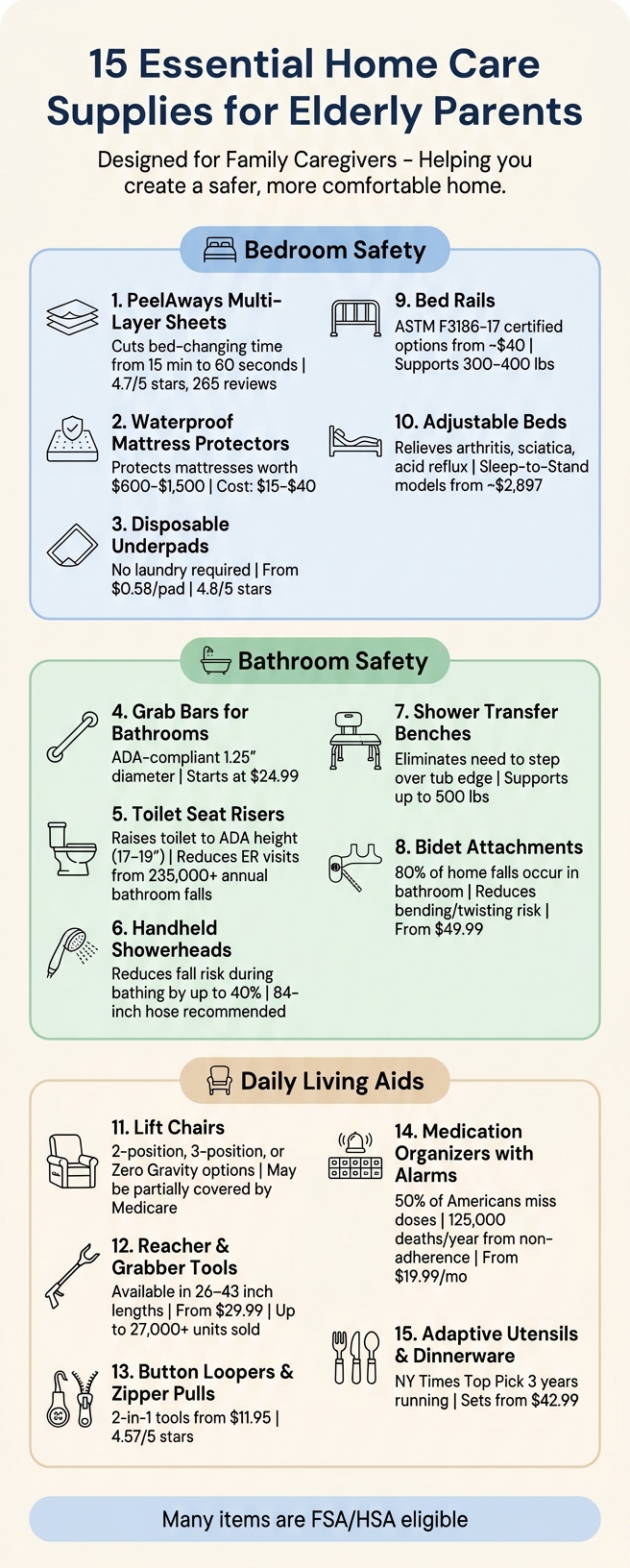
15 Essential Home Care Supplies for Elderly Parents
Safest Essentials for Elderly Senior Citizens at Home!
sbb-itb-45288fe
1. PeelAways Multi-Layer Waterproof Sheets

It’s 2 a.m., and the bed is wet again. You’re tired, your loved one feels embarrassed, and the thought of stripping the bed, washing sheets, and remaking it feels overwhelming. If this sounds familiar, PeelAways sheets might be just what you need.
These fitted sheets are designed with 5–7 waterproof layers, letting you peel away the soiled top layer to reveal a fresh, clean one beneath. That means no more wrestling with fitted corners in the middle of the night. Instead of spending up to 15 minutes changing bedding the traditional way, you can have a clean bed ready in under 60 seconds - saving you time and energy when you need it most.
PeelAways are made from a soft blend of bamboo, rayon, and polyester, so they feel like regular sheets. They’re free from chemicals like Vinyl, PVC, Phthalates, and fire retardants, making them a safe choice for seniors with sensitive skin. Each layer is completely waterproof, protecting the mattress from moisture, odors, and bacteria.
For caregivers, especially those with physical limitations, PeelAways can be a game-changer. There’s no heavy lifting or struggling to fit corners in the dark. As one caregiver, Sharon A., shared:
"PeelAway sheets make life so much easier for patient care and caregivers. Absolutely a must have item."
With a 4.7/5-star rating from 265 reviews, 95% of users say they’d recommend PeelAways. They come in a range of sizes, from Twin ($34.99) to King ($53.99), with a Twin XL 7-layer option ($41.99) that’s perfect for hospital-style beds. For the best results, consider pairing them with a standard waterproof mattress encasement for added protection. If your loved one moves a lot during sleep, sheet straps can help keep everything in place.
Caregiving is hard enough - PeelAways aim to make it just a little easier. Blog readers can save 10% with code BLOGS10 at checkout.
2. Waterproof Mattress Protectors
A waterproof mattress protector adds a protective layer between your loved one and the mattress, blocking liquids while keeping the bed comfortable. This simple addition can save you from the frustration and cost of replacing a mattress ruined by incontinence, night sweats, or spilled medications.
Mattresses can cost anywhere from $600 to over $1,500, and once fluids seep in, deep cleaning becomes nearly impossible. In contrast, a fitted waterproof protector, priced around $15–$40 for twin or queen sizes, offers an affordable solution. It’s easy to remove, wash, and replace, making life a little simpler.
When shopping for a protector, focus on true waterproofing. Look for one with a polyurethane backing that explicitly states "100% waterproof." For comfort, choose a top layer made of soft, quiet materials like cotton terry or bamboo knit. A snug, fitted design with deep pockets is essential - it keeps the protector in place, reducing the risk of loose fabric that could cause discomfort or even lead to falls. Avoid vinyl-backed options if possible; they often trap heat and make crinkling noises that can disturb sleep. According to the Sleep Foundation, waterproof protectors are especially helpful for older adults or those managing incontinence, with breathability being just as important as leak protection.
It’s smart to keep two protectors per bed so you can quickly swap out a soiled one. For heavy incontinence, pair the protector with an absorbent underpad for even faster changes. Wash protectors every one to two weeks - or immediately after an accident - using a mild detergent. Skip the bleach to preserve the material, and always follow the manufacturer’s care instructions.
If allergies or bed bugs are a concern, consider a zippered encasement that covers all six sides of the mattress. While these offer extra protection, they can be harder to remove and clean. For everyday use, a fitted protector is usually the most practical and manageable choice.
3. Disposable Underpads
Disposable underpads are a practical solution for managing incontinence. These single-use pads are placed under your loved one on beds, chairs, or wheelchairs to catch leaks before they reach the surface below. The result? Fewer bedding changes and a cleaner, more hygienic environment. Many users on Carewell have noted that these pads not only save time and effort but also help maintain odor-free spaces.
When selecting underpads, focus on three key factors: size, absorbency, and chemical safety. For heavy incontinence, the Wings Premium Quilted Underpads (40" x 57") are a solid choice. They provide ample coverage and are priced at $26.10 for a pack of 5 (about $5.22 per pad). These pads have earned a 4.8/5 rating on Carewell. For everyday use, Prevail Incontinence Underpads (30" x 36") are a budget-friendly option at approximately $0.58 per pad when purchased in a 100-pad case, also rated 4.8/5. To ensure safety, opt for products free from Vinyl, PVC, and Phthalates. Additionally, a soft or quilted top layer is ideal for reducing friction and enhancing comfort during extended use.
For caregivers juggling multiple responsibilities, the following table highlights the differences between disposable and washable protectors, helping you choose what fits your needs best:
| Feature | Disposable Underpads | Washable Protectors |
|---|---|---|
| Laundry Required | None (single-use) | Immediate washing required |
| Hygiene | Limits cross-contamination | Higher risk during handling |
| Best For | Frequent accidents, travel, chairs | Routine use, cost-conscious buyers |
| Portability | High - easy to move between surfaces | Moderate - usually fitted to bed |
| Price Range | $0.58 – $5.22 per unit | $25 – $75 per unit |
These underpads, alongside other caregiving essentials, can ease your daily routine while ensuring your loved one stays comfortable and cared for.
4. Grab Bars for Bathrooms
Keeping the bathroom safe is a crucial part of providing dignified care at home. Grab bars offer a dependable handhold in an environment where wet floors, hard surfaces, and frequent movements - like sitting or standing - can lead to dangerous falls.
Placement matters. Watch how your loved one moves through the bathroom to identify where they naturally need support. For example, a vertical bar near the shower entrance adds stability when stepping in and out, while a horizontal bar along the back wall helps with balance inside the shower. Near the toilet, a 42-inch bar installed 33–36 inches from the floor gives the leverage needed for sitting down and standing up safely.
Material and grip are just as important as placement. Stainless steel (304 grade) is the best choice for high-moisture areas, as it resists rust and lasts longer than plastic. A textured finish is safer than a smooth, polished surface, especially when wet. For diameter, the ADA-compliant size of 1.25 inches works well for most seniors, including those with arthritis. These features are recommended by experts and supported by real-life experiences.
"A strategically placed grab bar can reduce the risk of a fall by providing a reliable point of support during tricky transfers - like stepping into a shower or getting up from the toilet." - Taylor Davis, DMEsuperstore
For added safety, consider replacing traditional towel bars with combination towel-grab bars. Certified universal design expert Abbie Sladick explains, "Let's face it, when you are about to fall, you'll grab on to anything close by, including a towel bar... Why not make towel bars safer by replacing them with grab bars?" Standard towel bars aren't designed to hold body weight and can rip out of the wall under pressure. Always attach grab bars to wall studs, or use heavy-duty hollow-wall anchors like toggle bolts if studs aren't available. Avoid standard plastic drywall anchors, as they won't hold up. Once installed, give the bar a firm yank to confirm it's secure before trusting it.
Basic stainless steel grab bars start at around $24.99, while dual-purpose options, like those that double as towel racks or toilet paper holders, range from $99.99 to $108.00. These small investments not only reduce the risk of falls but also provide peace of mind for caregivers during daily routines.
5. Toilet Seat Risers
After installing grab bars, adjusting toilet heights is another key step in creating a safer bathroom environment.
Toilet seat risers elevate standard 14–15-inch toilets to the ADA-recommended height of 17–19 inches. This adjustment makes transfers easier and reduces strain on joints. Considering that over 235,000 Americans visit emergency rooms each year due to bathroom falls - and that more than 70% of senior fall injuries happen during transfers - this small change can make a big difference.
Proper positioning is crucial. Your parent's feet should rest flat on the floor, with their knees bent at a 90-degree angle. Taylor Davis from DMEsuperstore explains, "The 90-degree angle is biomechanically optimal. It allows the body to engage its largest muscles - the quadriceps and glutes - for standing, avoiding momentum or excess strain on weaker joints." For those recovering from hip surgery, a 5- or 6-inch locking riser ensures the correct hip height for transfers.
Choose a locking model for safety. Non-locking risers that simply sit on the toilet rim can be unstable and increase fall risks. Davis emphasizes, "A raised toilet seat is only as safe as it is stable. Even slight movement can throw someone off balance. Always use a locking model to prevent falls." Thankfully, modern locking risers are easy to install, requiring no tools and taking less than five minutes. Before buying, check your toilet bowl’s shape - round bowls are typically about 16.5 inches long, while elongated bowls measure around 18.5 inches. Many risers are designed for specific shapes.
Prices start at $31.49 for budget-friendly options like the Drive Medical 2-in-1 (which has a 4.2/5 rating from 16,940 Amazon reviews) and go up to $75.00–$79.99 for padded, premium models. For parents with arthritis or significant leg weakness, opt for a riser with built-in handles - these are a must-have, not a luxury. Additionally, many risers are FSA/HSA eligible, allowing you to use pre-tax dollars to help cover the cost. This simple upgrade not only enhances safety but also eases the physical demands on caregivers during daily routines.
6. Handheld Showerheads
Adding a handheld showerhead to your bathroom setup is a simple yet effective way to improve safety and independence during bathing. Paired with a shower bench and grab bars, this upgrade can lower the risk of falls during bathing by up to 40%. It’s a straightforward improvement that can make a world of difference in daily routines.
Hose length matters most. For seniors who bathe while seated on a shower bench or transfer chair, a hose shorter than 6 feet can create unnecessary challenges. An 84-inch (7-foot) hose provides the reach needed for full-body bathing without strain. As Carex explains:
"Bathing poses challenges with limited arm movement. An 84-inch hose ensures ample reach."
For even more flexibility, the Kohler Awaken G110 offers an 8-foot hose and holds a 4.7/5 rating from 756 reviews.
An on/off switch on the handle is a must-have. This feature allows users to pause the water flow while soaping up, eliminating the need to reach for the wall valve - a movement that could lead to slips or falls. For caregivers, this feature simplifies assistance during bathing. As noted by Carex:
"The on/off button is directly on the side of the shower spray for easy use and the ability to pause the water flow."
To ensure a comfortable and efficient bathing experience, choose a showerhead with a spray width of around 3.5 inches for broad coverage. A nylon-reinforced hose is also recommended to prevent kinking, ensuring smooth use every time.
A handheld showerhead allows precise water direction, reducing strain and increasing comfort for both the user and caregiver. Models with a diverter valve let you switch between a fixed and handheld showerhead without requiring plumbing modifications, and most can be installed in minutes without tools.
Always check the water temperature before use. Setting your water heater to a maximum of 120°F can help prevent accidental scalding. Additionally, many handheld showerheads are FSA/HSA-eligible, so you may be able to use your Health Savings or Flexible Spending Account for the purchase.
Popular options include the Moen 26900SRN, a trusted choice for aging-in-place needs, priced around $80–$130. Another standout is the Waterpik PowerPulse, which boasts a 4.8/5 rating from 1,542 reviews for its ergonomic handle and 6-foot hose. Once installed, ensure the showerhead is mounted at a height that’s easily reachable when seated, promoting safe and independent use.
7. Shower Transfer Benches
A shower transfer bench is a sturdy seat designed to bridge the bathtub wall, making it easier and safer for your elderly parent to enter and exit the tub. Instead of stepping over the high tub edge - a common cause of falls - they can sit outside the tub and slide in safely. This small change can make a big difference, considering over 3 million older adults visit emergency rooms annually for fall-related injuries, with the bathroom being a frequent culprit.
Health writer Sabrina Palmieri explains it perfectly:
"A tub transfer bench allows a person to sit down outside the bathtub and safely move into the tub without lifting their legs over the edge. Instead of stepping in, the user sits, slides, and rotates into position."
This design minimizes fall risks by replacing the need for risky movements with a smooth, seated transfer. Some benches even come with sliding or swivel seats, which use a rail system to help your parent glide into place with minimal effort - making it easier for both them and their caregiver.
When shopping for a transfer bench, focus on weight capacity and height adjustability. Look for a bench that supports at least 50 lbs more than your parent's weight for added safety. For example:
- KEKOY Shower Transfer Bench: Supports up to 500 lbs, adjusts from 17.7 to 22.4 inches, and assembles without tools.
- Drive Medical AquaSense Adjustable Transfer Bench: A budget-friendly option at $69.99, it offers a 250 lb capacity with a lightweight anodized aluminum frame.
Both options are FSA/HSA-eligible, so you can use your Health Savings or Flexible Spending Account to cover the cost.
Before buying, measure your bathtub (usually 28–30 inches wide) to ensure the bench fits properly. The legs should rest securely - two inside and two outside the tub - without blocking the drain. Make sure suction cups are firmly attached, and check rubber tips monthly to ensure they grip well on wet surfaces.
8. Bidet Attachments
Bidet attachments are a practical addition to any bathroom, offering a simple yet effective way to maintain hygiene while reducing physical strain. These devices connect to your existing toilet seat and use a water spray for cleaning, eliminating the need for reaching, twisting, or bending - movements that can be challenging or even risky for seniors with arthritis, limited mobility, or balance issues.
The bathroom is statistically one of the most hazardous areas in the home for older adults. Around 80% of falls at home occur in this space, and more than 25% of seniors experience at least one fall each year. With most people using the bathroom multiple times daily - somewhere between 4 and 10 times - a small adjustment that reduces physical effort can make a noticeable difference in safety and comfort.
As Bio Bidet explains:
"Installing a bidet for elderly family members reduces or eliminates the need for them to bend or twist to wipe."
Beyond reducing fall risks, bidets also promote better hygiene. They provide a more thorough clean than toilet paper, helping to prevent skin irritation and infections in sensitive areas. When selecting a bidet attachment, look for models that combine ease of use with features that address safety and comfort.
Non-electric bidet attachments are an excellent starting point. Take the LUXE Bidet NEO 180, for instance. At approximately $49.99, it’s budget-friendly, doesn’t require electricity, and installs easily with a standard T-adapter. Its lever control is designed to accommodate users with limited wrist mobility. With a 4.9/5 rating from over 16,000 reviews, many buyers praise its simplicity. As one 82-year-old reviewer, Diane M., shared, "The set up instructions are clear and concise and at 82 that's important!"
For those who prefer added comfort, such as warm water, consider a bidet seat like the Bio Bidet BB-2000. This model includes features like a heated seat and warm-water spray, though it does require a GFCI-protected electrical outlet within five feet of the toilet. Before purchasing, check your toilet bowl’s shape and ensure there’s enough space to accommodate the bidet without interfering with grab bars or other bathroom aids.
9. Bed Rails
Making the bedroom safer for your elderly parent often starts with the right bed rail. These rails provide a sturdy handhold to help your loved one reposition themselves, sit up, or transfer from the bed to standing without relying on bedding or waiting for assistance. For families, this means fewer falls and less physical strain on caregivers.
Getting in and out of bed can be a daily challenge for seniors. A bed rail offers stability, making these movements more controlled and secure. As Taylor Davis from DMEsuperstore explains:
"A bed rail should support movement, not trap it. If a user can't get in, out, or around it safely, the setup needs to change."
For most home environments, a bed assist rail is the better choice over a full-length hospital rail. Assist rails are shorter, handle-style bars designed for independent transfers. In contrast, full-length rails run along the entire mattress side and carry a higher risk of entrapment, making them more suitable for clinical settings. Safety is critical: between 1985 and 2009, the FDA recorded 803 entrapment incidents involving bed rails, leading to 480 fatalities.
When selecting a bed rail, prioritize models with ASTM F3186-17 certification, the U.S. safety standard for home bed rails. Choose a rail rated for at least 300 pounds, adding an extra 50 pounds above the user's weight for added security. To prevent head or limb entrapment, ensure the gap between the mattress and rail is less than 4.75 inches.
Here’s a quick look at some top-rated options to fit different needs and budgets:
| Product | Weight Limit | Key Feature | Best For | Price Range |
|---|---|---|---|---|
| BigDolphin | 350 lbs | Ergonomic Handle | General independence | ~$40–$46 |
| Lunderg | 300 lbs | Motion-Activated Night Light | Post-surgery / night trips | ~$50–$90 |
| KingPavonini | 400 lbs | Heavy Duty / 14" Mattress Fit | Heavier users | ~$55–$65 |
| Vaunn Medical | 300 lbs | Medical-Grade Steel | Hospital-to-home transition | ~$50–$65 |
| Stander EZ Adjust | 300 lbs | 5-Position Height Adjustment | Versatility across bed sizes | Up to $120 |
| YrHeiper | 350 lbs | Storage Pocket | Budget-conscious families | ~$40–$46 |
Sandra M., a caregiver, shared her story about using the Lunderg model for her father after hip replacement surgery:
"My dad had hip replacement surgery... He was terrified of falling getting out of bed at night. The Lunderg rail changed everything - that little night light means he is not fumbling in the dark anymore."
This story highlights the importance of choosing a secure, certified rail. However, for seniors with moderate to severe dementia, standard bed rails may not be the safest option, as they may not recognize the potential risks of entrapment. In such cases, alternatives like floor mats or bed alarms are better choices. Keep in mind that while Medicare typically doesn’t cover bed rails, they may be reimbursable through HSA or FSA accounts.
10. Adjustable Beds
Adjustable beds offer seniors the ability to independently modify the head and foot sections, helping to ease pain, improve circulation, and support better breathing. These features can address many of the discomforts that naturally come with aging.
For those managing arthritis, sciatica, or chronic back pain, the option to shift positions during the night can be life-changing. As Brian Chege of Vivid Care explains:
"The repositioning options in the bed help relieve back pain and nerve pain such as sciatica, keep the body in balance and reducing overall pain levels."
Raising the feet can help reduce swelling, while elevating the head can alleviate acid reflux and improve breathing. Brian Benko, CEO & Founder of The Clean Bedroom, highlights:
"An adjustable bed can help alleviate these common discomforts by promoting better blood flow, relieving pressure on problem areas, and redistributing your weight for a more comfortable sleep experience."
Finding the right type is essential. For independent users seeking pain relief, a Zero Gravity adjustable base is a great choice. For those with mobility challenges, the Sleep-to-Stand model, such as the Orin Rotating Sit-to-Stand Bed (starting around $4,299), provides extra support. If caregivers are assisting with daily transfers, a Hi-Lo bed like the Harmony Passport Hi-Low (starting at about $2,897) is a practical option.
Don’t forget: the mattress must be compatible with adjustable bases and flexible enough for split configurations. For added safety, consider pairing the bed with a bedside rail to make transfers easier and more secure.
11. Lift Chairs
Lift chairs are a practical way to reduce physical strain during seated transfers, offering both safety and convenience for users and caregivers alike.
These chairs are equipped with a motorized mechanism that gently tilts the seat forward, helping the user transition to a near-standing position without the need for rocking - an action that can increase the risk of falling. This feature is particularly beneficial for seniors dealing with knee, hip, or back pain, or for those who fear getting stuck in a chair when they’re home alone.
When choosing a lift chair, it’s important to consider how it will be used. A 2-position chair is ideal for basic daily activities, while a 3-position chair provides a deeper recline for napping. For maximum comfort, an infinite-position (Zero Gravity) chair allows users to elevate their feet and reduce swelling.
Key features to look for include a seat height that allows the user’s feet to rest flat on the floor, battery backup for use during power outages, and moisture-resistant fabric to help prevent skin issues. In smaller spaces, a “Wall Hugger” model can fully recline with just a few inches of clearance from the wall.
Medicare might cover the cost of the motorized lifting mechanism if prescribed by a doctor for medical reasons, though the chair itself is typically not covered. Because lift chairs can be heavy, purchasing from a retailer that offers White Glove Delivery - complete with in-home setup and packaging removal - can make the process much easier.
Used alongside other home care supplies, lift chairs can help create a safer, more comfortable environment for both seniors and their caregivers.
12. Reacher and Grabber Tools
Reacher and grabber tools are a game-changer for elderly parents, making it easier to pick up dropped items, reach high shelves, or even assist with dressing - all without bending past 90 degrees. These tools, much like lift chairs, promote independence by reducing the need for help with small, everyday tasks. They also play a role in minimizing the risk of falls, which is especially important for seniors.
A reacher grabber is a lightweight tool with a trigger mechanism, designed to help seniors - particularly those recovering from hip or knee replacement surgery - avoid bending too far during recovery. But their usefulness doesn’t stop there. These tools are handy for tasks like picking up dropped pills, pulling clothes out of a deep washer, or adjusting socks and pants while dressing.
When selecting the right reacher, consider the length that best fits your parent's needs:
- 32–33 inches: Ideal for most standing adults.
- 26–30 inches: Better for wheelchair users.
- 36–43 inches: Suited for taller individuals or those with strict no-bend restrictions.
Keep an eye out for these important features:
- Jaw Material: Non-slip silicone or rubber pads provide a firm grip on smooth surfaces.
- Magnetic Tip: Great for picking up small metal items like keys or medication foil.
- Trigger Tension: A low-tension trigger is easier for those with arthritis or weak hand strength.
- Shaft Material: Aluminum alloy strikes the right balance between strength and lightness, unlike heavier steel or more flexible plastic.
For ease of use, the tool should weigh no more than 8–10 ounces to avoid arm fatigue. Popular options include the GrabberTool 32", which has sold over 27,000 units, and the extended GrabberTool 43", with over 21,000 units sold. Prices range from $29.99 for a 33" Precision Grabber to $45.99 for a 43" extended or foldable model. If portability is a priority, consider a foldable model that collapses to about 16–17 inches - perfect for travel or hospital stays.
These tools pair well with other home care solutions, creating a safer and more independent environment for your loved one.
13. Button Loopers and Zipper Pulls
Sometimes, it’s the small tools that make the biggest difference in maintaining independence. Button loopers and zipper pulls are a game-changer for elderly parents who struggle with fastening buttons or pulling zippers. These tools offer a simple hook-and-pull motion, replacing the need for a precise pinch grip. For seniors dealing with arthritis, Parkinson’s, or weakened hands, they can mean the difference between needing help and managing on their own.
The National Institute on Aging highlights how reduced hand mobility can turn everyday tasks into significant challenges. Tools like these bridge that gap, helping seniors maintain their self-care routines and dignity.
One versatile option is a 2-in-1 tool that combines a button hook and a zipper pull. The Dr. Arthritis Button Hook & Zipper Pull, priced at $11.95, has earned a 4.57 out of 5-star rating from 155 reviews. Its snag-free wire loop and non-slip grip make it easy to use, even for those with limited hand strength. As one reviewer shared, “I didn’t realize how much I relied on someone else until I didn’t have to.” - Melissa R., Chicago, IL. Even a 94-year-old user found it incredibly helpful for managing hand mobility issues.
When selecting a button looper or zipper pull, pay attention to the wire loop’s length. Standard loops work well for shirt buttons, but heavier clothing like trousers may require a longer loop. For those with very weak grips, adding foam tubing to the handle can create a wider, more comfortable grip. Plus, their compact design makes them easy to carry, supporting independence wherever life takes you.
14. Medication Organizers with Alarms
Medication organizers with alarms are a lifeline for caregivers and elderly parents alike. They help ensure medications are taken on time and in the correct doses, reducing the risk of missed doses or double-dosing. For seniors juggling multiple prescriptions, these tools act as a safeguard while easing the mental load on caregivers. Given the serious consequences of medication errors, these devices are more than just convenient - they're critical.
The statistics paint a stark picture. Around 50% of Americans fail to take their medications as prescribed, a problem that often results in avoidable emergency room visits. Medication non-adherence is linked to approximately 125,000 deaths annually in the U.S. and costs an estimated $300 billion each year. For elderly individuals, even one missed dose can lead to a health emergency.
Modern medication organizers go far beyond the basic pillbox. Take the MOBI Smart Wi-Fi Pill Dispenser, for instance. Priced at $149.99 and boasting a 4.4-star rating from 33,631 reviews, this device uses audio alarms, flashing LED lights, and automatic compartment rotation to guide users to the correct dose. For seniors dealing with cognitive challenges, its color-coded LED guidance system - blue for the correct dose and red for errors - eliminates confusion.
Another standout option is the Idem Smart Clock. At $275.00, this device doubles as a day and time orientation clock while also providing medication reminders on a clear, easy-to-read screen. Caregivers can even send photos and messages remotely. As Claudia, a caregiver, shared:
"When I set a reminder, I can forget about it because I know I'll get a notification telling me whether the action was completed or not."
Connectivity is another game-changer. WiFi-enabled organizers send real-time alerts to caregivers' smartphones if a dose is missed. Studies show that 71% of users improved their medication adherence when a caregiver received these alerts. For active seniors, portable options like the Medikyu Single (starting at $19.99/month) keep alarm functionality accessible on the go. One user, DMitchell, shared:
"Medikyu has made all the processes to follow my father's medications a lot easier, especially to my mom, his caregiver."
When selecting a medication organizer, consider battery life - some models offer up to 180 hours (over a week) on a single charge, ensuring reliability even during power outages. Also, check that the compartments can accommodate all your parent's medications comfortably. These practical features not only reduce risks for seniors but also provide caregivers with greater peace of mind.
15. Adaptive Utensils and Dinnerware
Just like specialized bedding and mobility aids help with physical safety, adaptive utensils and dinnerware can make mealtimes easier and more independent for elderly parents. These tools are designed to address common challenges like reduced grip strength, tremors, or limited wrist mobility. Features such as bendable necks, wide textured handles, and raised-edge designs work to minimize spills and frustration, all while preserving dignity at the table.
Mealtimes can become a source of stress when you notice your parent struggling - whether it’s resorting to eating with their fingers, spilling food, or abandoning meals altogether. As registered dietitian Molly Robinson explains:
"Needing adaptive equipment does not mean your loved one is 'losing independence.' It means you are protecting it."
There are two standout products designed to meet different needs. The Carex Adaptive Eating Utensils Set includes five dishwasher-safe pieces: a soup spoon, eating spoon, fork, butter knife, and a spork. Each utensil features a 180° bendable neck and wide, textured rubber handles that provide thumb stability and reduce strain for shaky hands. The New York Times has named this set a "Top Pick" for three years running, praising it for being "therapeutically effective and safe".
For individuals with very limited grip strength, EaseWear's Adaptive Dining Sets offer a different kind of support. These utensils feature a 360° rotating joint and an adjustable silicone hand strap that secures the utensil to the hand, making grip strength unnecessary. EaseWear sets have a 4.87 out of 5-star rating from 15 verified reviews, with users calling them "game changers" for those with tremors or recovering from surgery. Prices start at $42.99 for a Starter Set (plate and cup) and go up to $137.99 for a Full Dining Set, which includes a plate, cup, spoon, fork, spork, and knife.
When selecting adaptive utensils or dinnerware, it’s important to match the product to your parent’s specific needs. Weighted or wide-handled utensils are ideal for arthritis or mild tremors, while hand-strap systems are better for those with severely limited grip. For dinnerware, look for plates with suction-based scoop features and raised inner edges to reduce spills. Materials like food-grade stainless steel and silicone make cleanup easier since they’re dishwasher-safe.
These dining tools are another way to support your loved one’s independence, adding to the essential tips for caring for an aging parent that make home care safer and more dignified.
Conclusion
Caring for an elderly parent at home is a journey filled with both rewards and challenges. The 15 supplies highlighted in this article - ranging from grab bars and toilet seat risers to adaptive utensils and waterproof bedding - are designed to tackle specific hurdles, whether it’s reducing physical strain, preventing falls, or maintaining your loved one’s dignity.
These items work together to ease the demands of caregiving. They simplify daily tasks, uphold your parent’s comfort and self-respect, and alleviate some of the stress you face as a caregiver.
When choosing supplies, think about your parent’s specific needs and the layout of your home. For example, a parent recovering from hip surgery may need different tools than someone dealing with mild arthritis or incontinence. Start by addressing the areas that cause the most difficulty - whether it’s managing nighttime bed changes, ensuring bathroom safety, or supporting mealtime independence - and build your caregiving plan step by step.
As registered nurse Avi Kaufman, RN, BSN, from Free Shipping Medical, explains:
"Managing it well at home isn't just about staying dry. It's about comfort, dignity, and making caregiving actually workable."
One common stress point for caregivers is managing the bed. PeelAways Multi-Layer Disposable Sheets offer a simple solution: just peel away a soiled layer to reveal a fresh one underneath, saving time and eliminating the need for heavy lifting or extra laundry. Blog readers can save 10% with code BLOGS10 at checkout. This discount can also be combined with subscriptions and bundle deals.
You can find PeelAways on Amazon or shop directly at Peelaways.com.
FAQs
Which supplies should I buy first for an aging parent at home?
Start with the basics: waterproof bed protection and incontinence supplies. A waterproof mattress protector shields the mattress from leaks, extending its life and keeping it clean. For even more convenience, disposable multi-layer waterproof sheets like PeelAways can be a game-changer. They allow for quick, hygienic bed changes - perfect for those unexpected nighttime accidents. These essentials not only make managing incontinence easier but also help reduce the workload for caregivers while ensuring your loved one stays comfortable and dignified.
How do I choose the right sizes for bathroom safety products?
To get started, measure your mattress carefully - length, width, and depth. This helps ensure a snug fit for items like waterproof sheets. If you have an adjustable split king bed, you’ll need two Twin XL sheets. For deeper mattresses or if you tend to move a lot while sleeping, go for larger sizes or sheets with extra layers. Adding sheet straps can also help keep everything in place. Proper sizing is key to staying comfortable and protecting your mattress effectively.
What can I do to cut down overnight incontinence cleanup?
To make overnight incontinence cleanup quicker and less stressful, consider using multi-layer disposable fitted sheets like PeelAways. These sheets let you peel off a soiled layer to instantly reveal a fresh, clean one underneath - no laundry required. Pair them with a waterproof mattress protector to keep the mattress dry and make cleanup even easier. Keeping essential supplies within arm’s reach and layering bedding can also simplify those late-night changes, saving you time and energy when it matters most.
Comments
0



SAVE MONEY & WATER
Professionals & Institutions save a fortune on labor/laundry.

SUPERIOR COMFORT
The first thing our customers notice is how soft our sheets are.

100% WATERPROOF
Each layer is 100% Waterproof, perfect for spills and accidents

SAVE TIME
Change the sheet in under 1 minute without stripping the bed.

Leave a comment