
Best Caregiving Products for Parkinson's Patients at Home

It's 2am. The sheets are wet again. Your loved one is embarrassed, your back is screaming, and you know the laundry is piling up. If this sounds like your life, you're not alone.
Parkinson's caregiving is hard. The tremors, the stiffness, the accidents - especially at night - turn basic tasks into uphill battles. But the right tools can make all the difference. From PeelAways disposable bed sheets that cut sheet changes to 60 seconds, to weighted utensils that steady shaky hands, these five products are designed to ease your load and help your loved one stay independent.
Quick Overview
Here’s what we’ll cover:
- PeelAways Multi-Layer Disposable Bed Sheets: Incontinence protection that reduces laundry by 50–80%.
- Weighted Utensils: Help with tremors during meals.
- Grab Bars: Bathroom safety made simple.
- Rollator Walkers: Improve mobility and prevent falls.
- Voice-Activated Reminder Devices: Manage medication schedules and daily tasks hands-free.
Caring for someone with Parkinson’s is overwhelming, but you don’t have to do it alone. Let’s break down these tools and how they can help.
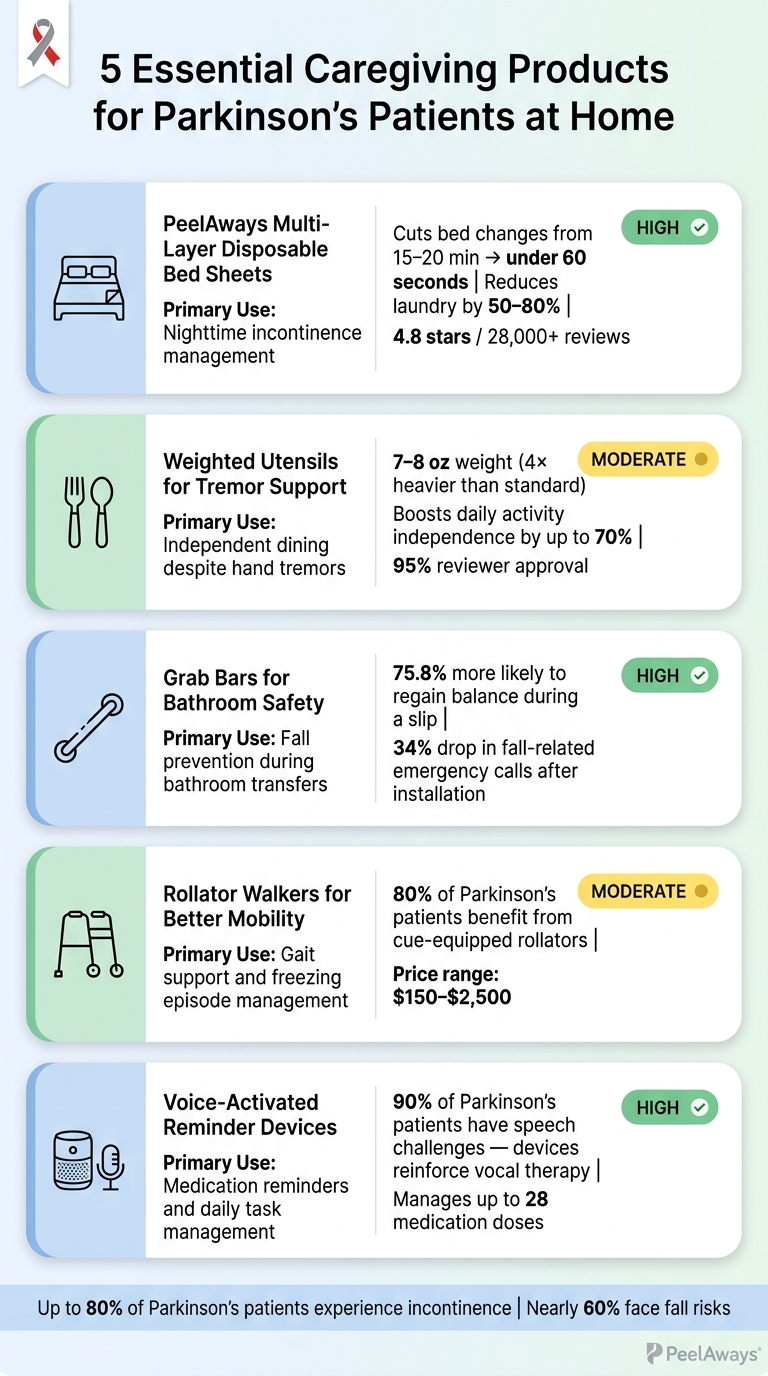
5 Best Caregiving Products for Parkinson's Patients: At-a-Glance Comparison
1. PeelAways Multi-Layer Disposable Bed Sheets

Primary Use
Nighttime incontinence is a common challenge in Parkinson's home care. PeelAways are multi-layer, disposable, waterproof bed sheets designed to make life easier for caregivers and patients. When accidents happen, you can peel away the soiled top layer in less than a minute, leaving a fresh, clean sheet ready to go.
Parkinson's Symptom Addressed
For those living with Parkinson's, nighttime incontinence (nocturia) is a frequent issue, with up to 70% of patients experiencing lower urinary tract symptoms as the disease progresses. Challenges like slowed movement, stiffness, and freezing episodes make reaching the bathroom in time difficult, especially at night. These moments are tough for both patients and caregivers, often leading to disrupted sleep and added stress.
PeelAways sheets are made with 5–7 breathable, waterproof layers crafted from a soft bamboo-rayon blend. When an accident occurs, you simply peel away the top layer - no hassle, no mess. This quick solution helps maintain dignity while simplifying care at home.
Caregiver Workload Reduced
Caregivers often face the exhausting task of nighttime bed changes. A survey found that over half of caregivers assist with nighttime toileting or changing sheets several times a week. Traditional sheet changes can take 15 to 20 minutes, adding to physical strain and disrupting sleep. PeelAways cut this process down to under 60 seconds, offering a practical solution that saves time and effort.
"PeelAway sheets make life so much easier for patient care and caregivers. Absolutely a must-have item." - Sharon A., Verified Buyer
For families dealing with frequent accidents, PeelAways can reduce laundry by 50–80%, potentially saving 4 to 6 loads per week. This not only lessens physical strain but also frees up time for more meaningful caregiving.
Ease of Use
PeelAways are as easy to use as a standard fitted sheet. They feature deep pockets and directional tags to ensure proper placement, and when a layer is soiled, it can be removed effortlessly by one person. This simplicity is especially helpful for households where caregiving falls on a spouse or adult child.
Available in various sizes, PeelAways start at $34.99 for Twin and Twin XL (5 layers) and go up to $53.99 for King. The Twin XL 7-layer option, priced at $41.99, is ideal for hospital-style adjustable beds often used in home care. With a 4.8-star rating from over 28,000 reviews and recognition as Caregiver Product of the Year, PeelAways are a trusted choice for improving both patient comfort and caregiver well-being.
Parkinson’s Care Partner Tips and Tricks: Care Partner Training Session 11
2. Weighted Utensils for Tremor Support
Adding to the tools that improve nighttime care, weighted utensils play a key role in helping individuals maintain independence during mealtime.
Primary Use
Weighted utensils are designed to help steady hands affected by tremors. Weighing between 7 and 8 ounces - about four times heavier than standard silverware - they provide the resistance needed to reduce shaking. This extra weight makes it easier for individuals to bring food to their mouths without spills or frustration.
Parkinson's Symptom Addressed
Tremors are a hallmark symptom of Parkinson's disease and can make everyday tasks, like eating, incredibly challenging. The added weight in these utensils helps to counteract involuntary movements while offering sensory feedback to improve hand control. Features like deep spoon bowls and 1-inch ergonomic, non-slip handles further enhance stability, making them effective even for those with moderate to severe tremors.
"The weighted utensils can aid in reducing the effects of tremors from Parkinson's or other disorders. Often, these utensils are helpful to improve the ability of the patient to self-feed independently." - Dr. Kirsten Davin, OTD, OTR/L, ATP, SMS
Studies show that tools like weighted utensils can boost independence in daily activities by as much as 70%.
Caregiver Workload Reduced
One of the biggest advantages of weighted utensils is their ability to empower self-feeding. For caregivers, this means less hands-on assistance and more time for other tasks. Plus, fewer spills lead to less cleanup, easing the overall caregiving burden.
"My husband was struggling as he ate; however, these weighted utensils have made eating so much easier. There was no adjustment time: right away he felt comfortable using the utensils." - Joan Kniss, Verified Buyer
Ease of Use
Most sets include essentials like a fork, teaspoon, soup spoon, and rocker knife. High-quality options often feature polished stainless steel and latex-free, non-slip handles. They’re also dishwasher safe up to 180°F, making sanitization simple. Prices for standard 4-piece sets typically range from $28.99 to $46.99, while more comprehensive kits - including non-slip mats and weighted cups - are available for around $104.42. These utensils are praised by 95% of reviewers for their discreet, restaurant-style design, which allows users to dine confidently without drawing attention.
3. Grab Bars for Bathroom Safety
Grab bars are a game-changer for creating a safer bathroom environment, especially for individuals with Parkinson's. They offer a secure anchor when navigating slippery or challenging areas, like stepping into the shower or getting up from the toilet. Strategically installed at key points - shower entrances, next to toilets, or near shower seats - grab bars significantly reduce the risk of falls. In fact, research shows that having a grab bar within reach makes it 75.8% more likely for someone to regain their balance during a slip.
Primary Use
Bathrooms are one of the riskiest places in the home, with falls making up 81.1% of all bathroom-related injuries. Grab bars provide a steady handhold, helping individuals transition safely between positions. This added stability not only protects the person using the bathroom but also eases the burden on caregivers who might otherwise need to assist with every movement.
"A properly placed, structurally anchored grab bar exactly where your body expects it to be... You stabilize. You recover. You move on." - Coley O’Brien McAvoy, Project Manager, HomePride Bath
Parkinson's Symptoms Addressed
For those with Parkinson's, grab bars offer crucial support by addressing common symptoms like postural instability and freezing episodes. They also help manage the challenges of bradykinesia and rigidity, making transitions less taxing. The ZUEXT Knurled 2-Pack is often recommended because its 1.25-inch diameter and anti-slip design accommodate weaker grips. Meanwhile, the Moen Home Care 24-Inch Stainless Bar is recognized for its strength and compliance with ADA standards.
Reducing Caregiver Workload
When individuals can rely on grab bars for support, caregivers are spared some of the physical demands of lifting or steadying their loved ones. For example, a walk-in shower equipped with grab bars allows caregivers to assist more easily, making daily tasks less exhausting. Plus, preventing a fall is far less draining - physically and emotionally - than dealing with the aftermath. An emergency services program even reported a 34% drop in fall-related calls within a year of installing grab bars. Proper installation is key to unlocking these benefits.
Ease of Installation and Use
For grab bars to be effective, they must be securely mounted into wall studs. If only one bar is installed, placing it diagonally can provide the best support for individuals of different heights and mobility levels. Avoid suction-cup models - they aren’t designed to hold full body weight and can fail unexpectedly.
Professional installation typically costs between $200 and $350 per bar, while the bars themselves range from $20 for basic options to over $150 for premium designs. For individuals with visual-spatial challenges - a common issue in Parkinson's - choosing a grab bar in a contrasting color, like matte black against white tile, can make it easier to locate quickly.
sbb-itb-45288fe
4. Rollator Walkers for Better Mobility
Rollator walkers provide Parkinson's patients with a stable, rolling base for walking, making life at home easier by improving mobility and lightening the load for caregivers. Some models even include advanced features like laser projections, metronomes, and vibrating handles to help users overcome freezing episodes. In fact, a clinical study found that 80% of Parkinson's patients experienced benefits from rollators equipped with these cueing systems.
Primary Use
Beyond bathroom safety, mobility aids like rollators play a key role in fostering independence. Many rollators come with built-in seats, offering patients a convenient way to rest when Parkinson’s-related fatigue sets in. Hybrid models, such as the Rollz Motion Rhythm (priced between $1,999 and $2,395), can even transform into transport chairs, allowing patients to start their journey on foot and ride back when needed. For navigating tight spaces like hallways or bathrooms, the U-Step 2 Neuro is a standout option with a turning radius of just 29 inches.
Parkinson's Symptoms Addressed
Freezing of gait (FOG) is one of the most challenging symptoms to manage. Rollators with laser projections create a visual cue on the floor, helping users "step over" the line and break out of a freeze. Built-in metronomes and vibrating handles further aid in establishing a steady walking rhythm.
"A projected laser line could help to trigger the user to break a freeze." - Rollz International
Another common symptom, festination - where steps unintentionally speed up - can be controlled using drag brakes. These brakes add resistance to the wheels, slowing the rollator to match the user’s pace. Additionally, upright designs with forearm supports encourage better posture, helping to reduce the forward hunch often seen in Parkinson’s patients and easing back strain.
One case study highlighted a 79-year-old man who regained his independence after using the Rollz Motion Rhythm. His freezing episodes had previously left him reliant on his son for constant supervision.
"Vincent's son stated that he had not seen his dad 'stand like that for about 10 years' and mobilised throughout his property without any need for supervision or support." - The OT Service
Caregiver Workload Reduced
Rollators equipped with built-in cues lessen the need for caregivers to intervene during freezing episodes. The hybrid walker-to-transport-chair design also eliminates the hassle of managing multiple devices, especially when patients tire during outings. Perhaps most importantly, these devices allow patients to move safely and independently at home, giving caregivers a chance to step back and reclaim some time in their day.
Ease of Use
Modern rollators are designed to be straightforward. Features like one-touch buttons activate cues, while smartphone connectivity enables caregivers to adjust settings remotely, ensuring the cues remain effective over time. Safety is a top priority, with features like a reverse braking system - the walker only moves when the brake levers are squeezed - giving users added control.
"The reversed brakes make me feel completely in control, especially when freezing starts. It's given me confidence to move again safely both indoors and outdoors." - Janet P., Parkinson's Patient
Before bringing a rollator home, make sure doorways are at least 28–30 inches wide to allow smooth passage. It’s also a good idea to remove deep-pile carpets, which can snag the wheels. Regular maintenance, such as checking the brakes, tire condition, and battery life, ensures the device remains reliable.
| Rollator Type | Key Feature | Best For | Price Range |
|---|---|---|---|
| Standard 4-Wheel | Lightweight frame, built-in seat | Early-stage balance support | $150 – $400 |
| Upright/Ergonomic | Forearm supports, stable base | Posture correction, mid-stage | $400 – $800 |
| Specialized PD (e.g., Rollz, U-Step) | Laser/sound/vibration cues, drag brakes | FOG, festination, advanced stage | $1,200 – $2,500 |
If cost is a concern, note that specialized Parkinson's rollators have a 60% first-appeal success rate for insurance coverage when classified as a "complex mobility device." To improve your chances, include a neurologist’s letter and a physical therapist’s fall-risk assessment with your claim.
5. Voice-Activated Reminder Devices
Technology has stepped up in ways that make life easier, especially for those managing Parkinson’s. Voice-activated devices are a game-changer, helping with medication schedules, daily reminders, and even smart home controls. For individuals dealing with tremors, cognitive fog, or speech challenges, these tools reduce the need for constant caregiver support while encouraging independence at home.
Primary Use
Devices like Amazon Alexa serve as versatile assistants, handling everything from medication reminders to managing shopping lists and controlling smart home systems. Then there are specialized tools like Pillo, a medication robot that doesn’t just remind - it stores and dispenses up to 28 doses of solid pills. It can manage up to four weeks of medications, depending on dosing schedules. Patients simply respond to prompts, confirm their doses, and caregivers are automatically updated through the device.
Parkinson's Symptoms Addressed
These devices tackle two major challenges: cognitive issues and motor difficulties. Memory lapses and “brain fog” can make sticking to complex medication schedules overwhelming. Voice reminders provide an external cue, so patients don’t have to rely solely on memory. For those with tremors or rigidity, the voice-first interface eliminates the frustration of using small buttons or touchscreens.
Another key benefit? Speech therapy. Around 90% of people with Parkinson’s struggle with reduced vocal loudness and unclear speech. When a smart speaker doesn’t understand a quiet or unclear command, it prompts the user to speak louder or more clearly - reinforcing techniques used in therapies like LSVT LOUD.
"Interacting with his smart speaker allows John to practice a LOUD, clear voice at home, with external feedback on speech volume and clarity that may help improve his self-awareness." - JMIR Rehabilitation and Assistive Technologies
Caregiver Workload Reduced
These tools don’t just assist patients - they lighten the load for caregivers too. For instance, Pillo sends caregivers alerts via a mobile app if a dose is missed. It also allows remote check-ins through video or voice calls, eliminating the need for constant manual tracking.
"Our proactive, voice-enabled health assistant tracks health regimens, and then initiates encouraging interactions which promote adherence and independence while enhancing connections between users, care teams and health organizations." - Pillo Health
Some devices, like PARKA AI, even generate automated clinical reports for healthcare providers. This saves time during appointments by summarizing symptoms and medication adherence.
Ease of Use
Ease of use is a priority, especially for individuals with Parkinson’s. Amazon’s Adaptive Listening Mode allows users with slower speech to complete commands without feeling rushed. Pillo takes it a step further with facial recognition, ensuring secure dispensing without the need for PINs or buttons.
| Feature | General Smart Speaker (e.g., Alexa) | Specialized Health Robot (e.g., Pillo) |
|---|---|---|
| Medication Support | Voice reminders only | Physical dispensing + reminders |
| Caregiver Integration | Standard calling/messaging | Missed dose alerts + drop-in video |
| Accessibility | Adaptive listening modes | Facial recognition for secure dispensing |
| Speech Therapy Support | Biofeedback for volume/clarity | Limited to conversational interaction |
| Privacy Controls | Standard device settings | Health data separated from personal data |
For caregivers, a quick tip: enable Adaptive Listening Mode on smart speakers. It’s a small adjustment that makes a big difference for patients who speak slowly or pause while talking.
Pros and Cons
This section breaks down the benefits and drawbacks of five products designed to support Parkinson's caregiving. Each item aims to improve safety, promote independence, and lighten the caregiver's responsibilities. The table below provides a side-by-side comparison to help you evaluate which options might work best for your needs.
PeelAways Multi-Layer Disposable Bed Sheets are a game-changer for managing overnight incontinence. When a layer becomes soiled, it can be removed in less than 60 seconds - no lifting or repositioning required. This feature significantly simplifies nighttime care. With a 95% user recommendation rate, these sheets are highly regarded. However, frequent accidents can deplete a 5-layer set quickly, sometimes within 1–2 weeks. Additionally, the sheets lack built-in corner straps, which could be an issue for active sleepers who may need to purchase straps separately.
Weighted utensils are designed to help patients with mild-to-moderate tremors regain independence during meals. These utensils weigh around 7–8 ounces each, roughly four times heavier than standard silverware, helping to steady hand movements. On the downside, they might cause fatigue for individuals with muscle weakness, and those with advanced rigidity may find limited benefit. An adjustment period is also necessary as users get accustomed to the added weight.
Grab bars are a straightforward solution for improving bathroom safety. They provide a stable support point for patients, reducing caregiver strain during transfers. The main drawback is the need for drilling during installation, which might not be an option for renters.
Rollator walkers enhance mobility and reduce the need for constant supervision. However, they require patient coordination and work best in spaces with clear, uncluttered pathways.
Voice-activated devices simplify managing daily tasks and medication reminders. While they reduce repetitive verbal prompting, they do require initial setup to function effectively.
| Product | Primary Use | Parkinson's Symptom Addressed | Caregiver Workload Reduced | Ease of Use |
|---|---|---|---|---|
| PeelAways Disposable Sheets | Incontinence management | Urinary incontinence; limited mobility | Minimizes laundry and avoids lifting | High – peel-method in under 60 seconds |
| Weighted Utensils | Independent dining | Hand tremors; shakes | Reduces need for feeding assistance | Moderate – requires an adaptation period |
| Grab Bars | Bathroom safety | Balance issues; fall risk | Lowers physical strain during transfers | High – once installed, no ongoing effort |
| Rollator Walkers | Mobility support | Gait instability; fatigue | Decreases need for constant supervision | Moderate – requires coordination and clear pathways |
| Voice-Activated Devices | Task and medication reminders | Cognitive reminders and daily tasks | Reduces repetitive verbal prompting | High – voice-activated with initial setup required |
Each product addresses specific caregiving challenges, offering solutions tailored to different needs. This comparison helps caregivers make informed decisions about the best tools for their situation.
Conclusion
Caring for someone with Parkinson's comes with unique challenges, but having the right tools can make a world of difference. These tools not only enhance patient safety, comfort, and independence but also lighten the load for caregivers.
Consider the impact: grab bars and rollators help reduce fall risks, which affect nearly 60% of Parkinson's patients. Weighted utensils make dining independently more manageable, while voice-activated reminders simplify medication routines. And when it comes to incontinence - an issue for up to 80% of those with Parkinson's - PeelAways multi-layer disposable sheets change the game. They cut nighttime bed changes from 15–20 minutes to under 60 seconds, sparing caregivers from heavy lifting and protecting both the mattress and the patient’s dignity.
For blog readers, PeelAways offers an exclusive 10% discount with code BLOGS10 at checkout. You can also save more with subscriptions and bundles. Visit our store to see how PeelAways can make caregiving easier.
Shop PeelAways on Amazon or directly on PeelAways.com.
FAQs
How do I know which products my loved one needs right now?
Observe how your loved one navigates their daily routines to pinpoint specific challenges. Do they struggle with mobility, fine motor skills, or managing incontinence? Pay attention to moments when they might need extra help, like standing, transferring, or completing tasks. For issues like tremors or stiffness, look into tools such as specially designed utensils or adaptive clothing. If incontinence is part of the picture, products like PeelAways multi-layer sheets can simplify cleanup, while absorbent underpads are a practical option for outings.
Will these tools still help as Parkinson’s symptoms get worse?
Assistive tools continue to be helpful even as symptoms worsen, making daily tasks easier, saving energy, and promoting independence. As Parkinson’s progresses, these devices can be adjusted to meet changing needs, helping to maintain a sense of control and quality of life. Experts suggest consulting an occupational therapist to regularly evaluate your needs and ensure your tools align with your abilities. Adapting caregiving approaches along the way can make managing the disease's challenges more manageable.
What home setup changes make these products work better?
To make the most of PeelAways and simplify caregiving, consider adding a waterproof mattress encasement to shield the mattress from spills or accidents. If your loved one tends to move around a lot during sleep, sheet straps can help keep the layers securely in place. For adjustable beds, double-check that the sheet size - typically Twin XL - and the pocket depth (14–16 inches) are the right fit. Motorized beds can also make transfers easier and more manageable. Lastly, keeping at least three bedding sets in rotation can save time and reduce stress when quick changes are needed.
Comments
0



SAVE MONEY & WATER
Professionals & Institutions save a fortune on labor/laundry.

SUPERIOR COMFORT
The first thing our customers notice is how soft our sheets are.

100% WATERPROOF
Each layer is 100% Waterproof, perfect for spills and accidents

SAVE TIME
Change the sheet in under 1 minute without stripping the bed.

Leave a comment